My DNA Match Is Old Enough to Be My Grandparent: Cousin Once Removed?
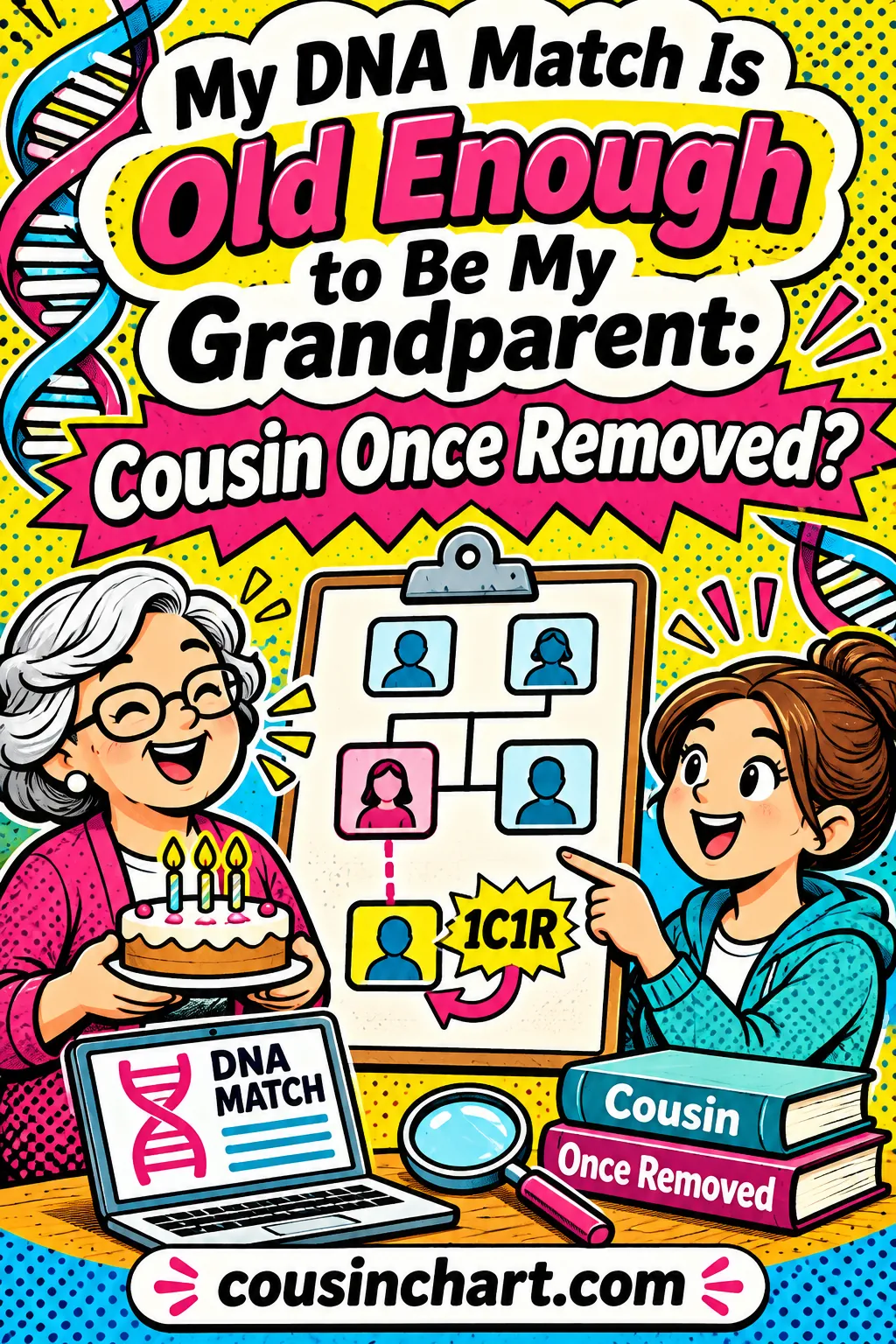
If a DNA match is much older than you, there's a good chance they belong to an older generation of the family, so they're often a cousin once or twice removed, a great-aunt or uncle, or a half aunt rather than a same-generation cousin. The shared cM narrows the options, and their age helps you pick between relationships that share the same number. Enter the figure in the free DNA match calculator to see every relationship that fits.
It's a common surprise. Your match list says "second cousin" or "first cousin," and the match turns out to be 78 years old while you're 35. That doesn't mean the label is wrong. It means DNA can't see birth years. Here's how to put the age gap and the cM together.
▶ Work it out in the free calculator
Why DNA Labels Ignore Age
Testing companies guess relationships from one number: how much DNA you share, measured in centimorgans (cM). They don't know when anyone was born, so they can't tell a second cousin from a first cousin twice removed when both share a similar amount.
That's why a "second cousin" label might really mean:
- your second cousin, about your age,
- your grandparent's first cousin, decades older,
- your parent's half first cousin,
- or someone else whose expected cM falls in the same range.
Those relationships can all land in a similar range, around the low 200s. The only way to sort them out is to look at ages, trees and other matches. The age gap you noticed is actually a helpful clue.
There's a simple reason the number can't settle it. DNA gets cut roughly in half with each generation it passes through. Your grandparent's first cousin is six steps away from you along the family line, counting up through the shared ancestors and back down. Your second cousin is also six steps away. Same number of steps, same expected amount of shared DNA. The ages of the people at the ends of that path don't enter the math at all.
How Removed Works When Someone Is Older
"Removed" means you and the match are a different number of generations from the ancestors you share. Each step of difference is one "removal."
Say the common ancestors are your great-grandparents. You're 3 generations down from them. Your parent's first cousin is only 2 generations down from those same people. Here's the math:
- Take the smaller number, 2, and subtract 1. That gives the cousin number: first cousin.
- Subtract the smaller number from the larger, 3 − 2 = 1. That's the removal: once removed.
So your parent's first cousin is your first cousin once removed.
Now go one generation further up. Your grandmother's first cousin shares her grandparents, which are your 2nd great-grandparents. You're 4 generations down from them, and the cousin is 2. Cousin number: 2 − 1 = 1. Removal: 4 − 2 = 2. So your grandmother's first cousin is your first cousin twice removed.
It's easy to slip by a generation with older matches, so always count from the shared ancestors, not from yourself.
One more thing trips people up: "removed" works in both directions. Your parent's first cousin is your first cousin once removed, and you are their first cousin once removed too. The term doesn't say who's older or higher in the tree. In everyday family talk, people often call the older one "my mom's cousin" and the younger one "my cousin's kid," which is clearer for daily use but means the same thing.
For a full walkthrough of the term, see the guide to the first cousin once removed.
Older Match Relationships and Typical cM
Here are the relationships that most often explain a match who's a generation or two older than you. The "generations" column shows how many steps down each of you is from the shared ancestor, the same numbers you'd set in a relationship calculator.
| Who they are in your family | Generations down (them, you) | Relationship to you | Typical shared cM |
|---|---|---|---|
| Your parent's full sibling | 1, 2 | Aunt or uncle | about 1,750 |
| Your parent's half sibling | 1, 2 (half) | Half aunt or uncle | about 870 to 910 |
| Your grandparent's sibling | 1, 3 | Great-aunt or great-uncle | about 870 to 910 |
| Your parent's first cousin | 2, 3 | First cousin once removed | about 430 |
| Your grandparent's first cousin | 2, 4 | First cousin twice removed | about 220 |
| Your parent's second cousin | 3, 4 | Second cousin once removed | about 120 |
| Your grandparent's second cousin | 3, 5 | Second cousin twice removed | roughly 60 to 70 |
For comparison, same-generation cousins share about 866 cM (first cousins), about 229 cM (second cousins) and about 73 cM (third cousins) on average. Notice how often an older relationship sits right next to a same-generation one. A first cousin twice removed and a second cousin are almost the same number.
These are averages. Real matches vary a lot, and the ranges overlap. Use the shared cM chart to see how wide each range runs.
Turning an Age Gap Into a Generation Guess
Before you can use age as a clue, you need a rough idea of how many years a generation covers in your family. There's no fixed number. Many families land somewhere between 20 and 35 years per generation, and it can swing a lot from one branch to the next. A working figure of about 25 to 30 years is a reasonable starting point, as long as you treat it as a guess and adjust for what you know.
Here's a quick way to read an age gap:
| Match is older than you by | Most likely generation offset | Relationships worth checking first |
|---|---|---|
| 0 to 15 years | Same generation | Sibling, first cousin, second cousin, third cousin |
| 15 to 40 years | One generation up (could be same) | Aunt or uncle, first cousin once removed, second cousin once removed |
| 40 to 65 years | Two generations up (could be one) | Grandparent, great-aunt or uncle, first cousin twice removed |
| More than 65 years | Two or three generations up | Great-grandparent, great-great-aunt, cousin three times removed |
The ranges overlap on purpose. A 30-year gap could be your parent's generation or your own, depending on the family. A 45-year gap is usually two generations, but in a family where people had children late, it might be only one.
Use your own family's ages to tighten this. Write down the birth years of your parents and grandparents on the side you think the match belongs to. If your grandparents were born in the 1930s and the match was born in 1936, that's a strong hint they sit in your grandparents' generation. If you don't know which side the match is on yet, check both.
Worked Example: The 78-Year-Old "Second Cousin"
You're 35. A match labeled "second cousin" shares 214 cM with you. Her profile says she was born in 1948.
Step 1: List what fits 214 cM. Put 214 into the DNA match calculator. You'll see second cousin, first cousin twice removed, half first cousin once removed and a few others. All of them are possible on the number alone.
Step 2: Line up the generations. You were born around 1991. Your parents were born around the early 1960s, and your grandparents around the 1930s or 1940s. A woman born in 1948 fits your grandparents' generation far better than yours.
Step 3: Pick the relationships from that generation. Someone in your grandparent's generation who shares about 214 cM is most likely your grandparent's first cousin. That makes her your first cousin twice removed.
Step 4: Confirm with a tree. Ask if she knows her grandparents' names. If one set matches your great-great-grandparents, you're done.
Notice that the label "second cousin" was a fair guess for the number. It just didn't account for age.
Worked Example: An Older Match at 900 cM
You share 902 cM with a 70-year-old man. You're 40.
This one has several strong possibilities:
- Great-uncle: your grandparent's brother. About 870 to 910 cM on average.
- Half uncle: your parent's half brother. A similar range.
- First cousin: possible in a big family, but he'd have to be about 30 years older than you while sharing a set of grandparents.
- Great-grandparent: not likely at 70 if you're 40, though the number fits.
Ages make the great-uncle the front runner. A half uncle is a real option too, especially if there's a known second marriage or a family secret in your parents' generation. The guide to what a half aunt or uncle is explains how that relationship works.
To tell them apart, start with family history and shared matches, which show you which grandparent's side he's on. If that grandparent or your parent has tested, the answer gets much clearer. A great-uncle is your grandparent's brother, so he'd share a sibling-sized amount with that grandparent. A half uncle is your grandparent's son, so he'd share a parent-child amount with them instead.
Worked Example: The 62-Year-Old at 438 cM
You're 31. A woman born in 1964 shares 438 cM with you. Your match list calls her a "first cousin once removed or second cousin."
Step 1: Read the range. At 438 cM, the strongest options are first cousin once removed, half first cousin, and great-great-aunt or uncle. A second cousin is possible only at the very high end of that relationship's range, so it's a weaker fit.
Step 2: Check the ages. Your parents were born in 1962 and 1965. She was born in 1964, right in your parents' generation. That points to a relationship one generation up from you.
Step 3: Choose between the one-up options. In your parents' generation, a person sharing about 430 cM is most often your parent's first cousin. A half first cousin would be in your own generation, so her age makes that less likely, though not impossible.
Step 4: Find the side. Look at your shared matches. She matches your mother's cousin Linda at a high level and doesn't match anyone from your father's side. That puts her on your mom's line.
Step 5: Name it. She's your mother's first cousin, so she's your first cousin once removed. Your mom shares grandparents with her, and those grandparents are your great-grandparents.
Step 6: Check it if you can. If your mom has tested, she should share roughly 866 cM with this woman, about double what you share. A number in that zone confirms the first-cousin link between them.
Worked Example: An 81-Year-Old at 118 cM
You're 38, and an 81-year-old man shares 118 cM with you. His tree is private, and the label says "third cousin."
At 118 cM, the possibilities spread out wide. Second cousin once removed, half second cousin, third cousin at the high end, and first cousin three times removed all fit. A man 43 years older than you is most likely two generations up, but one generation up is possible too.
Here's how to sort it:
- Two generations up: If he's your grandparent's second cousin, that's a second cousin twice removed, which usually shares less, around 60 to 70 cM. 118 cM is high for that, so keep it on the list but don't lead with it.
- One generation up: If he's your parent's second cousin, that's a second cousin once removed, about 120 cM. A great numerical fit, and possible if his branch had children later than yours.
- Further up, closer link: If he's your great-grandparent's first cousin, that's a first cousin three times removed. The expected amount is lower than 118 cM on average, but these ranges are wide.
The best next move is a polite message asking for the names of his grandparents and great-grandparents. If one of his grandparents is a sibling of one of your great-grandparents, you're second cousins once removed. That's the most common answer for this kind of match, but you won't know until the trees connect.
Worked Example: A 66-Year-Old at 1,720 cM
This one can be emotional, so go slowly. You're 44. A woman, 66, shares 1,720 cM with you, and you've never heard of her.
That amount fits a very short list: grandparent, aunt or uncle, half sibling, and in rare cases a double first cousin. A 22-year gap rules out almost nothing on its own. Here's how ages and family facts sort it:
- Grandparent: a 22-year age difference is too small for a grandparent in nearly every family.
- Aunt: very possible. She could be your parent's full sister, perhaps one you weren't told about, or one who was placed for adoption.
- Half sibling: possible too. She'd share one parent with you. A 22-year gap between half siblings happens when a parent had children much earlier in life.
Shared matches help again. If she matches people from both of your mother's parents' lines, she's likely your mother's full sister. If she matches only one grandparent's line, look at half sibling or half aunt options too. The guide on telling an aunt, uncle, grandparent or half sibling apart walks through this exact problem.
Take care with how you reach out. A match like this may know nothing about you either. Keep your first message short and kind, and give her space to reply.
Why Generation Gaps Get So Big
It can feel strange to have a cousin who's the age of your grandmother. But it's normal in many families. A few patterns cause it:
- Big families. The oldest and youngest siblings in a family of ten can be 20 years apart. Their kids and grandkids start out a generation offset.
- Second marriages. A grandfather who had children in his 20s and again in his 50s creates half siblings a whole generation apart.
- Young and older parents. If your side had kids late for three generations and their side had kids young, the gap adds up fast.
- Long gaps between branches. After a few generations, one branch can be a full generation ahead of the other.
So "old enough to be my grandparent" is a hint about generations, but not proof. A first cousin can be 30 years older than you, and a second cousin once removed can be younger.
Here's how that plays out over four generations. Picture two sisters. The older one, born in 1900, had her first child at 19, and that pattern held in her line. The younger one, born in 1915, had her children in her late 30s, and her line kept having kids later. By the time each line reaches the great-grandchildren, the older sister's great-grandchild might be born in the late 1950s, while the younger sister's great-grandchild is born in the 1990s. They're second cousins, exactly the same generation in the tree, yet more than 30 years apart in age.
How to Check It With the Calculator
You'll use two tools on this site. One reads the cM, the other names the relationship once you know where the match sits.
- Enter the shared cM. Open the DNA match calculator and type in the number from your match list. Write down every relationship it shows, not just the top one.
- Cross out what the ages rule out. If the match is 40 years older, cross off relationships where they'd have to be younger than you, like a niece or a first cousin's child.
- Name the relationship. On the relationship calculator, use the "My dad's cousin" quick-pick, or set the generations yourself. For your parent's first cousin, set the shared ancestor as 2 generations down to them and 3 down to you. The result reads "first cousin once removed," with a chart.
- Try the half option. If the cM is lower than expected, tick the half relationship setting and see what changes. Half relationships often explain an older match that seems "a little low."
Here are the exact settings for the older-match relationships you're most likely to need. In each case, the first number is how many generations the shared ancestor is above the match, and the second is how many generations it's above you.
| What you think they are | Generations to them | Generations to you | Half box | Result you should see |
|---|---|---|---|---|
| Your parent's sibling | 1 | 2 | Off | Aunt or uncle |
| Your parent's half sibling | 1 | 2 | On | Half aunt or uncle |
| Your grandparent's sibling | 1 | 3 | Off | Great-aunt or great-uncle |
| Your grandparent's half sibling | 1 | 3 | On | Half great-aunt or great-uncle |
| Your parent's first cousin | 2 | 3 | Off | First cousin once removed |
| Your grandparent's first cousin | 2 | 4 | Off | First cousin twice removed |
| Your parent's second cousin | 3 | 4 | Off | Second cousin once removed |
| Your grandparent's second cousin | 3 | 5 | Off | Second cousin twice removed |
Once you have the result, use Copy result to paste it into your notes, or Download my chart to keep a picture of the path. A saved chart is handy when you message the match, because it shows exactly how you think you connect.
Common Mistakes With Older Matches
Most mix-ups come from the same handful of slips. Here's what to watch for and how to fix each one.
| Mistake | What goes wrong | How to fix it |
|---|---|---|
| Trusting the label as final | You assume "second cousin" means same generation | Treat the label as one option from a list and check the age |
| Counting from yourself | You land one generation off on the removal | Count from the shared ancestors down to each person |
| Ignoring half relationships | A low number seems to rule out the right answer | Try the half box and compare the new expected cM |
| Reading age as proof | You rule out a same-generation cousin because they're 30 years older | Use age to rank options, not to cross out the close calls |
| Forgetting which side | You search the wrong half of your tree | Check shared matches before you build a tree |
| Taking one number as exact | You treat 214 cM as fitting only one relationship | Look at the full range in a shared cM chart |
The biggest one is the second. People often say "my grandma's cousin is my second cousin" because the word "second" feels like it should fit two generations. It doesn't. Your grandma's first cousin is your first cousin twice removed. The cousin number always comes from the person closer to the shared ancestors.
Edge Cases That Change the Math
A few family patterns can push the cM up or down in ways the standard tables don't expect.
Half relationships. When you share only one ancestor instead of a couple, you share roughly half as much DNA. A half great-aunt shares about as much as a first cousin once removed, around 430 cM. An older match who seems "a step too low" is often a half relative.
Double relationships. If two brothers married two sisters, their kids are double first cousins. The descendants of those families can share more than expected with each other. An older match who seems "a step too high" might connect to you twice.
Endogamy. In communities where people married within a small group for many generations, you can share small bits of DNA through many lines at once. Matches in those communities often look closer than they are. Expect those matches to look a step or two closer than the tree says.
Adoption and unknown parentage. If a parent or grandparent was adopted, or a father isn't who the family believed, an older match may connect through a line you didn't know to check. It's one of the most common reasons an older match doesn't fit any known branch.
Step relationships. Step relatives share no DNA through the step link. If you share cM with someone, there's a blood connection somewhere, even if the family knows them as a step relative.
What to Say When You Message an Older Match
Older testers can be wonderful sources. Many remember names, places and family stories that never made it into records. A good first message is short, warm and easy to answer. Here's a script you can adapt:
Hi, I see we share 214 cM on our DNA test. My family is from western Ohio, and my great-grandparents were John and Mary Weber. I think we might connect through your grandparents' generation. Do you know your grandparents' names, or where they lived? No rush at all. Thanks so much!
A few tips for messages to older matches:
- Give one or two names, not your whole tree. Pick the surnames you suspect connect.
- Ask one clear question. "Do you know your grandparents' names?" is easy to answer.
- Mention the cM. It tells them you're a DNA match, not a stranger selling something.
- Expect a slow reply. Some people check their accounts only a few times a year. A family member may manage the test for them.
- Thank them either way. Even a short "I'm not sure" keeps the door open.
If they reply and the link is close, like a possible aunt or half sibling, slow down. Let them set the pace, and don't share details about other family members before you know how the news will land.
Your Older Match Checklist
Work through this list for each older match, and you'll rarely go wrong:
- Write down the shared cM and the label your testing site gave.
- Enter the cM in the DNA match calculator and copy every relationship it lists.
- Note the match's age or birth year, if they share it.
- Write the birth years of your parents and grandparents on each side.
- Pick the generation the match most likely belongs to.
- Keep only the relationships that fit both the cM and the generation.
- Check shared matches to find which side and which grandparent line.
- Set the generations in the relationship calculator and save the result.
- Send a short, friendly message with one question.
- Record the answer and update your notes.
Tips for Confirming an Older Match
- Ask about grandparents. Older matches often know names and places from memory. One good reply can solve the whole puzzle.
- Check shared matches. If they match your known cousins on one side, you know which branch to look at. The guide to shared DNA matches shows how to read them.
- Compare with your parent. If your mom or dad has tested, check what they share with the same match. Your parent should share roughly twice as much if the match is on their side.
- Be patient and polite. Many older testers check their accounts rarely. A short, friendly message works best.
- Keep notes. Write down the cM, the label, the age and what you think the relationship is. It's easy to lose track once you have a dozen matches.
When you're ready to test your next match, drop its shared cM into the free DNA match calculator and work through the same steps.
▶ Work it out in the free calculator
Frequently Asked Questions
Can a DNA match older than me be my second cousin?
Yes. Second cousins can be decades apart in age when one branch had children much earlier or later. Still, an older match sharing around 229 cM is often a first cousin twice removed, so check their grandparents to be sure.
What's the difference between a first cousin once removed and a second cousin?
A first cousin once removed is one generation away from you and shares about 430 cM on average, often your parent's first cousin. A second cousin is in your own generation and shares about 229 cM. They have different common ancestors: grandparents for one of you versus great-grandparents for both.
Why did my DNA site call my great-aunt a first cousin?
Because the cM is similar. A great-aunt and a first cousin both share around 870 cM on average. The site only sees the number, so it picks a likely label without knowing ages.
How much DNA does a first cousin twice removed share?
On average, about 220 cM, close to a second cousin. The range is wide and overlaps with several other relationships, so use ages and trees to tell them apart.
Could an older match be a half aunt or half uncle?
Yes. A half aunt or uncle shares about the same amount as a great-aunt or first cousin. If shared matches point to only one of your grandparents, or there's a known second marriage, a half relationship is worth looking at.
Does a big age gap mean the label is wrong?
Not exactly. The label is a guess from the cM, and the cM may fit several relationships. The age gap simply tells you which of those guesses is most likely.
Is my grandmother's cousin my second cousin?
No. Your grandmother's first cousin is your first cousin twice removed. Their children are your second cousins once removed, and their grandchildren are your second cousins, in your own generation.
Should I test my parent to sort out an older match?
It helps a lot if your parent is willing. A match on your parent's side should share roughly twice as much with them as with you. That quickly shows which side the match is on and cuts the list of possible relationships in half.
What if an older match shares much more DNA than their age suggests?
Look for a double relationship or a closer link than you expected, like a half sibling instead of a cousin. Endogamy can also push numbers up. Check shared matches and family history before settling on an answer.