Got a DNA Kit for Christmas? What the Relationship Labels Actually Mean
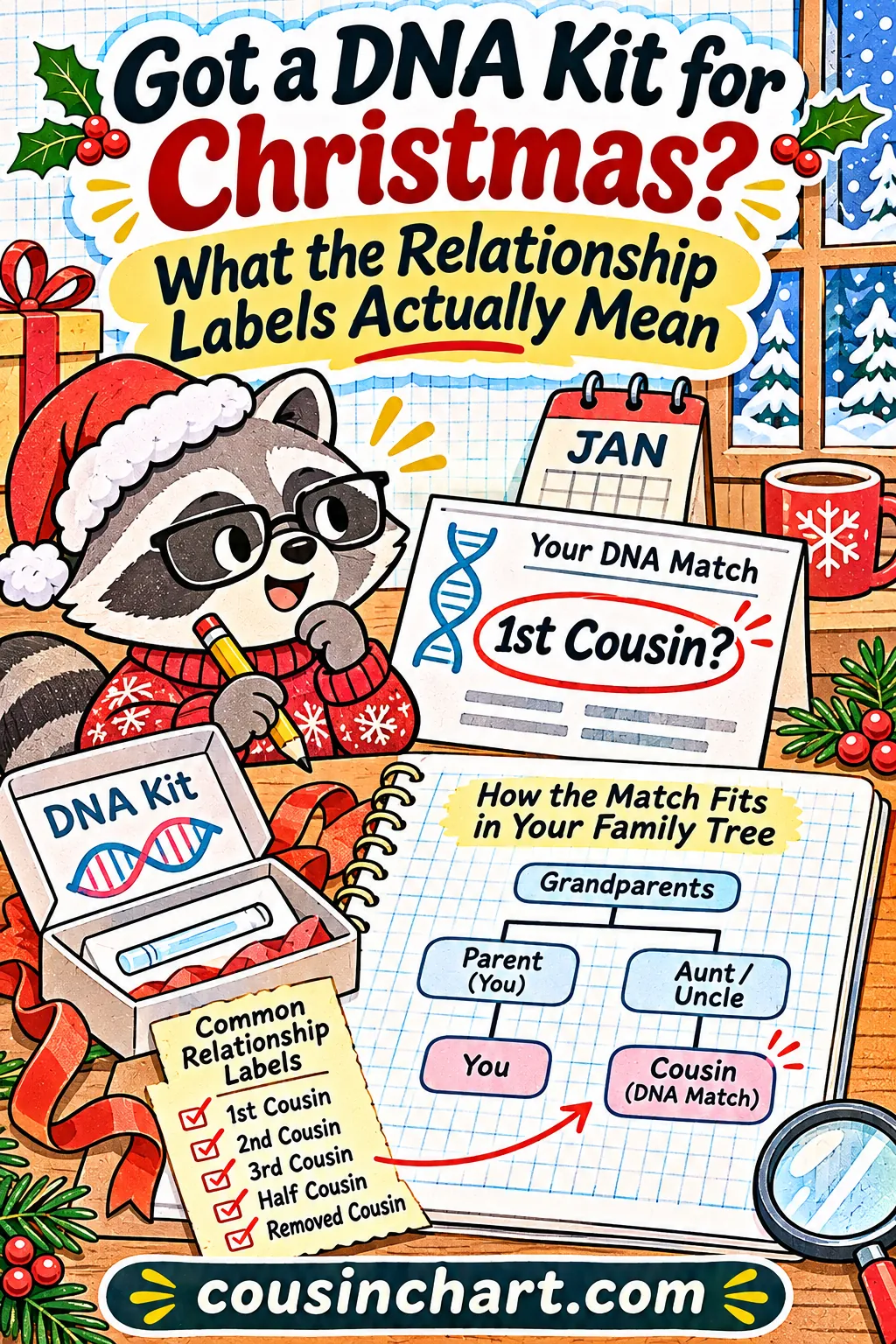
A DNA match label is the testing company's best guess from one number, the total shared centimorgans (cM), and several relationships share the same amount of DNA, so "Close Family" can mean a half sibling, a grandparent or an aunt, and "1st Cousin" can mean a half aunt or even a great-grandparent. To decode yours, type the shared cM into the free DNA Match Calculator and look at every relationship that fits, not just the top one. Then use ages, shared matches and which side of the family the match is on to pick the right answer.
If you unwrapped a DNA kit this Christmas, your results will probably land sometime in the new year. That's when the questions start. A cousin you've known all your life shows up as "Close Family." A stranger appears as "1st Cousin." Your aunt is listed with the same label as a half sibling would get. None of that means the test is broken. It means the label is a shortcut, and this guide shows you how to read past it before you message anyone or jump to conclusions.
▶ Work it out in the free calculator
What the Relationship Labels Actually Mean
Every big testing company does the same basic thing. It compares your DNA with everyone else in its database, adds up the stretches you share, and reports a total in centimorgans. A centimorgan is a unit for measuring shared DNA. The more cM you share with someone, the closer you're likely to be.
Then the company turns that number into a friendly label. The label names differ from company to company, but they usually look something like "Parent/Child," "Immediate Family," "Close Family," "1st Cousin," "2nd Cousin" and so on, sometimes with a range like "1st to 2nd Cousin."
Here's the catch. The label is built from the cM number alone. The company doesn't know your family tree, your ages or which grandparent you got your dimples from. So it picks the relationship that's most likely for that number, and every other possibility gets folded under the same label.
The table below shows the typical ranges behind the most common labels. These are the same ranges the DNA Match Calculator uses, from the Shared cM Project 4.0, a large collection of real, documented relationships.
| Shared cM (typical range) | Average | Relationships that fit | Label you might see |
|---|---|---|---|
| 2,376 to 3,720 | 3,485 | Parent or child | Parent/Child |
| 1,613 to 3,488 | 2,613 | Full sibling | Immediate Family or Sibling |
| 1,032 to 2,480 | 1,766 | Grandparent or grandchild | Close Family |
| 1,201 to 2,282 | 1,741 | Aunt, uncle, niece or nephew | Close Family |
| 1,160 to 2,436 | 1,759 | Half sibling | Close Family |
| 396 to 1,397 | 866 | First cousin | 1st Cousin or Close Family |
| 492 to 1,315 | 871 | Half aunt, half uncle, half niece or half nephew | 1st Cousin |
| 464 to 1,486 | 887 | Great-grandparent or great-grandchild | 1st Cousin |
| 102 to 980 | 433 | First cousin once removed | 1st or 2nd Cousin |
| 137 to 856 | 439 | Half first cousin | 1st or 2nd Cousin |
| 41 to 592 | 229 | Second cousin | 2nd Cousin |
| 43 to 531 | 221 | First cousin twice removed | 2nd Cousin |
Look down the "Average" column and you'll see the problem straight away. A grandparent, an aunt and a half sibling all average around 1,750 cM. A first cousin, a half aunt and a great-grandparent all average around 870 cM. When the averages sit that close together, a single number can't separate them.
Why the averages cluster
It comes from how DNA is passed down. You get half your DNA from each parent, and each of them passed down a random half of theirs. Relationships that sit the same number of steps apart, on average, end up sharing the same amount of DNA.
You can see this in the relationship calculator on the CousinChart home page. It shows an average percentage under each result:
- Half sibling: about 25% on average
- Aunt or uncle: about 25% on average
- Grandparent: about 25% on average
- First cousin: about 12.5% on average
- Half aunt or half uncle: about 12.5% on average
- Great-grandparent: about 12.5% on average
Same percentage, different relationship. That's exactly why the label lumps them together.
The label is a ranking, not a verdict
Think of the label as the top result in a list, not the only answer. Most testing sites let you click into a match and see more detail, often including the shared cM and a list of possible relationships. Write down the cM number. That's the only part of the match you need for decoding, and it's the number you'll type into the calculator.
If you'd like a deeper explainer on the unit itself, the guide to centimorgans explained covers how cM are measured and why bigger numbers mean closer family.
Why a Half Sibling Can Show Up as "1st Cousin"
This is the mix-up that sends the most people searching in January. You expected a half sibling to say "Close Family," but the label says "1st Cousin." Or you have a half sister you grew up with, and the match page calls her your cousin.
Here's what's happening. Half siblings share a typical range of 1,160 to 2,436 cM. First cousins share 396 to 1,397 cM. Those two ranges overlap between 1,160 and 1,397 cM. If you and your half sibling happened to inherit a little less in common than average, your number can drop into that overlap, and the label may lean toward the more common relationship.
It works the other way too. A first cousin at the high end of the cousin range can get pushed up into "Close Family." So can a double first cousin, the child of two siblings who married two siblings, who often shares about as much as a half sibling.
The most common label mix-ups
| What the label says | What you expected | What's probably going on |
|---|---|---|
| Close Family | First cousin | A high-sharing first cousin, or a double first cousin |
| 1st Cousin | Half sibling | A low-sharing half sibling in the overlap zone |
| Close Family | Half sibling | Correct, but the label also covers aunts, uncles and grandparents |
| Close Family | Aunt or uncle | Correct, but a half sibling would get the same label |
| 1st Cousin | Great-aunt or great-uncle | Normal. Great-aunts share about the same as first cousins |
| 1st Cousin | Half aunt or half uncle | Normal. Half aunts sit right on the first cousin average |
| 2nd Cousin | First cousin once removed | Normal. Your parent's cousin often lands in the 2nd cousin band |
| Sibling | Parent or child | Rare. Check the cM number. Parents share about 3,400 to 3,700 cM |
Almost every row is the test working as designed. The label is incomplete, not wrong.
Half sibling vs aunt or uncle: the hardest pair
The single trickiest pair is a half sibling versus an aunt or uncle. Their ranges are nearly identical, and so are their averages, 1,759 cM for a half sibling and 1,741 cM for an aunt or uncle. DNA totals alone will never split them.
What does split them:
- Age. An aunt or uncle is usually a generation older than you. A half sibling is usually closer to your age, though big gaps happen.
- Shared matches. A half sibling shares only one parent with you, so they'll match people on one side of your family. An aunt or uncle matches people on one side too, but they'll also match your parent's other siblings and cousins at a higher level than you do.
- Testing one more person. If your known parent tests, the answer often becomes clear fast. More on that below.
The site has a full guide on this exact puzzle, aunt, uncle, grandparent or half sibling, if you want to go deeper.
Why "half" changes the number
A full sibling shares both parents with you. A half sibling shares one. That cuts the expected sharing roughly in half compared with full siblings, which is why a half sibling drops into the same band as aunts and grandparents.
The same rule works for every relationship. A half aunt shares half as much as a full aunt. A half first cousin shares half as much as a full first cousin. You can watch this happen in the relationship calculator. Tick Half relationship? and the average DNA percentage under the result drops by half. That simple toggle explains most of the label surprises people run into.
How to Decode a Label With the Free Tools
You'll use two free CousinChart tools. The DNA Match Calculator turns a cM number into a list of possible relationships. The relationship calculator on the home page names a relationship once you know the path, and it shows how the "half" toggle changes things. Neither needs an account, and nothing you type gets saved.
Step 1: Find the shared cM on your match page
Open the match on your testing site and look for the total shared DNA. It's usually shown in cM, sometimes next to a percentage and the number of shared segments. Write down the cM total. You don't need the segment count for this.
Step 2: Enter it in the DNA Match Calculator
Open the free DNA Match Calculator. You'll see one box labeled Total shared centimorgans (cM) and a slider underneath that runs from 0 to 3,720.
- Type your number into the box, or drag the slider until the number matches.
- Read the result box. It shows Most likely with a relationship, plus that relationship's typical range and average.
- Scroll to All possible relationships at this cM. This is the part that matters. Every relationship whose typical range includes your number is listed, sorted by how close your number is to each one's average. A star marks the top pick.
- Look at the little bar under each row. The shaded part is that relationship's full range, and the marker shows where your number falls. A marker sitting near the middle of a bar is a comfortable fit. A marker right at the edge is possible but less typical.
If your number is over 2,400 cM, a note appears explaining that it points to a parent, a child or a full sibling, and that ages and family context decide which.
Step 3: Cross off what's impossible
Now bring in what you know. The calculator can't see ages, but you can. Go down the list and cross off anything that doesn't fit:
- A match born the same decade as you can't be your grandparent.
- A match 60 years older than you is very unlikely to be your half sibling.
- A match who says they're from your dad's family can't be a relative only on your mom's side.
What's left is your short list. Often it's two or three relationships, sometimes just one.
Step 4: Check the path in the relationship calculator
Once you have a short list, the relationship calculator helps you see what each option actually means on a family tree. It has two builders, YOU and THEM. Each asks how far up the tree the shared relative sits, with + and − buttons and a label that names the generation.
To compare a half sibling with a full sibling:
- Set YOU to 1 (the label reads parent) and THEM to 1.
- The result reads Sibling, with "You share about 50% of your DNA on average."
- Tick Half relationship? The result changes to Half sibling, and the DNA line drops to about 25%.
To compare a half aunt with a full aunt:
- Set YOU to 2 (grandparent) and THEM to 1.
- The result reads Aunt or uncle, about 25%.
- Tick Half relationship? It becomes Half aunt or uncle, about 12.5%. That's the same average as a first cousin, which is why a half aunt so often wears a "1st Cousin" label.
To check a first cousin and a half first cousin, set both builders to 2. The result reads 1st cousin, about 12.5%. Tick the half box and it becomes Half 1st cousin, about 6.25%.
Under They are, tap female or male to get the exact word, such as half aunt or half nephew. Leave Related by on blood. Step and marriage relationships share no DNA, so the calculator hides the DNA line when you switch to them, and that's a handy reminder that a step-relative will never appear as a match at all.
Step 5: Save what you found
Under the result you'll see three buttons. Copy result copies a one-line answer you can paste into your notes. Download my chart saves a picture of the path from you to the shared relative to them. Print this result gives you a paper copy. Open Make it yours to type names on the chart, up to 18 characters each. Photos you add stay on your device.
Three Worked Examples With Real Numbers
These are made-up testers with numbers run through the DNA Match Calculator, so you can see how the list behaves.
Example 1: Nora sees "Close Family" at 1,812 cM
Nora, 34, got a kit from her husband for Christmas. In late January a match appears with initials she doesn't recognize, labeled "Close Family," sharing 1,812 cM.
She types 1,812 into the calculator. Four relationships fit:
| Relationship | Typical range | Average | How far from 1,812 |
|---|---|---|---|
| Grandparent or grandchild | 1,032 to 2,480 | 1,766 | 46 |
| Half sibling | 1,160 to 2,436 | 1,759 | 53 |
| Aunt, uncle, niece or nephew | 1,201 to 2,282 | 1,741 | 71 |
| Full sibling | 1,613 to 3,488 | 2,613 | 801 |
The top pick is grandparent, but the next two are almost tied with it. A difference of 46 versus 53 cM tells you nothing. This is where Nora's own knowledge takes over.
- Nora knows all four of her grandparents, and none of them have tested. If the match's profile shows a birth year near hers, grandparent is out.
- The match's profile says they were born about 30 years ago. Grandchild is out too. Nora has no children old enough.
- That leaves half sibling, or a niece or nephew, or an aunt or uncle. Nora has one full brother with no children, and she knows all her aunts and uncles.
Her short list is now half sibling, or an unknown aunt or uncle. Shared matches will decide it, and we'll get to that in a moment.
Example 2: Marcus sees "1st Cousin" at 1,290 cM
Marcus, 41, got a kit from his kids. A match labeled "1st Cousin" shares 1,290 cM. He has only a handful of first cousins and doesn't recognize the name.
He enters 1,290. Six relationships fit:
| Relationship | Typical range | Average | How far from 1,290 |
|---|---|---|---|
| Great-grandparent or great-grandchild | 464 to 1,486 | 887 | 403 |
| Half aunt, uncle, niece or nephew | 492 to 1,315 | 871 | 419 |
| First cousin | 396 to 1,397 | 866 | 424 |
| Aunt, uncle, niece or nephew | 1,201 to 2,282 | 1,741 | 451 |
| Half sibling | 1,160 to 2,436 | 1,759 | 469 |
| Grandparent or grandchild | 1,032 to 2,480 | 1,766 | 476 |
The "most likely" result is great-grandparent, which is clearly not right for a match in his own generation. That's a perfect lesson in why you read the whole list. Marcus's number sits right in the overlap zone, high for a cousin and low for a half sibling or uncle.
He crosses off great-grandparent and grandparent by age. He crosses off aunt or uncle, because the match is three years younger than he is. His short list: first cousin, half sibling, or a half niece or half nephew. Three very different family stories, all from one label that said "1st Cousin."
Example 3: Priya sees "2nd Cousin" at 430 cM
Priya, 27, received a kit from a holiday gift exchange. A match labeled "2nd Cousin" shares 430 cM. She enters 430. Five relationships fit:
| Relationship | Typical range | Average | How far from 430 |
|---|---|---|---|
| First cousin once removed | 102 to 980 | 433 | 3 |
| Half first cousin | 137 to 856 | 439 | 9 |
| Second cousin | 41 to 592 | 229 | 201 |
| First cousin twice removed | 43 to 531 | 221 | 209 |
| First cousin | 396 to 1,397 | 866 | 436 |
Two answers sit almost exactly on their averages. The match is 58, which fits one generation above Priya. A first cousin once removed at that age would be one of her parents' first cousins. A half first cousin would be Priya's own generation, so the age points strongly toward the first one.
To see what that means on a tree, she sets YOU to 3 and THEM to 2 in the relationship calculator. The result reads 1st cousin once removed. Her shared relatives with this match are her great-grandparents, who are the match's grandparents. Now she knows which couple to look for in her tree.
Narrow It Down: Age, Shared Matches and Which Side
Once you have a short list, three clues do most of the work. You don't need any special software for them, just your match list and a notebook.
Clue 1: Age and generation
Age is the fastest filter. Relationships come with rough generations attached:
| Relationship | Usual generation compared with you | Typical age gap |
|---|---|---|
| Half sibling | Same | Often within 20 years, sometimes more |
| Aunt or uncle | One up | Often 15 to 40 years older |
| Grandparent | Two up | Often 40 to 70 years older |
| First cousin | Same | Often within 20 years |
| Half aunt or half uncle | One up | Wide. Can even be younger than you |
| First cousin once removed | One up or one down | Wide |
Those age gaps are rules of thumb, not rules. Families with big age spreads break them all the time, and a half uncle younger than you isn't unusual in a large or blended family. Still, a match who's clearly in your grandparents' generation narrows things a lot.
Clue 2: Shared matches
Shared matches are people who match both you and the mystery match. They're the single most useful clue after the cM number.
Here's how to use them:
- Open the mystery match and find the list of shared matches, sometimes called "in common with" or "relatives in common."
- Look for people you can place. Your known first cousin on your mom's side. A second cousin on your dad's side. Anyone you can identify.
- Note which side those known people belong to.
If every shared match you recognize is on your dad's side, the mystery match is related to you through your dad. If they show up on both sides, you may be looking at a full sibling or someone related through both parents.
The guide to what shared matches are walks through this in more detail.
Clue 3: Test one more person
Nothing settles a "Close Family" puzzle faster than one more test. If your known mother tests and the mystery match shows up as her match too, the match is on your mom's side. If your mother doesn't match them at all, they're on your dad's side.
For the half sibling versus uncle question, testing a known parent is often decisive. If the match is your half sibling through your dad, your dad will match them as parent and child, around 3,400 to 3,700 cM, and your mom won't match them at all. If they're your dad's brother, your dad will match them as a sibling, usually somewhere around 2,600 cM, and again your mom won't match them. Either way, your dad's number is far higher than yours, and the size of it tells you which story is true.
If a parent or grandparent is open to testing, ask first and let them choose their own privacy settings.
When the Result Is a Real Surprise
Sometimes the decoding points somewhere nobody expected. A half sibling no one mentioned. A parent who isn't the person you grew up calling Dad. A grandparent's secret from 60 years ago. These discoveries are more common than most people expect when a whole family starts testing, and they land hard, especially right after the holidays.
There's no single right way to handle it. A few steps help almost everyone, though.
Pause before you message
The urge to write to the match right away is strong. Give it a few days first. You want to send one calm, clear message, not a rushed one you'll wish you could take back. Use those days to:
- Run the cM through the calculator and write down every possible relationship.
- Check shared matches to find the side of the family.
- Think about what you actually want from contact. Information? A relationship? Just to know?
A first message you can adapt
Keep it short, friendly and low-pressure. Give them room to answer in their own time.
"Hi! I just got my DNA results and see that we share a good amount of DNA, about 1,800 cM, so we're probably close family. I'm trying to figure out how we're connected. I know my mom's side well but less about my dad's. I'd love to compare notes if you're open to it, and no pressure at all if not. Happy new year!"
Notice what that message does. It shares the number, which helps them decode it too. It offers a clue about which side you know. And it doesn't name a relationship or make any claims. The guide on how to confirm a DNA match has more on building a case before you name anything.
Talking to family
If the result touches your parents or grandparents, think about who to talk to first and where. A quiet one-on-one conversation usually goes better than an announcement at a family dinner. Start with what you found, not what you assume:
"My DNA results showed a close match I don't recognize, about 1,800 cM, which could be a half sibling or an aunt or uncle. Do you have any idea who it might be?"
That leaves room for the other person to share what they know without feeling cornered.
If the discovery is weighing on you, it's okay to take your time and lean on people you trust. Some adoptees and people with unexpected results find it helpful to talk with a counselor who has experience with family discoveries.
Privacy settings are yours to choose
Most testing sites let you change your display name, hide your match list from others, or turn off matching entirely. If you're not ready to be found by close relatives, look at those settings before your results come in. The guide to DNA test privacy explains what each kind of setting usually controls.
A Christmas-to-Spring Timeline for New Testers
DNA kits are popular holiday gifts, which means a lot of people mail their samples at the same time. Processing can take several weeks, sometimes longer after the holidays. Your testing company will give you an estimate when it receives your kit. Here's a calm way to pace the whole thing.
| When | What to do |
|---|---|
| Christmas week | Open the kit and read the instructions. Activate or register it online before you collect the sample, if the kit asks you to |
| Before mailing | Collect the sample exactly as directed. Most saliva kits ask you not to eat, drink or chew gum for a set time beforehand |
| Mailing | Mail it soon. If you're mailing during the holiday rush, check your carrier's official holiday schedule |
| While you wait | Choose your privacy settings. Write down the names and birth years of every grandparent and great-grandparent you know |
| Results day | Look at your closest matches first. Write down each one's cM before reading the labels |
| First week after | Decode any surprising labels with the calculator. Check shared matches. Don't message strangers yet |
| A few weeks after | Send calm first messages. Start a simple tree with the matches you can place |
If you gave the kit
If you're the one who gave a DNA kit, you can help the person avoid a rough January. Mention, kindly, that DNA tests sometimes turn up relatives nobody knew about. Show them where the privacy settings are. Offer to help them read their match list when the results come in. That small heads-up turns a possible shock into a shared project.
A helpful prep job: write down your known family
The best thing you can do while you wait is gather what you already know. Make a simple list:
- Your parents, with birth years.
- All four grandparents, with birth years and places.
- Your aunts and uncles on both sides.
- Your first cousins, roughly by age.
- Any great-grandparents you know by name.
When your results arrive, this list lets you sort matches by side in minutes. One sheet of paper is plenty.
Troubleshooting Common Label Puzzles
| Situation | What to check | Likely explanation |
|---|---|---|
| A known first cousin shows as "Close Family" | Their cM number | High-sharing first cousin, or double first cousins if your parents' families intermarried |
| A known half sibling shows as "1st Cousin" | Their cM number | Low sharing in the overlap between 1,160 and 1,397 cM |
| A known aunt and an unknown match get the same label | Both cM numbers and ages | Aunts and half siblings share the same range. Age and shared matches decide |
| A known relative doesn't appear at all | Whether they tested with the same company, and their privacy settings | They may have hidden their matches, or tested elsewhere |
| Two known cousins share very different amounts | Nothing. This is normal | DNA is passed down randomly, so siblings inherit different pieces |
| The "most likely" result is a great-grandparent for someone your age | The full list of possible relationships | The calculator ranks by number alone. Cross off by age |
| Your numbers seem high across the board | Whether your parents come from the same small community | Families with many shared ancestors can share extra DNA, which pushes labels closer |
| A match says "Parent/Child" but you're not sure who's the parent | Birth years | The older person is the parent. Full siblings rarely reach that range |
Variations by family situation
The same decoding method works for everyone, but the questions change depending on your family.
If you were adopted
Adoptees often get the most out of a holiday DNA kit, and also the biggest surprises. Your closest matches are your best leads. Write down every match over about 400 cM, decode each one, and group them by shared matches. Two clusters usually mean two birth parents. Take things at your own pace, and consider joining an adoptee support community before reaching out to birth relatives.
If your family is blended
Step-relatives never show up as DNA matches, since they share no DNA. Half siblings will, at the "Close Family" level. If you have half siblings through both parents, your match list can look busy. Use the relationship calculator with Half relationship? ticked to see what each half relative's children are to you. For example, set YOU to 1 and THEM to 2, tick half, and the result reads Half niece or nephew, about 12.5% on average. That's why your half sibling's kids often show up as "1st Cousin."
Start Decoding Your Matches
Write down the shared cM for every match that surprises you. Put each number into the DNA Match Calculator and read the whole list, not just the top pick. Cross off anything ruled out by age, check shared matches for the side, and use the relationship calculator with the half toggle to see what each remaining option looks like on a tree. With those steps, a confusing label turns into a short list you can actually work with, and you'll be ready for a calm first message instead of a rushed one.
▶ Work it out in the free calculator
Frequently Asked Questions
Why does my DNA test say "Close Family" instead of a specific relationship?
"Close Family" covers relationships that share about the same amount of DNA, usually a grandparent, an aunt or uncle, a half sibling, or a niece or nephew. They all average around 1,750 cM, so the company can't tell which one it is from the number alone. Ages and shared matches decide.
Can a half sibling show up as a first cousin on a DNA test?
Yes. Half siblings typically share 1,160 to 2,436 cM, and first cousins share 396 to 1,397 cM. If a half sibling falls in the overlap between 1,160 and 1,397 cM, the label can read "1st Cousin." Check the cM number and the full list of possible relationships.
How do I tell a half sibling from an aunt or uncle with DNA?
You usually can't from the cM number alone, since the ranges are nearly identical. Look at ages first, then at shared matches to see which side of the family the match is on. Testing your known parent is often the quickest way to settle it.
When will I get my results from a DNA kit I got for Christmas?
Testing companies usually take several weeks after they receive your sample, and the holiday rush can add time. The company will give you an estimate and email you when results are ready. Register the kit and mail it soon after Christmas to get in the queue early.
What does it mean if the "most likely" relationship doesn't make sense?
The calculator and the testing sites rank possibilities by cM alone, so the top pick can be wrong for your family, like a great-grandparent for someone your age. Read every relationship on the list and cross off the ones that don't fit by age or family history.
Is a great-aunt really the same DNA level as a first cousin?
Yes, on average. Great-aunts, great-uncles, first cousins, half aunts and great-grandparents all share about 12.5% of your DNA on average, so they often get the same "1st Cousin" label. That's why ages matter so much when reading a match.
Should I message a surprise close match right away?
It's usually better to wait a few days. Decode the cM, check shared matches, and think about what you want from contact. Then send a short, friendly message that shares the cM number and gives the other person room to reply in their own time.
Do step-relatives show up as DNA matches?
No. Step-relatives and in-laws aren't related by blood, so they share no DNA and won't appear on your match list. If you see a step-relative listed, check the name carefully, because it may be a different person in their family.