What Is My Second Cousin's Child to Me?
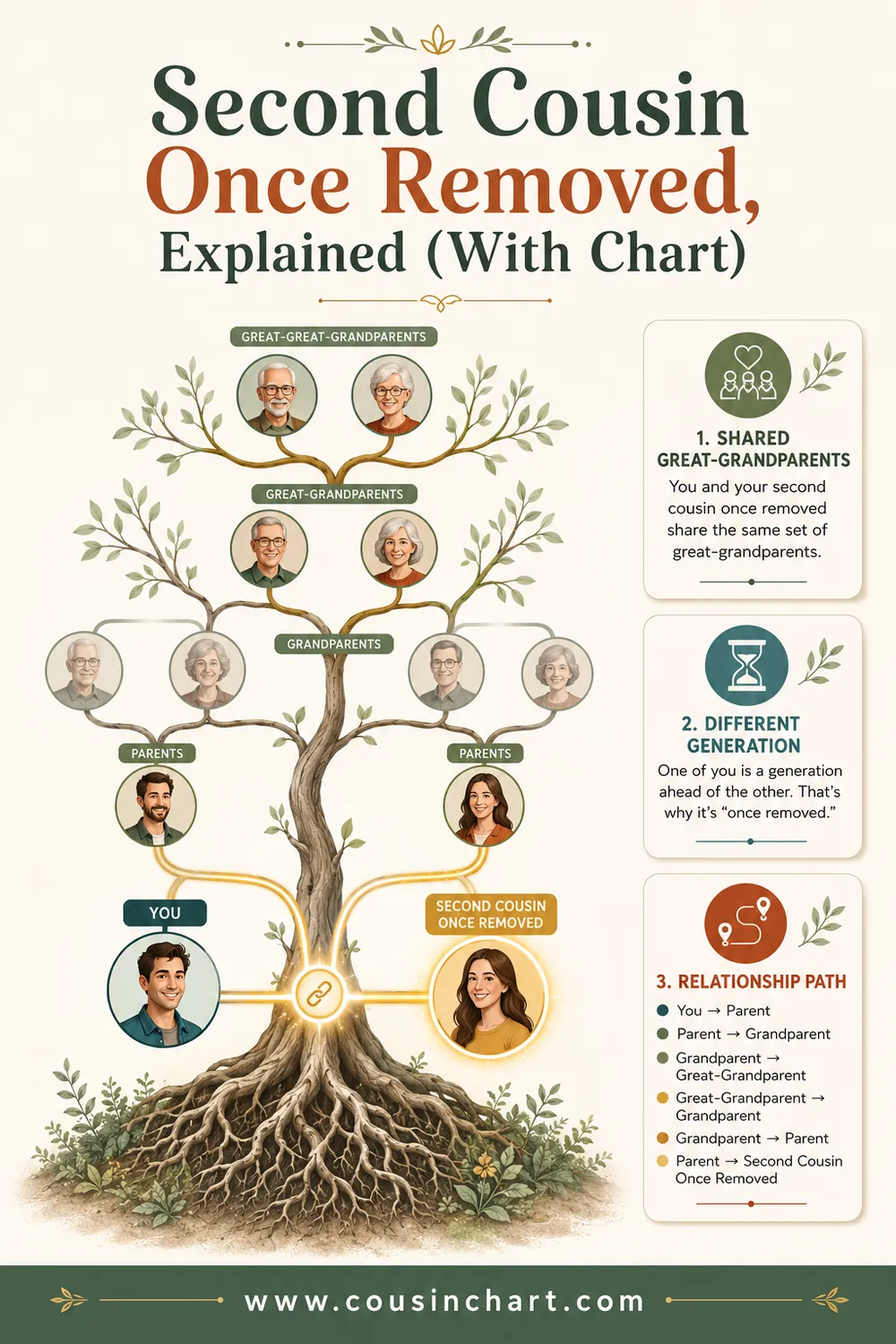
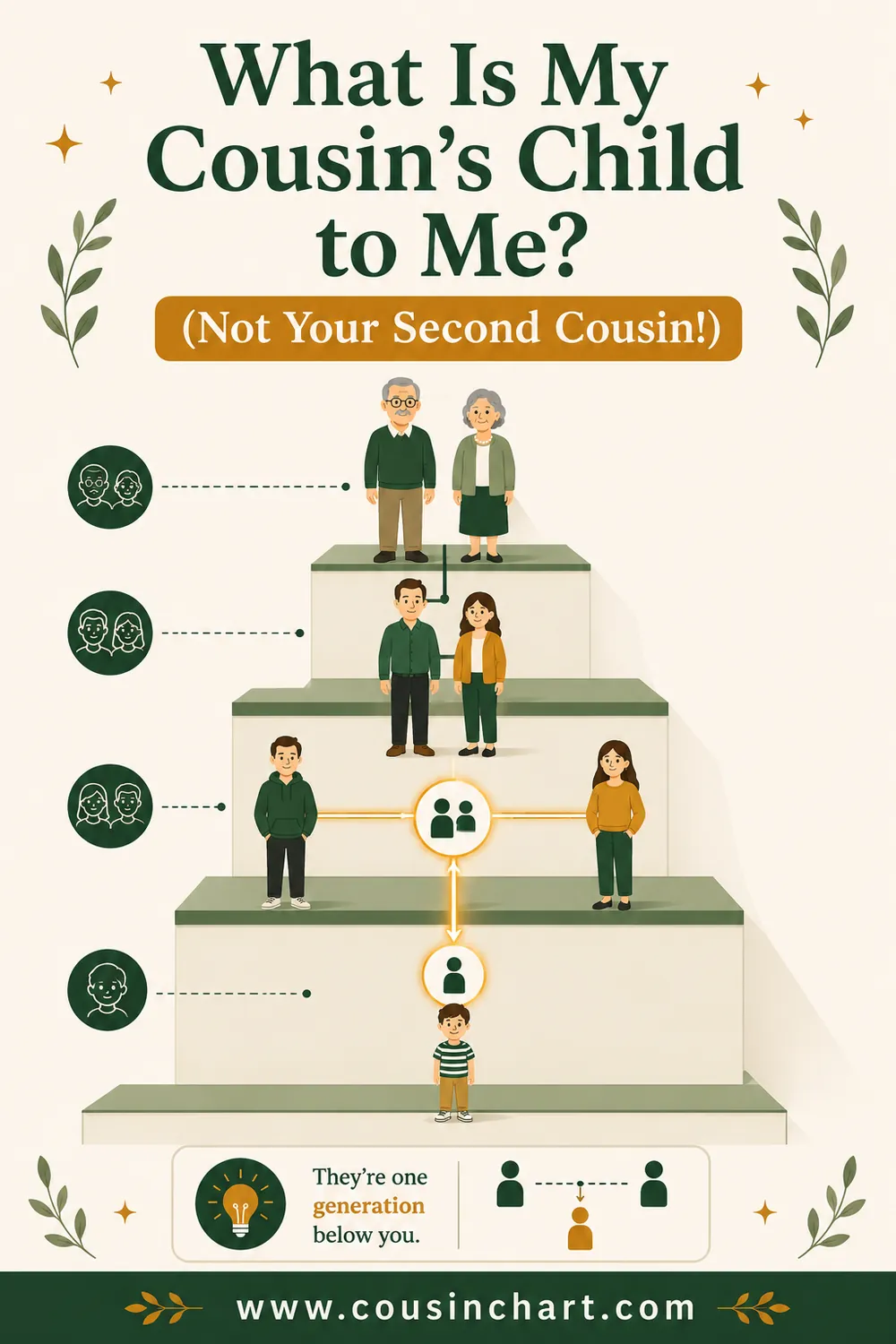
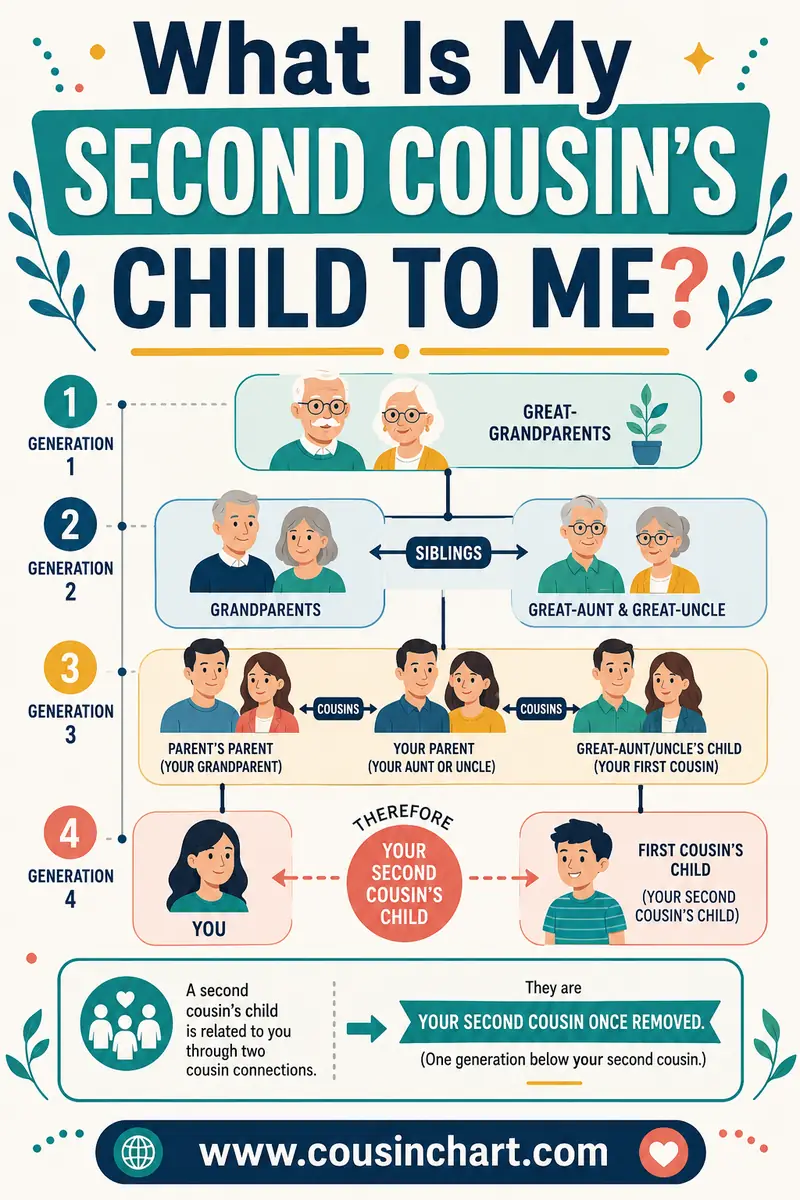
Your second cousin's child is your second cousin once removed. The "second cousin" part stays put — it's anchored to the cousin relationship at your generation — and "once removed" records that the child sits one generation below you. They are not your third cousin: that title belongs to a different person entirely (your parent's second cousin's grandchild — more usefully, the child of your own second cousin is a third cousin to your children).
This guide makes the rule effortless: why the number doesn't budge, where third cousins actually come from, the tiny amount of DNA involved, and what to call the kid at the reunion. For any relative you can't place by counting, the free family relationship calculator does it in seconds.
Relationship quick-check. Tap a phrase to see the correct term:
The answer will appear here.
The Rule: The Number Stays, the Removal Counts
Every cousin term is two dials, set independently:
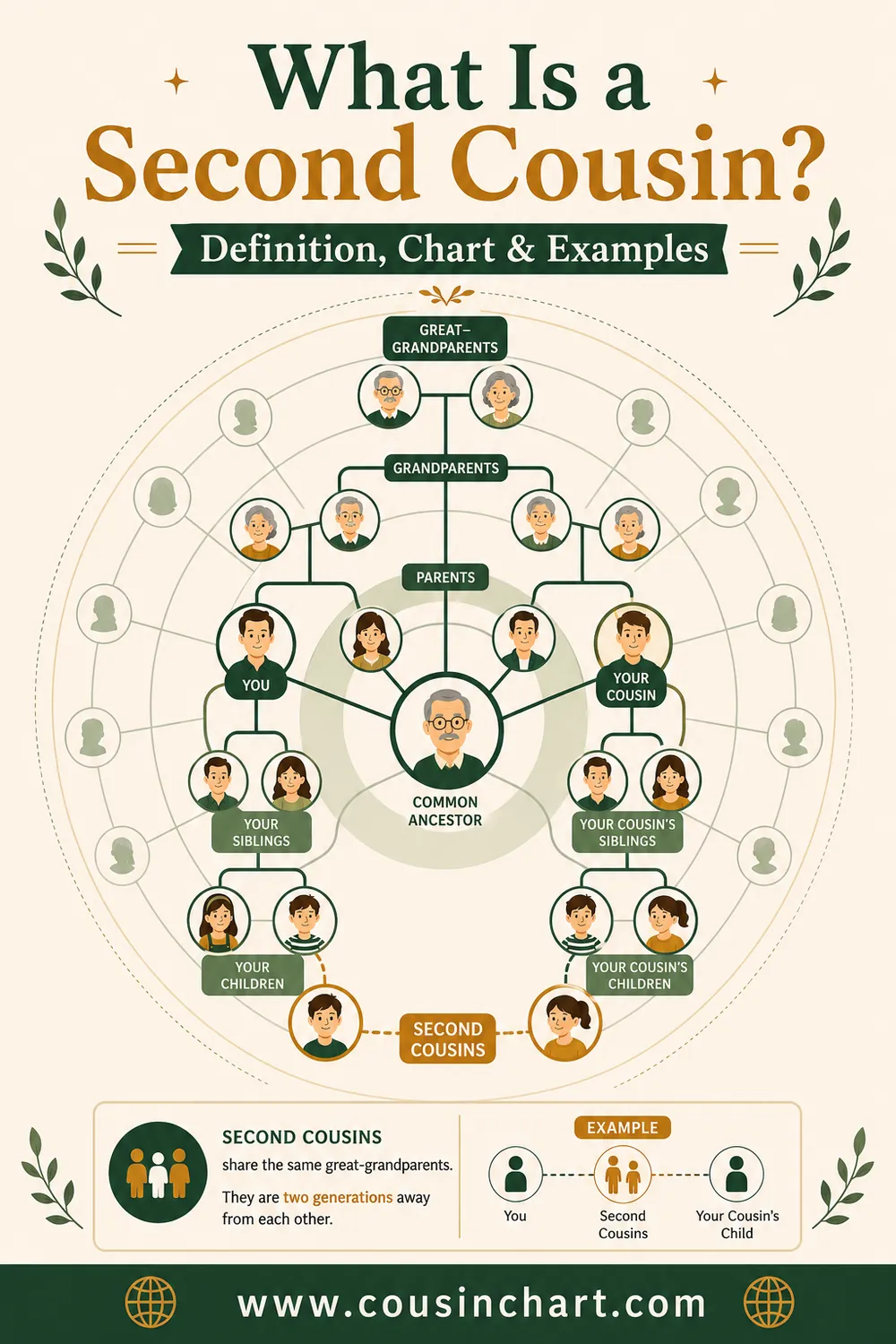
- The cousin number measures how far back the shared ancestors sit — counted from the person closer to them. You and your second cousin share great-grandparents; that pins the number at "second." Your second cousin's child doesn't move that ancestor couple one inch, so the number stays "second." (Need the base relationship first? Start with what is a second cousin.)
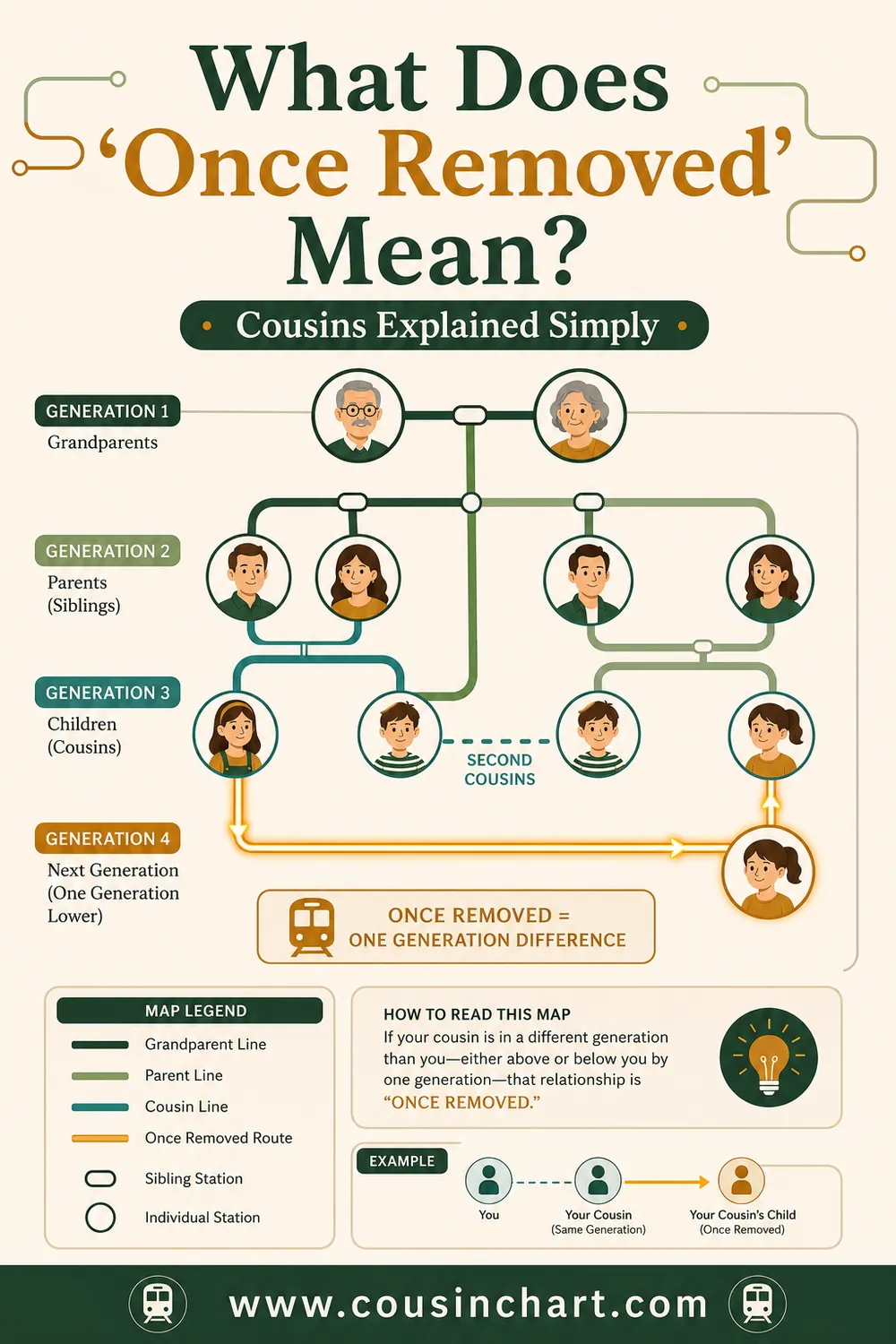
- "Removed" measures the generation gap between the two of you. The child is one generation below you: once removed.
Second cousin + one generation gap = second cousin once removed, abbreviated 2C1R. The counting system generalizes to everything — what does once removed mean walks the whole method — and the 2C1R relationship itself, covering both this case and your parent's second cousin, gets a full treatment at second cousin once removed.
If you've read our piece on what is my cousin's child to me, you already know this exact move one row closer to the trunk: first cousin's child → first cousin once removed. Same machine, different row.
Why "Third Cousin" Is the Tempting Wrong Answer
The intuition — "second cousin, plus one step, equals third cousin" — misreads what the number counts. Cousin numbers count generations back to the shared ancestors, not steps between people.
Third cousins share great-great-grandparents and stand in the same generation. Your second cousin's child fails both tests: their closest shared ancestors with you are still your great-grandparents (via their parent), and they're a generation below you.
Here's where third cousins really come from — the generation slide:
| Pair | Relationship | Shared ancestors |
|---|---|---|
| You + your second cousin | Second cousins | Great-grandparents |
| You + their child | Second cousins once removed | Same couple (their great-grandparents, your great-grandparents) |
| Your child + their child | Third cousins | That couple — now great-great-grandparents to both kids |
The relationship "slides down" one notch per full generation: your second cousin's child is once removed to you, but a plain third cousin to your kids. Family trees don't add steps sideways; they add floors downward.
The DNA Between You
A second cousin once removed shares about 1.56% of your DNA — roughly 120 centimorgans on average, with a realistic range of about 30–215 cM. Three practical notes:
- It's half your second cousin's share. You and your second cousin average ~3.125% (~230 cM); their child gets half of that overlap passed down.
- The average collides with other relationships. Half second cousins and first cousins three times removed share the same ~1.56% average, so DNA sites label matches in this zone with ranges like "2nd–3rd cousin." The number narrows it; the paper trail names it.
- Detection is reliable but no longer guaranteed. At this distance virtually all true relatives still share some detectable DNA, but the amount varies wildly — a genuine 2C1R at 30 cM can look "more distant" than a 3rd cousin having a lucky inheritance day. Don't rank family closeness by centimorgans alone.
If a ~120 cM stranger appears in your match list, "child of one of my second cousins" belongs on the shortlist of explanations — and sketching candidate paths through the relationship calculator is the fastest way to test it.
What This Kid Actually Is at the Reunion
Officially: your second cousin once removed. Practically: "cousin," and nobody will ever object. Some families with strong ties to a big extended clan use "little cousin," or teach kids to call adult 2C1Rs "aunt" and "uncle" as courtesy titles — all perfectly good customs.
The precise term earns its keep in exactly three venues:
- Genealogy records and software, where 2C1R is the standard shorthand and getting it right keeps generations aligned.
- DNA match lists, where translating centimorgans into candidate relationships is the whole game.
- Estate law, where intestacy statutes rank cousin classes precisely — whether someone is a second cousin or a second cousin once removed can genuinely matter when distant kin inherit. (Rules vary by state; check current law.)
Everywhere else, warmth beats taxonomy. Hand the kid a juice box.
The Whole Branch at a Glance
Anchor once, and every descendant of your second cousin files into place. Say your second cousin is Priya:
- Priya → second cousin (~230 cM)
- Priya's children → second cousins once removed (~120 cM)
- Priya's grandchildren → second cousins twice removed (~60 cM)
- Priya's children + your children → third cousins (~75 cM to each other)
- Priya's husband → cousin by marriage (0 cM, unlimited potluck access)
The two dials never change: descendants of Priya add removals to you, while each matched pair of new generations (your kids, her kids) bumps the cousin number instead. Once you see the machine, no relative on the tree can surprise you again.
Test Yourself: Five Reunion Curveballs
The rule sticks better once you've run it a few times. Cover the answers and try these — every one is solvable with the two dials.
**1. Your second cousin Priya brings her new baby. Your mom asks what the baby is to her.**
Your mom is one generation above you, and Priya's baby is one below — but count from the cousin pair. Your mom and Priya are already second cousins once removed (mom is the "up" version). The baby adds one more floor: second cousin twice removed to your mom.
**2. Priya's daughter, now grown, brings her baby.**
Grandchild of your second cousin: the number holds, two floors down — second cousin twice removed to you, and third cousin once removed to your kids (one floor below their third cousin).
3. Your second cousin's child and your first cousin's child compare notes. What are they to each other?
Trick question — it depends on the sides. If both descend from the same great-grandparent line, work from the shared couple; if your first cousin is on your other side, the two kids may be nothing to each other at all. Cousin terms only connect people who share an ancestor.
4. Someone at the table is your "second cousin once removed" — but she's 70 and you're 30. Upward or downward version?
Almost certainly upward: she's likely your parent's second cousin. Same label either way; the age gap just hints at which floor she's on. Confirm by asking which generation shares the great-grandparents.
**5. Priya turns out to be your half second cousin. What's her child to you?**
The half rides along: half second cousin once removed, at roughly half the usual ~120 cM. The counting rules don't change — only the DNA expectation does.
Score yourself loosely — the point isn't the quiz, it's noticing that you never needed to memorize anything. Two dials, every time. And curveball #3 is the one to remember at big reunions: not everyone at the same table is on the same tree.
FAQ
Is my second cousin's child my third cousin?
No — they're your second cousin once removed. Third cousins share great-great-grandparents and sit in your own generation. It's your children and your second cousin's children who are third cousins.
What is my second cousin's child to my child?
Third cousins. Both kids are four generations down from the same couple — the great-grandparents you share with your second cousin — and in the same generation as each other.
How much DNA do I share with my second cousin's child?
About 1.56% on average — roughly 120 centimorgans, typically anywhere from about 30 to 215 cM. That's half your average share with the second cousin themselves.
What is my parent's second cousin to me?
Also your second cousin once removed — the same term covers one generation up as well as down. Your parent's second cousin's child, meanwhile, is your third cousin.
What is my second cousin's grandchild to me?
Your second cousin twice removed: same anchored cousin number, two generations of gap. Their children would be three times removed.
Am I my second cousin's child's aunt or uncle?
No — aunt and uncle titles belong to siblings of parents (and their spouses). You're the child's second cousin once removed, though plenty of families use "auntie" or "uncle" as a courtesy title for any adult cousin, which is a custom, not a chart error.
Are second cousins once removed blood relatives?
Yes — you both descend from the same couple (your great-grandparents), sharing about 1.5% of your DNA. Distant enough that marriage between them is legal essentially everywhere, close enough to show up in DNA tests and inheritance law.
Two Dials, Zero Doubt
The number points at the shared ancestors; the removal counts the floors between you — and a second cousin's child moves only the second dial. That's the whole answer: second cousin once removed to you, third cousin to your kids, ~120 cM in the test tube. When the next branch-of-a-branch question lands at a family gathering — and it will — open the free family relationship calculator, tap the path, and show everyone the answer with the chart attached. Faster than the debate, friendlier than being the person who says "well, actually."