What Is a Haplogroup? Maternal vs Paternal Haplogroups in Plain English
A haplogroup is a large group of people who share a common ancestor on a single, unbroken family line, either the direct father-to-son line (a Y-DNA haplogroup) or the direct mother-to-child line (a mitochondrial or mtDNA haplogroup). It's named with letters and numbers, like R1b or H1, and it tells you about one deep branch of your ancestry from thousands of years ago, not about your recent family or your whole background. Below is a plain-language guide to maternal vs paternal haplogroups, who in your family shares each one, and what a haplogroup can and can't tell you.
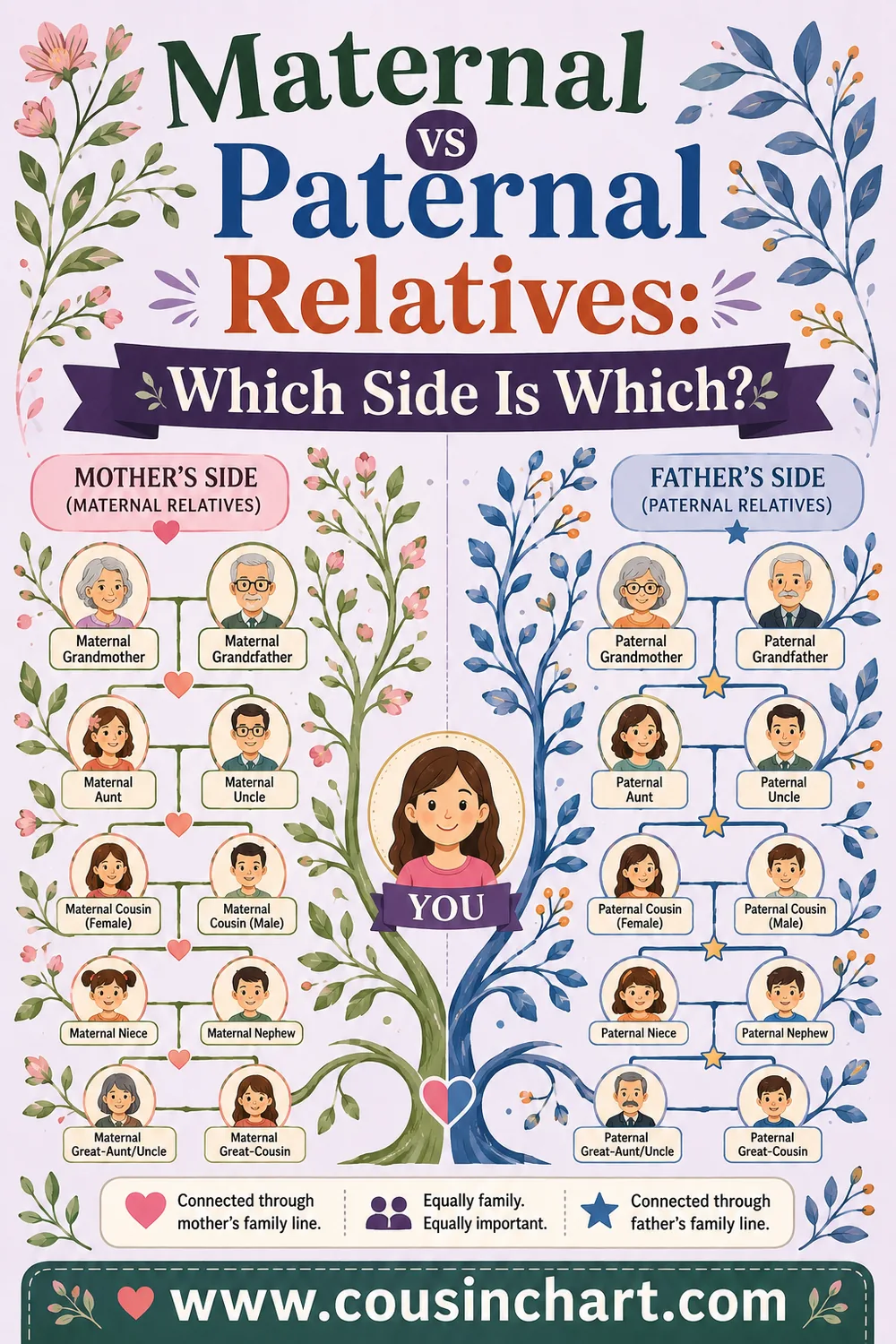
Tap a relative to see if they share your maternal or paternal line.
▶ Work out any relative in the free relationship calculator
Maternal vs paternal haplogroup
| Maternal haplogroup (mtDNA) | Paternal haplogroup (Y-DNA) | |
|---|---|---|
| Passed down by | Mothers to all their children | Fathers to their sons only |
| Who has one | Everyone | Only people with a Y chromosome (usually males) |
| Line it follows | Your mother, her mother, her mother... | Your father, his father, his father... |
| Example names | H, H1, U5, L2a | R1b, I1, E1b1a, J2 |
| Changes with marriage or surname? | No | No, but it often follows a surname line |
A daughter doesn't receive a Y chromosome, so she can't test her own paternal haplogroup. She can learn it by asking her father, a brother, or her father's brother or his son to test.
Who shares your haplogroup?
| Relative | Same maternal (mtDNA) haplogroup? | Same paternal (Y-DNA) haplogroup? |
|---|---|---|
| Your mother | Yes | No |
| Your mother's mother | Yes | No |
| Your father | No (he has his mother's) | Yes, if you're male |
| Your father's father | No | Yes, if you're male |
| Your full brother or sister | Yes | A brother: yes, if you're male |
| Your mother's sister's children | Yes | No |
| Your father's brother's son | No | Yes, if you're both male |
| Your father's mother | No | No |
Your haplogroups follow only two of your many lines. Go back five generations and you have 32 ancestors, but your mtDNA traces just one of them and your Y-DNA traces just one more. That's why a haplogroup is a small window, not the whole view.
How haplogroup names work
Haplogroups are named like branches of a giant tree. Each letter is a big branch, and each number or letter after it is a smaller branch:
- R is a big branch.
- R1 is a smaller branch of R.
- R1b is a branch of R1, and it can split further into longer names.
A longer name means a more detailed, more recent branch. Different tests may report your haplogroup at different levels of detail, so two companies might show slightly different names for the same line.
What a haplogroup can and can't tell you
| It can tell you | It can't tell you |
|---|---|
| Which deep branch of the human family tree your direct maternal or paternal line belongs to | Your ethnicity or nationality |
| Roughly where that branch was common thousands of years ago | Who your recent ancestors were |
| Whether two people could share a direct-line ancestor (if their haplogroups differ, they don't on that line) | How closely two people are related |
| Clues to test a surname line with male relatives | Anything about your other lines |
Many unrelated people around the world share the same broad haplogroup, so a match on haplogroup alone doesn't make someone a close relative.
How do you find your haplogroup?
- Take a DNA test that reports haplogroups. Some general ancestry tests report a maternal haplogroup, and a paternal one for males; specialized Y-DNA and mtDNA tests go much deeper.
- Pick the right relative using the chart above. To learn your father's Y line, a woman can ask her father or brother to test.
- Read it as one line. Use it alongside your family tree and your autosomal DNA matches.
For how the three main DNA test types compare, see Y-DNA vs mtDNA vs autosomal. To see why your mother's and father's sides show up differently in regular tests, read do you get more DNA from your mother or father?
Common mistakes
- Reading a haplogroup as an ethnicity. It's one deep line, not your whole background.
- Thinking a haplogroup match means a close relative. Millions of people can share a broad haplogroup.
- Expecting a daughter's test to show her father's Y line. She doesn't carry a Y chromosome.
- Forgetting your father's mtDNA isn't yours. He passes his Y to sons, but his mtDNA came from his mother and stops with him.
Found a relative through a DNA test? The free relationship calculator shows the exact term once you know the family link.
▶ Work out any relative in the free relationship calculator
Frequently Asked Questions
What is a haplogroup in simple terms?
A big group of people who share an ancient common ancestor on one direct line: the father-to-son line (Y-DNA) or the mother-to-child line (mtDNA).
What is the difference between a maternal and paternal haplogroup?
A maternal haplogroup follows mtDNA from your mother, her mother and so on, and everyone has one. A paternal haplogroup follows the Y chromosome from father to son, so only males carry it.
Can a woman find her paternal haplogroup?
Not from her own DNA, because she has no Y chromosome. She can ask her father, a brother or a paternal uncle or male cousin to test.
Does a haplogroup show my ethnicity?
No. It follows only one deep line out of many, and it isn't the same as an ethnicity estimate.
Do siblings have the same haplogroup?
Full siblings share the same maternal haplogroup. Full brothers also share the same paternal haplogroup.