Family Branches: Maternal Lines, Cadet Branches and More
A "family branch" is one line of descent within a larger family tree — the group of people who trace down from a particular ancestor. Your maternal branch is your mother's side; your paternal branch is your father's side. Genealogists also talk about cadet branches (lines descending from younger sons) and collateral branches (the side lines of cousins, aunts, and uncles that split off from your direct line).
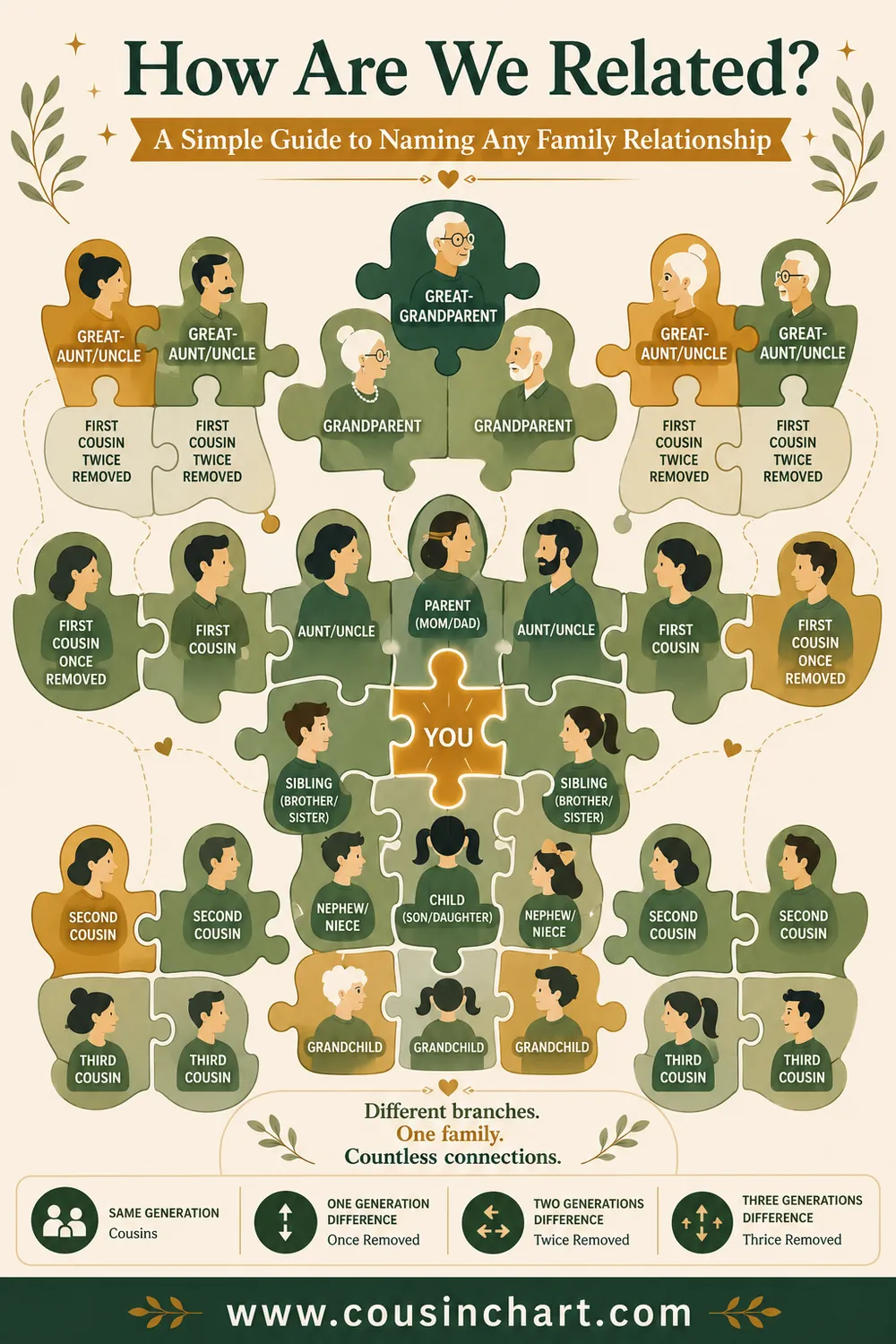
This guide explains all the "branch" and "line" vocabulary you'll meet in family history — plainly, with examples. These words sound technical, but each one just names a different piece of the same tree. And whenever you want to see how two people on different branches actually connect, the free relationship calculator traces it in seconds.
Relationship quick-check. Tap a term to see which branch or line it means:
The answer will appear here.
What "Branch" Actually Means
Picture a family tree as an actual tree. The trunk is a shared ancestor; the branches are the lines of descendants spreading out from them. A family branch is any one of those lines — a group of relatives who all trace back to the same point on the tree.
The word is flexible. "Branch" can mean something big (the entire descendants of a great-great-grandparent) or something small (your one aunt and her three kids). What stays constant is the idea: a branch is a subset of the family united by descent from a common ancestor. When someone says "that's the Chicago branch of the family" or "we're the Italian branch," they mean a whole line that split off and grew somewhat separately.
Maternal vs. Paternal Branches
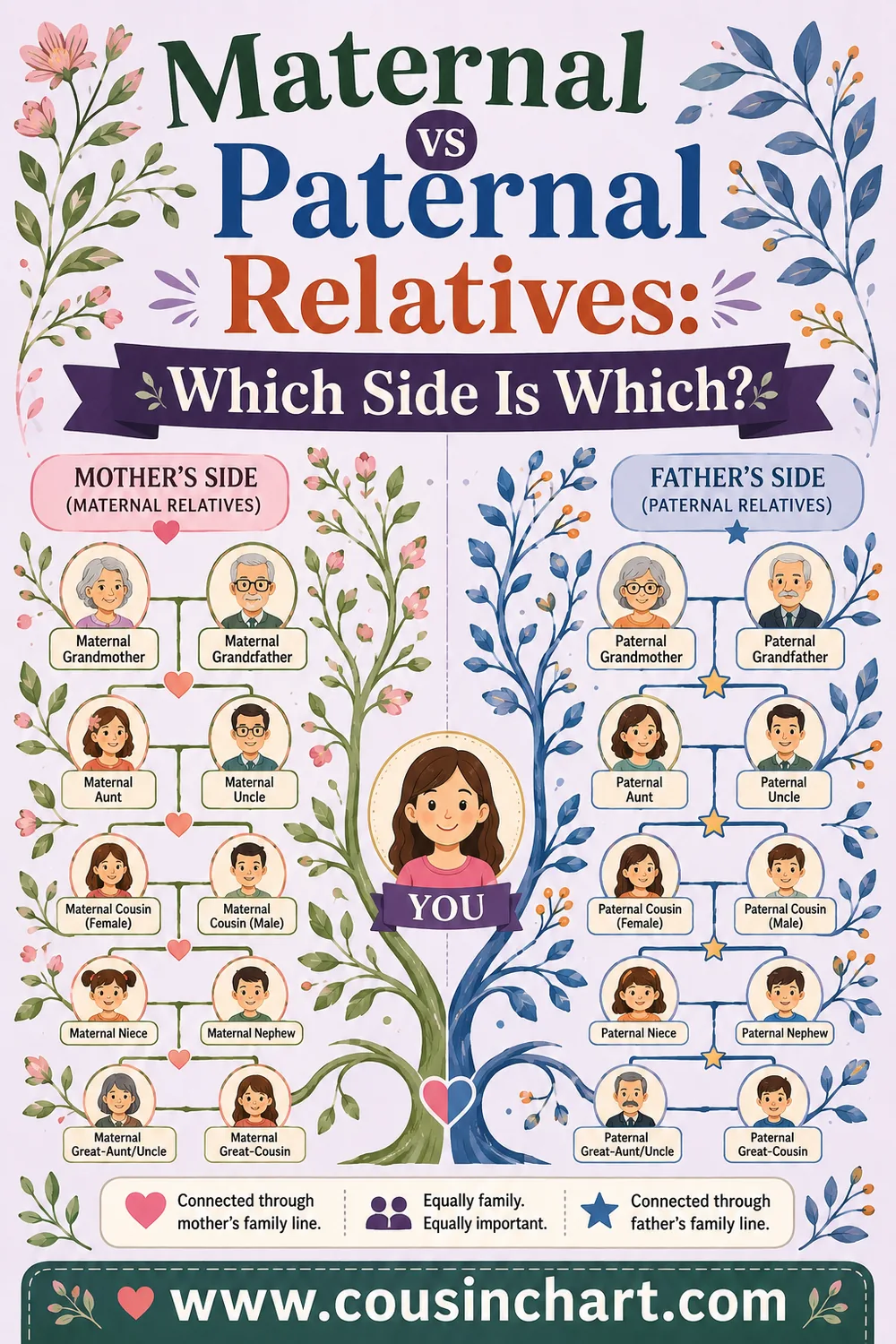
The most common branch split is the simplest: your family divides into two halves at you.
- Maternal branch (mother's side): your mom, her parents, her siblings, and all their descendants.
- Paternal branch (father's side): your dad, his parents, his siblings, and all their descendants.
Everyone in your extended family sits on one side or the other (or occasionally both, in families where lines cross). This is why people say "my cousin on my mom's side" — they're telling you which branch. The distinction matters for everything from which grandparents you're describing to certain DNA tests. We give the two sides their own full comparison in maternal vs paternal relatives.
Direct Line vs. Collateral Branches
Genealogists draw a sharp, useful line between two kinds of relatives:
- Your direct line (or direct ancestors) is your straight chain upward: you → parents → grandparents → great-grandparents, and so on. These are the people you literally descend from — no detours.
- Your collateral branches are the side lines: your siblings, aunts, uncles, cousins, nieces, and nephews. They share ancestors with you but aren't in your direct chain of descent.
| Term | Who it covers | Example |
|---|---|---|
| Direct line (lineal) | Your straight ancestors and descendants | Parents, grandparents, children |
| Collateral branch | Relatives off to the side | Aunts, uncles, cousins, nieces |
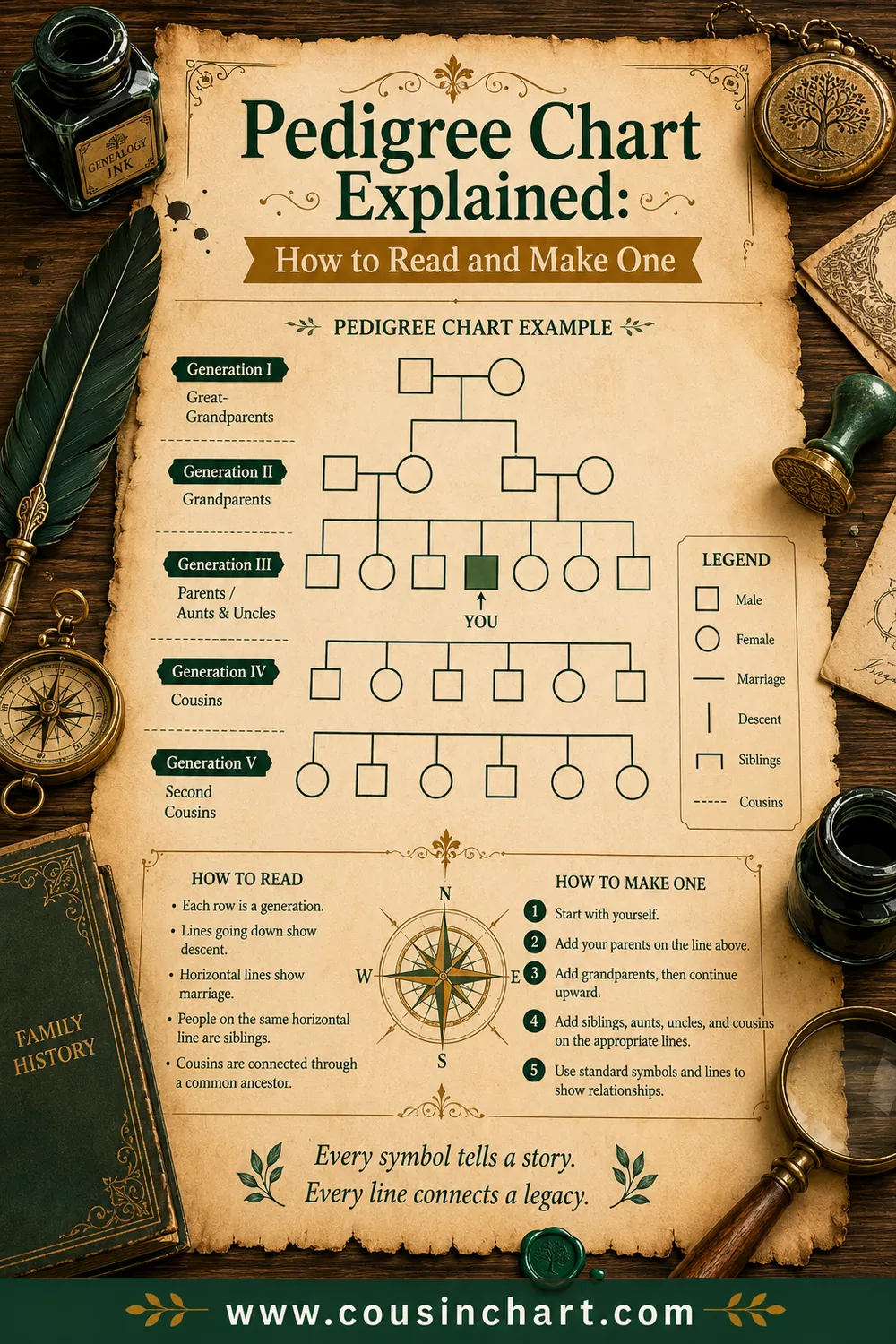
This split is more than jargon — it shapes how you research. Tracing your direct line means climbing straight up, parent by parent. Filling in collateral branches means fanning out sideways to capture cousins and their families. A pedigree chart shows only your direct line; a full family tree adds the collateral branches around it.
The Pure Lines: Matriline and Patriline
Two special branches run in perfectly straight, single-sex chains:
- Your matriline (maternal line) is mother to mother to mother: you, your mother, her mother, her mother, and so on — ignoring everyone who married in. This is the line mitochondrial DNA follows, passed from mothers to all their children.
- Your patriline (paternal line) is father to father to father — often the line a surname and Y-DNA travel down.
These pure lines are narrower than the broad "mom's side / dad's side" branches. Your maternal branch includes your mother's brothers and their kids; your matriline is only the strict mother-to-mother chain. Genealogists and DNA testers care about the pure lines because they carry specific inheritance (mtDNA, Y-DNA, surnames) in a clean, traceable path.
Cadet and Senior Branches: The Historical Terms
In older, especially aristocratic, genealogy you'll meet two more branch words:
- The senior branch is the line descending from the eldest child (historically the eldest son) — the "main" line that traditionally inherited titles and estates.
- A cadet branch is a line descending from a younger child — a "junior" branch. In systems of primogeniture (where the eldest inherited everything), cadet branches were the younger sons' families, who often had to make their own way.
Royal and noble families are full of these terms: a famous dynasty might have a senior branch holding the throne and several cadet branches holding lesser titles or ruling elsewhere. The words survive mainly in historical and royal genealogy today, but they capture something every large family experiences — one line stays "central" while others spin off and grow their own identities.
Why Branch Vocabulary Helps Your Research
Knowing these terms turns a confusing family tree into an organized one. When you can say "I'm strong on my paternal direct line but I've barely touched the maternal collateral branches," you know exactly what's left to research. The vocabulary also clears up conversations: "the senior branch" or "the cadet branch," "the maternal side" or "the matriline" each point to a precise slice of the tree.
Most practically, branches are how you organize a growing family history. Rather than one overwhelming tree, you can build and store it branch by branch — mom's side, dad's side, this cadet line, that collateral cluster of cousins. And when two branches finally connect through a marriage or a shared distant ancestor, working out the resulting relationship is exactly what how are we related and the homepage calculator are for.
A Quick Glossary of Branch and Line Terms
Once you start reading genealogy, the branch-and-line words pile up fast. Here they are in one place, so you can decode any family history document at a glance:
| Term | Plain meaning |
|---|---|
| Lineal / direct line | The straight chain of ancestors and descendants you belong to |
| Collateral line | Side relatives — siblings, cousins, aunts, uncles, nieces, nephews |
| Maternal / paternal branch | Your mother's side / your father's side, broadly |
| Matriline | The strict mother-to-mother chain (follows mtDNA) |
| Patriline | The strict father-to-father chain (often follows the surname and Y-DNA) |
| Senior branch | The line from the eldest child — traditionally the "main" line |
| Cadet branch | The line from a younger child — the "junior" branch |
| Agnatic line | Descent traced only through males |
| Cognatic line | Descent traced through both males and females |
| Distaff side | An older word for the maternal or female line |
Two of those — distaff and agnatic — turn up mostly in old records and legal documents. If you ever hit "the distaff side" in a dusty will, it simply means the mother's/wife's side of the family.
How Branches Show Up in Real Records
Branch vocabulary isn't just tidy theory — it changes how documents read and how you plan a search:
- Wills and estates. Older wills often favor the senior branch or the agnatic (male) line, which is why property and surnames follow certain branches and skip others. Knowing the terms helps you predict who inherited what, and where the paper trail leads next.
- Surnames. The patriline usually carries the surname, so surname-based research naturally climbs one specific branch. The maternal branches, carrying different surnames each generation, are the ones most people neglect — and where the richest surprises often hide.
- DNA tests. A Y-DNA test lights up only the patriline; a mitochondrial test only the matriline. Both are narrow single lines, not your whole maternal or paternal branch, which is a distinction that trips up a lot of first-time testers.
The practical upshot: when a branch feels like a brick wall, it's often because you've been climbing a single line (surname, patriline) and ignoring the wider branch around it. Fanning out sideways into the collateral relatives frequently finds the record that the direct climb couldn't.
FAQ
What does "family branch" mean?
A family branch is one line of descent within a larger family tree — a group of relatives who all trace back to a shared ancestor. It can be large (all descendants of a great-great-grandparent) or small (one aunt and her children). "Mom's side" and "dad's side" are the two most familiar branches.
What's the difference between the maternal and paternal branch?
The maternal branch is your mother's side of the family — her parents, siblings, and their descendants. The paternal branch is your father's side. Your whole extended family sorts onto one side or the other, which is what people mean by a cousin being "on my mom's side."
What is a collateral branch?
A collateral branch is a side line of the family — your siblings, aunts, uncles, cousins, nieces, and nephews. They share ancestors with you but aren't in your direct line of descent. It contrasts with your direct (lineal) line: parents, grandparents, and great-grandparents straight up.
What is a cadet branch?
A cadet branch is a family line descending from a younger child, historically a younger son. In systems where the eldest inherited titles and estates, cadet branches were the "junior" lines. The term is most common in royal and aristocratic genealogy, alongside the "senior branch" of the eldest child.
Is the maternal line the same as the maternal branch?
Not quite. The maternal branch is your whole mother's side, including her siblings and their families. The maternal line (matriline) is the strict mother-to-mother chain only — you, your mother, her mother, and so on. The pure line is narrower and is what mitochondrial DNA follows.
See How the Branches Connect
Family branches are just the tree's way of organizing itself — maternal and paternal, direct and collateral, senior and cadet. Learn the words and a sprawling family history suddenly has a clear structure you can navigate. And when a cousin from one branch marries into another, or a distant line loops back to yours, the free family relationship calculator untangles it, naming exactly how the two branches connect.