1850 Census Records: How to Search Free
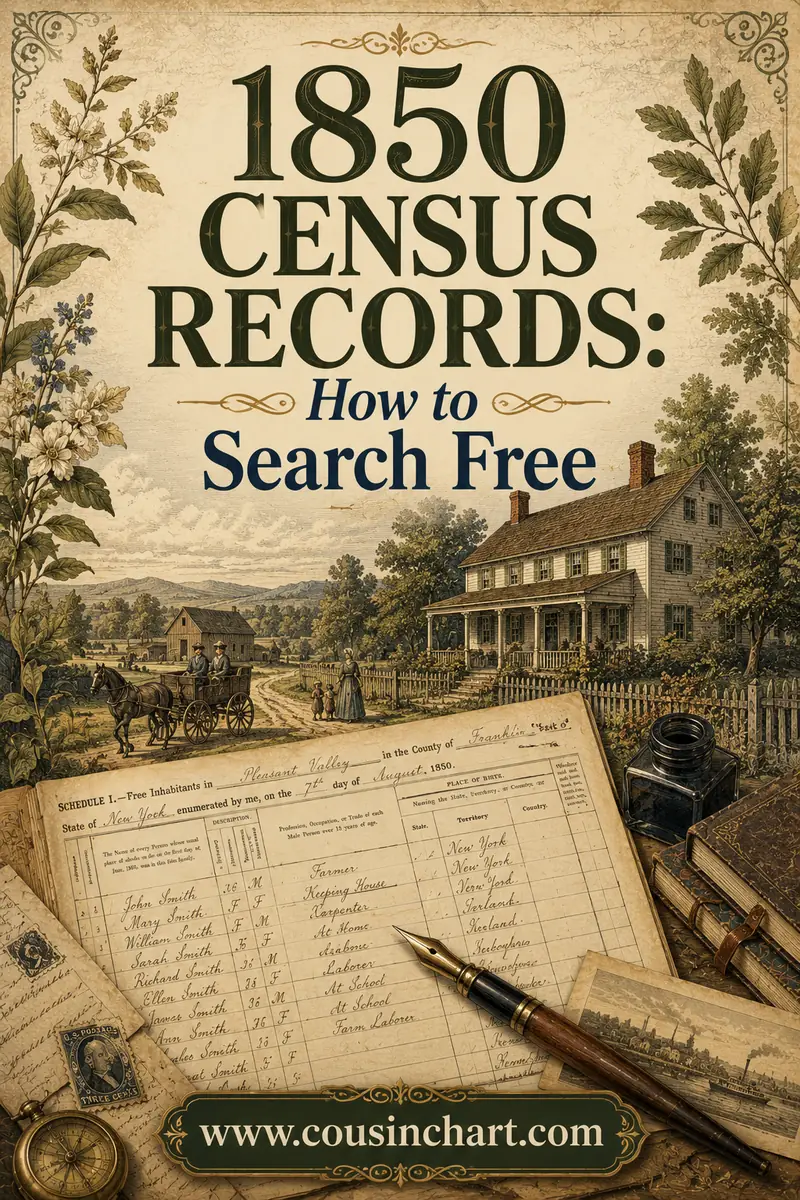
The 1850 census is free to search on FamilySearch.org — free account, full index, original page images. It's a milestone census: taken as of June 1, 1850, it was the first U.S. census to list every free person by name, not just the head of household. For most American family lines, 1850 is where the census stops being tally marks and starts being your actual ancestors, named, aged, and placed.
This guide covers how to search it free, exactly what the 1850 columns record, the census's famous blind spots (no relationships stated, enslaved people unnamed on the main schedule), and how to use the companion slave and mortality schedules. Because 1850 households mix parents, grown children, in-laws, and boarders with no relationship column to sort them, the free family relationship calculator on our homepage earns its keep here — once you've worked out who's who, it names every connection exactly.
Which record should I search? Tap your 1850s research problem for the free starting point.
Tap a situation above to see where to search.
Map how you're related to them →Why 1850 changed everything
From 1790 through 1840, a census entry was one named head of household plus anonymous tick marks: "3 free white males under 5," and so on. Useful, but you're matching silhouettes. The 1850 census — the seventh — abandoned that format and enumerated every free individual by name, a change so useful that genealogists still talk about "getting back to 1850" as the moment a family line comes into focus.
Practical consequences:
- Wives appear by name for the first time (a leading clue for maiden-name research when combined with marriage records).
- Children appear by name and age — a family's full roster, capturing kids who died young and appear in no later record.
- Elderly parents living with grown children become visible, often the only surviving evidence linking two generations born in the 1700s.
How to search the 1850 census free
- Go to FamilySearch.org (free account) and open the 1850 census collection from the records search.
- Enter the name with an age range of ±5 years — 1850 ages are approximations supplied by whoever answered the door.
- Add the state, not the county — county lines moved constantly in that era.
- Open the image for every candidate hit. The typed index gives a name and age; the page gives the whole household plus the neighbors, and in 1850 the neighbors are often kin.
- Record the citation (state, county, district, page, dwelling and family numbers).
FamilySearch's index is complete, but 1850 handwriting and phonetic spelling defeat every index sometimes. Fallbacks: search a child with a distinctive name, drop the surname and search first name + age + birthplace within a county, or find a known neighbor and browse the pages around them. The general playbook is in our census search guide.
What the 1850 census asked, column by column
| Column | What it tells you |
|---|---|
| Name | Every free person, phonetically spelled |
| Age | As of June 1, 1850 — treat as ±3 years |
| Sex, color | The era's categories: white, black, mulatto |
| Occupation | Males over 15 |
| Value of real estate | A quick prosperity gauge; land value implies deeds to find |
| Birthplace | State or country — the migration-mapping column |
| Married within the year | Points to an 1849–50 marriage record |
| Attended school / cannot read or write | Literacy and schooling snapshot |
The birthplace column is the workhorse. Line up the children's birthplaces oldest to youngest and you get the family's route: eldest born Virginia, middle children Kentucky, youngest Missouri — that's the westward trail, decade by decade, telling you which states' records to search next.
What 1850 does NOT tell you
Three limits define 1850 research:
- No relationships are stated. The relationship-to-head column doesn't arrive until 1880. An 1850 household is a list of names under one roof: the 23-year-old "Mary" might be a wife, sister, or hired girl. Never assume — prove with marriage, probate, and church records. Once proven, chain the links and let the free relationship calculator name what each person is to you.
- Enslaved people are not named on the population schedule. The 1850 and 1860 slave schedules list slaveholders by name but the enslaved only by age, sex, and color, with rare exceptions. African American research therefore usually anchors at the 1870 census — the first to name formerly enslaved people — and works backward using the slave schedules, probate records, and Freedmen's Bureau files; our African American genealogy guide covers the method.
- Ages and spellings wobble. Cross-check every fact against 1860, church registers, and gravestones.
The 1850 mortality schedule: the census of the dead
Alongside the population count, enumerators recorded everyone who died in the twelve months before June 1, 1850 — name, age, birthplace, month of death, and cause. In an era decades before most states kept death certificates, the mortality schedule is often the only record of a death, especially a child's. If an ancestor "disappears" right around 1850, check it — free on FamilySearch. (Mortality schedules were repeated for 1860, 1870, and 1880.)
Making 1850 the hinge of your research
Use 1850 as a pivot point in both directions:
- Forward: match the 1850 household against 1860 and 1870. Children marry out under new surnames, the family may move a county west, and a vanished husband usually means probate records exist.
- Backward: take the 1850 head of household and find him as a name-plus-tally-marks entry in 1840 and 1830. The tick-mark age columns should match the family you now know by name — a satisfying check that you've got the right household.
- Sideways: the same-surname households on nearby pages are usually brothers, cousins, and married sisters. Sorting out whether the John Smith two farms over is a brother or a first cousin changes what his descendants are to you — second cousins versus more distant — and the calculator shows each scenario instantly.
Worked example: matching 1850 names to 1840 tally marks
Here's the backward step in practice. Suppose 1850 shows the household of Elijah Carter, 52, farmer, born Virginia, with wife Nancy, 47, and children aged 24 down to 6, all born Tennessee except the youngest two, born Missouri.
- Predict the 1840 household. Remove anyone born after 1840, subtract ten years from every age, and you get the expected 1840 shape: one male 40–49 (Elijah), one female 30–39 (Nancy), and children distributed across the under-15 age brackets.
- Search 1840 for "Elijah Carter" in Tennessee (the children's birthplaces say the family hadn't reached Missouri yet). Free on FamilySearch — 1840 is indexed by head of household.
- Compare the tally columns. The right entry should show tick marks matching your predicted ages, give or take the usual slop. Two Elijah Carters? The one whose tally pattern fits your family's ages is almost certainly yours.
- Repeat for 1830. Each verified step back adds confidence — and the older tick marks in those households (a woman 70–79, say) hint at a grandparent living with the family, a generation you can then chase through probate records.
This age-pattern matching is the standard technique for the pre-1850 "silhouette" censuses, and it only works if you've first squeezed 1850 for every name, age, and birthplace — which is exactly why 1850 is the hinge.
FAQ
Where can I search the 1850 census for free?
FamilySearch.org has the complete 1850 census indexed with original images, free with a free account. Commercial sites hold the same images with independent indexes, often accessible free through public libraries.
Why is the 1850 census so important?
It was the first U.S. census to name every free person, not just heads of household. It's the earliest census where you can see whole families — wives and children included — by name.
Does the 1850 census show how people were related?
No. Relationships to the head of household weren't recorded until 1880. Household order suggests structure (head, then wife, then children by age), but every relationship should be proven with marriage, probate, or church records.
Were enslaved people listed in the 1850 census?
Not by name on the population schedule. Separate 1850 slave schedules list slaveholders by name and enslaved people only by age, sex, and color. The 1870 census is the first to name formerly enslaved Americans.
What was the 1850 mortality schedule?
A companion schedule listing everyone who died in the year before June 1, 1850, with age, birthplace, and cause of death — frequently the only death record from that era. It's free on FamilySearch.
What if I can't find my family in the 1850 index?
Search a child with an unusual first name, try phonetic spellings, drop the surname and search age plus birthplace within a county, or locate a known neighbor and browse the surrounding pages manually.
Meet the whole family, by name, in 1850
If your American lines reach the mid-1800s, the 1850 census is where the silhouettes become people — free on FamilySearch tonight. Anchor the household, map the birthplace trail, check the mortality schedule, then step forward to 1870 and 1880. And as the same-surname neighbors resolve into brothers, aunts, and cousins, the free CousinChart relationship calculator will tell you exactly what each one — and their descendants — is to you.