Maiden Names on a Family Tree: How to Write Women's Names (and Dates)
The standard rule for a maiden name on family tree charts is simple: record every woman under the surname she was born with, and list any married surnames as extra names, not as her main one. So your grandmother goes on the chart as Mary Jones, not Mary Smith, even if everyone knew her as Mrs. Smith for sixty years. When you write about her in a narrative, genealogists use a handy format that shows both: Mary (Jones) Smith, with the birth surname in parentheses and the married surname after it.
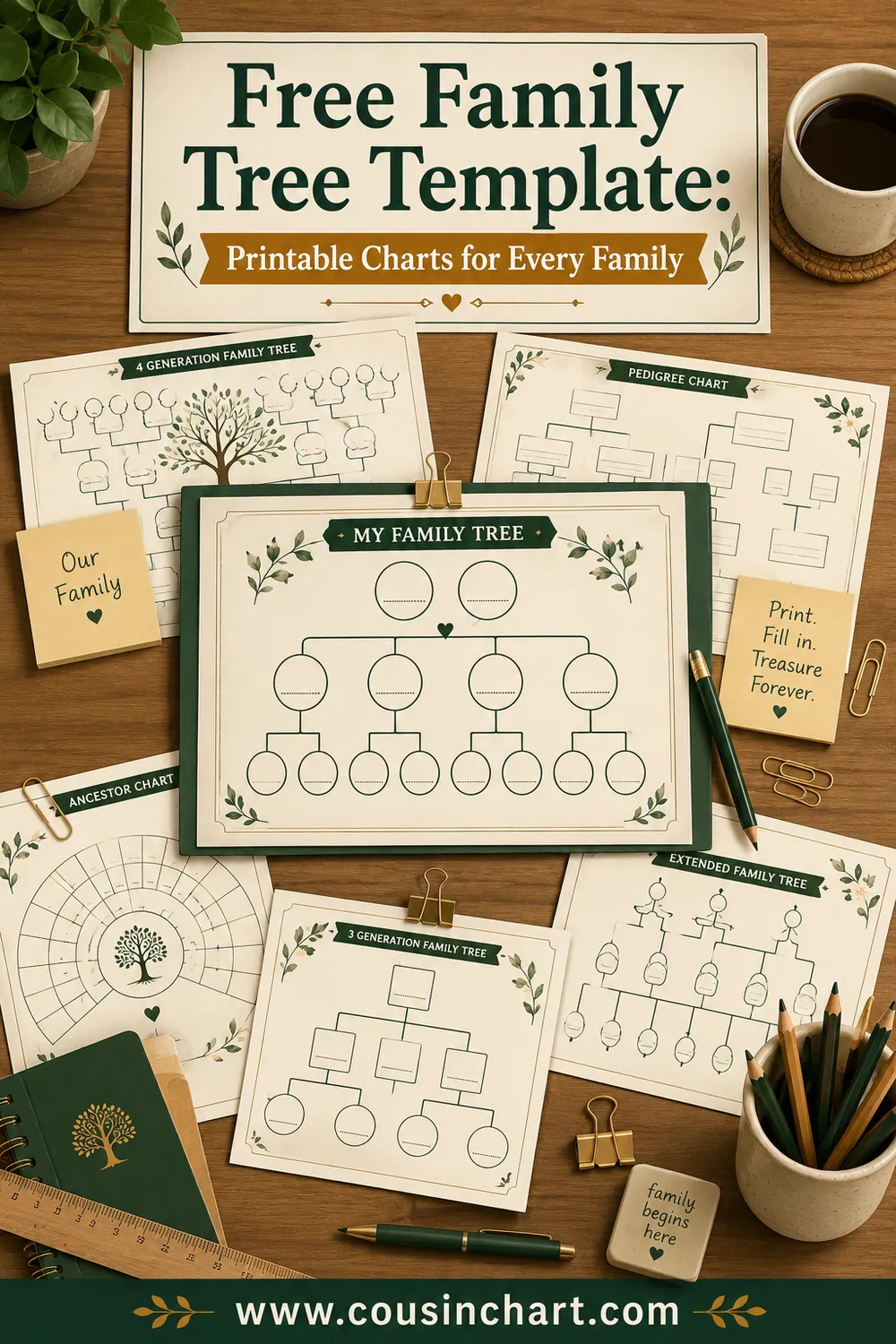
That's the short answer. The rest of this guide explains why genealogists do it this way, how to show both names on charts, group sheets and software, what to do when you don't know her birth surname, and how to handle nicknames, spelling variants, multiple marriages and dates. We'll lean on the published practice of the Board for Certification of Genealogists (BCG) and the guidelines of the National Genealogical Society (NGS), the two U.S. organizations most associated with genealogy standards. If you haven't picked a chart yet, start with our pillar page of free family tree templates and come back here to fill in the names.
Quick check. Tap a question for the short answer:
Maiden Name on Family Tree Charts: The Standard Rule
On a family tree, a woman's main entry uses her birth surname. That's sometimes called her maiden name, from the old word for an unmarried woman. Married names still matter, and you should record them, but they go in a secondary spot: an "also known as" line, a notes field, or the alternate-name field in your software.
Here's how that looks in practice for a woman born Mary Jones who married Isaac Hobbs and, later, Baptist Clark.
- On a pedigree chart or tree box: Mary Jones
- In a narrative, report or article: Mary (Jones) Hobbs Clark
- In genealogy software: primary name Mary Jones; alternate names Mary Hobbs and Mary Clark, each tied to its marriage
That narrative example isn't made up. It's the title of a real case study, "A Family for Mary (Jones) Hobbs Clark of Carroll County, Arkansas," by Melinda Daffin Henningfield, CG, published in the National Genealogical Society Quarterly in March 2019. The BCG shares it on its website as an example of certified-level work. The title follows the classic pattern: given name, birth surname in parentheses, then married surnames in the order the marriages happened.
Why this is the convention
Recording women by birth surname isn't about ignoring marriage. It's about making the tree work. Here's why it's the norm:
- It points to her parents. The birth surname is usually her father's surname, or her family's surname, so it's the thread that leads you back a generation. A married name only tells you who her husband was, and he's already on the chart.
- It doesn't change. A woman might have one birth surname and several married ones over her lifetime. Picking the one that never changes keeps her entry stable.
- It prevents duplicates. If you entered her as Mary Hobbs in one place and Mary Clark in another, you could easily end up with two people where there was only one.
- It keeps the chart consistent. If every man is listed by his birth surname, listing every woman the same way means the whole chart follows one rule.
The same logic shows up in the BCG's material on numbering a genealogy. In "Numbering a Genealogy 1: Immigration," Judy Kellar Fox, CG, shows a woman's entry written with her birth name first and her married surname after it, Margaret Maitland Walker, and explains that spouses don't get their own number because they belong to the genealogy of another surname. In other words, the birth surname is what places her in her own family.
How to Write a Woman's Name in Each Format
Different kinds of records have different amounts of space and different jobs. Here's how to handle a woman's names in each one. The example woman is illustrative: Clara Ann Novak, called "Annie," who married first Peter Lund and later George Reyes.
| Where you're writing | How to write it | Example |
|---|---|---|
| Pedigree chart or fan chart box | Birth name only; married names if space allows, smaller | Clara Ann Novak |
| Family group sheet, wife's line | Birth name in the name field; married surnames in notes or "other marriages" | Clara Ann Novak (other marriage: George Reyes) |
| Narrative, biography or report | Given names, birth surname in parentheses, married surnames in order | Clara Ann (Novak) Lund Reyes |
| Genealogy software | Birth name as primary; each married name as an alternate name | Primary: Clara Ann Novak. Also known as: Clara Lund; Clara Reyes |
| Index or name list | Index under birth surname, with cross-references from married surnames | Novak, Clara Ann. See also Lund; Reyes |
| Casual family tree for kids or a gift | Whatever your family knows her by, as long as you're consistent | Grandma Annie (Novak) Reyes |
A few small conventions make these entries clearer:
- Nicknames go in quotation marks after the given names: Clara Ann "Annie" Novak. Don't replace the real name with the nickname.
- Some genealogists write surnames in capital letters on charts and in notes, such as Clara Ann NOVAK, so the surname can't be confused with a given name. It's optional. Just pick one style and stick to it.
- "Née" means "born" and is sometimes used in place of parentheses: Clara Reyes, née Novak. It's common in obituaries and newspapers. Genealogists usually prefer the parenthetical form because it fits more neatly on charts.
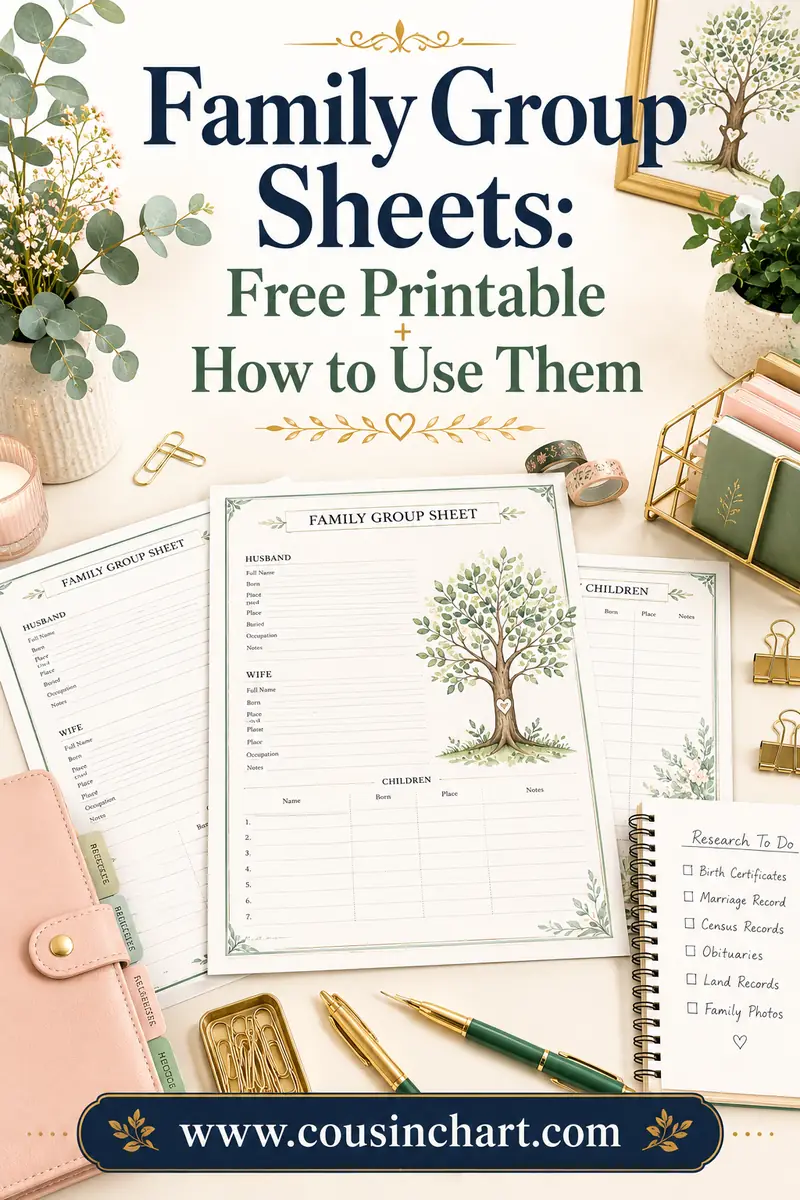
If you're filling in a family group sheet, the wife's line is where this matters most. The sheet is built around one couple, so the woman's birth name links the sheet to her parents' sheet, while her husband's surname is already right there above her.
Showing Both Names: Married Names and Multiple Marriages
Married names are evidence. They're how a woman appears in censuses, deeds, church registers and gravestones for most of her adult life, so you need to record them. The trick is to record them in a way that's clearly linked to each marriage.
One marriage
For a woman who married once, list her birth surname as her main name and her married surname as an alternate. In a narrative, write it as Given (Birth) Married, for example Helen (Park) Morales.
Two or more marriages
List married surnames in the order the marriages happened, after the birth surname in parentheses: Mary (Jones) Hobbs Clark. Each marriage gets its own family group, with its own children. That order helps a reader see at a glance which husband came first, and which children belong to which marriage.
When a woman's name changes for other reasons
Women's names also change after divorce, after a partner's death, through a remarriage that reused an earlier name, or because she simply chose to. Treat each of these the same way: record the name as she used it, note the record you saw it in, and keep her birth name as the primary entry.
A BCG sample work shows why this matters. In a kinship study titled "Following the Umbilical Line From Rachael Vowles to Her Granddaughter," Faye Jenkins Stallings, CG, documents a woman who had a long relationship with a man named Stanley Young and appears as Young in some records, including her tombstone. But in legal documents she signed after his death, she used her birth surname, Vowles. The study standardizes her name as Rachael Vowles, noting that this is how she signed it. If you'd entered her only as "Rachael Young," you'd have missed the records she created under her own name.
When You Don't Know Her Maiden Name
This is one of the most common gaps in any family tree. The FamilySearch Research Wiki's article on maiden names in the United States calls finding them an especially difficult challenge, particularly in records from around 1850 or earlier. Even professionals treat it as a problem to be solved, not a detail to fill in. In a BCG article on pedigree evaluation, Karen Stanbary, CG, and the BCG DNA Committee list an "unknown maiden name of a mother" among the gaps a careful genealogist should identify and work to resolve.
Here's how to handle it on the tree in the meantime.
Leave the surname blank or clearly marked as unknown
If you don't know her birth surname, don't fill the space with her married surname. Mary Smith, wife of John Smith, should go on the chart as just "Mary," or "Mary [surname unknown]," until you find evidence. Software will usually let you leave the surname field empty. On paper, a short, consistent marker works, as long as it can't be mistaken for a real surname.
Why does this matter so much? Because "Mary Smith" looks like a fact. A cousin who copies your tree will assume Smith was her birth name, and soon several trees online will have her born a Smith, with the wrong parents attached.
Don't guess, and label any hypothesis
Sometimes you'll have a strong hunch, such as a neighbor family with the same unusual given names. The NGS Guidelines for Sound Genealogical Research address exactly this. They say genealogists state something as a fact only when it's supported by convincing evidence, and limit any conclusion not based on convincing evidence with words such as "probably" or "possibly," explaining their reasoning. On a tree, that means writing a hypothesis in the notes ("possibly a daughter of Thomas Ward; see notes") rather than putting "Ward" in the surname field.
Where to look for a maiden name
FamilySearch's help article on finding a woman's maiden name suggests two starting points: her marriage record, and the death record of her spouse or one of her children, which may name her as the mother. Beyond those, these record types often reveal a birth surname:
- Her children's birth, baptism and marriage records
- Obituaries for her, her husband, her siblings or her children
- Wills and probate records of her father, which may name a married daughter
- Land records, where a married daughter and her husband sell her share of a parent's land
- Church records such as marriage banns
- Gravestones, which sometimes give a birth surname
- Children's middle names, which sometimes preserve the mother's surname (a clue, never proof on its own)
The Mary (Jones) Hobbs Clark case is a reminder of how hard this can get. As the article explains, a courthouse fire destroyed county records that might have shed light on her family, and the author used DNA evidence alongside two documents that recorded her maiden name as Jones. Our guide to the Genealogical Proof Standard explains how genealogists build a conclusion like that from many pieces of evidence.
Nicknames, Middle Names and Spelling Variants
Women's names are often harder to pin down than men's for reasons beyond marriage. Family nicknames, middle names used as first names, and shifting spellings all show up in the records.
Nicknames
Record the full given name from the best record you have, and put the nickname in quotation marks: Martha Ellen "Nellie" Brooks. If the family only ever knew her as "Nellie," note that in her entry, because it may be how she appears in letters, newspapers and some censuses.
Middle names used as first names
A woman named Clara Ann who went by Ann all her life might appear as Clara, Ann, Annie or C. A. in different records. Keep her full name in the main entry, and add the forms you've seen as alternates. That way a search for any of them will find her.
Spelling variants
Spelling was flexible for most of history, especially for people who couldn't write their own names. In the Rachael Vowles study, the author notes that her surname also appears as Vowels and Vowells and her first name as Rachel. In the Mary (Jones) Hobbs Clark article, a daughter's name Mahaley is also spelled Mahaly and Mahola. In both cases, the professional approach is the same: choose one standard spelling for the main entry, explain the choice, and list the variants.
Choosing the standard form
Which spelling should be the main one? Good options, in rough order of preference:
- The way she signed her own name, if you have a signature. That's the reason the Vowles study gives.
- The spelling used in the most reliable record, such as a birth or baptism record made at the time.
- The spelling used most often across records.
Whatever you choose, write a note saying why. That small habit saves future relatives a lot of confusion.
Writing Dates on a Family Tree
Names and dates go together on every chart, and dates have their own conventions. The main one is to write dates as day, month (spelled out or abbreviated), and full four-digit year. You can see this style throughout BCG-published work. The Rachael Vowles study, for example, says she was born on 28 August 1814 and died on 23 July 1896.
Why not 8/28/1814? Because numeric dates are ambiguous. Americans read 03/04/1890 as March 4, but much of the world reads it as April 3. Spelling out the month removes all doubt. A four-digit year matters too, since a family tree can span several centuries.
| Situation | How to write it | Example |
|---|---|---|
| Exact date known | Day, month, four-digit year | 28 August 1814 |
| Only month and year | Month and year | August 1814 |
| Approximate, from a census age or similar | "about" or "abt" | about 1845 |
| Before or after a known event | "before"/"bef" or "after"/"aft" | before 10 February 1868 |
| Between two dates | "between ... and ..." | between 1844 and 1846 |
| Calculated from another fact | "calculated" or "cal," with the source in a note | calculated 1814, from age at death |
Approximate dates are perfectly respectable. The Mary (Jones) Hobbs Clark article says her oldest child was born about 1845 or 1846. That's honest, and it's far better than inventing a precise date.
Marriage dates and women's names
A marriage date tells you when a woman's name changed. If you know she married on a particular date, any record before it should show her birth surname, and any record after it may show her married surname. That's a powerful way to sort records, and it's another reason to record each marriage carefully with its date and place.
Cite Every Name: The Sources Behind the Tree
A name on a chart is a claim. Professional standards ask you to show where it came from. The BCG's page on ethics and standards summarizes its documentation standards as asking genealogists to cite sources for every fact that isn't common knowledge. The NGS guidelines say much the same thing: genealogists record the source for each item of information they collect.
For women's names, citations matter even more than usual, because a woman's names change across records. A good habit is to attach each version of her name to the record where you found it, as in this illustrative set of entries:
- "Mary Jones," from her marriage record
- "Mary Hobbs," from the 1850 census
- "Mary Clark," from a later census, after her second marriage
Laid out that way, the names stop looking like contradictions and start telling her story. If you use genealogy software, most programs let you attach a source to each name. When you share your tree as a GEDCOM file, those alternate names and their sources can travel with it. Our guide to GEDCOM files explains how that works.
Worked Example: One Woman, Three Names, One Entry
Let's put everything together. This person and her records are illustrative, not a real case.
Your great-grandmother was known to the family as "Nana Rose Fischer." From records you've gathered, you know:
- Her baptism record names her Rosalie Marie Brandt, born 3 March 1902.
- A 1920 census lists her as Rose Brandt, age 17, in her parents' household.
- Her first marriage record shows Rosalie Brandt married Otto Keller on 14 June 1923.
- A 1930 census lists her as Rose Keller.
- Her second marriage record shows Rose Keller, widow, married Henry Fischer on 2 May 1936.
- Her obituary calls her Rose M. Fischer.
Here's how to record her:
- Tree box: Rosalie Marie "Rose" Brandt, b. 3 Mar 1902
- Narrative: Rosalie Marie "Rose" (Brandt) Keller Fischer was born on 3 March 1902...
- Software: primary name Rosalie Marie Brandt; nickname Rose; alternate names Rose Keller (from 14 June 1923) and Rose M. Fischer (from 2 May 1936), each with its source attached
- Family groups: two separate groups, one with Otto Keller and one with Henry Fischer, each listing that couple's children
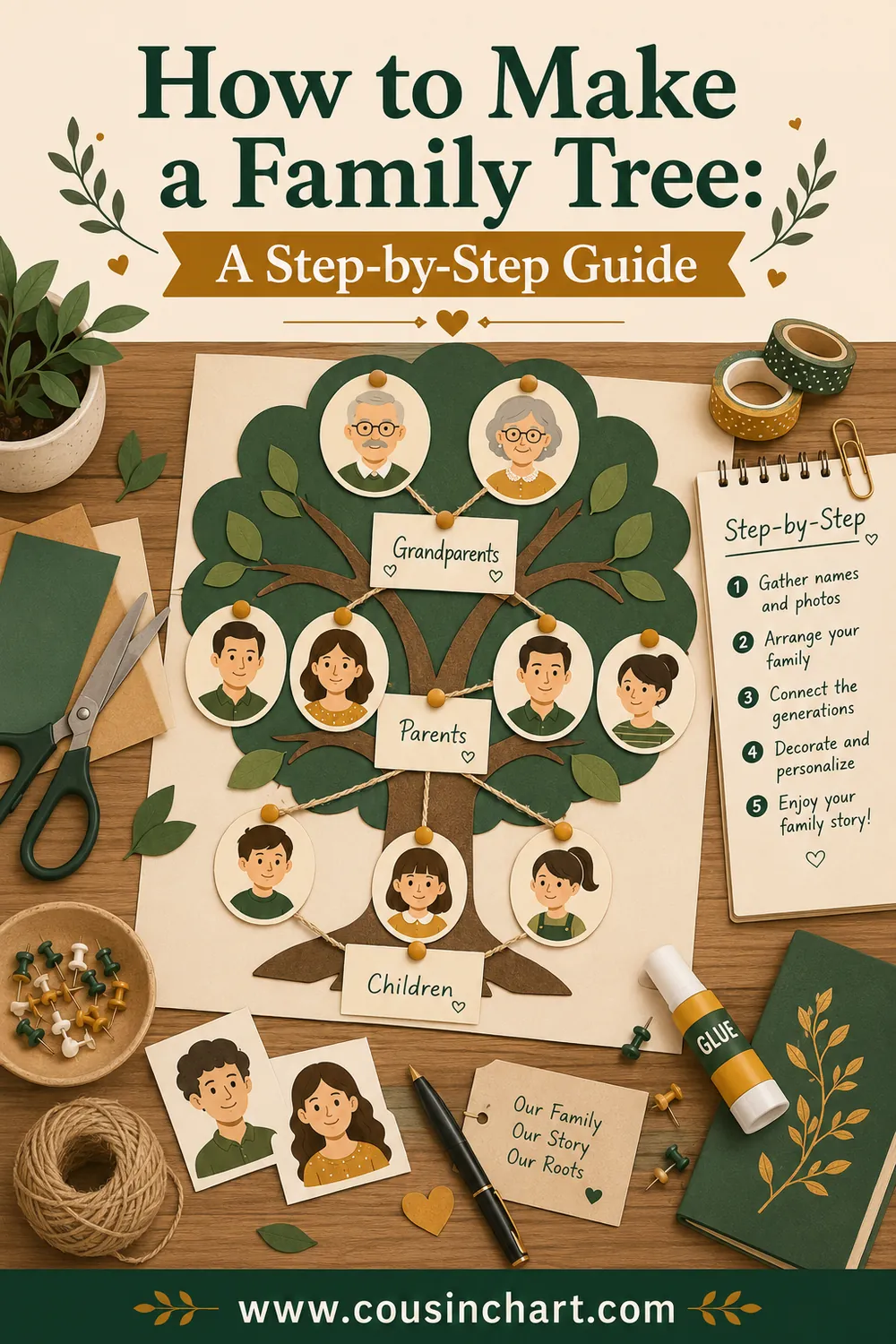
Notice what this does. Anyone reading your tree can see her parents' surname, both husbands, when her name changed, and where each version of her name came from. If you're laying this out on a chart for the first time, our step-by-step guide on how to make a family tree shows where each piece goes.
What Your Grandmother's Maiden Name Tells You About Your Bloodline
A lot of people come to this topic with a question like this: "My grandmother's maiden name was Cochrane. What part of my bloodline am I?" It's a great question, and it shows exactly why the maiden name matters on a tree.
Your grandmother's maiden name is, in most Western naming traditions, her father's surname. That makes it the surname of her paternal line: her father, his father, and so on back. So if your grandmother was born a Cochrane, you descend from the Cochrane family through her. You're a Cochrane descendant, even though you don't carry the name.
Here's how that sits on your tree, using an illustrative family:
- You
- Your mother (born a Bell, say, if your grandmother married a Mr. Bell)
- Your grandmother, born a Cochrane
- Her father, a Cochrane, your great-grandfather
- His father, a Cochrane, your great-great-grandfather
Each of your grandparents brings a surname line into your tree. You have four grandparents, so you have four birth surnames at that level, and eight at the great-grandparent level. Two of the four grandparent surnames come from women, and the only way to know them is to record the maiden names. Leave them out and half of your family lines simply disappear from the chart.
That's also why an unknown maiden name is such a frustrating gap. It doesn't just hide one woman's parents. It hides an entire surname line above her, with all of its ancestors. Fill in that one name, and a whole new branch opens up. If you'd like to see how those branches fit together, a pedigree chart template gives every one of those surname lines its own box.
Maiden Names on Different Kinds of Family Tree Charts
Each type of chart handles names a little differently, but the birth-surname rule holds across all of them.
Pedigree charts
A pedigree chart shows your direct ancestors only, with fathers on top and mothers below in each pair. Every woman on a pedigree chart is someone's mother, and her box is the start of her own family line. Use her birth surname here without exception. Married surnames aren't needed, because her husband sits right beside her.
Descendant charts
A descendant chart starts with one ancestor and branches down through the generations. Daughters born into the family appear under their birth surname, which is the family's surname. Their husbands are added as spouses. When daughters' children appear, they'll carry their fathers' surnames, so the chart quietly shows how surnames shift through the female lines.
Fan charts and large wall charts
Space is tight in the outer rings of a fan chart. Use the birth name, and abbreviate given names if you must. Save married names, nicknames and notes for your research file.
Family group sheets
The wife's line on a group sheet gets her birth name, plus her own parents' names. Her other marriages go in a separate field. Children's spouses are also listed by birth names, which helps you link each child's own family later.
Gift and display trees
For a framed tree or a children's project, you have more freedom. Many families like to show both names, such as "Rose (Brandt) Fischer," so younger relatives recognize the name they knew. That's fine, as long as your research copy keeps the birth name as primary.
A Quick Checklist Before You Share Your Tree
Before you print a chart, upload a tree or send a file to a cousin, run through this list for every woman on it:
- Is her primary name her birth name, not a married name?
- If her birth surname is unknown, is the field blank or clearly marked, rather than filled with her husband's surname?
- Are her married names recorded as alternates, in the order of her marriages?
- Does each marriage have its own family group with the right children?
- Is her nickname in quotation marks, not replacing her real name?
- Are spelling variants listed, with a note explaining which form you chose?
- Are dates written as day, month and four-digit year, with "about," "before" or "after" where they're uncertain?
- Does every version of her name have a source attached?
- Have you labeled any guesses as "possibly" or "probably," with your reasoning in the notes?
It takes a few minutes, and it's the difference between a tree that helps your relatives and one that spreads mistakes.
Common Mistakes With Women's Names
Filling the surname with her husband's name
This is the big one. It creates a false birth surname that can mislead everyone who copies your work. Leave it blank, or clearly mark it as unknown, until you have evidence.
Creating two people out of one woman
It's easy to end up with a "Mary Hobbs" and a "Mary Clark" in your database who are really the same person. Before adding a new woman, search for her under every surname she might have used.
Assuming a widow's maiden name from her last husband's family
When a woman married more than once, her last married name is the furthest from her birth name. Don't assume the surname on her gravestone tells you anything about her parents.
Dropping the married names entirely
The opposite mistake also causes trouble. If you record only her birth name, you'll miss the many records that list her under married names. Keep them all, just in the right fields.
Treating "née" or parentheses as part of the surname
In software, the parentheses format belongs in narrative writing, not in the surname field. Typing "(Jones) Smith" as a surname will scramble searches and exports. Use the program's separate fields for birth name and alternate names.
Inventing exact dates
If a census only tells you her age, write "about" with the year. A tidy but invented date looks authoritative and can send relatives down the wrong path.
Special Situations
Women who never changed their surname
Many women kept their birth surnames after marriage, by custom, by choice, or because they never formally married. Families from many cultures and naming traditions follow customs where a woman's surname doesn't change at marriage at all. In every case, the birth-surname rule still works perfectly: you record her birth surname as her main name and note any other names she used.
Hyphenated and combined surnames
If a woman combined her birth and married surnames, such as Lee-Martin, record her birth surname (Lee) as her primary name and the combined form as an alternate. That keeps her linked to her parents while preserving the name she used.
Adoption and name changes in childhood
If a girl was adopted or her surname changed in childhood, you may have two "birth" surnames to consider. Most genealogists record the name at birth as primary when it's known, with the adoptive or later name as an alternate, and explain the change in a note. The exact approach depends on what the family wants the tree to show and on what's known.
Same-sex couples and husbands who took a wife's name
The rule isn't really about women. It's about recording everyone by their birth name and treating later names as alternates. That works just as well for a man who took his wife's surname, or for spouses of any gender who changed or combined names.
Try It Yourself
Write each of these illustrative women's names in narrative form, then check below.
- Born Ellen Grace O'Brien, married Daniel Walsh.
- Born Sofia Lindqvist, married first Erik Berg, then Nils Holm.
- First name Hannah, birth surname unknown, married Joseph Carter.
- Born Margaret Rose Hale, known to everyone as "Peggy," married William Ford.
Answers: (1) Ellen Grace (O'Brien) Walsh. (2) Sofia (Lindqvist) Berg Holm, with the married surnames in the order of the marriages. (3) Hannah (surname unknown) Carter in narrative, and just "Hannah" with a blank surname field on the chart. Don't record her as Hannah Carter in the name field. (4) Margaret Rose "Peggy" (Hale) Ford.
Wrapping Up: The Maiden Name Rule in One Sentence
Record every woman under the surname she was born with, list her married names as alternates in the order she used them, write "Given (Birth) Married" when you describe her in words, and cite where each version of her name came from. If you don't know her birth surname, leave it blank rather than borrowing her husband's. Those few habits, which match the practice you see in BCG-published work and the NGS research guidelines, make your tree clearer for everyone who uses it after you. Ready to start filling in names? Pick a layout from our free family tree templates.
And when you're working out how the people on your tree connect to each other, our free family relationship calculator can help. You pick how two people connect, and it names the relationship, such as "first cousin once removed."
Frequently Asked Questions
Do you put the maiden name on a family tree?
Yes. The standard genealogy convention is to record every woman under the surname she was born with, often called her maiden name. Her married surnames still go on the tree, but as alternate names or notes rather than her main name. The birth surname links her to her parents and never changes, while married names can change several times. It also keeps your tree consistent, since men are recorded by their birth surnames too. On a narrative or report, you can show both by writing her name as Given (Birth surname) Married surname.
How do you write a maiden name and married name together?
In narrative writing, put the birth surname in parentheses between the given names and the married surname, like Mary (Jones) Smith. If she married more than once, list the married surnames in order after the parentheses, like Mary (Jones) Hobbs Clark. This format appears in professional genealogy journals and in sample work shared by the Board for Certification of Genealogists. On charts with limited space, use just the birth name, and in software, enter the birth name as primary and each married name as an alternate.
What does née mean on a family tree?
Née is a French word meaning born, and it introduces a woman's birth surname, as in Clara Reyes, née Novak. You'll see it often in obituaries, wedding announcements and older newspapers. It means the same thing as the parentheses format genealogists usually prefer, Clara (Novak) Reyes. Either is fine in narrative writing. In genealogy software, don't type née into the surname field. Use the separate fields for her birth name and her alternate married names so searches and exports work properly.
What do I do if I don't know my ancestor's maiden name?
Leave her surname blank, or mark it clearly as unknown, and never fill it with her husband's surname. Recording her as Mary Smith because she married John Smith creates a false birth surname that others may copy. Then start searching. FamilySearch suggests checking her marriage record and the death records of her spouse or children, which may name her as the mother. Children's birth and marriage records, obituaries, her father's will and land records are other good places to look. Record any hunch as a hypothesis in your notes.
Should a widow who remarried be listed under her first or second husband's name?
Neither, as her main name. List her under her birth surname, then record both married surnames as alternate names in the order of her marriages. In narrative writing that looks like Mary (Jones) Hobbs Clark, where Hobbs was the first husband and Clark the second. Give each marriage its own family group, with the children of that marriage. This shows clearly which husband came first and which children belong to which marriage, and it keeps her linked to her own parents.
How do you show a nickname on a family tree?
Write the full given name from the best record you have, and put the nickname in quotation marks after it, such as Martha Ellen "Nellie" Brooks. Don't replace the real name with the nickname, because official records will usually use the full name. If the family knew her only by the nickname, add a short note saying so, since letters, newspapers and some censuses may use it. Many genealogy programs also have a dedicated nickname field that keeps it searchable.
How should dates be written on a family tree?
Genealogists usually write dates as day, month and four-digit year, such as 28 August 1814. Spelling out or abbreviating the month avoids confusion, since a numeric date like 03/04/1890 means March 4 in the United States but April 3 in much of the world. For uncertain dates, use qualifiers such as about, before, after or between, and note what the estimate is based on. An honest approximate date is always better than an exact one you've guessed.
What if a woman kept her own surname after marriage?
Then her entry is simple: her birth surname is her main name, just as for any other woman, and you don't need a married-name alternate unless she used one somewhere. Many women kept their birth surnames, by choice, by custom in their family's naming tradition, or because they never formally married. A Board for Certification of Genealogists sample study describes a woman who used her birth surname on legal documents even though another surname appeared on her tombstone, which is a good reason to record every name she used.
Is it wrong to list my grandmother under her married name?
It isn't wrong for a casual family tree, a gift or a children's project, as long as you're consistent. For a research tree that others might copy, though, the birth surname is the expected convention, and using only a married name can cause confusion about her parents and create duplicate entries. A good compromise for display charts is to show both, such as Grandma Annie (Novak) Reyes, while keeping her birth name as the primary entry in your software or research notes.
Sources
We checked every source below while writing this guide. Last reviewed October 30, 2026, by Joan Ramos.
- A Family for Mary (Jones) Hobbs Clark of Carroll County, Arkansas (National Genealogical Society Quarterly 107, March 2019), by Melinda Daffin Henningfield, CG (Board for Certification of Genealogists (sample work))
- Following the Umbilical Line From Rachael Vowles to Her Granddaughter, by Faye Jenkins Stallings, CG (Board for Certification of Genealogists (sample work))
- Numbering a Genealogy 1: Immigration, by Judy Kellar Fox, CG (Board for Certification of Genealogists)
- Skillbuilding: The Truth About Pedigree Evaluation, by Karen Stanbary, CG, and the BCG DNA Committee (Board for Certification of Genealogists)
- Ethics and Standards (Board for Certification of Genealogists)
- Guidelines for Sound Genealogical Research (National Genealogical Society (copy hosted by FamilySearch))
- Find a woman's maiden name in historical records (FamilySearch Help Center)
- Maiden Names in the United States (FamilySearch Research Wiki)