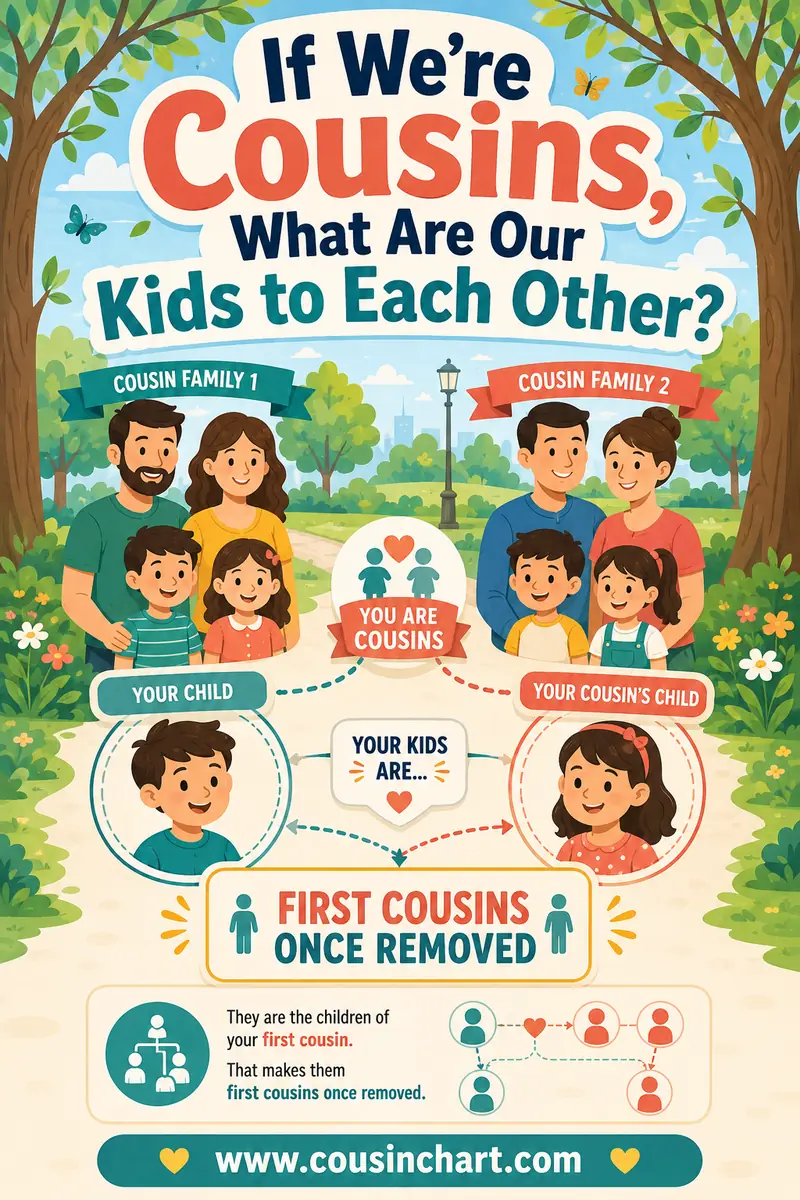
If We're Cousins, What Are Our Kids to Each Other?
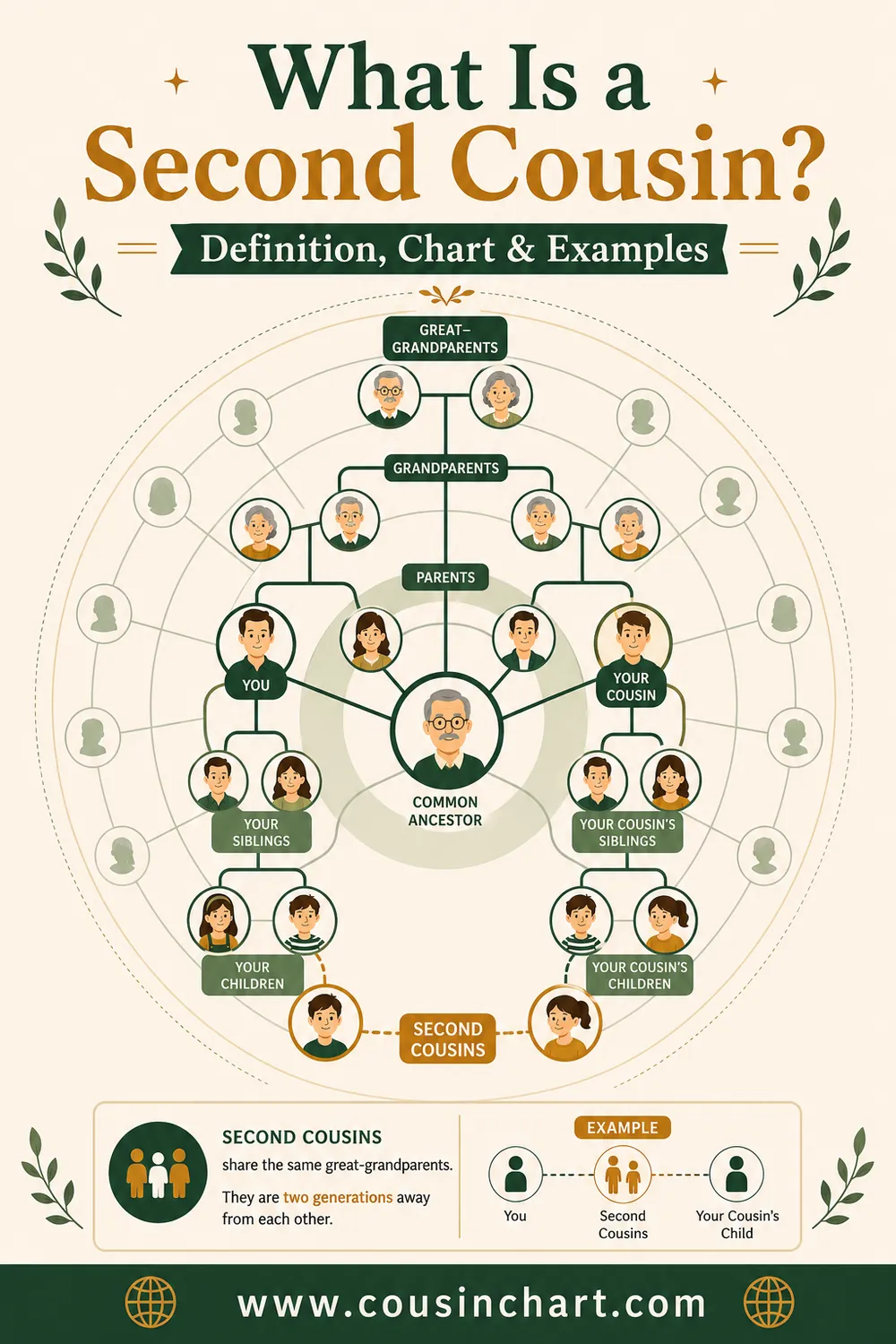
If you and someone are first cousins, your children are second cousins to each other. The pattern is beautifully simple: each new generation of kids bumps the cousin number up by one, so your grandchildren will be third cousins, your great-grandchildren fourth cousins, and so on down the line.
This guide walks through why that works, what your cousin's kids are to you (different question, different answer), and how the pattern changes for second cousins, half cousins, and double cousins. If you'd rather skip the mental math entirely, the free family relationship calculator on our homepage names any connection between two relatives in seconds.
Relationship quick-check. Tap a phrase to see the correct term:
The answer will appear here.
The One Rule That Explains Everything
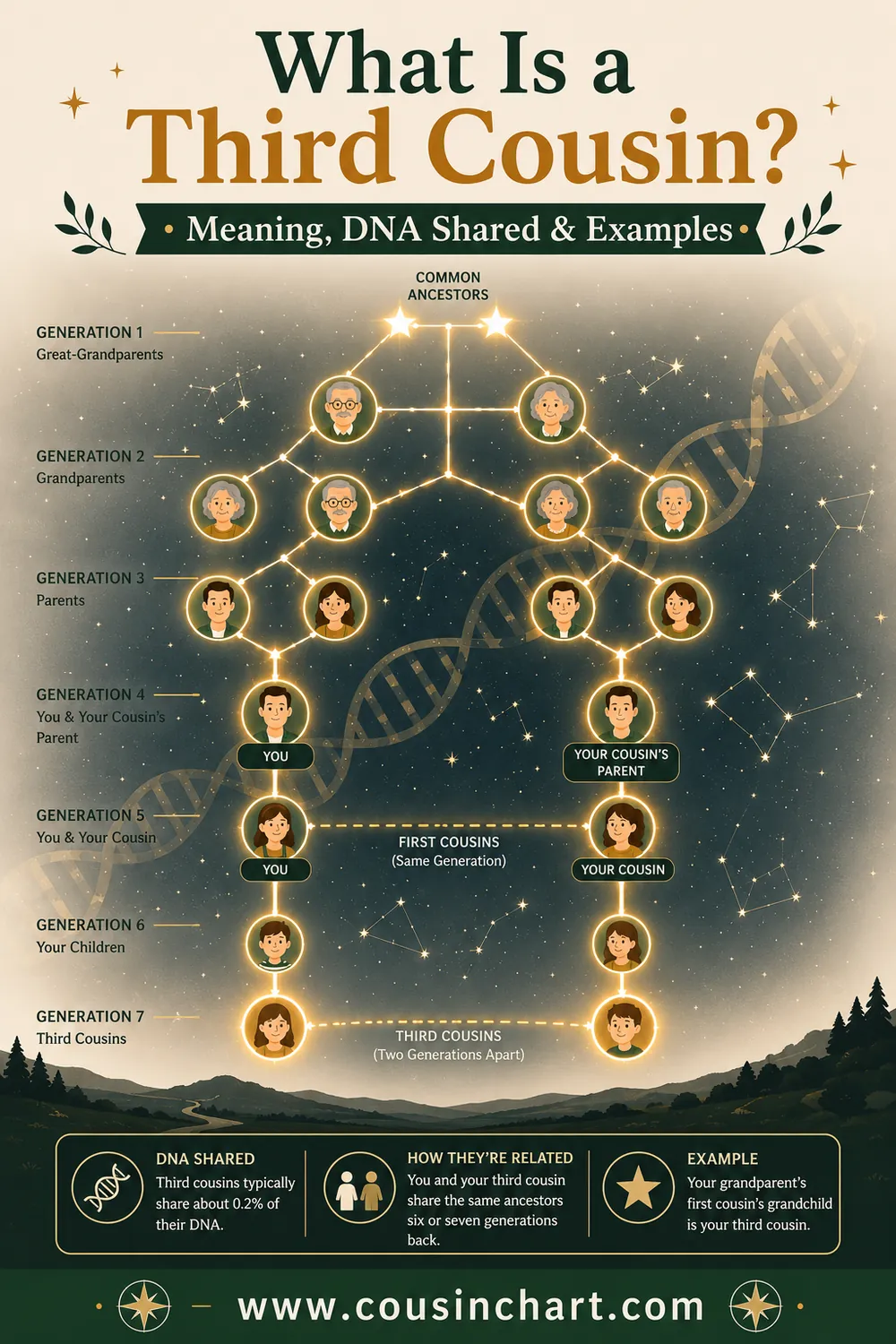
Cousin numbers count how far back the shared ancestor sits. First cousins share grandparents. Second cousins share great-grandparents. Third cousins share great-great-grandparents. Each "great" you add to the shared ancestor adds one to the cousin number.
Now watch what happens when you and your first cousin each have a child. Your shared grandparents are the great-grandparents of both children. Shared great-grandparents is the textbook definition of second cousins — so that's exactly what the kids are.
The same logic repeats forever. Your grandchildren look back and find those same ancestors sitting at the great-great-grandparent level, which makes the grandkids third cousins. Nobody has to remember anything except "one more generation of kids = one more cousin number."
Why the Kids Aren't "First Cousins Once Removed" to Each Other
This is the most common mix-up, and it's worth untangling because both terms live in the same neighborhood.
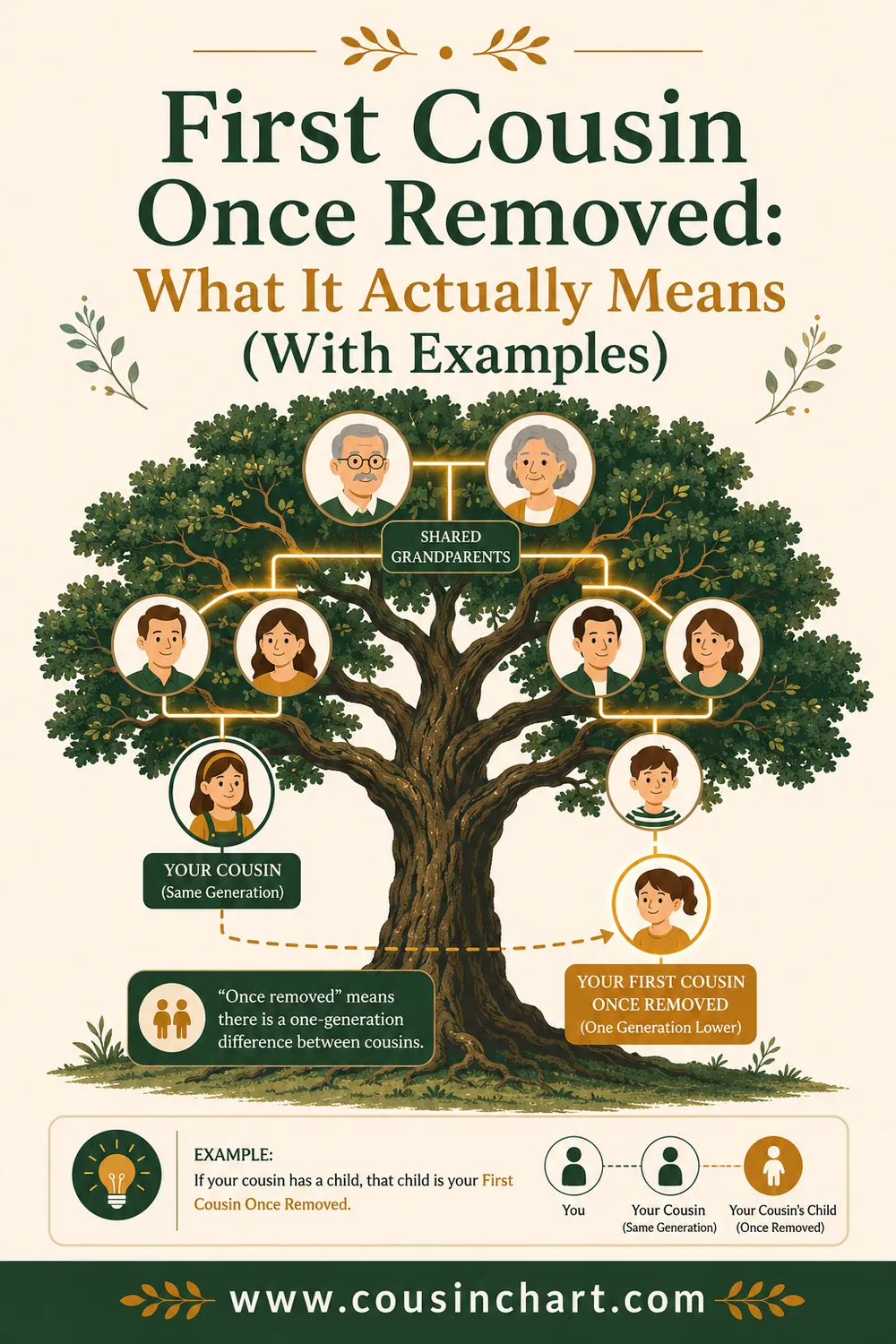
- "Removed" describes a generation gap. It applies when two people sit in different generations — like you and your cousin's child.
- Cousin numbers describe same-generation pairs. Your child and your cousin's child are both exactly one generation below the original cousin pair. No gap, so no "removed."
So the kids are plain second cousins to each other. The "once removed" relationships in this picture belong to the diagonal pairs: you and your cousin's child are first cousins once removed, and your child and your cousin are the same thing in the other direction.
A quick way to keep it straight: same row = cousin number, different row = removed. If two people were born into the same generation of the family, they get a clean cousin label. If one is up or down the tree from the other, count the gap and say "removed" that many times.
The Full Pattern, Generation by Generation
Here's the whole cascade in one table, starting from you and your first cousin:
| Generation | Relationship to each other | Shared ancestor |
|---|---|---|
| You + your first cousin | First cousins | Grandparents |
| Your kids + their kids | Second cousins | Great-grandparents |
| Your grandkids + their grandkids | Third cousins | Great-great-grandparents |
| Your great-grandkids + theirs | Fourth cousins | 3× great-grandparents |
And if you start further apart, the ladder just begins on a higher rung:
| If you two are… | Your kids are… | Your grandkids are… |
|---|---|---|
| First cousins | Second cousins | Third cousins |
| Second cousins | Third cousins | Fourth cousins |
| Third cousins | Fourth cousins | Fifth cousins |
| First cousins once removed | Second cousins once removed | Third cousins once removed |
Notice the last row: if the starting pair is offset by a generation, that offset never goes away. The kids inherit both the growing cousin number and the stubborn "once removed." When the branches get that tangled, the cousin calculator is honestly faster than a whiteboard.
What Your Cousin's Kids Are to You
Different question from the one in the title, but it's usually asked in the same breath. Your first cousin's child is your first cousin once removed — the cousin number stays at "first" because the family split still happened at your grandparents' level, and the "once removed" marks the one-generation gap between you.
That means one child at a family reunion holds two labels at once: they're your first cousin once removed, and they're your own children's second cousin. Neither label is more correct — they just describe the relationship from two different seats at the table. Our second cousin explainer covers the kids' side of this fence in more depth.
How Much DNA Will the Kids Share?
Second cousins share about 3.125% of their DNA on average — roughly 75–230 centimorgans on a DNA-testing site. That's a quarter of what first cousins share (~12.5%), because two extra meioses sit between them.
Extending the ladder:
- First cousins: ~12.5% shared DNA
- Second cousins: ~3.125%
- Third cousins: ~0.78%
- Fourth cousins: ~0.2% — small enough that some genuine fourth cousins share no detectable DNA at all
These are averages, not promises. DNA recombination is random, so one pair of second cousins might share 2% while another pair shares 5%. Both are normal, which is why testing companies report relationship ranges rather than exact labels.
Special Cases: Double, Half, and Step
Real families rarely stick to the textbook diagram, so here's how the variations flow down to the kids:
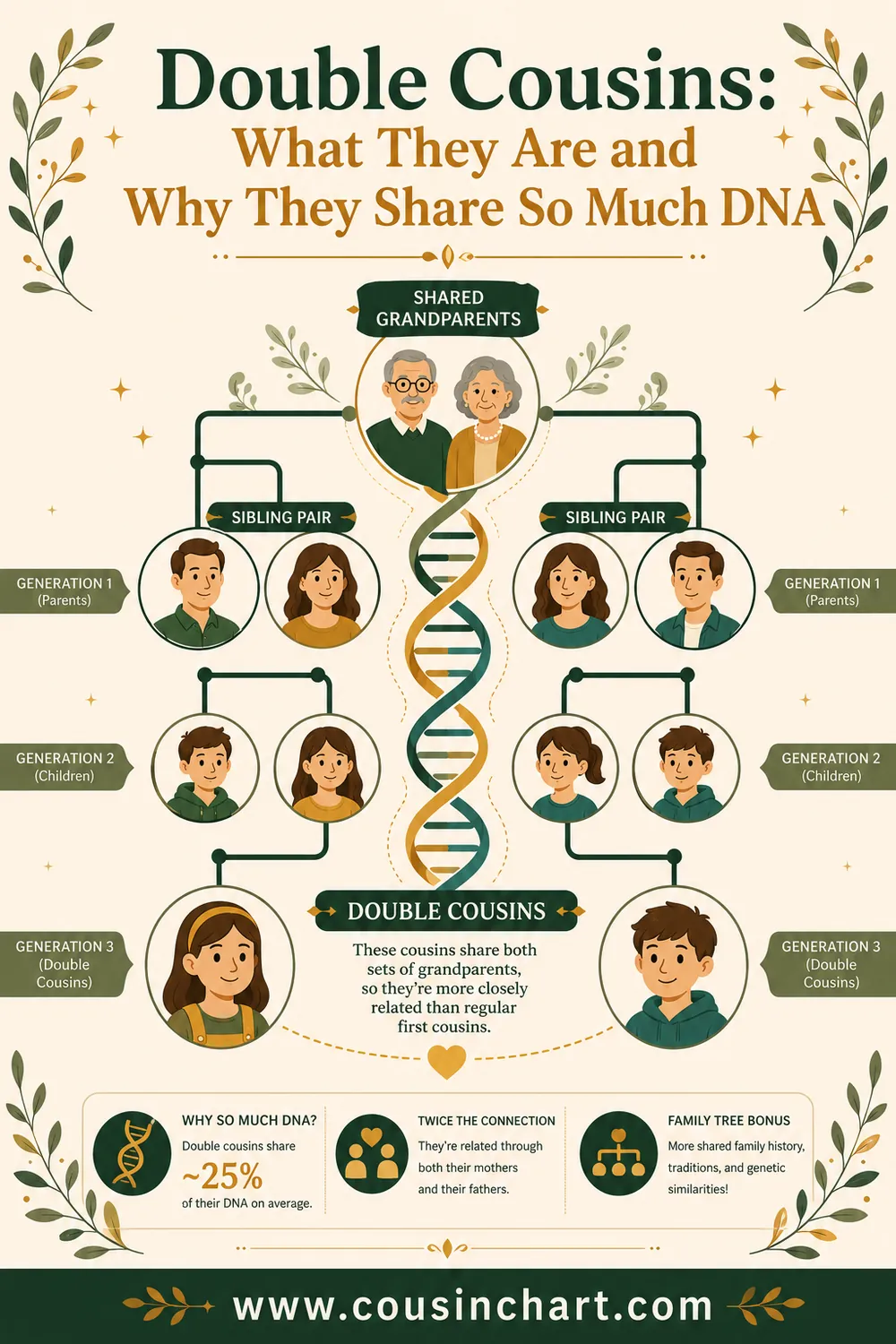
- Double first cousins. If two siblings from one family married two siblings from another, their kids are double first cousins (~25% shared DNA). Those cousins' kids become double second cousins, sharing about 6.25% — twice the usual second-cousin amount, because they're related through both parental lines.
- Half first cousins. If the connecting parents were half-siblings, the cousins are half first cousins (~6.25%), and their kids are half second cousins (~1.5%). The "half" prefix simply rides along each generation.
- Step and adopted branches. A stepchild of your cousin has no blood tie to you, so the cousin ladder never starts — the kids are family socially, not genealogically. An adopted child is different: genealogy and the law treat adoption as full kinship, so your cousin's adopted child's kids slot in as second cousins to your kids on the tree, even though a DNA test would show no match.
The Other Question: What If Two Cousins Have a Kid Together?
The title question assumes you and your cousin each have kids with other people. But some readers arrive here asking the other thing — if cousins marry each other, what is their child? — so let's answer it cleanly.
The child is simply each parent's son or daughter, full stop; no special term applies. What's unusual is the shape of the tree above the child. Because first cousins share a set of grandparents, their child has only six distinct great-grandparents instead of the usual eight — the shared couple occupies two slots at once. Genealogists call this pedigree collapse: the ancestor chart folds in on itself where the two branches meet. On paper, the child descends from the same couple twice, through two different lines, and family tree software will happily draw both paths.
Genetically, the child of first cousins is expected to have about 6.25% of their DNA doubled up (identical copies inherited through both parents from the shared grandparents). In practical health terms, large studies put the baseline risk of significant birth defects around 3–4% for unrelated couples and roughly 4–7% for first-cousin couples — a real but modest increase, comparable to the added risk of a mother giving birth in her early forties. It's why many jurisdictions allow first-cousin marriage and others don't, and why genetic counseling is the standard advice for cousin couples rather than alarm.
And the cousin ladder still runs for that child, with a twist: their relationship to everyone else in the family often computes twice. Your cousin-couple's child and your own child, for instance, are second cousins through both of the couple's lines to the shared grandparents — a mild double-relationship that nudges their shared DNA above the usual second-cousin average. Once pedigree collapse enters a tree, expect the calculator to occasionally hand you two valid answers; both are true, and DNA adds them together.
Same Generation, Wildly Different Ages
One thing that trips people up about "your kids are second cousins": the kids might be born thirty years apart and still be exactly second cousins. Cousin terms track tree position, not birthdays, and the two drift apart surprisingly fast.
Here's how it happens. Suppose your grandparents' first child (your parent's eldest sibling's line) had children young, at 20, for two generations running — while your line averaged 35. By the second-cousin generation, one branch's kids are middle-aged before the other branch's kids are born. Nothing went wrong; the branches just run at different speeds.
Practical consequences worth knowing:
- A second cousin can be your child's age — or your parent's. At big reunions, sorting people by apparent age gives you the wrong chart almost every time. Ask "whose grandchild are you?" instead — the answer places someone on the tree instantly.
- The oldest person in a generation is a resource. A 60-year-old second cousin remembers the great-grandparents your 25-year-old second cousin never met, even though they hold the identical spot on the chart.
- DNA doesn't care either. Two second cousins born 40 years apart share the same expected ~3.125% as two born the same week. Testing companies estimate the relationship, not the ages, which is why a match's age should never talk you out of what the centimorgans say.
So when your eight-year-old asks why her "second cousin" has gray hair, the answer is the honest one: the family tree has rows, the rows don't watch the clock, and she and the gray-haired gentleman are simply standing in the same row.
Practice: Three Reunion Puzzles
Cover the answers and give these a try:
- Your first cousin's daughter and your son. Both one generation below the cousin pair, same row: second cousins.
- Your second cousin's grandchild and your child. Work it in two steps: your child and your second cousin's child are third cousins (same generation, both one step down). The grandchild sits one generation below that, so your child and the grandchild are third cousins once removed. (If that one made you squint, you see why the calculator exists.)
- Your double first cousin's son and your daughter. Double branch, next generation: double second cousins.
The mechanical habit worth building: find the shared ancestor, count each person's steps back to it, and the smaller count minus one is the cousin number, with the difference as the removals.
Passing the Ladder Down With the Kids
If the second cousins in question are still young, this is the perfect age to make the connection stick — second cousins who grow up knowing each other stay findable for life, while ones who don't often meet again only as confused DNA matches decades later.
Three low-effort moves that pay off for the next generation:
- Say the term out loud occasionally. "That's your second cousin Maya" costs nothing, and kids absorb the structure faster than adults do.
- Write the link down once. A note in the family tree file — or even a labeled photo — connecting the two branches saves some future grandchild a genuine research project. Branches lose track of each other in as little as one generation.
- Trade the grandparents' stories now. Your kids' shared great-grandparents are the couple both branches will eventually ask about. Whoever holds the photos and stories today should copy them across the branch while the copying is easy.
FAQ
If we're first cousins, are our kids second cousins or first cousins once removed?
Second cousins — to each other. "First cousin once removed" describes a different pair: you and your cousin's child, who sit one generation apart. The two kids sit in the same generation, so they get a clean cousin number.
What are my cousin's kids to my kids' kids?
Your cousin's children and your grandchildren are second cousins once removed — the second-cousin relationship belongs to the kids' generation, and your grandchild sits one generation below it.
If we're second cousins, what are our children?
Third cousins. Every generation of children adds one to the cousin number: second cousins' kids are third cousins, third cousins' kids are fourth cousins, and so on.
Can our kids marry each other if we're first cousins?
The kids would be second cousins, and second-cousin marriage is legal in every US state. Laws restricting marriage generally apply to first cousins and closer, and they vary by state — always check the current law where you live.
How much DNA do second cousins share?
About 3.125% on average, which usually shows up as roughly 75–230 cM on testing sites. The exact amount varies quite a bit from pair to pair because DNA inheritance is random.
What are my kids to my first cousin themselves?
First cousins once removed — the mirror image of your relationship to your cousin's kids. Your cousin and your children sit one generation apart on the same first-cousin branch, so the label carries one removal.
If someone is my cousin by marriage, what are our kids to each other?
Nothing, genealogically — a cousin by marriage shares no ancestor with you, so the ladder never starts and the kids inherit no blood connection. Socially they may grow up calling each other cousins anyway, which works fine everywhere except a DNA test.
Do double first cousins' kids share more DNA than normal second cousins?
Yes — double second cousins share about 6.25% on average, twice the usual second-cousin figure, because they're related through both of their parents' family lines.
Name Any Branch, Instantly
So: first cousins produce second cousins, second cousins produce third cousins, and every diagonal pair picks up a "removed." That covers this branch — but family trees keep manufacturing new puzzles, usually five minutes into a reunion. When someone asks what your double cousin's granddaughter is to your niece, don't reach for scratch paper: the free family relationship calculator maps the exact path and hands you the correct term instantly.