How to Spell Cousin: The Rule That Makes It Stick
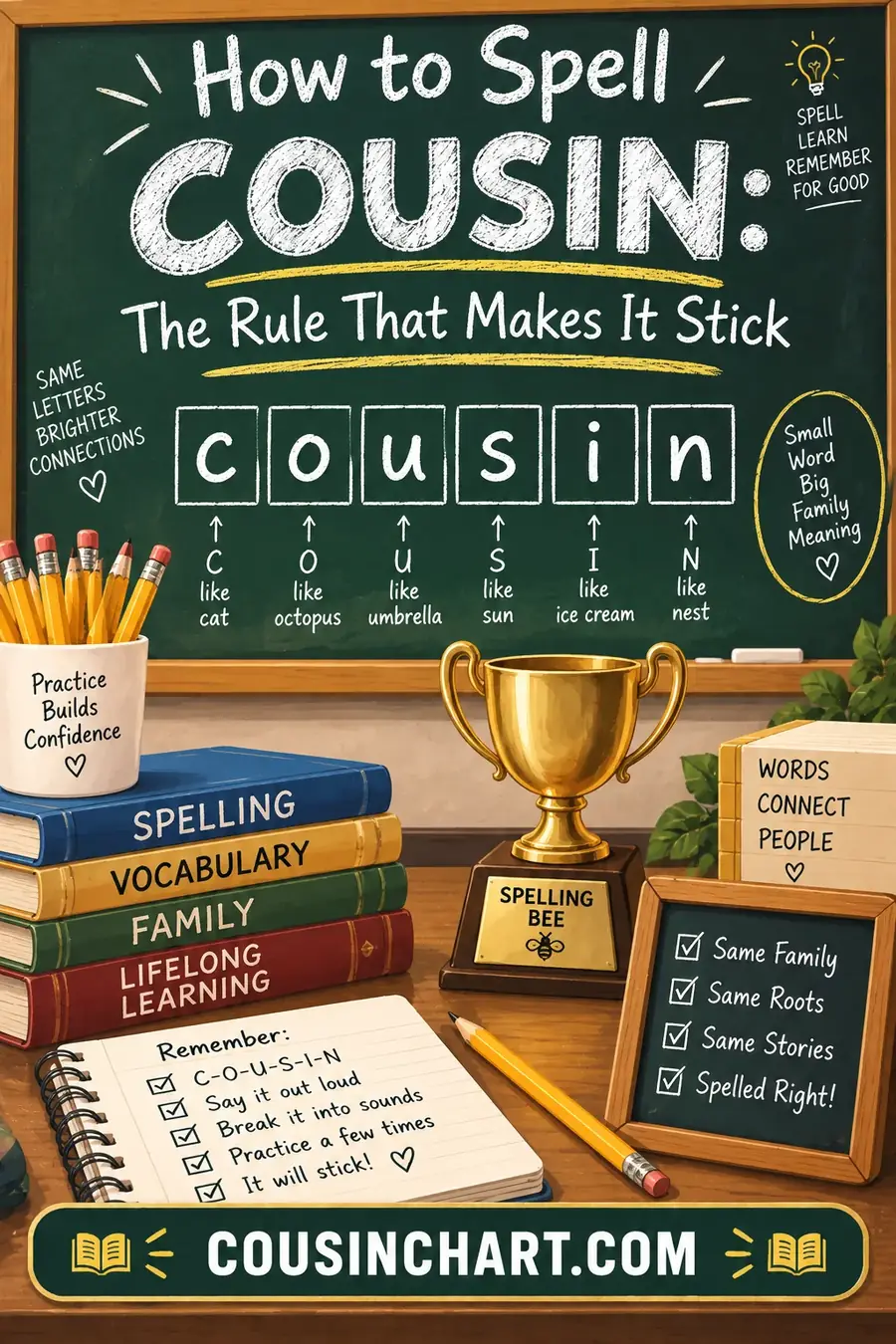
Cousin is spelled C-O-U-S-I-N. One S, an OU in the middle, and an -IN ending that sounds like "-un."
It's a commonly misspelled word for a specific reason: nothing about how it sounds tells you how it's written. "KUH-zin" suggests cuzin, cusin or couzin long before it suggests cousin.
The Three Errors
Cousine — adding an E. This is actually the correct French spelling for a female cousin, which is where the confusion comes from. In English there's no E.
Cuzin / cusin — spelling it phonetically. Reasonable, and wrong.
Couzin — using a Z. The S makes a Z sound, which is exactly why people reach for the letter Z.
Why It Looks Wrong
The word came into English from Old French cosin, which came from Latin consobrinus — meaning, roughly, mother's sister's child.
English kept a French-influenced spelling while the pronunciation drifted, which is the same story behind a lot of English's least phonetic words. The OU spelling representing a "uh" sound is a French inheritance, not an English rule.
That's genuinely useful to know, because it explains why sounding it out fails. The spelling isn't following English phonics — it's preserving a French one.
The Memory Trick
The one that works best for most people:
COUSIN has "US" in it — because a cousin is one of US.
C-OU-S-I-N. The OU and S sit together in the middle, and "us" is exactly what a cousin is: family.
It's memorable because the meaning and the letters line up, which is what makes a mnemonic stick rather than becoming another thing to remember.
Two alternatives if that one doesn't land:
"Count on your cousin" — both start with C-O-U, which handles the first three letters, the part people most often get wrong.
Break it as COUS + IN — "cous" like couscous, then "in." Slightly odd, and it works for people who cook.
The Same OU Pattern
Cousin isn't alone. A group of English words uses OU for a "uh" sound, nearly all of them arriving through French:
- Country — not "cuntry"
- Couple — not "cupple"
- Courage — not "curage"
- Cousin — not "cuzin"
- Double — not "dubble"
- Trouble — not "trubble"
- Young — not "yung"
- Touch — not "tuch"
- Enough — not "enuf"
- Nourish, flourish, journey, southern
Learning the group is more efficient than learning cousin alone. A child who notices that country, couple, double and trouble all share the pattern has a rule rather than six separate memorized words.
For Teaching a Child
Point out the pattern, not just the word. Write country, couple, cousin, trouble, double in a column with the OU underlined. The pattern is the lesson.
Use the "one of US" trick explicitly. Say it while pointing at the letters.
Have them write it, not just spell it aloud. Spelling aloud tests a different pathway from writing, and writing is where it usually matters.
Watch for the E. Cousine is the most persistent error because it looks right and is a real word in French. Worth flagging directly.
Use it in a sentence about a real cousin. Words attached to real people stick considerably better than words on a list.
The Plural and Related Words
Cousins — just add S. No spelling change, no doubled letter.
Cousin's — belonging to one cousin. My cousin's car.
Cousins' — belonging to more than one cousin. My cousins' house, where several cousins live there.
Cousinhood, cousinly — both exist and both keep the base spelling unchanged.
There's no irregular plural here, which makes cousin easier than its spelling suggests once you have the base word.
Related Terms Worth Knowing
While you're here: the words that go around cousin cause almost as much trouble as the spelling.
Removed — describes a generation gap, not distance in the family. Your parent's first cousin is your first cousin once removed. More in what is my dad's cousin to me.
Second cousin — shares great-grandparents with you, and is in your generation.
Nephew and niece — your sibling's children, not your cousin's children. Your cousin's children are your first cousins once removed.
If you're trying to pin down an actual relationship rather than a spelling, a cousin chart sorts it in a couple of clicks.
Words That Follow the Same Pattern
Cousin belongs to a group of English words where OU represents a short "uh" sound rather than the "ow" of out or the "oo" of soup. Nearly all arrived through French.
The core group: country, couple, courage, cousin, double, trouble, young, touch, enough, rough, tough, nourish, flourish, journey, southern, courteous, encourage, adjourn.
Teaching the group is far more efficient than teaching the words individually. A learner who notices that country, couple, double and trouble all share the pattern has acquired a rule; a learner who memorises four separate spellings has acquired four facts.
A useful sorting exercise: write a mixed list containing OU words from all three sound groups — out, soup, couple — and have the learner sort them by sound rather than by spelling. It makes the pattern visible in a way that reading a list doesn't.
Related Words and Their Spellings
Cousins — plural, just add S. Cousin's — belonging to one cousin. My cousin's car. Cousins' — belonging to several cousins. My cousins' house. Cousinly — in the manner of a cousin. Rare but real. Cousinhood — the state or relationship of being cousins. Cousinage — an archaic collective term for one's cousins, occasionally still seen in genealogical writing.
None of these change the base spelling, which makes cousin easier than its irregular look suggests. Get the six letters right once and every derived form follows.
Why English Spelling Does This
Briefly, because it makes the whole thing less arbitrary.
English absorbed an enormous quantity of French vocabulary following the Norman Conquest, and it generally kept the French spellings while the pronunciation drifted toward English patterns over the following centuries. The result is a large body of words spelled by one language's conventions and pronounced by another's.
Cousin is a clean example. Old French cosin, from Latin consobrinus, entered English with a spelling that reflected French orthography. The pronunciation shifted; the spelling largely didn't.
That's genuinely useful to know when teaching it, because it explains why sounding the word out fails. The spelling isn't following English phonics — it's preserving a French one, and no amount of sounding out will produce it.
Teaching It to a Child
Start with the pattern, not the word. Write country, couple, double, trouble and cousin in a column with the OU underlined in each. The rule is the lesson; cousin is just one example of it.
Use the "one of US" trick out loud while pointing at the letters. Mnemonics that connect to meaning stick considerably better than ones that don't.
Have them write it, not spell it aloud. Oral spelling and written spelling use different pathways, and writing is where it usually matters.
Flag the E specifically. Cousine is the most persistent error because it looks plausible and is a real French word. Naming the trap in advance prevents it.
Use it in a real sentence about a real cousin. Words attached to actual people are remembered far better than words on a list.
Come back to it after a week. A word spelled correctly once has not been learned. A word spelled correctly a week later probably has.
Related Spellings Worth Knowing
While you're on family vocabulary, a few neighbors cause similar trouble.
Nephew — PH, not F. From Latin nepos via Old French. Niece — IE, not EI. One of the few common words where the "i before e" rule actually holds. Aunt — AU, and pronounced two different ways depending on region without changing the spelling. Grandparent — one word, no hyphen. Sibling — one B. Ancestor — OR at the end, not ER. Genealogy — the one people get wrong most often. It ends in -LOGY but the middle is A-L-O, not O-L-O. It's genea (race, generation) plus logy, not "geneology."
Genealogy is worth flagging specifically to anyone researching a family tree, since they'll write it hundreds of times.
Common Questions About the Word
Is "cousin" ever spelled with a Z? No. The S makes a Z sound, which is why the error is so common, but the spelling is always S.
Is "cousine" ever correct in English? No. It's the French feminine form and has no standing in English, where "cousin" covers both.
Why doesn't English distinguish male and female cousins? Most Romance languages do — cousin and cousine in French, primo and prima in Spanish. English dropped the gendered forms when it absorbed the word, as it did with most inherited French vocabulary. See short word for cousin for how other languages handle it.
What about "cuz"? A legitimate informal shortening in speech and writing, though it also serves as shorthand for "because." Context distinguishes them easily.
Is there a formal title, like "Aunt Mary"? No. Unlike aunt, uncle and grandparent, cousin isn't used as a title before a name in modern English — though it was, historically, and it survives in some formal and royal contexts.
Quick Reference
The spelling: C-O-U-S-I-N. Six letters, one S, no Z, no E. The memory trick: cousin has US in it, because a cousin is one of us. The pattern: OU making a short "uh" sound, as in country, couple, double, trouble, young. The most common error: cousine, which is the French feminine form and not English. The plural: cousins. Possessive singular: cousin's. Possessive plural: cousins'. Why it looks wrong: it kept a French spelling while the pronunciation drifted toward English, which is why sounding it out fails.
Why It's Worth Getting Right
Cousin turns up more often in writing than most family words — on invitations, in genealogy notes, in messages, in family trees, on forms. It's also one of the words people quietly avoid using in writing because they're unsure of the spelling, which is a small shame given how straightforward the rule is once the pattern is visible.
Six letters, one S, the OU making a short "uh" sound like country and couple, and the "one of us" trick to hold it in place. That's the whole thing, and it takes about a minute to learn permanently.
A Note for Genealogy Writing
If you're researching or writing up a family tree, cousin is one of a handful of words you'll type hundreds of times, alongside a few others that cause similar trouble.
Genealogy is the most commonly misspelled word in the field — it ends in -logy but the preceding vowel is A, not O. It comes from genea meaning race or generation, not from "geneo."
Descendant takes an A in the final syllable when used as a noun. Descendent with an E is an adjective and considerably rarer, to the point where the A spelling is nearly always the one you want.
Ancestor ends in -or, not -er.
Lineage, maternal, paternal, collateral and consanguinity round out the set worth getting right in anything you'll share with relatives or publish.
Cousin fits into this group as a word that appears constantly, looks slightly wrong, and rewards learning once properly rather than checking repeatedly.
Frequently Asked Questions
How do you spell cousin? C-O-U-S-I-N. One S, no Z, no E on the end. The OU makes a "uh" sound, which is why sounding it out leads people astray.
Is it cousin or cousine? Cousin in English. Cousine is the French spelling for a female cousin — a real word, just not an English one, which is why the error is so common.
Why is cousin spelled with OU? It came into English from Old French cosin, and English kept a French-influenced spelling while the pronunciation shifted. Several other words share the pattern — country, couple, trouble, double, young.
What's a good way to remember the spelling? "COUSIN has US in it, because a cousin is one of US." The letters and the meaning line up, which is what makes it stick better than a rule about letter order.