Gravestone Symbols and Meanings: 40 Carvings Explained
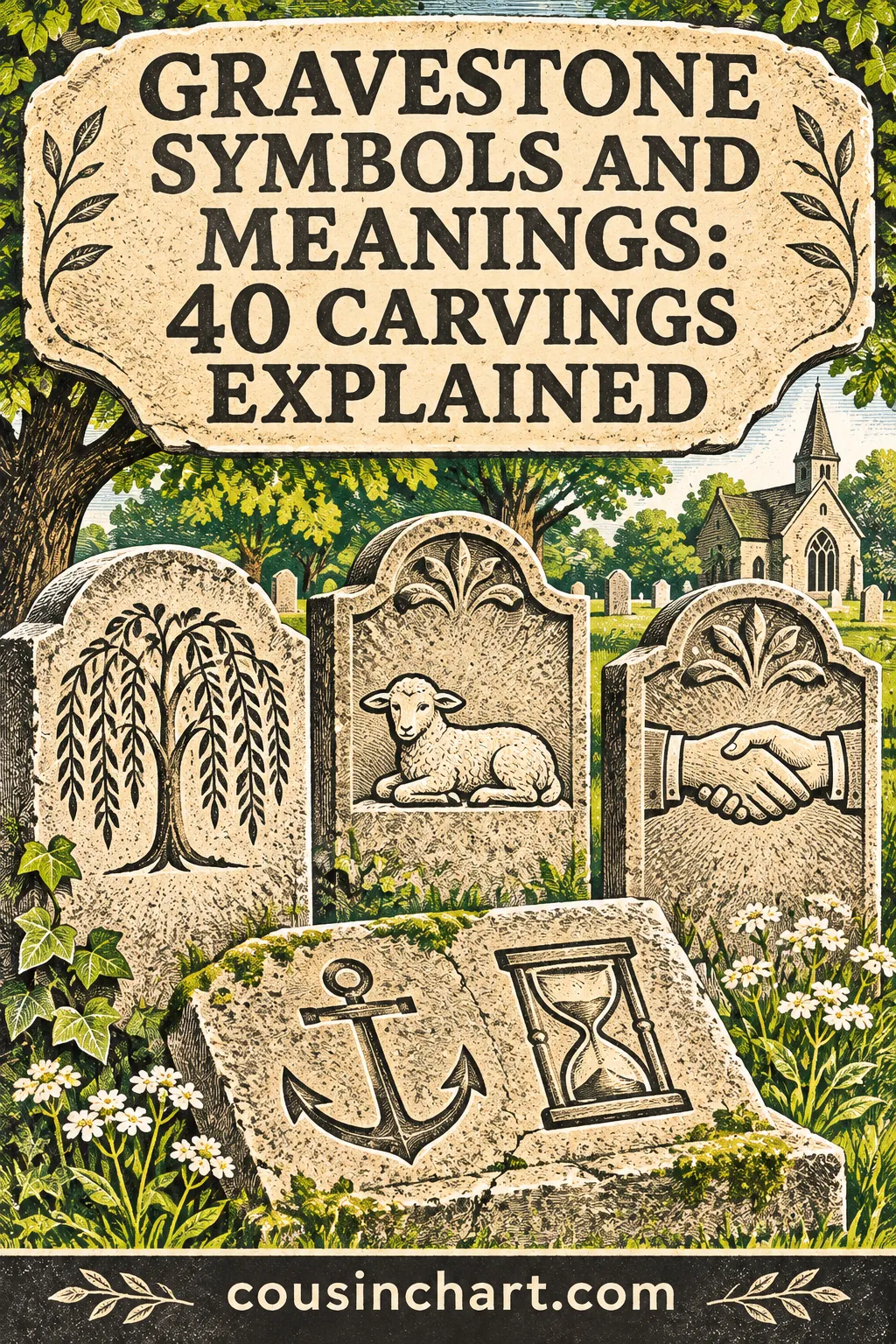
Gravestone symbols and meanings usually fall into a few groups: plants and flowers (life, grief and remembrance), animals (innocence and the soul), hands and objects (farewell, faith or a person's work), and emblems of clubs, faiths and military service. A weeping willow means mourning, a lamb almost always marks a child, clasped hands mean farewell or a lasting bond, and an anchor stands for hope.
Below are 40 of the carvings you're most likely to find in an American cemetery, grouped so you can scan by what you see on the stone. After the list, you'll find tips for reading worn carvings and for using what you learn in your family research.
The 40 Carvings, at a Glance
Plants, trees and flowers
- Weeping willow – Mourning and grief. One of the most common symbols on 19th-century stones, often paired with an urn.
- Rose (full bloom) – A life lived fully, often on the grave of a woman who died in the prime of life.
- Rosebud or broken bud – A child or young person. A broken stem or bud means a life cut short.
- Lily – Purity and innocence; often used for women and for Easter-themed resurrection imagery.
- Ivy – Faithfulness, friendship and eternal life, since ivy stays green all year.
- Oak leaves and acorns – Strength, endurance and honor; often on the stones of men.
- Laurel wreath – Victory, achievement and distinction; sometimes used for soldiers, scholars or artists.
- Wheat sheaf – A long, fruitful life, usually someone who lived to an old age. It can also mark a farmer.
- Tree stump or cut log – A life cut short. Look for the number of cut branches, which sometimes match family members who died.
- Poppy – Eternal sleep and remembrance; later strongly tied to remembrance of soldiers.
- Palm frond – Victory over death and spiritual peace.
- Morning glory – A short life, or new beginnings, since the flower blooms and closes in a single day.
Animals and birds
- Lamb – Innocence. Almost always marks the grave of an infant or young child.
- Dove – Peace and the soul's departure. A dove flying downward often stands for the Holy Spirit; one flying upward, the soul rising.
- Butterfly – Resurrection and transformation, and sometimes a short life.
- Rooster – Awakening, watchfulness or the resurrection at dawn.
- Owl – Wisdom, watchfulness or the night of death.
- Eagle – Courage and freedom; often near patriotic or military imagery.
- Dog – Loyalty and faithfulness. Sometimes carved at the feet of a figure, sometimes simply the person's own pet.
- Shell (scallop) – Pilgrimage, the journey of life, and in some traditions, baptism.
Hands and human figures
- Clasped hands – Farewell, or an unbroken bond between two people (often a married couple). Look at the cuffs: one lace and one plain cuff usually means husband and wife.
- Hand pointing upward – The soul has gone to heaven.
- Hand pointing downward – Sudden or unexpected death. It is less common than the upward hand and easy to misread, so check the stone's dates and inscription.
- Hand holding a broken chain – The death of a family member, with the chain link standing for the family bond that has been broken.
- Praying hands – Devotion, faith and a request for eternal life.
- Angel – A guide or guardian of the soul. Angels blowing trumpets suggest the resurrection.
Objects and everyday items
- Urn (often draped) – Mourning and the body's return to dust. Very popular in the early 1800s.
- Anchor – Hope and steadfastness. It can also mark a sailor or a life linked to the sea.
- Hourglass – Time running out. A winged hourglass means that time flies.
- Open book – A life recorded, the Bible, or a learned person. Two open pages can mean a married couple.
- Broken column – A life cut short, often the head of the family.
- Draped cloth or veil – Mourning, and the thin veil between life and death.
- Torch turned downward – A life put out. An upright torch means eternal life.
- Harp or lyre – Praise, music and harmony in the afterlife; sometimes the grave of a musician.
- Gates or an open door – Passage from this life into the next.
- Crown – Glory, reward in the afterlife, or victory over death.
Faith, fraternal and military emblems
- Cross – Christian faith in many forms. A Celtic cross with a ring often reflects Irish or Scottish heritage.
- Square and compass – Membership in the Freemasons. Often has a letter "G" in the middle.
- Three linked rings – The Independent Order of Odd Fellows (rings often carry the letters F, L and T for Friendship, Love and Truth).
- Shield or crossed swords – Military service; crossed swords can indicate high rank or a death in battle. Government-issued headstones may also show a faith emblem above the name.
How to Use This List at the Cemetery
When you stand in front of an unfamiliar headstone, work through it in this order:
- Note the shape of the stone. Thin slate tablets, marble tablets, granite blocks and obelisks each fit a different era, which helps you guess when it was carved.
- Find the main carving. It's usually at the top of the stone, called the tympanum on older tablets.
- Look for secondary symbols. Borders, corners and the base often carry ivy, flowers or emblems.
- Read the symbols together. A lamb plus a rosebud nearly always means a small child. Clasped hands next to two open book pages often means a married couple.
- Check the inscription. Words like "Asleep in Jesus" or a lodge abbreviation confirm what the symbol suggests.
Symbols by Era
Gravestone symbols and meanings also changed over time. Carvings went in and out of fashion, which makes them a rough way to date a stone when the numbers are worn away.
| Era | Common symbols | What was happening |
|---|---|---|
| Late 1600s to mid-1700s | Winged skulls, hourglasses, crossbones | Stark reminders of death in early New England |
| Mid-1700s to early 1800s | Winged faces (soul effigies), urns | A softer view of death and the soul |
| Early to mid-1800s | Urn and willow, draped cloth | The popular mourning style of the period |
| Mid to late 1800s | Lambs, hands, flowers, doves, books | Garden cemeteries and sentimental imagery |
| Late 1800s to early 1900s | Fraternal emblems, wreaths, ivy | Lodges and clubs were at their peak |
| 1900s onward | Crosses, flowers, hobbies, photos | Personal touches and simpler designs |
These are tendencies, not rules. A family might order an "old-fashioned" design long after it went out of style, so always weigh the symbol alongside the dates and the type of stone.
Reading Worn or Faded Carvings
Many old stones are hard to read. Here are gentle ways to see a carving better without causing harm:
- Visit at the right time of day. Low sunlight from the side throws shadows into carvings and makes them pop. Early morning or late afternoon works best.
- Use a large mirror. Bounce sunlight across the stone at a low angle if the stone faces away from the sun.
- Take several photos. Shoot straight on and from each side. Later, adjust the contrast on your computer.
- Use a flashlight. On a cloudy day, hold a flashlight close to the surface and shine it across the carving.
Never use chalk, shaving cream, flour or crayons to bring out letters. These methods can stain or damage the stone, and many cemeteries ban them. If a stone truly needs cleaning, ask the cemetery office for advice before trying any cleaning.
Turning Symbols into Family History Clues
A gravestone symbol can lead you to records you didn't know existed:
- A Masonic, Odd Fellows or other lodge emblem suggests membership records. Lodges often kept rolls with dates and sometimes notes about family.
- A military emblem points to service records, pension files or draft records.
- A lamb or rosebud next to an adult's stone may reveal a child who appears in no census, because they were born and died between census years.
- A broken chain or cut branches may count family members who died, which you can compare with the records you already have.
- A Celtic cross or a carving in another language can hint at where the family came from.
Once you know who's buried there, our Find a Grave search guide and free cemetery records guide help you find burial registers, plot maps and other people buried nearby. Older inscriptions often use words that have changed meaning, so keep our list of old genealogy terms handy too. Abbreviations like "consort" and "relict" are common on 19th-century stones.
Common Mistakes When Reading Symbols
Reading a single symbol in isolation. A dove can mean peace, the Holy Spirit or simply a love of birds. The other carvings and the inscription tell you which.
Assuming every hand means the same thing. Upward, downward, clasped and holding a chain each mean something different. Look closely at the fingers and cuffs.
Treating a symbol as proof of membership. A Masonic emblem strongly suggests membership, but it's still a clue. Confirm it with lodge or family records before adding it to your tree as fact.
Ignoring the back and sides. Many stones carry a second name or carving on the back, especially family stones with several people.
Forgetting about later replacements. A modern stone on an old grave may use new symbols that don't reflect the family's original choice.
How to Record What You Find
When you visit a cemetery for research, keep a simple record for each stone, and copy it into your genealogy research log when you get home. Writing down gravestone symbols and meanings next to each name makes patterns easy to spot later:
| Field | Example |
|---|---|
| Name(s) on stone | Mary Ellen Hayes |
| Dates | 1851–1879 |
| Main symbol | Clasped hands |
| Other symbols | Ivy border, rosebud at base |
| Inscription | "Gone but not forgotten" |
| Stone type | White marble tablet |
| Location | Section C, row 4 |
| Photo file names | hayes_front.jpg, hayes_back.jpg |
This makes it easy to compare stones later and spot patterns, such as a family plot where every stone carries the same lodge emblem.
Gravestone Symbols and Meanings Across Faiths and Groups
Many carvings come from a particular faith or community, and knowing that background helps you read a whole cemetery section, not just one stone.
Jewish cemeteries. You may see a Star of David, a pair of hands with fingers spread (a sign of descent from the priestly Kohanim), or a pitcher (linked to the Levites, who washed the priests' hands). Hebrew letters at the top often stand for "here lies." Small stones left on top of a headstone are a long-standing Jewish custom of remembrance, so leave them in place.
Catholic and other Christian graves. Letters such as IHS are a monogram for the name of Jesus, and the Chi Rho, which looks like a P crossed with an X, comes from the first letters of "Christ" in Greek. A cross over a crown or an anchor combined with a cross mixes faith with hope or reward.
Fraternal and benefit societies. Some groups supplied their members with distinctive monuments. Stones carved to look like tree trunks or stacked logs, for example, are often tied to the Woodmen of the World, a fraternal benefit society, and frequently show that group's emblem.
Military sections. Uniform government-issued markers usually show the person's name, rank, branch and war, with a small faith emblem above.
When a symbol seems unusual, look at nearby graves. Families and communities tended to be buried together, so the stones around a puzzling carving often explain it. Reading gravestone symbols and meanings as a group, row by row, turns a quiet walk through a cemetery into a real research trip.
FAQ
What does a lamb on a gravestone mean?
A lamb almost always marks the grave of an infant or young child and stands for innocence. You'll often see it on small stones in family plots from the 1800s.
What do clasped hands on a headstone mean?
Clasped hands mean farewell or an unbroken bond. If one cuff is lacy and the other plain, the carving usually represents a husband and wife, with the bond continuing after death.
What does an anchor on a grave mean?
An anchor stands for hope and steadfast faith. It can also mark the grave of a sailor or someone whose life was tied to the sea.
What does a weeping willow mean on a gravestone?
A weeping willow stands for mourning and grief. It was especially popular in the early to mid-1800s, often paired with an urn.
What does a hand pointing down on a gravestone mean?
A downward-pointing hand usually suggests a sudden or unexpected death, though it is less common than an upward-pointing hand, which means the soul has risen to heaven. Check the dates and inscription for more context.
How can I tell if a gravestone symbol is Masonic?
Look for the square and compass, often with a "G" in the center. Other fraternal groups used their own emblems, such as the three linked rings of the Odd Fellows.
Is it safe to use chalk to read an old gravestone?
No. Chalk, shaving cream and flour can stain or damage stone. Use side lighting from the sun, a mirror or a flashlight, and take photos instead.