Family Tree Template in Spanish (Árbol Genealógico, Printable)
An árbol genealógico is a family tree, and a Spanish-language template needs more than translated labels. Hispanic naming customs mean most people carry two surnames — the father's first, the mother's second — which is genuinely useful for genealogy because the mother's family line stays visible for generations rather than disappearing at every marriage. A template with one name box per person loses that. This page covers the vocabulary, how the naming system works, and what a template needs to accommodate it. For working out how two relatives connect, use the cousin calculator.
Free printables for this page
Download a blank PDF (US Letter or A4) — free, no sign-up — or customize it in the maker above before printing.
 Árbol Genealógico (Spanish)
 3-Generation Family TreeYou, parents and grandparents. Portrait, big boxes, 10 minutes to fill.
What do you need? Tap the closest match.
Tap an option above. Two surnames is the design constraint that matters.
The vocabulary
The words a Spanish-language template needs, most of which come in masculine and feminine forms.
| English | Spanish (m.) | Spanish (f.) |
|---|---|---|
| Family tree | árbol genealógico | — |
| Father / mother | padre | madre |
| Parents | padres | — |
| Son / daughter | hijo | hija |
| Brother / sister | hermano | hermana |
| Grandfather / grandmother | abuelo | abuela |
| Great-grandparent | bisabuelo | bisabuela |
| Great-great-grandparent | tatarabuelo | tatarabuela |
| Uncle / aunt | tío | tía |
| Cousin | primo | prima |
| Nephew / niece | sobrino | sobrina |
| Grandson / granddaughter | nieto | nieta |
| Husband / wife | esposo | esposa |
| Great-uncle / great-aunt | tío abuelo | tía abuela |
Plural forms usually take the masculine for a mixed group — padres covers both parents, hermanos a group of brothers and sisters, tíos an uncle and aunt together.
Cousin degrees: primo hermano or primo carnal is a first cousin; primo segundo a second cousin. "Once removed" has no neat single equivalent and is usually expressed descriptively.
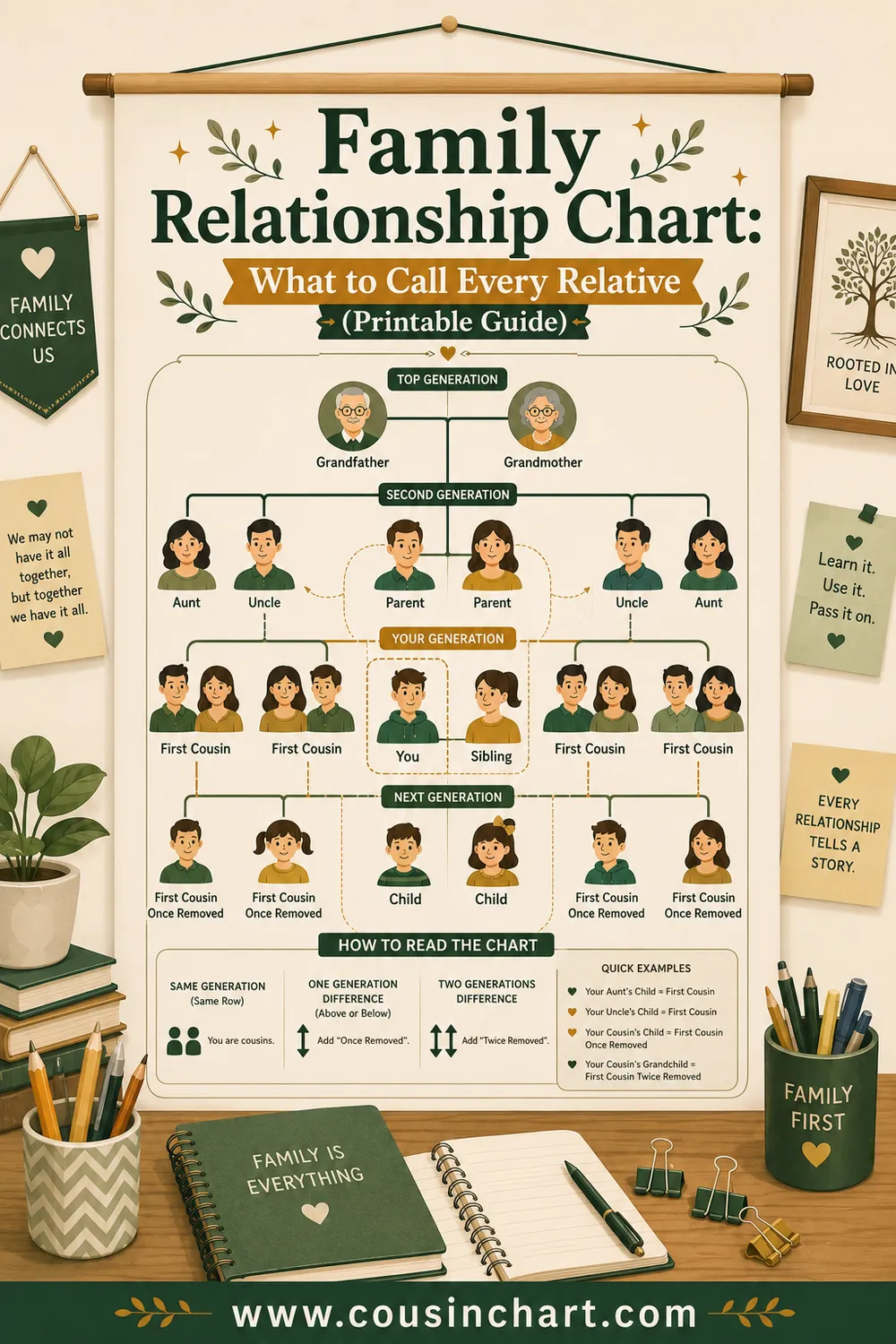
For the English equivalents side by side, the full naming system is in family relationship chart, and blank grids to write Spanish labels onto are in printable family tree.
**And pariente means relative in general**, while familiar is used as both an adjective and, loosely, a noun for family member.
Two surnames, and why it matters
The feature that genuinely changes what a template needs.
Most people in Spanish-speaking countries carry two surnames: the father's first surname, followed by the mother's first surname. So María García López has a father whose first surname is García and a mother whose first surname is López.
Children take the same pattern. María's children with a Martínez would be Martínez García — his first surname, then hers.
The genealogical advantage is real. In English-language records, a woman's maiden name disappears the moment she marries, and tracing a maternal line means finding a marriage record for every generation. In the Spanish system the mother's surname is carried forward in her children's names, so the maternal line is visible on the face of the record.
Which is why a template needs two name fields per person, or a box wide enough for both. A single "Name" line built for the English convention forces people to drop one — usually the mother's, which loses exactly the information the system preserves.
Married women traditionally did not change their names, though de + husband's surname (María García de Martínez) was and in places still is used. Practice varies by country and generation.
Order and practice vary regionally, and some countries now permit parents to choose which surname comes first. If you are recording a real family, record what they actually use rather than what the convention says.
What the template needs
Design points specific to a Spanish-language tree.
Two surname lines per box, or one wide line. This is the single most important difference from an English template.
Labels in Spanish — abuelo paterno, abuela materna, padre, madre — with the gendered forms correct for each box.
Room for longer text. Spanish runs perhaps fifteen to twenty per cent longer than English for the same content, and bisabuela materna is a considerably longer label than "great-grandmother".
Accents preserved. Árbol, genealógico, tío, María — a template that drops accents looks careless and, in the case of names, is simply wrong.
A bilingual option, where the two languages sit in the same box, is worth having for families whose generations do not share a first language. Grandparents fill it in Spanish, grandchildren read it in English.
And the paternal/maternal distinction is built into the labels in a way English lacks — abuelo paterno and abuelo materno are distinct words where English needs "grandfather on my father's side".
For Spanish class
The standard assignment, and how to make it work.
Three generations is the usual scope — the student, parents, and grandparents. Fifteen boxes at most.
Both surnames on every person, which is the part the exercise is usually testing.
Labels rather than just names. The point of the assignment is the vocabulary, so each box should carry the relationship word — mi abuela materna — as well as the name.
Presenting aloud is common: "Ésta es mi abuela. Se llama Rosa García Fernández." Design the sheet so the student can hold it up while speaking.
Photographs help enormously with retention, and turn a vocabulary exercise into something the student wants to keep.
Adapt the shape first, exactly as with any children's template. A sheet with fixed padre and madre boxes creates the same problem in any language, and the classroom considerations are in family tree templates for kids and family tree school project ideas.
And allow a fictional or historical family as an alternative. A student who cannot complete their own tree can chart a family from a book or a well-known historical figure and learn exactly the same vocabulary.
Regional differences worth knowing
Enough variation that "the Spanish system" oversimplifies.
Spain traditionally uses father's surname then mother's, though since 1999 parents have been able to choose the order, and since 2017 the default where parents disagree is alphabetical.
Mexico and much of Latin America follow the same paternal-then-maternal pattern, with de used in some married-name conventions.
Argentina historically used a single paternal surname more commonly, though double surnames are widespread and legally available.
Portugal and Brazil, though Portuguese-speaking rather than Spanish, reverse the order — mother's surname first, then father's — which is worth knowing if a family tree spans both.
Compound surnames joined by y (Spain) or e are used in some families, and they count as one surname rather than two.
Naming for a child with one recorded parent varies by country and period, and older records frequently reflect conventions that have since changed.
The practical rule for a real family tree: record the names as they appear in the documents, and note the convention in a legend rather than normalising everything to one pattern.
Building a bilingual family record
Worth doing deliberately where a family spans languages.
Label boxes in both languages, with Spanish first if the older generation is the source of the information.
Record place names in their original form, with the English version in brackets if useful. Ciudad de México (Mexico City) rather than one or the other.
Keep dates in an unambiguous format. Both Spanish and British conventions put the day first, but American records put the month first, and a tree spanning both will contain both. Writing the month as a word — 12 marzo 1948 — removes the ambiguity entirely.
Interview in the language the person is most comfortable in, and record it in that language. Translating as you write loses detail and adds errors.
Note which language a source is in when you cite it.
And expect spelling variation in older records. Accents were often omitted, and clerks recorded names phonetically — the same person can appear as Hernández, Hernandes and Ernandez across three documents. That is normal, not an error, and it is a good reason to search records with and without accents.
Searching Spanish-language records
Where the naming system helps, and where it makes searching harder.
Search on both surnames separately. An index may have recorded only one, or reversed them, and searching the full double surname as a single string frequently returns nothing.
Search with and without accents. Many indexes strip them, and some transcribers never entered them. Núñez and Nunez should both be tried.
Expect phonetic spellings. Clerks wrote what they heard, and literacy was not assumed — the same family can appear as Jiménez, Ximénez and Gimenez across a century of records.
**Watch for the de particle** in surnames such as de la Cruz or del Río. Indexes file these inconsistently — sometimes under D, sometimes under C or R — so try both.
Church records are often the deepest source in Spanish-speaking countries, with baptism, marriage and burial registers reaching back well before civil registration. They routinely name parents and frequently grandparents, which makes a single baptism entry worth two generations.
And note the naming patterns. Children were often named after grandparents in a predictable order, so a repeated given name across generations is a clue rather than a coincidence — useful when a record is ambiguous.
Common mistakes
Using an English template unchanged, which leaves room for one surname and quietly discards the maternal one.
Dropping accents. Wrong in names, and it makes searching records harder.
Assuming the mother's surname is a middle name. It is a surname, and it carries genealogical information.
Getting the gendered forms wrong — abuelo for a grandmother, primo for a female cousin.
Assuming the same convention across all Spanish-speaking countries. Order and practice vary.
Assuming married women changed their names. Traditionally they did not.
Reversing the surname order, which is the Portuguese pattern rather than the Spanish one.
Normalising spelling variants in historical records instead of recording what the document actually says.
**And using fixed padre/madre labels** on a children's sheet, which creates the same difficulty in any language — the sideways relatives are covered in extended family tree template and the naming of cousin degrees in cousins on a family tree.
FAQ
What is a family tree called in Spanish?
An árbol genealógico. Individual relationship words are gendered — abuelo and abuela for grandfather and grandmother, primo and prima for a male and female cousin.
Why do Spanish names have two surnames?
Because most Spanish-speaking countries use the father's first surname followed by the mother's first surname. It keeps the maternal line visible across generations, where the English convention loses a woman's surname at marriage.
Which surname comes first?
Traditionally the father's, then the mother's. Spain has allowed parents to choose the order since 1999, and practice varies by country. Portuguese naming reverses it — mother's first, then father's.
Do Spanish women change their surname when they marry?
Traditionally no. The de + husband's surname form (María García de Martínez) has been used in some countries and periods, but keeping one's own surnames is the norm.
What does a Spanish family tree template need that an English one does not?
Two surname fields per person, correctly gendered Spanish labels, room for longer text, and preserved accents. A single name line built for the English convention forces people to drop the maternal surname.
How do you say first cousin and second cousin in Spanish?
Primo hermano or primo carnal for a first cousin, primo segundo for a second cousin. "Once removed" has no neat single equivalent and is usually described rather than named.
Two surnames, correct labels, accents intact
A Spanish family tree template is not an English one with translated words on it. The naming system carries both parents' surnames, which is genuinely valuable for genealogy and requires boxes built for two names rather than one. Get the gendered labels right, keep the accents, allow for text that runs longer than English, and record names as the documents actually spell them rather than normalising the variants. For a classroom version, three generations with both surnames and the relationship words labeled is the standard. And whenever a relationship name is unclear in either language, the cousin calculator will settle it.