Family Tree Template Printable: Which One to Use and How to Fill It In
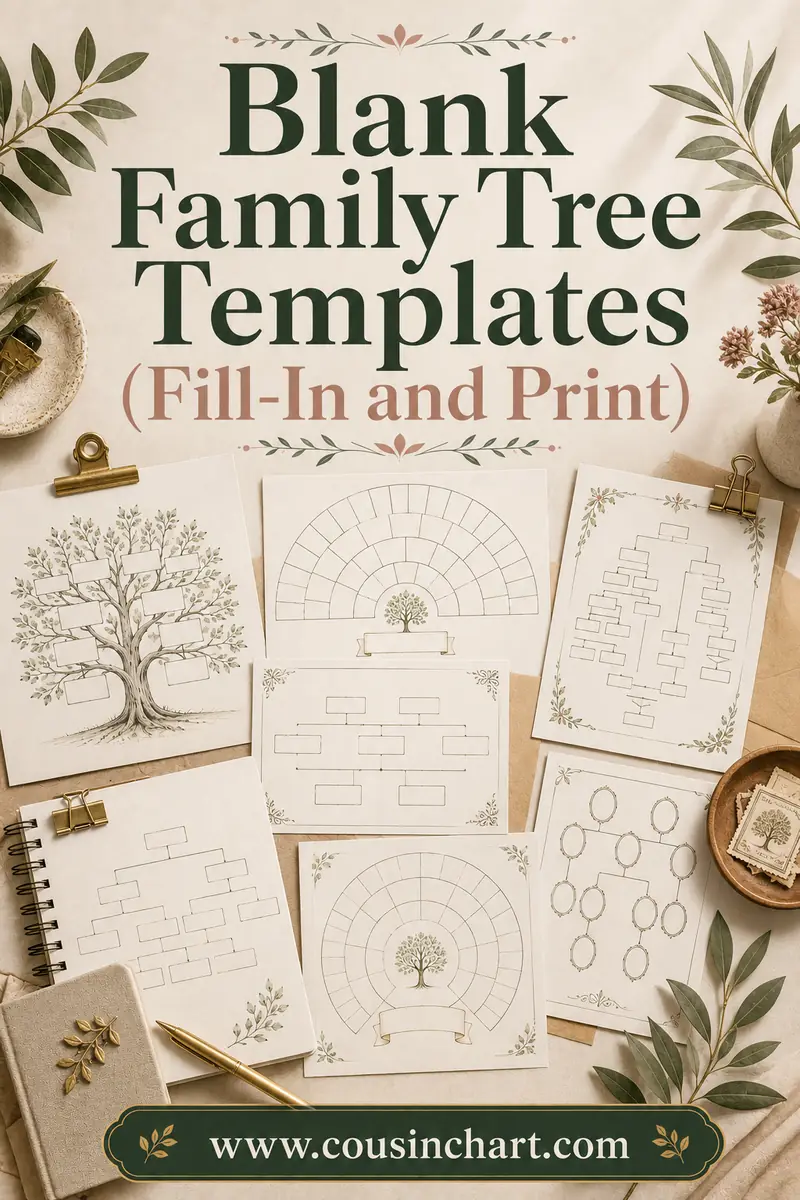
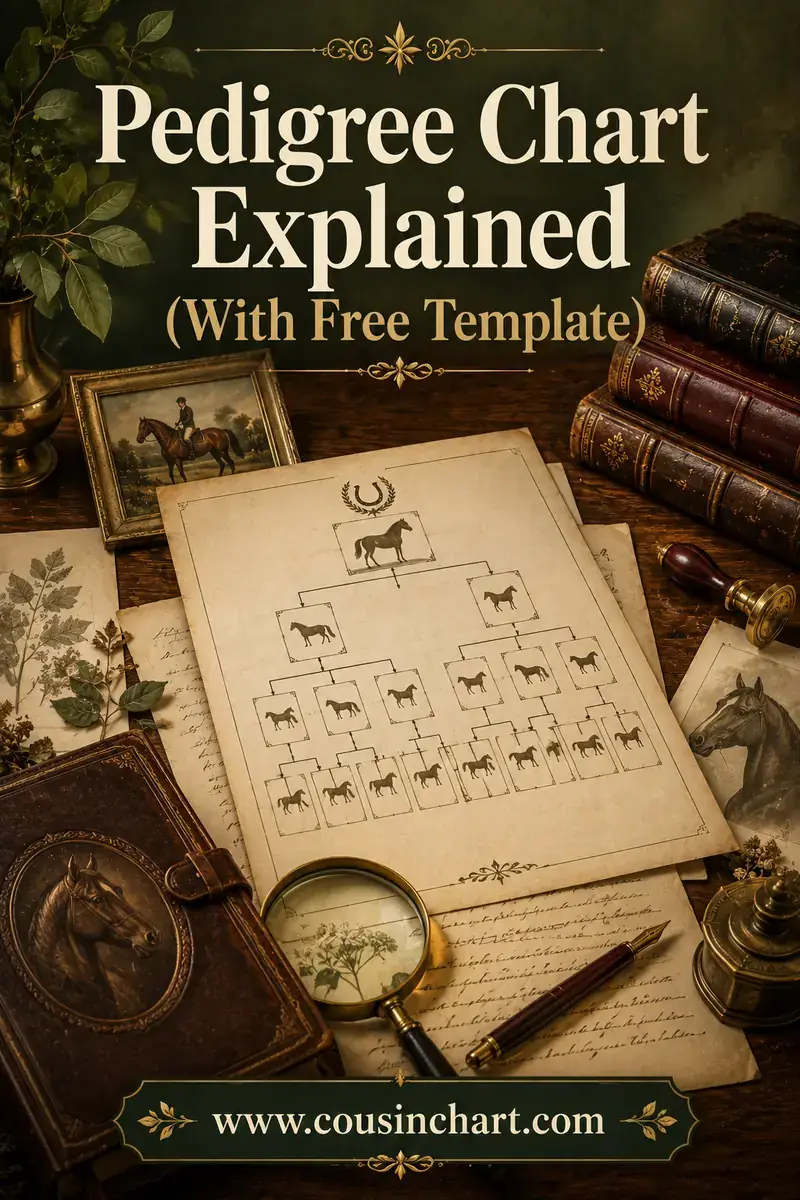
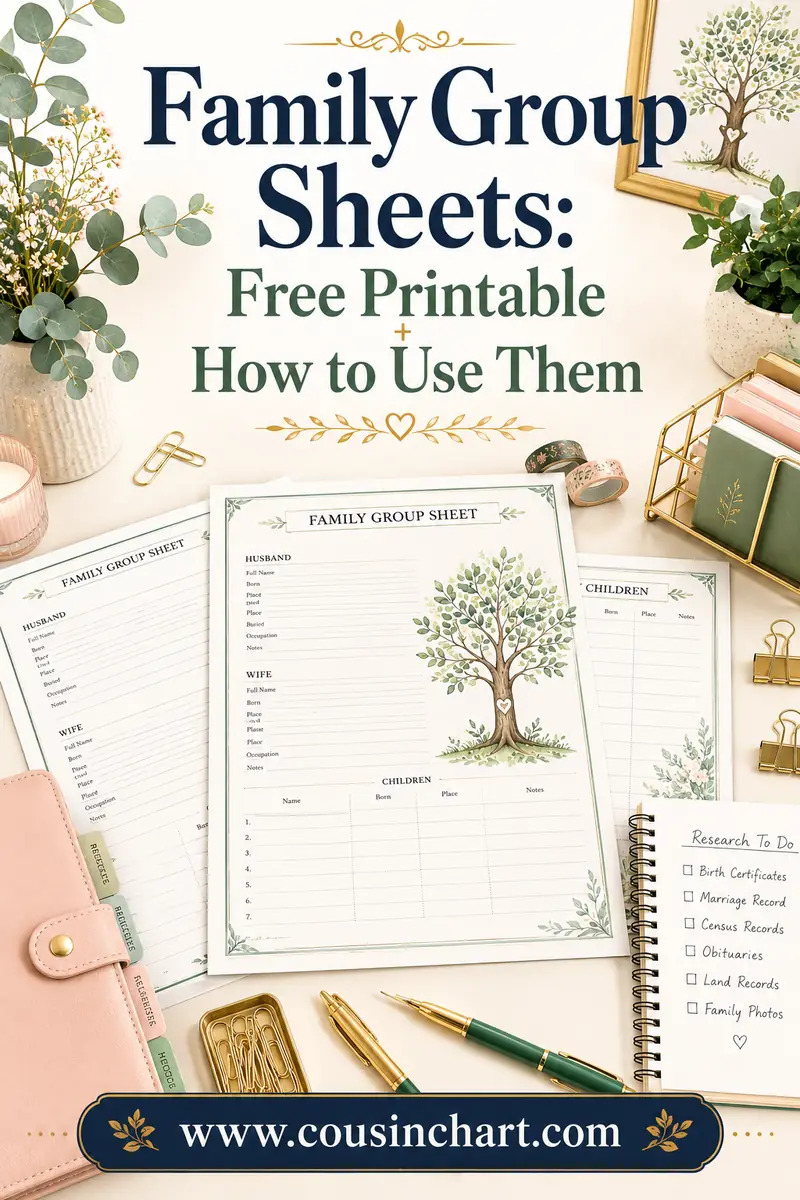
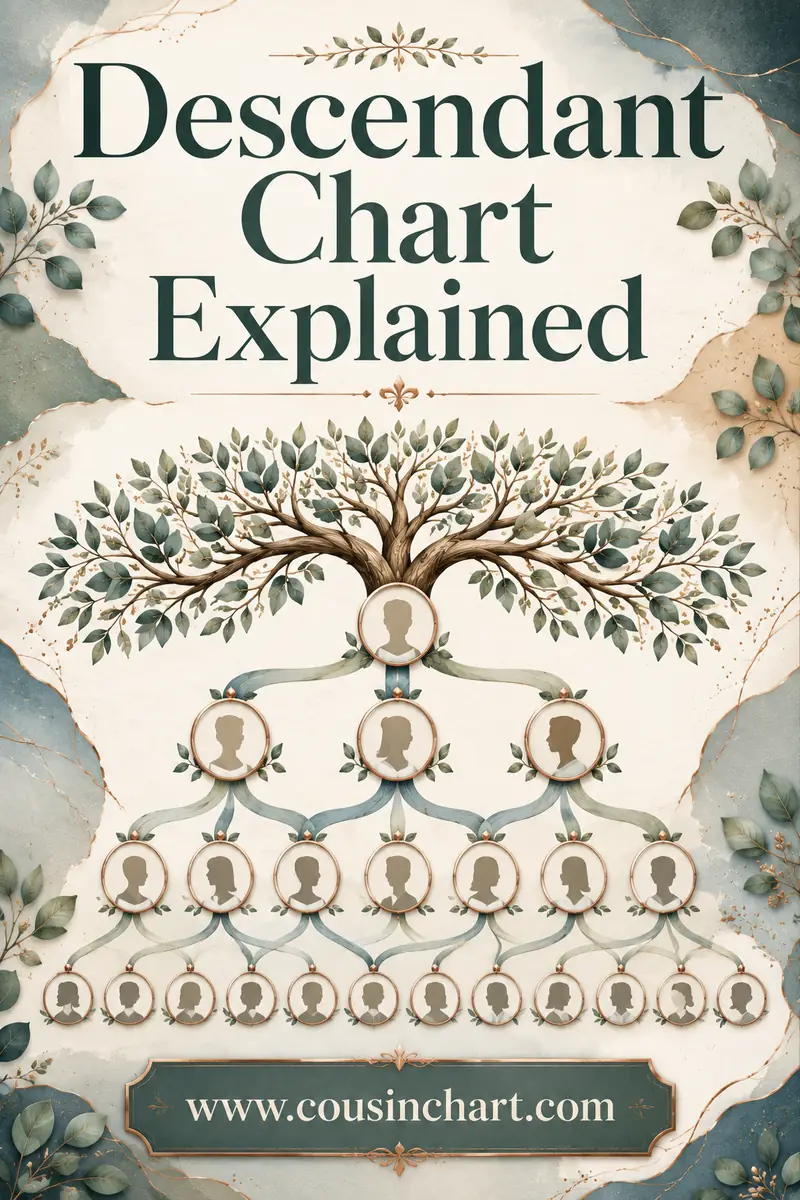
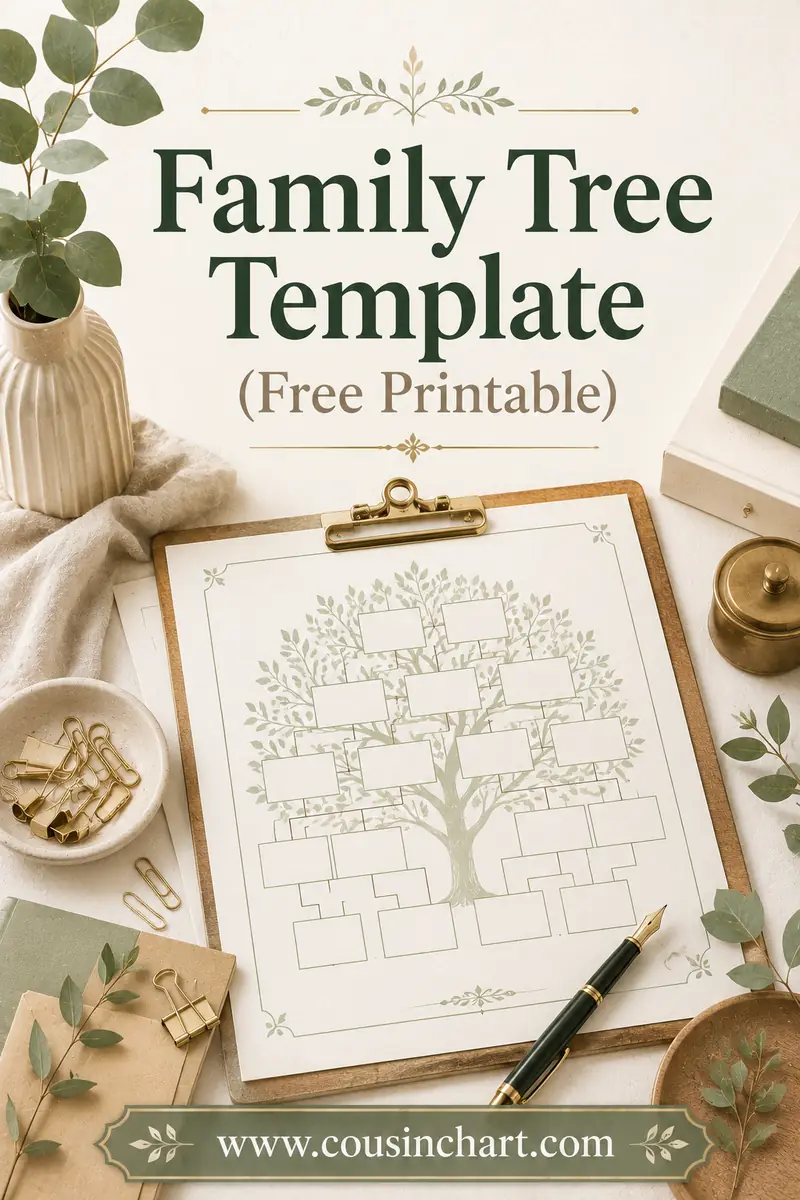
A printable family tree template is a blank chart you print at home and fill in by hand. The main types are the ancestor (pedigree) chart for your direct line, the descendant chart for tracing a couple forward, the family group sheet for one household with all its children, and the fan chart for showing many generations in a small space. Pick the one that matches the question you're trying to answer, not the one that looks prettiest.
Our printable family tree collection has all four, ready to print on ordinary paper. If you're not sure which to grab, the tap-through below sorts it out in about five seconds.
Which printable template do you need? Tap what you’re trying to do.
Tap an option above to see which template fits.
Browse the printable templates →What is a printable family tree template?
It's a blank chart designed to be printed and filled in with a pen or pencil. No software, no account, no subscription — a PDF, a printer, and half an hour at the kitchen table.
That sounds low-tech next to online tree builders, and it is. It's also why researchers who've used every program going still keep printed charts on the desk. A page of boxes shows you your gaps at a glance in a way that a scrolling screen never quite manages. You see the empty column and you know exactly what next weekend is for.
Printables also do things software can't. You can hand one to a 91-year-old great-aunt and she'll fill it in. You can pass one round a reunion table with a pen. You can frame it. You can mail it to the cousin who doesn't do email.
What a printable chart is not
It's not your research archive. A chart holds names, dates and places — the summary. It has no room for source citations, conflicting evidence, document scans or the reasoning behind a conclusion.
So treat the chart as a display and planning tool, and keep the real research somewhere it can breathe: a research log, a folder of scans, a set of family group sheets, or genealogy software. People who try to make one chart do everything end up with 4-point handwriting in the margins and no idea where anything came from.
Which family tree template should you use?
Here's the whole decision in one table.
| What you want to do | Template to print | What it shows |
|---|---|---|
| Trace your own ancestors backwards | Pedigree / ancestor chart | Your direct line only — parents, grandparents, back |
| Trace one couple's descendants forward | Descendant chart | Children, grandchildren, and their spouses |
| Record a single household in full | Family group sheet | One couple plus every child, with dates and places |
| Fit 6–7 generations on one sheet | Fan chart | Generations as curved rings around you |
| Show both parents' lines symmetrically | Bow tie chart | You in the middle, paternal and maternal lines fanning out both ways |
| Work out how two relatives connect | Kinship chart | The relationship path between two people |
| A quick, uncomplicated chart | Simple family tree | A handful of generations, minimal fuss |
| Start with nothing and improvise | Blank family tree template | Empty boxes you can label however you like |
Most people need two: an ancestor chart to see the shape of their direct line, and a stack of family group sheets to actually hold the detail. Everything else is either display or a special case. Our comparison of family tree chart types goes deeper if you want the full landscape.
Ancestor charts vs descendant charts — the difference that confuses everyone
An ancestor chart narrows as you read backwards in time: one of you, two parents, four grandparents. Every generation back doubles, so the boxes multiply predictably. That predictability is why blank pedigree charts come in fixed sizes — 4-generation, 5-generation, 7-generation — with a known box count each time.
A descendant chart goes the other way and it's chaos by comparison. One couple might have two children or eleven, and each of those might have none or seven. There's no formula, so descendant templates are always more flexible and less tidy. If you're building a reunion chart, expect to sketch it once in rough before you commit to a layout.
What do you write in each box?
Every template box wants the same core facts. Keep them in the same order on every box and the chart becomes scannable rather than something you have to decode.
The standard five:
- Full name — including middle names, and the maiden name for every married woman
- Born — date and place
- Married — date and place
- Died — date and place
- Buried — where you know it, though many designs leave this off
A useful convention borrowed from professional charts: write surnames in CAPITALS (John Andrew MILLER). At a glance you can separate the surname from a middle name that happens to be a surname too, which is a genuinely common problem in families that used maiden names as middle names.
The maiden name rule
Write women's maiden names, always. Not "Mary Miller" if Miller came from her husband — write "Mary REILLY."
This is the single most common reason a family tree stalls. A married surname tells you nothing about where she came from, and her father's surname is the door into an entire new branch. Every woman on your chart carries half of everything behind her, and the maiden name is the key.
Date format: 3 Mar 1885, not 3/3/85
Genealogists write dates as DD MMM YYYY with the month spelled or abbreviated in letters. So: 3 Mar 1885, 14 Sep 1923, 2 Jan 1901.
The reason is practical. "03/04/1885" means 3 April in Britain and March 4th in the United States, and family history crosses borders constantly. Once your chart mixes a record from Ireland with a record from Ohio, numeric dates become a trap you set for yourself.
Always write the year in full. "85" could be 1885 or 1985 and in a hundred-year chart both are plausible.
For anything uncertain, use the standard qualifiers:
- abt — about (abt 1885)
- bef — before (bef 1890)
- aft — after (aft 1902)
- c. or circa — same as "about"
An honest approximation is worth far more than a confident guess. A guess hardens into fact within a month and then you can't remember whether you knew it or invented it.
Place names: write what it was called then
Record the place as it stood at the time of the event, not as it appears on a map today. Counties split, towns were absorbed, and national borders moved repeatedly.
A birth in 1880 in a village that's now in Poland may have been registered in the German Empire — and the surviving record sits in an archive organized the old way. Writing the modern name sends future-you looking in the wrong country's archives.
Go as specific as you can: town, county or district, then state or country. In US research the county is usually the level that holds records, so "Marion County, Indiana" is far more useful than "Indiana." Where the modern name matters to you too, add it in brackets.
How many generations should your template have?
Match the chart to what you can actually fill, plus one column of room to grow.
| Generations | Direct ancestors | Total people | Best paper |
|---|---|---|---|
| 3 | 6 | 7 | Letter / A4, either orientation |
| 4 | 14 | 15 | Letter / A4, landscape |
| 5 | 30 | 31 | Letter / A4 landscape (tight) or 11×17 |
| 6 | 62 | 63 | 11×17 / A3, or a fan chart |
| 7 | 126 | 127 | 11×17 / A3 minimum, fan, or continuation sheets |
Two things to take from that table.
First, the generation count includes you. A 4-generation chart means you, parents, grandparents and great-grandparents — 15 people, not 16 and not 8. Almost every "my chart doesn't have enough boxes" complaint comes down to this.
Second, every generation back doubles the ancestors. Going from 5 to 6 generations doesn't add a bit more work, it adds as much as everything you've already done. That doubling is why 4 and 5 generations are the popular printable sizes, and why anything past 6 wants a fan layout or a multi-sheet system.
How do you print these templates properly?
Small choices here make the difference between a chart you use for years and one you reprint in frustration.
- Print landscape whenever the chart allows it. Family trees grow sideways. Landscape buys you a meaningful amount of extra width for the same paper.
- Set margins to minimum and switch off any "shrink to fit" or "fit to printable area" option — that's what silently shrinks your text to unreadable.
- Print a plain draft first. Ordinary paper, black and white, no fuss. You'll be correcting things for weeks. Save the good stock for the version you've proved.
- Use cardstock for keepers. Something in the 65–110 lb range takes ink cleanly and survives being handled at a reunion.
- Go oversized for 6+ generations. 11×17 (tabloid) or A3 from a print shop costs a couple of dollars and transforms a cramped chart into a usable one.
- Check the PDF page size matches your paper before sending anything to a print shop. A Letter-sized PDF printed on A3 gets scaled, and scaled charts look subtly wrong.
- Fill in pencil. Genealogy revises itself constantly. Pencil for the working chart, pen for the framed one.
Multi-sheet charts without the mess
If you want more depth than one sheet holds, don't shrink — split. Print several standard charts and link them: the last ancestor on chart 1 becomes person 1 on chart 2, with a note on each sheet saying where it continues.
Number the sheets, and number the people. The standard system is Ahnentafel numbering: you are 1, your father is 2, your mother is 3, and from there anyone's father is their number × 2 and their mother is their number × 2 + 1. Men always land on even numbers, women always on odd — which makes errors jump out at you. Our Ahnentafel chart guide covers it properly, and it's also a brilliant way to name scanned document files so your folders sort themselves.
Printable templates vs digital ones
Printables aren't the only option, and they're not always the right one.
| Approach | Strengths | Weaknesses |
|---|---|---|
| Printable PDF | No software, works anywhere, easy to hand round, easy to frame | Fixed size, manual updates, no source storage |
| Word template | Type directly, edit forever, print when ready | Text boxes fight you as the tree grows |
| Excel template | Sorts and filters, handles lots of people, easy data entry | Looks like a spreadsheet, not a keepsake |
| Google Docs template | Free, shared editing with relatives, autosaves | Limited layout control for large charts |
| Canva template | Genuinely attractive results, great for gifts | Design-first, awkward for deep research charts |
| Genealogy software | Sources, hundreds of people, generates charts on demand | Learning curve, and you'll still print charts to think with |
A common and sensible pattern: research in software or a spreadsheet, print charts to spot the gaps, and make a Canva or fan chart when you want something worth framing.
Mistakes people make with printable templates
- Counting generations wrong. You are generation 1. Check the box count before you print fifty copies.
- Using married surnames for women. Every one of them closes off an entire branch behind her.
- Ambiguous numeric dates. 05/06/1910 is unreadable to anyone but you a decade later.
- Modern place names. Records are filed under the jurisdiction that existed at the time.
- Putting siblings on a pedigree chart. They don't fit and they don't belong. Siblings go on a family group sheet, which has a row for every child.
- Filling gaps with guesses. An empty box is honest. A wrong box corrupts everything behind it.
- No source notes anywhere. If the chart is your only record, you'll never be able to check a disputed date. Pair it with a log.
- Printing before you plan. Sketch on scrap paper first — how many generations, which branch, portrait or landscape — then print.
- Only printing one. Charts get spilled on, marked up and given away. Print three.
Where printable forms fit into real research
The chart is the front page. Behind it, most researchers keep a small stack of standard forms, and there's a good reason those specific forms have survived decades of practice:
- Family group sheets — one per couple, holding every child with dates and places. This is where the actual detail lives.
- Research logs — what you searched, in which collection, on what date, and what you found, including the searches that found nothing. Logging failures is what stops you running the same fruitless search next spring.
- Correspondence and source lists — who you asked, what they sent, where the copy is saved.
Our free printable genealogy forms roundup covers the full set. Print a handful now rather than later — the habit of writing things down as you go is the difference between a tree you can defend and a tree you'll have to rebuild.
FAQ
What is the best printable family tree template for a beginner?
A 4- or 5-generation ancestor chart. It fits on ordinary paper, holds 15 or 31 people, and covers everything most people can fill in without deep record research. Print a family group sheet alongside it for whichever household you're working on.
Do printable family tree templates include cousins and siblings?
Pedigree and ancestor charts don't — they show only your direct line of ancestors. To record siblings, use a family group sheet, which has a row for every child in a household. To show cousins and wider branches, use a descendant chart starting from a shared couple.
What paper size do I need to print a family tree template?
US Letter or A4 handles up to about four generations comfortably and five if you print landscape. Six or seven generations really want 11×17 inches (tabloid) or A3, a fan chart layout, or a set of linked continuation sheets on standard paper.
How should I write dates on a printable family tree?
Use day, month in letters, then the full year: 3 Mar 1885. Numeric formats are ambiguous between US and UK conventions, which matters as soon as your family crosses a border. Mark uncertain dates with "abt", "bef" or "aft" rather than guessing.
Should I fill in a family tree template in pen or pencil?
Pencil for your working chart, pen for the display copy. New records change dates, spellings and sometimes whole relationships, and every experienced researcher has a much-erased working chart alongside a clean framed one.
Can I print a family tree template for free?
Yes. Blank charts, pedigree charts, family group sheets and fan charts are all freely available as printable PDFs, including on this site. You only need to pay if you want oversized printing from a shop or specially designed decorative versions.
Print one and fill in what you know
The fastest way to start a family tree is to print a blank chart tonight, write in every name you already know, and mark every gap with a question mark. Those question marks are your research plan, and they'll tell you more in five minutes than an hour of clicking around ever will.
Pick a chart from our printable family tree templates, or start with the plainest option — a blank family tree template — and build from there. When a name turns up that nobody can place, our family relationship calculator will tell you exactly how you're related, and what do I call them will tell you what to actually call them at the next family dinner.