Free Family Tree Template: Printable Charts for Every Family
A free family tree template is the fastest way to get your family history out of your head and onto paper: print the chart, write yourself in the first box, and work backward one generation at a time. You can download our free printable family tree templates right here on CousinChart — 3-, 4-, and 5-generation layouts, fan charts, a kid-friendly tree and more than 20 other layouts — no signup, no watermark, sized for standard home printing.
This guide walks through each layout, who goes in which box, and how to pick the right template for a school project, a reunion display, or the start of serious genealogy research. And when you hit a relative you can't place — is great-grandma's sister's grandson a second cousin? — the free family relationship calculator on our homepage sorts it out before your pen touches the box.
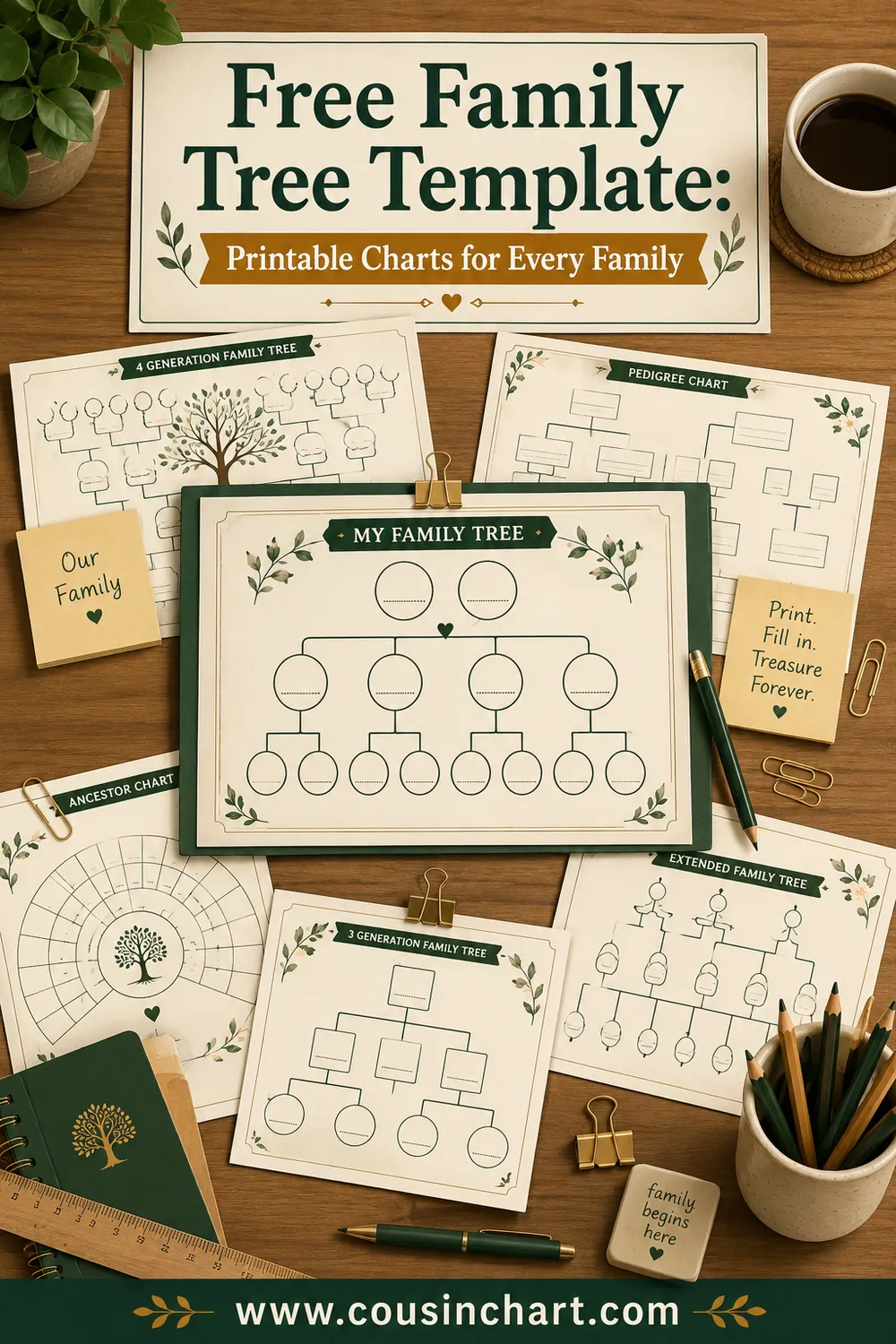
Free printable charts — download or customize
Every chart below is free: no sign-up, no watermark. Download a blank PDF in US Letter or A4, or use the maker above to choose colors, fonts and layouts and type in your family's names before you print.
 3-Generation Family TreeYou, parents and grandparents. Portrait, big boxes, 10 minutes to fill.
 4-Generation Pedigree Chart
 5-Generation Pedigree Chart
 6-Generation Pedigree Chart63 ancestors on one portrait page; names-only outer column.
 Pedigree Continuation Sheet
 Blank Fan Chart (5 Generations)
 Numbered Fan Chart (5 Generations)
 Numbered Fan Chart + Name ListFan as a page header, numbered lines 1–31 below for details.
 6-Generation Fan Chart
 7-Generation Fan Chart (Poster)127 wedges, sized for 11×17 tabloid; also prints on Letter.
 Ahnentafel Ancestor List
 Family Group Sheet
 Descendant Chart
 Cousin Relationship ChartThe classic cousin grid: 1st cousin, 2nd cousin, times removed.
 Research Log
 Source Citation Log
 Family Interview Worksheet
 Family Tree With Siblings
 Photo Family Tree
 Árbol Genealógico (Spanish)
 Blended Family Tree
 Extended Family Tree
 Genogram Template
 Family Reunion Checklist
 Kids' Family Tree
 Bow Tie Family Tree
 Kinship Chart (Fill-In)
Relationship quick-check: tap a phrase to see who they are — and where they go on your chart.
Tap a phrase above to see the answer.
Work out any family relationship →Pick your template: the five classic layouts
Every family tree template answers the same two questions — how many generations, and ancestors-only or the whole bushy family? Here's how the standard layouts compare:
| Template | People it holds | Best for |
|---|---|---|
| 3-generation tree | 7 (you, parents, grandparents) | Kids, school projects, gifts |
| 4-generation chart | 15 | Most adults starting out |
| 5-generation chart | 31 | Genealogy research, reunion displays |
| Fan chart | 15–31 in a semicircle | Wall art, framing, Pinterest boards |
| Kids' tree (with branches) | Flexible | Classrooms, including siblings & cousins |
All of our printable versions are laid out for US Letter and A4, in both portrait and landscape where the design allows. Print at 100% scale ("actual size") so the boxes stay big enough to write in.
The 3-generation tree (7 boxes)
The friendliest starting point. One box for you at the base, two above for your parents, four at the top for your grandparents. Children can usually complete this one from memory in a single sitting, which is why it's the classroom standard. If you're making one with a child, let them add photos — a picture tree of grandparents is a genuinely great grandparent gift.
The 4-generation chart (15 boxes)
The workhorse. You, 2 parents, 4 grandparents, 8 great-grandparents. This is the layout most adults should print first: nearly everyone can fill the first three generations, and the great-grandparent row is exactly where it gets interesting — those eight names are the doorway to real research. Four generations also fits comfortably on one landscape page with room to add birth and death years under each name.
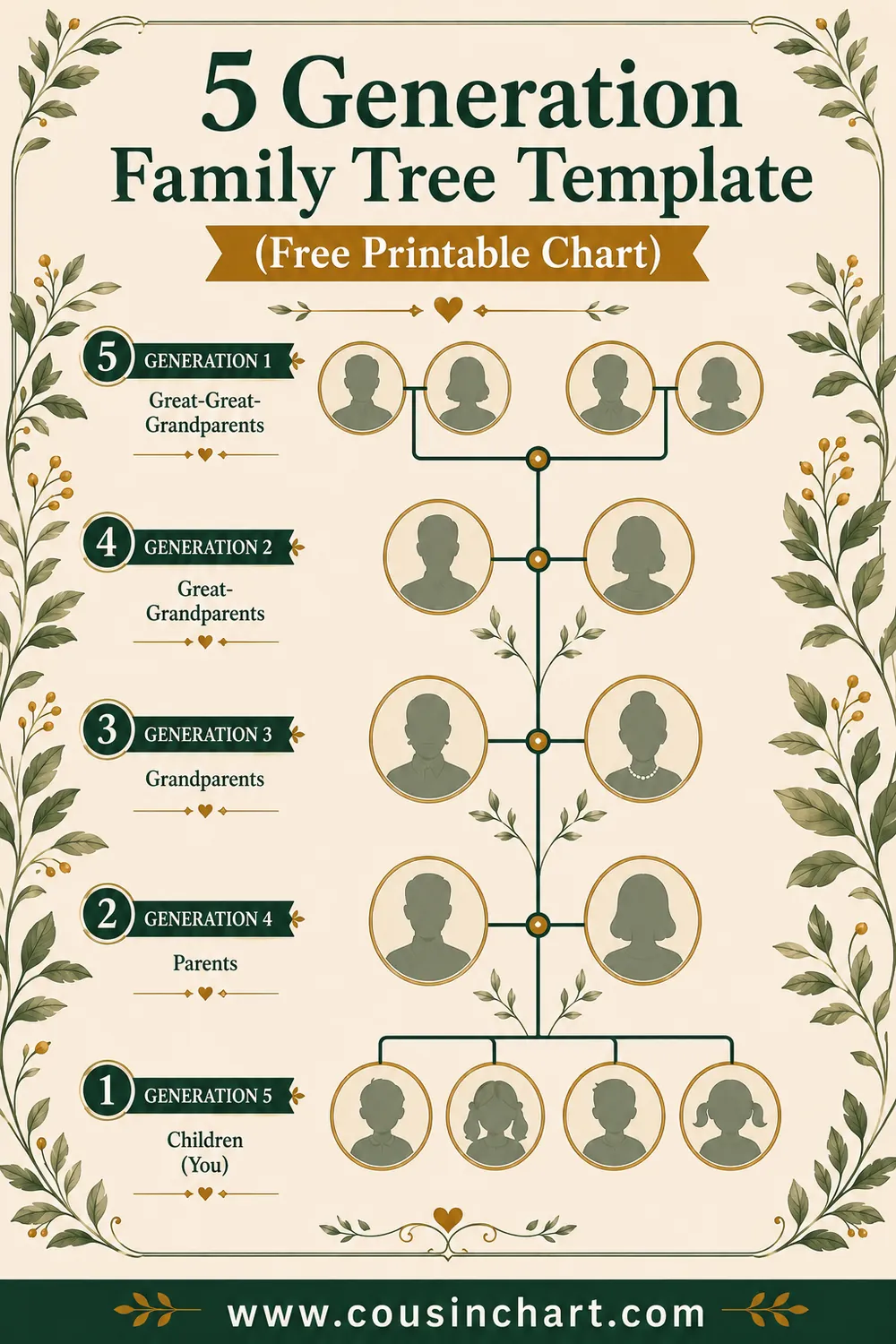
The 5-generation chart (31 boxes)
The serious one: 16 great-great-grandparents across the top row. It's the standard working chart in genealogy because it holds a meaningful chunk of your ancestry on a single page. Boxes get small, so this one works best in landscape with last names in CAPS. We've written a full guide to filling it in — see the 5 generation family tree template article — and the printable is available there too.
The fan chart
Same information as a pedigree chart, arranged as a semicircle: you at the center, each generation an arc radiating outward. Fan charts are the prettiest of the bunch — this is the one people frame, and the one that gets repinned endlessly on Pinterest. If you're making a decor piece or a reunion poster, start here. The trade-off: arcs are harder to write in neatly, so pencil first.
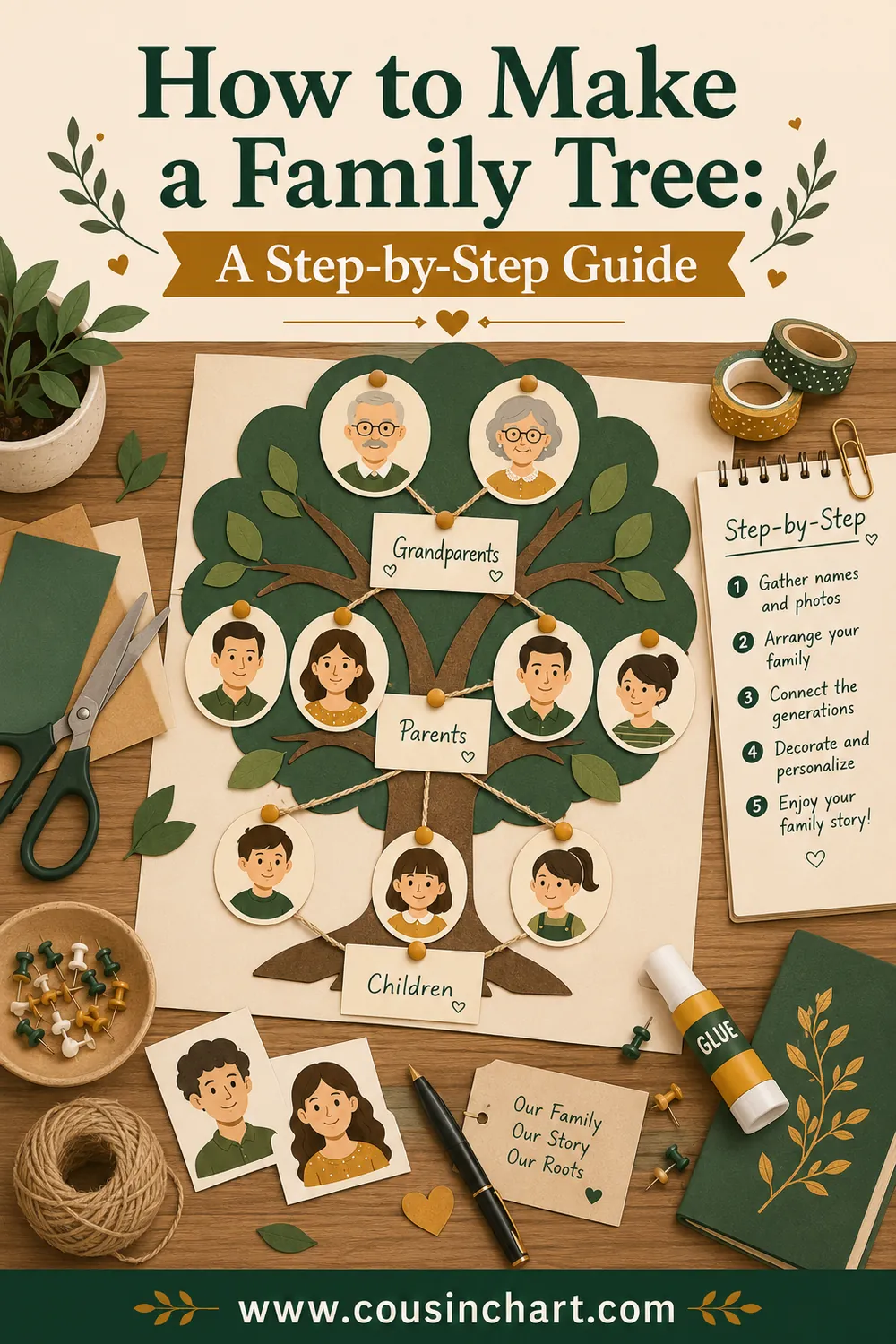
The kids' tree with branches
A literal tree with leaves or apples for each family member. Unlike the ancestor charts above, this layout happily includes siblings, aunts, uncles, and cousins — the whole living family rather than the ancestral line. Perfect for classrooms and for blended families, since you can add a leaf for anyone without breaking a rigid structure.
Who goes in which box
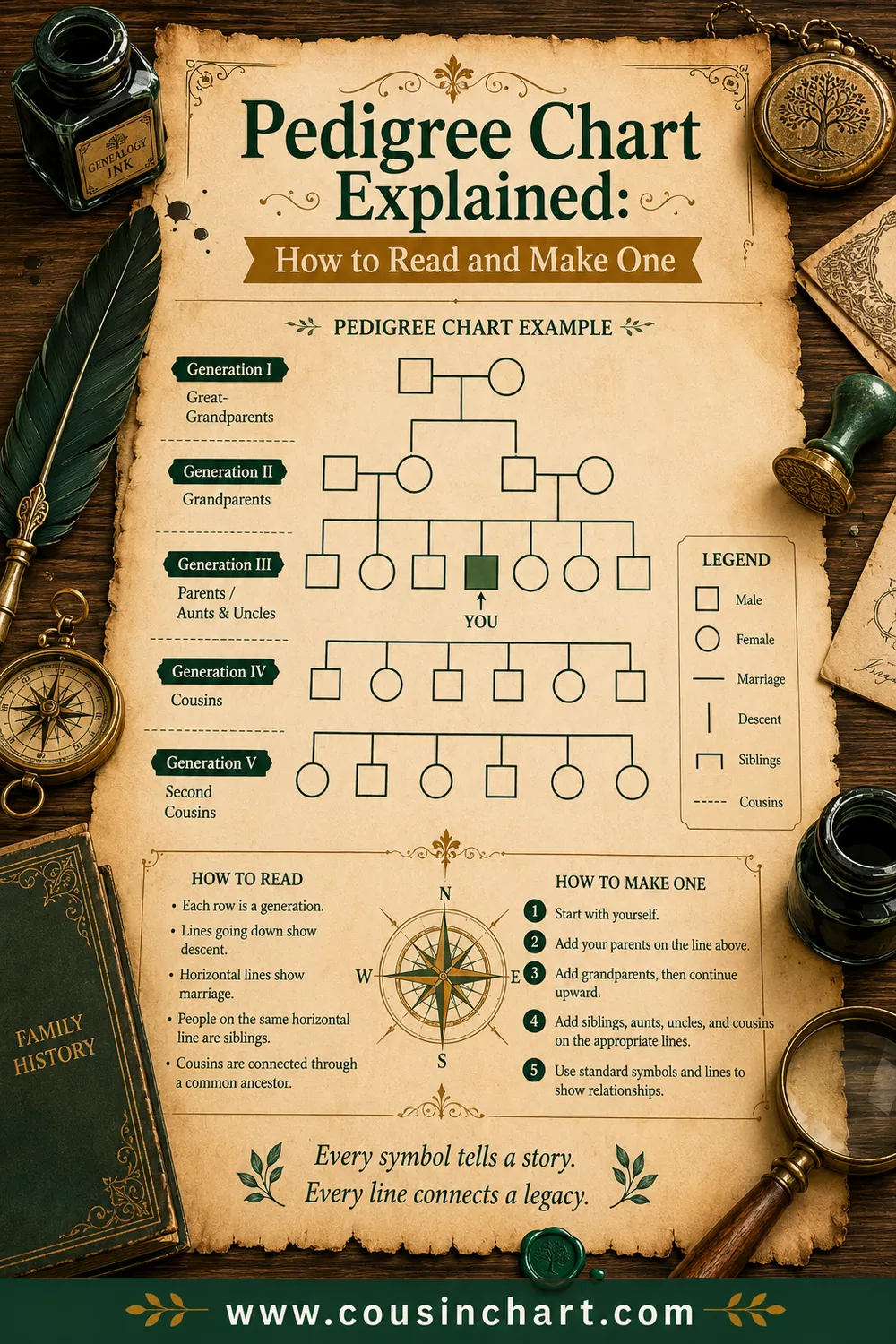
Ancestor charts follow one rule that surprises people: every generation doubles, and only direct ancestors get a box. You, then 2 parents, 4 grandparents, 8 great-grandparents, 16 great-great-grandparents. No aunts, no siblings, no cousins — those belong on descendant charts or the branchy kids' tree.
The conventional arrangement:
- You go in the single box at the left (landscape) or bottom (portrait). This spot is called the "root person" — it can be you, your child, or anyone whose ancestry the chart shows.
- Father's line goes on top, mother's line below (or left/right on portrait trees). Keeping sides consistent matters more than which side is which.
- Fill each box with full name, birth year, and death year if known: "MARTINEZ, Elena — b. 1921, d. 2003". Maiden names for the women — always maiden names, or the chart becomes a wall of one surname.
- Not sure how someone connects? Don't guess. Check the connection with the free relationship calculator first — one wrong link in generation 3 corrupts everything above it.
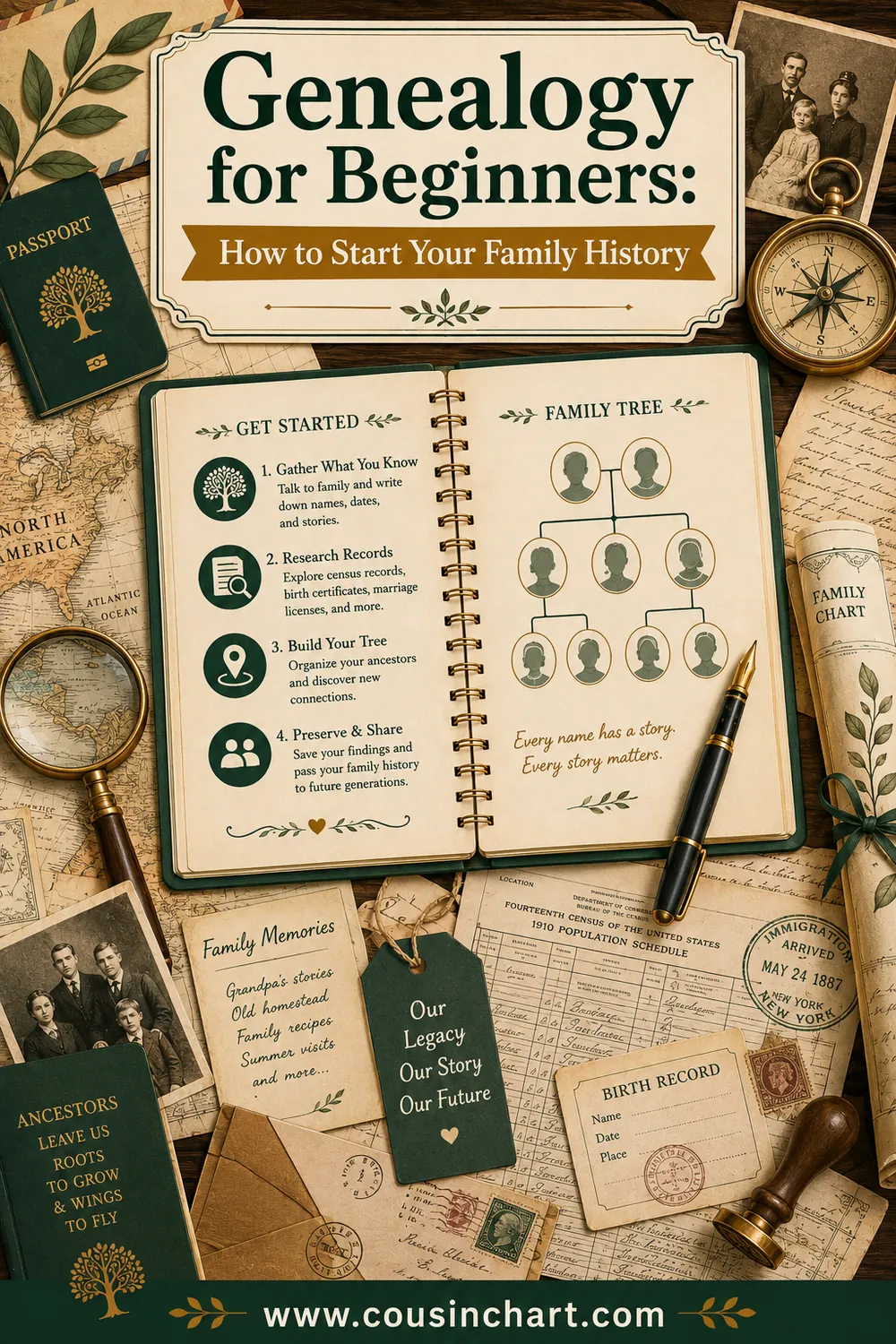
If a box stays empty, that's normal and honest. An empty box is a research goal, not a failure. Genealogists call these "brick walls," and half the hobby is knocking them down — our genealogy for beginners guide shows where to look first.
Printing and filling tips that save you a reprint
- Print at actual size, not "fit to page." Scaling shrinks the boxes unevenly.
- Pencil first, pen second. Especially for the older generations, where dates get revised as you research.
- Surnames in CAPITALS, maiden names for women. The two habits that make a chart readable in 20 years.
- Use one date format everywhere. Genealogists write "12 Mar 1921" because 03/12 and 12/03 mean different things on different continents.
- Add a "chart date" line. Family trees grow; knowing when you filled it in matters later.
- For gifts and Pinterest boards: print the fan chart on cardstock, fill it in your best handwriting, and frame it. A completed 4-generation fan chart is a wedding, anniversary, or Mother's Day gift that costs almost nothing and lands like a heirloom — pin the blank template now so it's there when you need it.
Printable vs. digital: do you even need software?
Honest answer for most people: not yet. Genealogy software and family-tree websites earn their keep once you're tracking hundreds of people with sources attached — but for a school project, a gift, a reunion poster, or your first serious attempt at four generations, paper wins. It's faster to start, easier to hand around a kitchen table, and it never locks your grandmother's name behind a login.
A sensible progression looks like this: start with a printed template this weekend; if the hobby bites (it tends to), move your data into a free FamilySearch tree or a desktop program later, and keep printing charts from it for display. Nothing you write on paper is wasted — the 15 or 31 names transfer in twenty minutes, and you'll transfer them with far fewer errors because the paper stage forced you to check relationships as you went.
When the template raises relationship questions
Here's what actually happens when you fill in a family tree: the chart itself is easy, and then a relative walks past, looks over your shoulder, and asks "so what's Aunt Rosa's grandson to me?" The template can't answer that — it only shows direct ancestors. That's what the calculator side of this site is for. Type the path, get the term: second cousin, first cousin once removed, granduncle. It's free, it needs no signup, and it turns your printed chart into the family reference document at every reunion. Between the printable and the how to make a family tree walkthrough, you've got the full toolkit.
FAQ
What's the best free family tree template for beginners?
A 4-generation chart. It has 15 boxes — you, parents, grandparents, and great-grandparents — which nearly everyone can at least partly fill from family knowledge, and it fits on one printed page. Move up to a 5-generation chart when you start researching in records.
How many people fit on each family tree template?
A 3-generation template holds 7 people, 4 generations holds 15, and 5 generations holds 31. Each generation doubles: 1, 2, 4, 8, 16. That doubling is why single-page templates stop at five generations — generation six alone would need 32 boxes.
Do siblings and cousins go on a family tree template?
Not on ancestor (pedigree) charts — those show only your direct line: parents, grandparents, and so on. To include siblings, aunts, uncles, and cousins, use a branching "family tree" layout or a descendant chart, which starts from an ancestor and shows everyone descended from them.
Should I write maiden names or married names?
Maiden names, always. Genealogy charts record women under their birth surnames so each person connects to their own parents' line. Writing "Mary Smith" for a woman born Mary Kowalski erases the trail to the entire Kowalski branch.
What size paper do family tree templates print on?
Most free templates, including ours, are designed for US Letter (8.5×11") and A4. Print at 100% / actual size. For a 5-generation chart or a fan chart you plan to display, many print shops will enlarge a PDF to 11×17" for a dollar or two.
Can I make a family tree template work for a blended family?
Yes — use a branching layout rather than a strict ancestor chart. Give each parent-couple its own branch so half siblings and step siblings each connect to the correct biological parents. Our half siblings vs step siblings guide explains how each relationship attaches to the tree.
Print one, fill it in this weekend
Grab the free printable family tree template that fits your project — 3 generations for the kids, 4 for your first serious attempt, 5 for the research binder, the fan chart for the wall. Pin the ones you like so they're a click away at the next family gathering. And when the chart sparks the inevitable "wait, how are we related?" debate, settle it in ten seconds with the free CousinChart relationship calculator — no signup, just answers.