What Is My Dad's Cousin to Me? The Answer, With a Chart
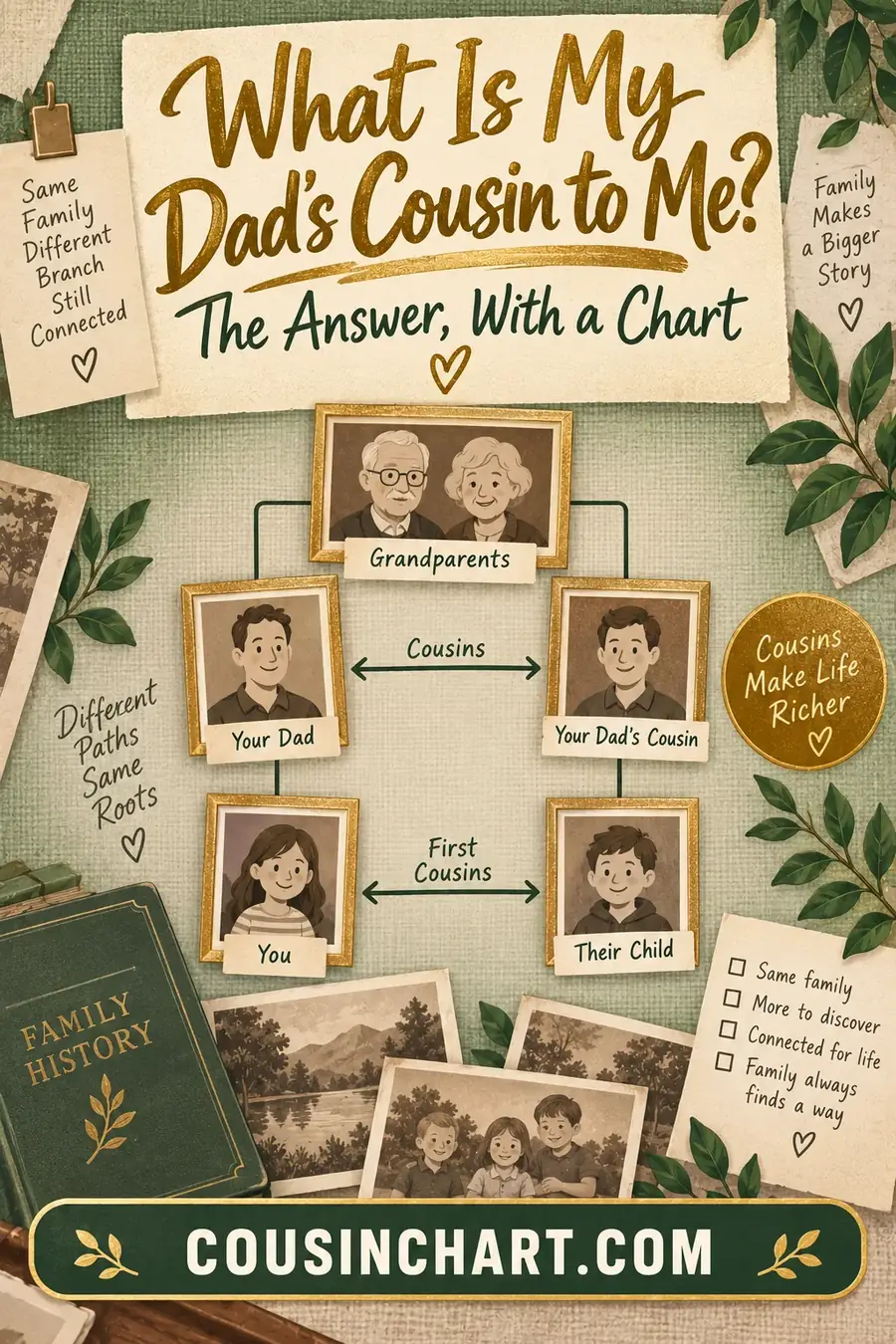
Your dad's first cousin is your first cousin once removed. Not your second cousin, which is the answer most people guess, and not your uncle, which is what many families call them in practice.
Here's why, and how to work out any version of this question yourself.
The Two Numbers
Every cousin relationship has two parts, and confusing them is the whole problem.
The number (first, second, third) tells you how many generations back the shared ancestor is. First cousins share grandparents. Second cousins share great-grandparents. Third cousins share great-great-grandparents.
"Removed" tells you how many generations apart the two people are from each other. Not removed means you're in the same generation. Once removed means one generation apart.
Your dad's cousin shares great-grandparents with... your dad. Not with you. You're one generation further down, which is exactly what "once removed" describes.
Working It Through
Your dad and his cousin are first cousins — they share a set of grandparents.
You are one generation below your dad. So relative to your dad's cousin, you're one generation off.
The shared-ancestor relationship is still "first cousin" territory, because that's the closest relationship in the chain. The generation gap adds "once removed."
Your dad's first cousin = your first cousin once removed.
The Full Set
| Their relationship to your parent | Their relationship to you |
|---|---|
| Your parent's first cousin | Your first cousin once removed |
| Your parent's second cousin | Your second cousin once removed |
| Your parent's first cousin once removed | Your first cousin twice removed |
| Your grandparent's first cousin | Your first cousin twice removed |
And going the other direction:
| Their relationship to you | Their relationship to your child |
|---|---|
| Your first cousin | Your child's first cousin once removed |
| Your first cousin once removed | Your child's first cousin twice removed |
| Your second cousin | Your child's second cousin once removed |
What About Their Children?
This is the follow-up question almost everyone asks next.
Your dad's cousin's children are your second cousins.
The logic: you and they are in the same generation, and you share great-grandparents — your great-grandparents are their great-grandparents, through the sibling link between your grandparent and their grandparent.
Same generation plus great-grandparents shared equals second cousins, with no "removed" involved.
So: - Your dad's cousin → your first cousin once removed - Your dad's cousin's kids → your second cousins - Your dad's cousin's grandkids → your second cousins once removed
Why Families Say "Uncle" Instead
In a great many families, your dad's cousin is simply "Uncle Dave" and always has been.
This isn't wrong in any way that matters. Many cultures use courtesy titles for older relatives regardless of the technical relationship, and in plenty of languages the equivalent term genuinely covers a broader range of relatives than the English "uncle" does.
The technical term matters in three situations: genealogy research, legal or inheritance questions, and DNA test interpretation. Everywhere else, "Uncle Dave" is the correct answer socially.
The General Method
For any relative, two steps:
Step 1: Find the closest common ancestor. Trace back from each person until you hit the same person or couple.
Step 2: Count generations from that ancestor to each of you.
- Same number on both sides: you're cousins of that number. Two generations back for both = first cousins. Three = second cousins.
- Different numbers: use the smaller number for the cousin level, and the difference for the "removed" count.
Example: the shared ancestor is your great-grandparent (3 generations up from you) and their grandparent (2 generations up from them). Smaller number is 2, so first cousins. Difference is 1, so once removed. First cousin once removed.
A cousin chart does this instantly if you'd rather not count, and it's genuinely faster for anything beyond second cousins where the arithmetic gets slippery.
DNA Test Context
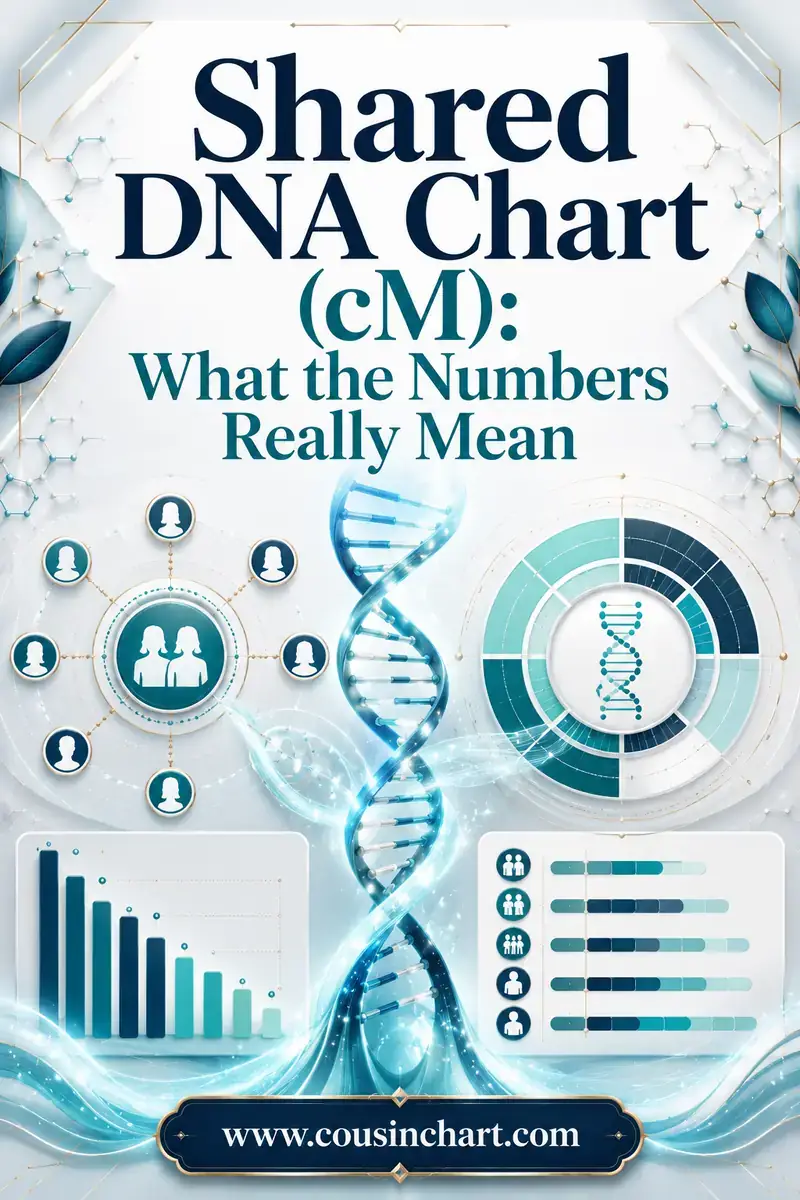
If you've taken a DNA test and are trying to interpret a match, the shared-DNA percentages differ meaningfully between these relationships:
| Relationship | Average shared DNA |
|---|---|
| First cousin | ~12.5% |
| First cousin once removed | ~6.25% |
| Second cousin | ~3.125% |
| Second cousin once removed | ~1.5% |
These are averages, and actual shared DNA varies considerably because inheritance is random beyond the parent-child level. A predicted relationship from a testing service is a range of possibilities, not a determination — which is exactly why knowing the terminology helps you interpret what you're looking at.
A Full Reference Table
Working outward from you, with the relationship named in both directions.
| Person | Their relation to you | Your relation to them |
|---|---|---|
| Your parent's sibling | Aunt or uncle | Niece or nephew |
| Your parent's first cousin | First cousin once removed | First cousin once removed |
| Your parent's second cousin | Second cousin once removed | Second cousin once removed |
| Your grandparent's sibling | Great-aunt or great-uncle | Great-niece or great-nephew |
| Your grandparent's first cousin | First cousin twice removed | First cousin twice removed |
| Your first cousin's child | First cousin once removed | First cousin once removed |
| Your first cousin's grandchild | First cousin twice removed | First cousin twice removed |
| Your second cousin's child | Second cousin once removed | Second cousin once removed |
Note that "removed" is symmetrical. If someone is your first cousin once removed, you are theirs. The term describes the generational gap between you, not a direction — which is why the same label appears in both columns.
The Common Points of Confusion
"Removed" doesn't mean distant. A first cousin once removed is genetically closer to you than a second cousin, despite the second cousin having no "removed" attached. The number describes the shared ancestor; "removed" describes the generation gap. They measure different things.
Great-aunt vs. grand-aunt. Both are used for your grandparent's sister. "Great-aunt" is far more common in everyday speech; "grand-aunt" is more technically consistent with "grandparent" but sounds unfamiliar to most people. Neither is wrong.
Second cousin vs. first cousin once removed. The most frequent mix-up by a wide margin, and the one this article exists to settle. Same generation equals a plain cousin number; different generation adds "removed."
Cousin-in-law. Not a formal genealogical term, though it's widely used and perfectly clear — your cousin's spouse, or your spouse's cousin.
Double cousins. When two siblings from one family marry two siblings from another, their children share all four grandparents rather than two, making them genetically as close as half-siblings while being called first cousins. Rare, and it breaks the usual arithmetic.
Working Out Any Relationship Yourself
The two-step method, stated plainly enough to use without a chart.
Step 1: find the closest common ancestor. Trace back from yourself and from the other person until you land on the same person or couple.
Step 2: count generations up to that ancestor from each of you.
- Same count on both sides — you're cousins of that number, with no "removed." Two up from each of you means first cousins. Three means second cousins. Four means third.
- Different counts — take the smaller number for the cousin level, and the difference for the removal.
Worked example. The shared ancestor is your great-grandparent (three generations up from you) and that same person's grandchild's... let's simplify: the ancestor is three up from you and two up from them. Smaller number is two, so first cousins. The difference is one, so once removed. First cousin once removed.
Second worked example. Ancestor is four up from you, four up from them. Same number, so no removal. Four generations up means great-great-grandparents, which makes you third cousins.
Once you've done this three or four times it becomes quick. A cousin chart does it instantly if you'd rather not count, and it's genuinely faster past second cousins where the arithmetic gets slippery.
Why This Terminology Exists at All
English is unusually vague about extended family compared with many languages, and the cousin system is the one place it gets precise.
Many languages distinguish maternal from paternal relatives, older from younger siblings, and blood relatives from relatives by marriage, all with distinct words. English collapses most of that — "uncle" covers your mother's brother, your father's brother, and both of their spouses.
Against that background, the first/second/removed system is oddly technical. It exists largely because inheritance, property and title mattered enormously in the societies where the terminology was fixed, and establishing exact degrees of kinship had legal consequences.
That's also why it survives mostly in legal, genealogical and DNA-testing contexts today, and why families otherwise ignore it in favor of calling everyone an aunt or a cousin regardless of the arithmetic. Both usages are correct in their own domain.
What This Means for DNA Matches
If you've taken a DNA test and are trying to place a match, the terminology maps onto shared-DNA ranges.
| Relationship | Average shared DNA | Typical range |
|---|---|---|
| First cousin | ~12.5% | 7-13% |
| First cousin once removed | ~6.25% | 3-7% |
| Second cousin | ~3.1% | 2-4% |
| Second cousin once removed | ~1.5% | 0.6-2.5% |
| Third cousin | ~0.8% | 0.3-2% |
These are averages with genuinely wide ranges. Beyond the parent-child relationship, inheritance is random — two people who are second cousins may share considerably more or less than the average, and testing services report a range of possible relationships rather than a single answer.
Which is why the terminology helps. A service reporting "1st cousin once removed / half first cousin / great-aunt" is telling you the shared DNA is consistent with several structurally different relationships. Knowing what each term actually means lets you work out which is plausible from what you already know about the family.
Beyond third cousins, shared DNA becomes small enough that some genuine relatives share none detectably at all, which is why distant matches are unreliable individually and useful mainly in clusters.
Quick Reference
Your dad's first cousin → your first cousin once removed. Your dad's cousin's children → your second cousins. Your dad's cousin's grandchildren → your second cousins once removed. Your first cousin's children → your first cousins once removed. Your grandparent's first cousin → your first cousin twice removed.
The rule in one line: same generation from the shared ancestor gives a plain cousin number; a generation gap adds "removed," counted by the size of the gap.
One Final Thought
The technical terms exist for genealogy, legal questions and DNA interpretation, and they're genuinely useful in all three. Everywhere else, "Uncle Dave" is the right answer, and nobody at a family gathering has ever been improved by being corrected on it.
A Note on Half and Step Relationships
Two variations that come up constantly and aren't covered by the standard arithmetic.
Half cousins. If your parent and their parent are half-siblings — sharing one parent rather than two — then you and they are half first cousins, sharing roughly half the DNA of full first cousins. The terminology is used mainly in genealogy and DNA contexts; most families simply say cousin.
Step relationships. Your step-parent's nieces and nephews aren't blood relatives and have no genealogical cousin designation, though "step-cousin" is widely used and perfectly clear. Nothing about the shared-ancestor arithmetic applies, since there is no shared ancestor.
Both matter for DNA test interpretation — a half first cousin and a full first cousin once removed share similar amounts of DNA, which is exactly the kind of ambiguity that makes knowing the terminology useful.
The "1x Removed" Shorthand You Will See on DNA Sites
Testing services and genealogy forums compress these labels aggressively, and the shorthand trips people up more than the relationships themselves do.
1st cousin 1x removed is a first cousin once removed - the "x" is simply "times," so 1x removed means one generation apart. It is the relationship this whole page is about: your father's first cousin, or your own first cousin's child.
1st cousin 2x removed is a first cousin twice removed, meaning two generations apart. Your grandfather's first cousin sits here, and so does your first cousin's grandchild.
2nd cousin 1x removed is a second cousin once removed - your second cousin's child, or one of your parents' second cousins.
You will also see the relationship compressed further into letter-and-number form: 1C1R, 1C2R, 2C1R, and so on, where C is cousin and R is removed. Ancestry, 23andMe, MyHeritage, and FamilyTreeDNA all use some version of this in match lists.
Two things are worth remembering when you read one of these labels. The removal number never tells you which direction the generation gap runs - a 1C1R can be a generation above you or a generation below - so the label alone will not tell you whether a match is an older relative or a younger one. And the cousin number always refers to the closer of the two people to the shared ancestor.
What Is Your Mother's Cousin to You?
The answer does not change with which parent is involved, which is the first thing worth saying, because people often assume the maternal and paternal sides work differently. They do not.
What is your mother's cousin to you: your first cousin once removed, exactly as your father's cousin is. Your mother and her cousin share a set of grandparents; you are one generation further down that line, which produces the single removal. Their children are your second cousins, and their grandchildren are your second cousins once removed.
So when someone asks what would I call my mother's cousin at a family gathering, there are really two answers, and they serve different purposes. The technically correct one is "first cousin once removed." The one most families actually use is "aunt" or "uncle," or just the person's first name, because a generational gap tends to attract the courtesy title regardless of the paperwork. Neither is wrong; one is for records and DNA matches, the other is for Thanksgiving.
If it helps, keep this page open as a cousin explainer the next time the question comes up - the chart settles the argument faster than anybody's memory of how it was explained to them as a child.
Frequently Asked Questions
Is my dad's cousin my second cousin? No — that's the most common misconception. Your dad's first cousin is your first cousin once removed. Your second cousins are your dad's cousin's children, who are in your generation.
What does "once removed" actually mean? It means the two people are one generation apart from each other. It has nothing to do with how distant the relationship is overall — that's what the number (first, second, third) describes.
Is it wrong to call my dad's cousin "uncle"? Not socially. Many families and cultures use courtesy titles for older relatives regardless of the technical relationship. The precise term matters for genealogy, legal questions and DNA interpretation, not for everyday use.
What are my dad's cousin's children to me? Your second cousins. You're in the same generation and share great-grandparents, which is exactly the definition of a second cousin.