How to Build a DNA Family Tree From Your Matches
You build a DNA family tree by working backwards from your matches instead of forwards from yourself. Sort your matches into clusters that represent family lines, build fast rough trees for the closest match in each cluster, look for the ancestral couple those trees have in common, then work that couple's descendants forward until the lines meet at a person who fits your DNA. Records confirm the connection; the DNA tells you where to look.
That inversion is the whole trick. A traditional family tree grows upward from you, one documented generation at a time. A DNA tree is assembled from fragments — other people's ancestries — that you fit together until they interlock. Before you start, get comfortable reading shared centimorgan figures, because every decision you make depends on them: the free DNA match calculator turns any cM total into the list of relationships it could represent.
How much tree should you build for a given match? Tap their shared cM band:
Tap a band to see how deep to dig.
How Is a DNA Family Tree Different From a Regular One?
A conventional family tree and a DNA family tree answer different questions, and mixing them up causes most of the frustration beginners hit.
A conventional tree answers who were my ancestors? You start with yourself, work up through birth, marriage and death records, and every generation is documented before you add the next. It grows slowly and neatly.
A DNA family tree answers how am I related to these specific people? You start with a list of strangers who share DNA with you, reconstruct enough of each one's ancestry to see where they overlap, and let the overlaps reveal your own line. It grows messily, in patches, with gaps you fill later.
| Conventional tree | DNA family tree | |
|---|---|---|
| Starting point | You | Your matches |
| Direction | Upward from you | Upward from matches, then forward again |
| Evidence | Records first | DNA first, records to confirm |
| Standard of proof per person | High, all the way | Rough at first, tightened at the end |
| Typical shape | One neat pyramid | Several disconnected clumps that eventually join |
| Best for | Documenting a known family | Unknown ancestors, misattributed parentage, brick walls |
You need both. The DNA tree finds the answer; the conventional tree proves it. If you're new to the documented side, our guide to building your family tree covers the fundamentals that this article assumes.
Step 1: Anchor Yourself With What You Already Know
Before touching a match list, write down your own tree as far as you genuinely know it — usually four generations, sometimes only one or two.
This "anchor tree" does two jobs. It lets you recognize a match as belonging to a known branch the moment you see a familiar surname, and it shows you where your gaps actually are, which is where the DNA work is aimed.
Keep it small and honest. Include names, approximate birth years and places. Mark anything you're unsure of with a question mark rather than quietly promoting a guess to a fact — half-remembered family stories cause more wrong turns in DNA work than any other single thing.
A printable family tree chart is genuinely useful here, and not for nostalgic reasons. Having your four grandparent lines on paper beside you while you sort matches means you can scribble cluster colors and surnames straight onto it, and you'll refer to it fifty times a session.
Step 2: Sort Your Matches Into Clusters
A raw match list is unusable. A thousand names sorted by cM tells you very little about which branch anyone belongs to. Clustering fixes that.
The principle is simple: people who share DNA with you and with each other usually belong to the same branch of your family. If matches A, B and C all appear on each other's shared-match lists, they're related to you through the same ancestral line.
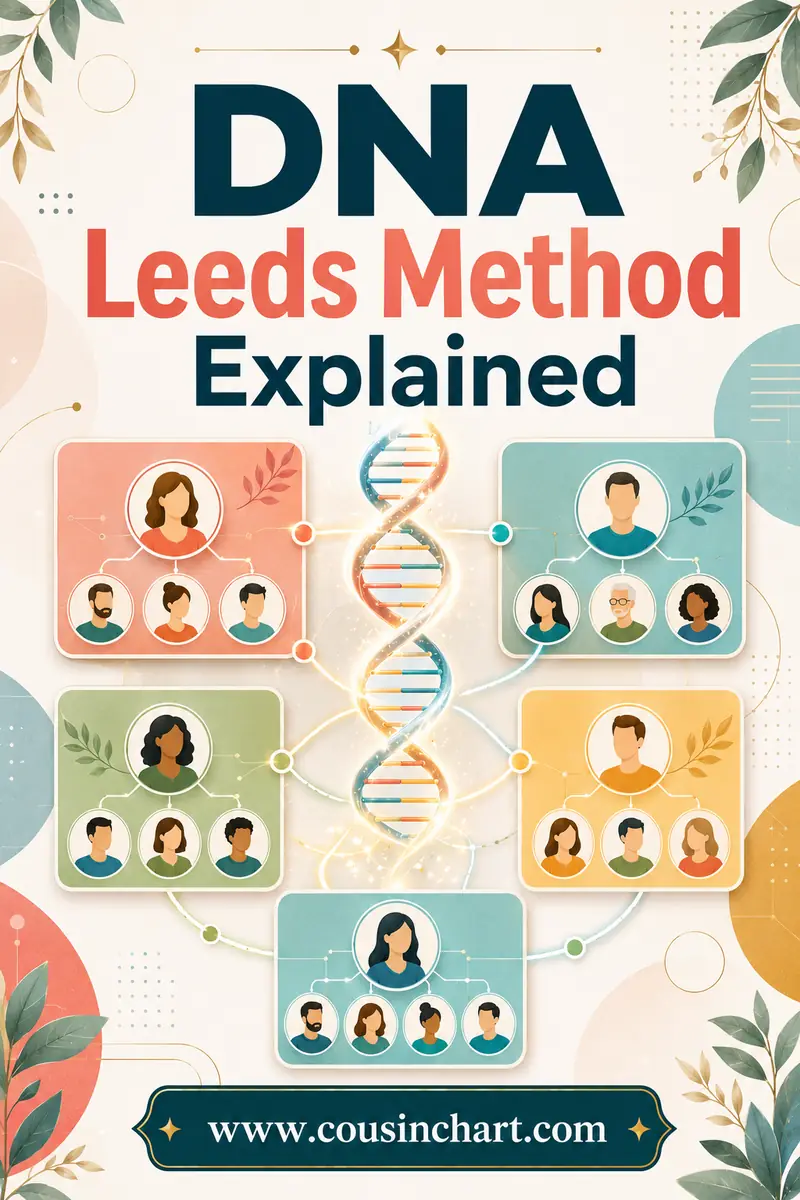
Use the Leeds Method
The Leeds Method is the standard manual approach and needs nothing but a spreadsheet. You list matches in roughly the 90–400 cM range down the left, then go through each one's shared-match list, assigning a color to each group that hangs together.
That range is chosen deliberately. Above about 400 cM, matches are close enough to share with several of your lines at once and they blur the groups. Below about 90 cM, matches get too numerous and too unreliable.
Most people finish with four color groups, which usually correspond to the four grandparent lines. That's the moment the match list stops being noise.
Or let software do it
MyHeritage and GEDmatch both offer automated clustering — often called AutoClusters — which produces the same colored-grid result without the manual passes. DNAGedcom offers similar tools. Ancestry's own groups and colored dots let you record clusters even if you worked them out by hand.
Same logic, less spreadsheet. Automated clustering is faster; manual clustering teaches you your own match list in a way the automated version doesn't. Doing one round by hand is worth the afternoon.
Label each cluster as soon as you can
The instant you recognize even one person in a cluster — a known second cousin, a surname from your anchor tree — label the whole cluster with that family line. Now every other match in the group has a home, including the ones with no tree and a username like "user7734."
Unlabelled clusters are your unknown lines. Those are the ones the rest of this process is for.
Step 3: Build Quick and Dirty Trees
This is where most of the work happens, and where people over-engineer.
For the closest unlabelled match in each cluster, build a fast, rough tree. The community's own term for these is "quick and dirty," and the name is the instruction: you are not producing a sourced document. You're producing enough structure to spot an overlap.
What goes in a quick tree
- The match's name, approximate age and location — from their profile, their tree, or a quick search.
- Their parents and grandparents. Great-grandparents if the match is under about 200 cM.
- Siblings of each ancestor, because your connection often runs through a sibling rather than the direct line.
- Rough dates and places. "About 1890, Ohio" is fine.
Where to find it fast
- Obituaries. The fastest genealogical tool in existence — one obituary can name parents, siblings, children and grandchildren in a single paragraph.
- FindAGrave. Headstones, dates, and often linked family members.
- FamilySearch. Free, huge, and includes other people's trees you can borrow structure from.
- Census records. Whole households in one row group, which is exactly what you need.
- Newspaper archives. Marriage announcements and society columns nail down relationships.
Our guide to tracing a family tree free covers where to get all of this without a second subscription.
Keep them separate from your real tree
Build quick trees somewhere they can't contaminate your documented research — a separate file, a private unsearchable tree, or plain sketches on paper. Quick trees are full of assumptions. If you graft them onto your main tree before confirming them, you'll be untangling it for years.
Step 4: Find the Common Couple
Build three or four quick trees for matches inside the same cluster, then look for a couple who appears in all of them.
That couple is your common ancestral couple for that line — the people you and everyone in that cluster descend from. Finding them is the pivot point of the whole exercise.
What "convergence" looks like in practice
You build a tree for a 240 cM match and find a great-grandparent couple, Samuel and Ada Trent of Pike County. You build one for a 180 cM match in the same cluster and there they are again, two generations up on their mother's side. A third match's tree shows an Ada Trent as a great-great-grandmother. That's convergence, and it's usually the moment the puzzle stops feeling random.
Sanity-check the generation
Use the cM amounts to check whether the couple sits at a plausible depth. If your matches share 200–300 cM with you, the common couple is likely at the great-grandparent or great-great-grandparent level, not the grandparent level. If the couple you've found sits at the wrong depth for the DNA, something in one of the trees is wrong.
Run the numbers through the DNA match calculator before you commit. It's a thirty-second check that catches a genuinely common mistake — building an elegant theory one whole generation off.
Do it twice
One cluster gives you one couple. A second cluster gives you a second couple. Two couples define a much narrower target than one, because the person you're looking for descends from both — and the number of people who descend from two specific families is usually very small.
Step 5: Work Forward From the Couple
This is the step people skip, and it's the one that actually produces answers.
Having found the ancestral couple, you now build their descendants — every child, every grandchild, every great-grandchild you can trace. This is called descendancy research, and it runs opposite to normal genealogy.
Why forward, not backward
Your unknown ancestor isn't above the common couple. They're below it. Going further back adds names you don't need; coming forward walks you toward the person you're trying to identify.
How to do it
- List all the couple's children from census records, obituaries and cemetery records.
- For each child, find their spouse and their children.
- Repeat down the generations, keeping rough dates and places.
- Cross-reference your other cluster's descendant list, looking for a marriage that joins the two lines.
When a descendant of couple A married a descendant of couple B, their children are your candidates. From there ordinary logic narrows it: who was the right age, who lived in the right place, who fits the shared cM amounts with the other matches.
Expect it to be tedious
Descendancy research is genuinely slow. You'll trace three families that go nowhere before one clicks. That's normal, not a sign you're doing it wrong. Work one child at a time and write down the ones you've eliminated so you don't redo them.
Step 6: Confirm It With Records
At this point you have a theory. A theory is not a tree.
Confirmation means the DNA and the paperwork agree, and every one of these should line up before you write anything in ink:
- The cM amount fits. The shared total falls comfortably within the documented range for the relationship you're proposing.
- The shared matches fit. Other people in the cluster relate to your candidate in ways consistent with your theory.
- The ages and geography work. Nobody had a child at eleven or lived two states away at the crucial moment.
- The records exist. Birth, marriage, death, census and probate records place the right people together at the right times.
- Alternatives are excluded. You've considered the other relationships that fit the same cM figure and ruled them out.
Our DNA match confirmation guide sets out the full workflow, including chromosome-level checks where the testing company supports them. Work through it properly. The difference between a solid DNA tree and a fictional one is exactly this step.
Watch for the classic traps
Copying other people's trees. Unsourced online trees replicate errors at scale. A name appearing in forty trees means forty people copied it, not that it's right.
Assuming one cM figure means one relationship. A 1,750 cM match could be a half-sibling, grandparent, aunt, uncle, niece or nephew. Ages and shared matches decide it, not the number alone.
Ignoring half relationships and multiple relationships. Half-siblings, remarriages, and cousins related through more than one line all distort expected amounts. If a number seems off, ask whether the relationship is doubled or halved rather than forcing the tree to fit.
Endogamy. In populations where families intermarried across generations — Ashkenazi Jewish, Acadian, Puerto Rican and Low German Mennonite communities among many others — everyone shares more DNA with everyone, cM figures inflate, and clusters merge into one blob. These trees lean far harder on documented records and take longer. Recognizing it early saves months.
Step 7: Keep the Whole Thing Organized
DNA tree-building generates chaos faster than any other kind of genealogy. Six weeks in you'll have a match spreadsheet, nine half-built trees, screenshots of shared-match lists, and a note that just says "Ada?? Pike Co."
A system that holds up
- One master match spreadsheet. Name, cM, cluster color, tree yes/no, testing site, notes, status. Everything else can be rebuilt from this.
- A consistent naming scheme for quick trees. "Cluster-Blue-240cM-Rivera" beats "tree3."
- Screenshots of match lists. Profiles get deleted, trees get set to private, people withdraw from databases. Capture what you see.
- A research log. What you searched, where, when, and what you found — including nothing. Negative results are worth as much as positive ones because they stop you repeating an evening's work.
- A written theory statement. One paragraph: who you think the connection is and why. Rewrite it when the evidence changes. It exposes wishful thinking better than any chart.
Our guide to organizing genealogy research covers the filing side in detail.
Print the finished part
Once a branch is confirmed, get it out of the software and onto paper. A printable family tree chart of a confirmed line is genuinely useful during research — you can see the whole shape at a glance, spot the gap you're working on, and share it with a match without giving them access to your working files. It's also the thing relatives actually want when you tell them what you've found.
How Long Does Building a DNA Family Tree Take?
Depends almost entirely on your closest useful match:
| Closest cluster match | Realistic effort |
|---|---|
| 1,300+ cM | Hours — the tree is nearly given to you |
| 575–1,330 cM | An evening or two |
| 200–600 cM | A few weekends |
| 90–200 cM | Several weeks of steady work |
| Under 90 cM only | Months, and better with volunteer help |
Two things change the timeline more than skill does. Whether your matches have public trees, and whether new closer matches appear. Databases grow constantly, so a cluster that's stuck today can resolve the week someone's niece gets a kit for Christmas. Check for new matches monthly — it's five minutes and it has ended a lot of long searches.
FAQ
How do I build a family tree using DNA matches?
Cluster your matches into family lines using shared-match data, build quick rough trees for the closest match in each cluster, and look for an ancestral couple those trees have in common. Then trace that couple's descendants forward until two lines join at a person who fits your DNA, and confirm the connection with birth, marriage, death and census records.
How far back should I build a match's tree?
Match it to the shared cM. For matches above 575 cM, two generations up is usually enough. For 200–600 cM, build to great-grandparents. For 90–200 cM, go to great-great-grandparents. Below about 40 cM, don't build at all until you have a theory — those matches work better as supporting evidence than as starting points.
What is a quick and dirty tree?
A fast, deliberately unsourced tree built for a DNA match to reveal where their ancestry overlaps yours. You use obituaries, FindAGrave, FamilySearch and census records to sketch parents and grandparents in an hour, with no attempt at proof. Keep them separate from your documented tree so the assumptions never leak into your real research.
Do I need a paid subscription to build a DNA family tree?
No. FamilySearch, FindAGrave, Chronicling America and many state archives are free, and free obituaries and census indexes cover most quick-tree needs. A subscription speeds things up when you're doing heavy descendancy research, but a short focused month is usually better value than a year, and plenty of people complete searches without one.
Why don't my clusters match my known family lines?
Usually one of three reasons. Endogamy can merge clusters into one large group where families intermarried over generations. A cluster with no familiar surnames may represent a misattributed parentage somewhere in the line. Or the cluster is simply too distant to recognize yet. Work the closest matches first — clarity usually arrives from the top of the list downward.
How do I know my DNA tree is actually correct?
When several independent things agree: the shared cM total falls in the documented range for the proposed relationship, the shared matches relate to your candidate consistently, ages and geography work, records place the right people together, and you've ruled out the other relationships that fit the same number. If any one of those doesn't hold, the theory needs more work.
Start With One Cluster
Building a DNA family tree isn't one big task — it's the same small task repeated: cluster, build a rough tree, find the couple, come forward, confirm. Do it once for your strongest cluster and the method stops feeling abstract.
Start with the number in front of you. Run your closest unexplained match's shared centimorgan total through the free DNA match calculator to see which relationships are genuinely possible, then decide how deep to build. When a branch is confirmed, put it on a printable family tree chart so you can see what you've actually proved — and what's still blank.
One cluster at a time is how every one of these gets solved.