How Many Cousins Does the Average Person Have?
Most people have somewhere around 5 to 12 first cousins, though the real number swings widely with family size. The count explodes as you go outward: the average person has roughly two to three dozen second cousins and potentially close to 200 third cousins — and the number of more distant cousins climbs into the thousands. Cousins multiply fast because each generation back doubles the branches spreading out toward you.
This guide puts real numbers on it, shows why the count grows so steeply, and explains why your own tally might be far above or below average. It's the kind of math that makes you rethink how big your family really is. And if you want to sort out how any specific relative connects, the free relationship calculator names the relationship for you.
Relationship quick-check. Tap a cousin type to see roughly how many you have and who they are:
The answer will appear here.
The Short Answer, Level by Level
Here's the rough picture for an "average" person, based on typical family-size estimates. These are ballpark figures — your real numbers depend entirely on how big the families in your tree are:
| Cousin type | Shared ancestor | Rough average count |
|---|---|---|
| First cousins | Grandparents | ~5–12 |
| Second cousins | Great-grandparents | ~20–30 |
| Third cousins | Great-great-grandparents | ~150–190 |
| Fourth cousins | 3rd-great-grandparents | ~900+ |
| Fifth cousins | 4th-great-grandparents | ~4,700+ |
The jump from one row to the next is the whole story. First cousins you can name; by third cousins you'd struggle to list them all; by fifth cousins you're looking at thousands of people you'll almost certainly never meet. The estimates above come from average fertility figures applied across the generations — real families vary enormously.
Why the Number Explodes
The reason cousins multiply so fast is baked into how family trees branch. To find your cousins at any level, you go up to a shared ancestor and then count all their descendants except your own direct line.
- For first cousins, you go up to your grandparents and count their grandchildren (minus you and your siblings). If your grandparents had 3 children and each had a couple of kids, that's a handful of cousins.
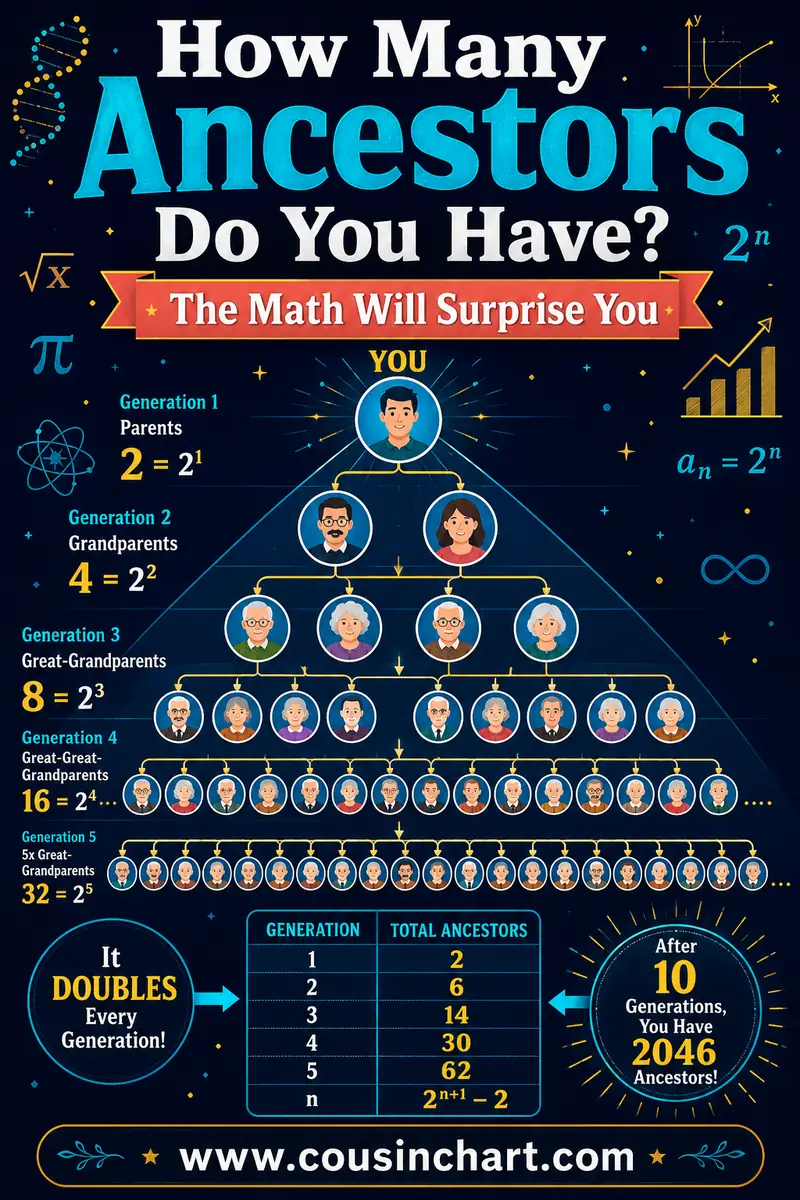
- For second cousins, you go up one more level to your great-grandparents — of whom you have eight — and count all their great-grandchildren. Eight great-grandparents, each seeding a whole spreading branch, produces far more descendants.
- For third cousins, you go up to your sixteen great-great-grandparents, and each one anchors an even larger fan of descendants.
Every level back roughly doubles the number of ancestral couples whose descendants count as your cousins — and each of those couples has had generations to multiply. That's why the count balloons. The same doubling drives the ancestor explosion we cover in how many ancestors do you have.
First Cousins: The Numbers You Can Actually Name
First cousins are the cousins you know — the ones at holidays and weddings. The average of roughly 5 to 12 comes straight from family size: it depends on how many siblings your parents had, and how many children each of those aunts and uncles had.
- If your parents each had 2 siblings, and each of those had 2–3 kids, you land around 8–12 first cousins.
- In a small family — say each parent had one sibling with one child — you might have just 2 first cousins.
- In a large family, first cousins can easily hit 20 or more.
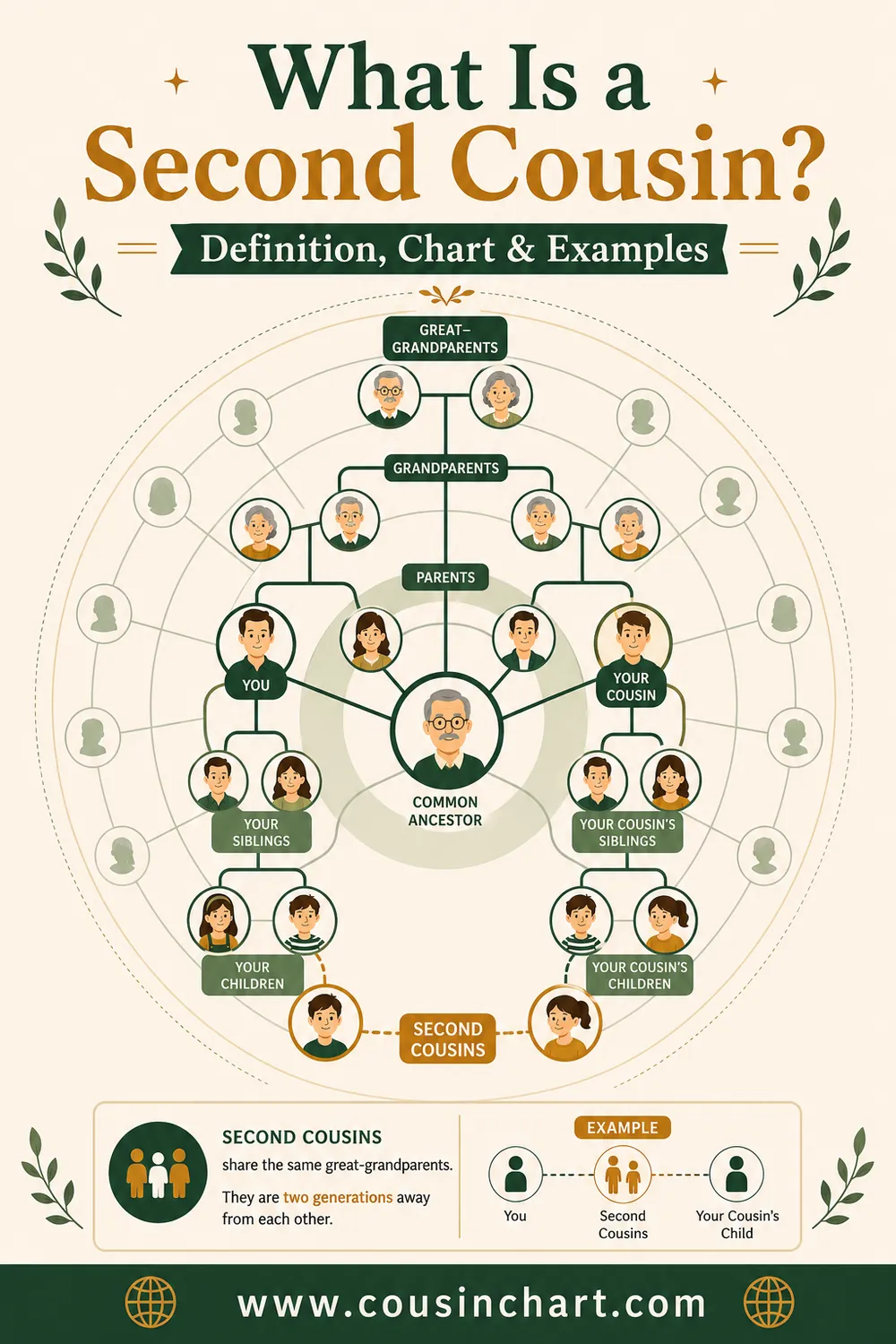
First cousins share grandparents and about 12.5% of their DNA on average. They're the anchor everyone pictures when they hear "cousin." For where second cousins sit relative to them, see what is a second cousin.
Second and Third Cousins: The Ones You Half-Know
This is where the numbers start outrunning your memory. Second cousins — the grandchildren of your great-grandparents' children, sharing great-grandparents with you — typically number a few dozen. You might know a handful and have never met the rest.
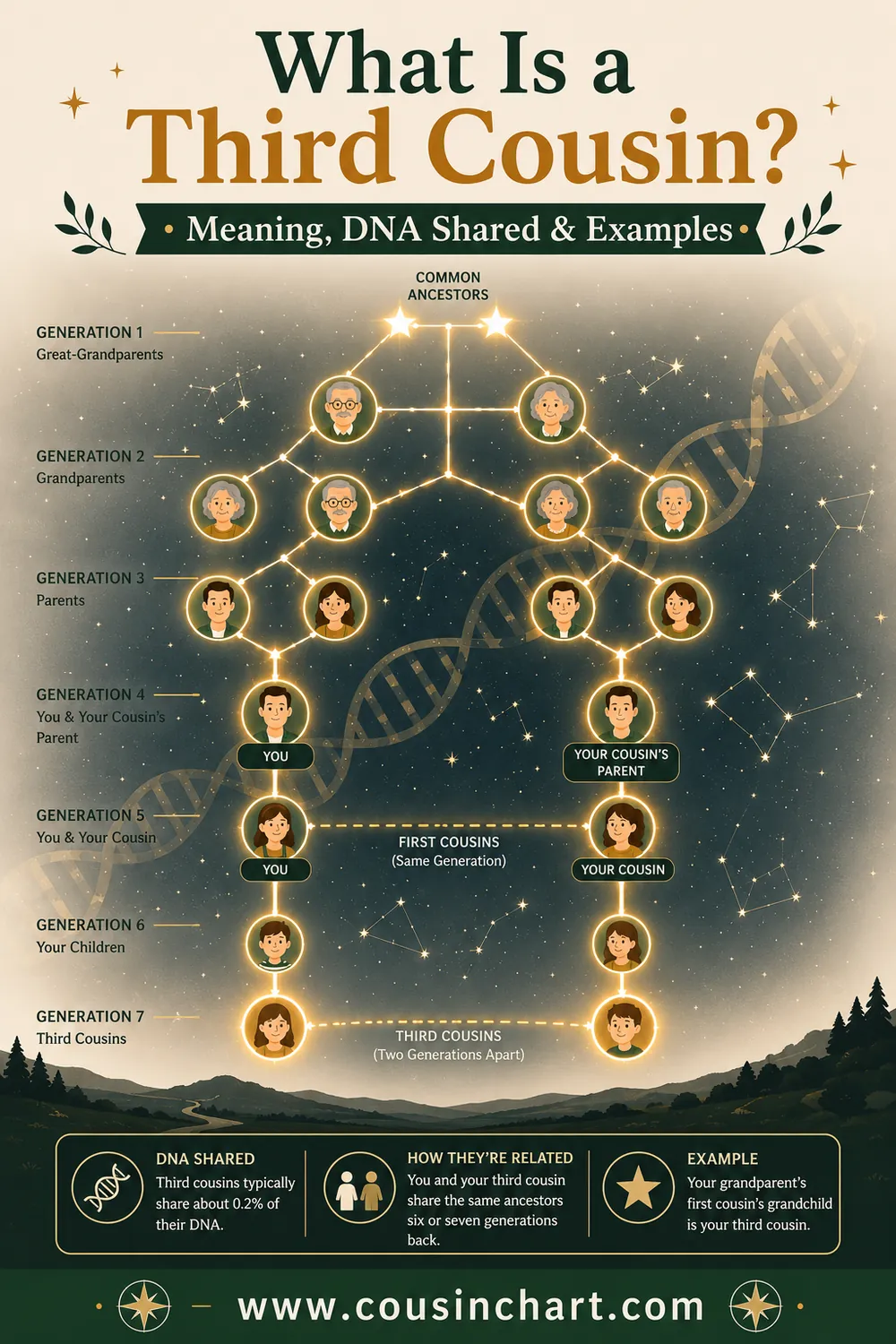
Third cousins share great-great-grandparents, and the average count leaps toward 150–190. Almost nobody can name their third cousins without research; there are simply too many, scattered across branches that split four generations ago. This is exactly the zone where DNA testing shines — sites like AncestryDNA routinely surface dozens or hundreds of second and third cousin matches you had no idea existed. Third cousins usually still share a small, detectable slice of DNA, which is why they show up. We cover that threshold in what is a third cousin.
Distant Cousins: Into the Thousands
Past third cousins, the count stops being a family fact and becomes a statistic. Estimates put the average person's fourth cousins near a thousand and fifth cousins in the several thousands. Add up everyone from fourth cousins outward and a typical person has, on paper, thousands of living cousins they will never meet or even know about.
Two things follow from this:
- You're related to far more people than you feel. The "family" you experience is a tiny visible core inside a vast, mostly invisible web.
- DNA fades before the paper trail does. By fourth and fifth cousins, most pairs share little or no detectable DNA, even though the relationship is genealogically real. That's why distant DNA matches thin out even as the paper-trail cousin count keeps climbing.
Why Your Count Might Be Way Off Average
"Average" hides huge variation. Your personal cousin count depends on factors these tidy numbers can't capture:
- Family size. The single biggest factor. A tree full of large families produces many times more cousins than a tree of only children.
- Generational timing. Families that had children young pack more living cousins into overlapping lifespans.
- Culture and era. Historical periods and cultures with larger typical families push every cousin level upward.
- Survival and records. Whether distant branches survived and stayed documented affects how many cousins you can actually identify.
So don't be alarmed if you have 3 first cousins or 30 — both are perfectly normal depending on your family. The averages describe a statistical middle, not a target.
Estimate Your Own First-Cousin Count in 30 Seconds
You don't need the averages — you can calculate your actual first-cousin number with one small piece of arithmetic. First cousins are the children of your aunts and uncles, so:
- Count your aunts and uncles — all the siblings of both your parents (don't count your parents themselves).
- Add up how many children each of them had. That total is your exact number of first cousins.
Say your mother had 2 siblings and your father had 3, giving you 5 aunts and uncles. If those five had, respectively, 2, 3, 1, 2, and 2 children, you have 10 first cousins — no averages required. The same method extends outward: to count second cousins you'd tally the children of your parents' cousins, though at that level most people quickly lose track and turn to a DNA test or a family tree.
A Worked Example: One Family, Every Level
Numbers land better with a concrete family. Meet Maya, whose tree has fairly typical mid-size families at each level:
| Level | The math for Maya | Her cousin count |
|---|---|---|
| First cousins | 4 aunts/uncles, ~2 kids each | ~8 |
| Second cousins | Her 4 grandparents had ~3 kids each, whose grandkids number… | ~30 |
| Third cousins | 8 great-grandparents, each anchoring a wide branch | ~170 |
| Fourth cousins | 16 great-great-grandparents' descendants | ~900 |
Maya knows all 8 first cousins by name, recognizes maybe 6 or 7 of her 30 second cousins, and has met a small handful of her ~170 third cousins — usually the ones who happen to live nearby or turned up in a DNA match list. By the fourth-cousin row, she couldn't name a single one without research. That steep drop-off between "cousins you know" and "cousins you have" is completely normal, and it happens to everyone at roughly the same place: right around the second-to-third-cousin boundary.
Big Families vs. Small Families: A Side-by-Side
To see how much family size swings the totals, compare two people whose families sit at opposite ends of the range:
| Cousin level | "Small family" tree (~2 kids/couple) | "Large family" tree (~5 kids/couple) |
|---|---|---|
| First cousins | ~2–4 | ~20+ |
| Second cousins | ~10 | ~100+ |
| Third cousins | ~50 | ~1,000+ |
Same generations, wildly different totals — because the effect compounds. An extra child at every couple doesn't add cousins, it multiplies them, and the multiplication stacks with each level back. This is why two people can both be "average" in their own families yet have cousin counts that differ by a factor of ten or more. The tidy averages are a midpoint between these extremes, not a number most people actually land on.
FAQ
How many first cousins does the average person have?
Roughly 5 to 12, though it varies widely with family size. The count depends on how many siblings your parents had and how many children each of those aunts and uncles had. Small families may yield just a couple of first cousins; large families can produce 20 or more.
How many second and third cousins do people have?
The average person has around two to three dozen second cousins and potentially close to 190 third cousins. The numbers climb steeply because each generation back roughly doubles the ancestral couples whose descendants count as your cousins.
Why do cousin numbers grow so fast?
Because finding cousins means counting all the descendants of a shared ancestor. Each level back involves more ancestral couples (2 grandparents, 4 great-grandparents, 8 great-great-grandparents), and each couple anchors a whole spreading branch of descendants, so the totals multiply quickly.
How many total cousins does a person have?
Counting outward through fourth and fifth cousins, a typical person has thousands of living cousins on paper — the vast majority of whom they'll never meet. Only the closest core (first and often second cousins) is usually known personally.
How do I calculate my exact number of first cousins?
Count all the siblings of both your parents — your aunts and uncles — then add up how many children each of them had. That total is your precise first-cousin count, no averages needed. For example, five aunts and uncles with 2, 3, 1, 2, and 2 children gives you exactly 10 first cousins.
Do I share DNA with all my cousins?
No. First, second, and third cousins usually share detectable DNA, but by fourth and fifth cousins most pairs share little or none. The genealogical relationship stays real even after the shared DNA fades below what tests can measure.
Make Sense of Your Own Cousin Web
The average person's family is far bigger than it feels — a handful of first cousins you know by name, and thousands of more distant cousins fanning out beyond memory. Whether you're trying to place a newly discovered relative or just curious how someone connects, the free family relationship calculator works out the exact degree in seconds, turning that sprawling web into a clear, nameable relationship.