Can an Aunt or Uncle Be "Once Removed"?
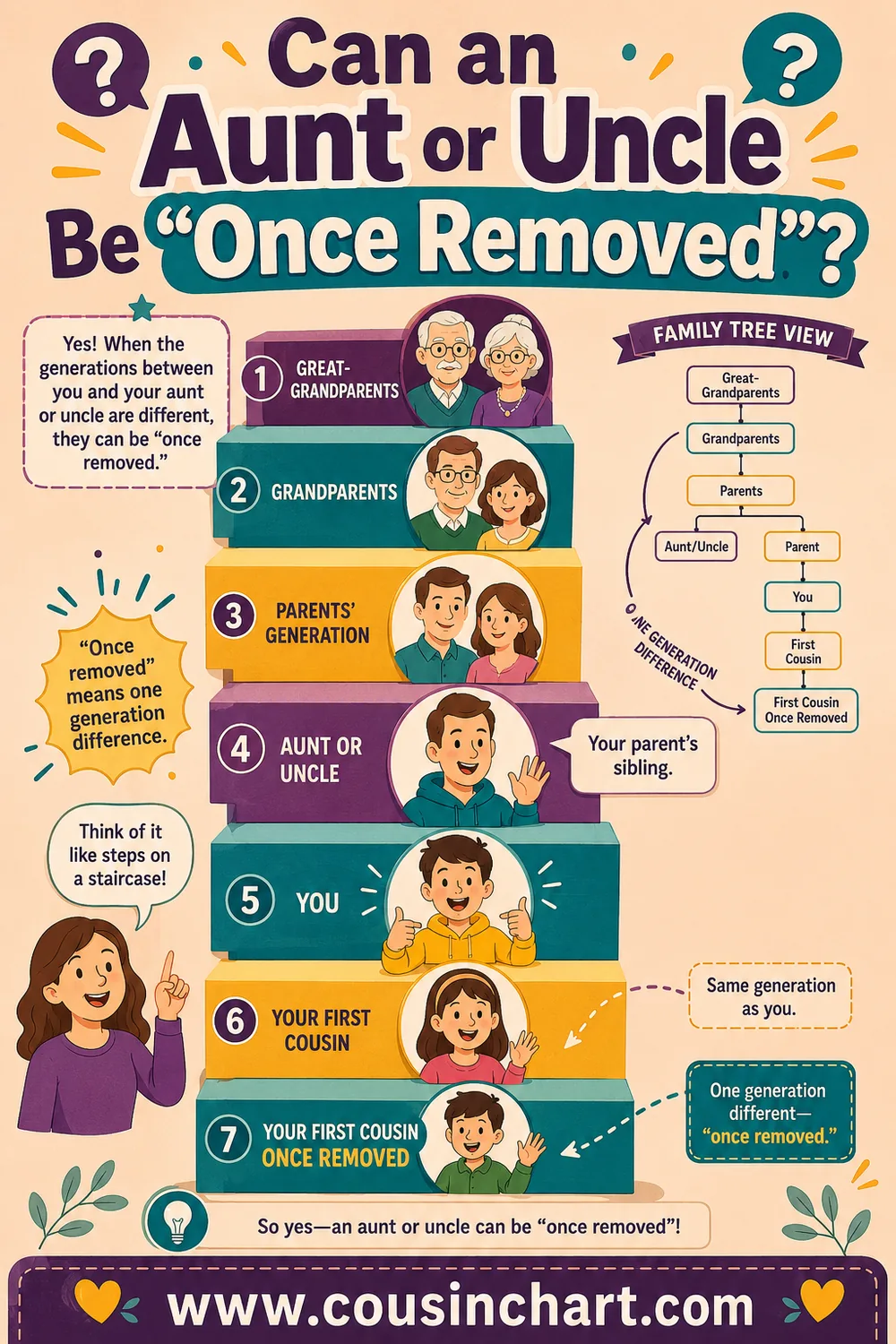
Strictly speaking, no — "removed" is a cousin word, not an aunt-and-uncle word. When someone says "uncle once removed," they almost always mean one of two real relationships: a great-uncle (a grandparent's brother) or a parent's male cousin (who is actually your first cousin once removed).
So the phrase isn't nonsense — it's just pointing at a relative who has a different official name. This guide untangles which one, shows how the aunt-and-uncle ladder really scales (with "great," not "removed"), and gives you the correct term for every uncle-ish person at the reunion. If you'd rather skip the theory, the free relationship calculator names any family connection in seconds.
Relationship quick-check. Tap a phrase to see the correct term:
The answer will appear here.
Why "Removed" Doesn't Apply to Aunts and Uncles
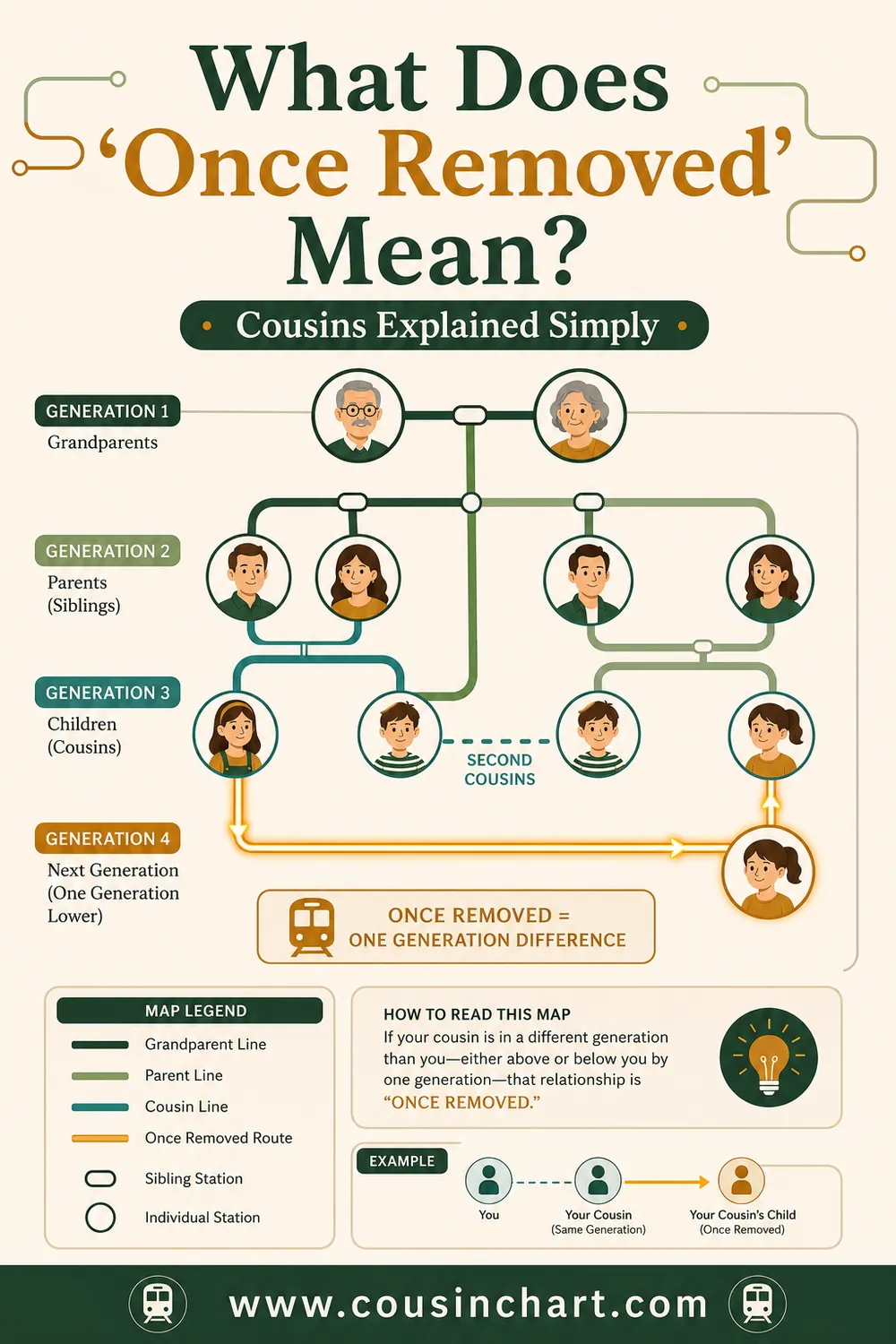
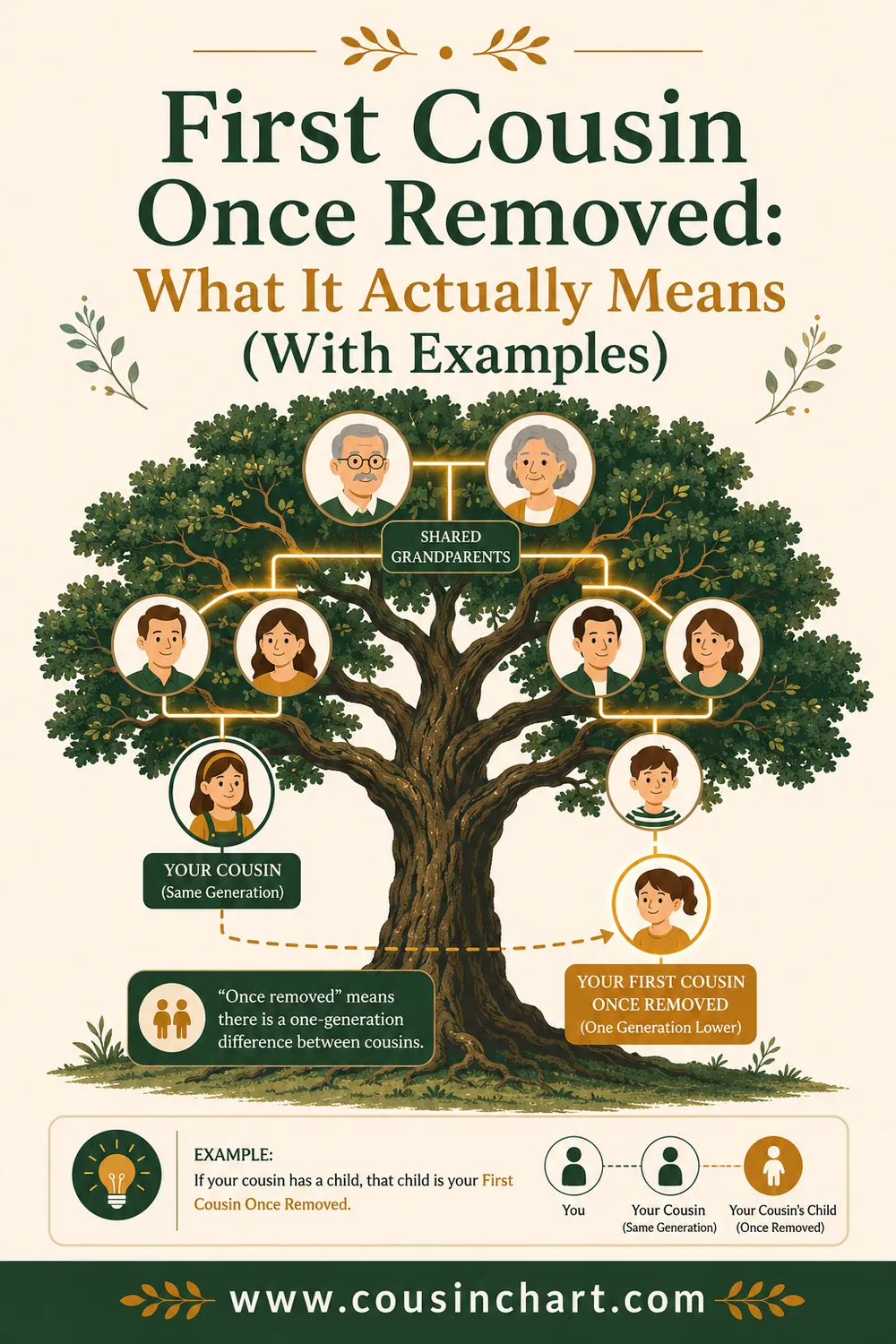
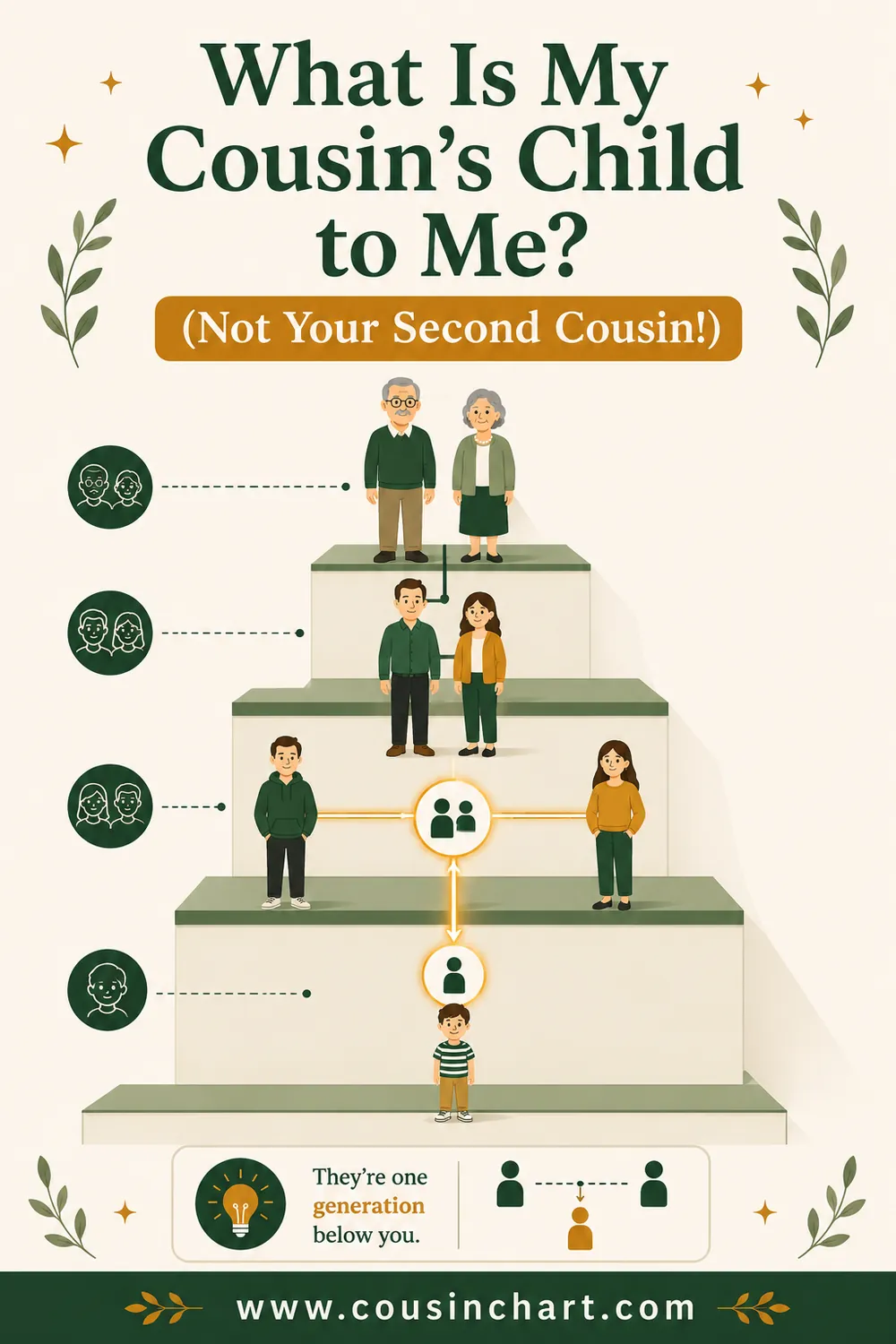
"Removed" has one precise job in genealogy: it measures the generation gap between two cousins. Your cousin's child is your first cousin once removed because you're one generation apart. The word only makes sense when the base relationship is a cousin relationship. We break the counting system down in what does once removed mean.
Aunts and uncles don't need it, because the aunt-and-uncle family of terms already has its own generation dial: the word "great" (or "grand"). Each generation you go up adds one:
- Parent's sibling → aunt / uncle
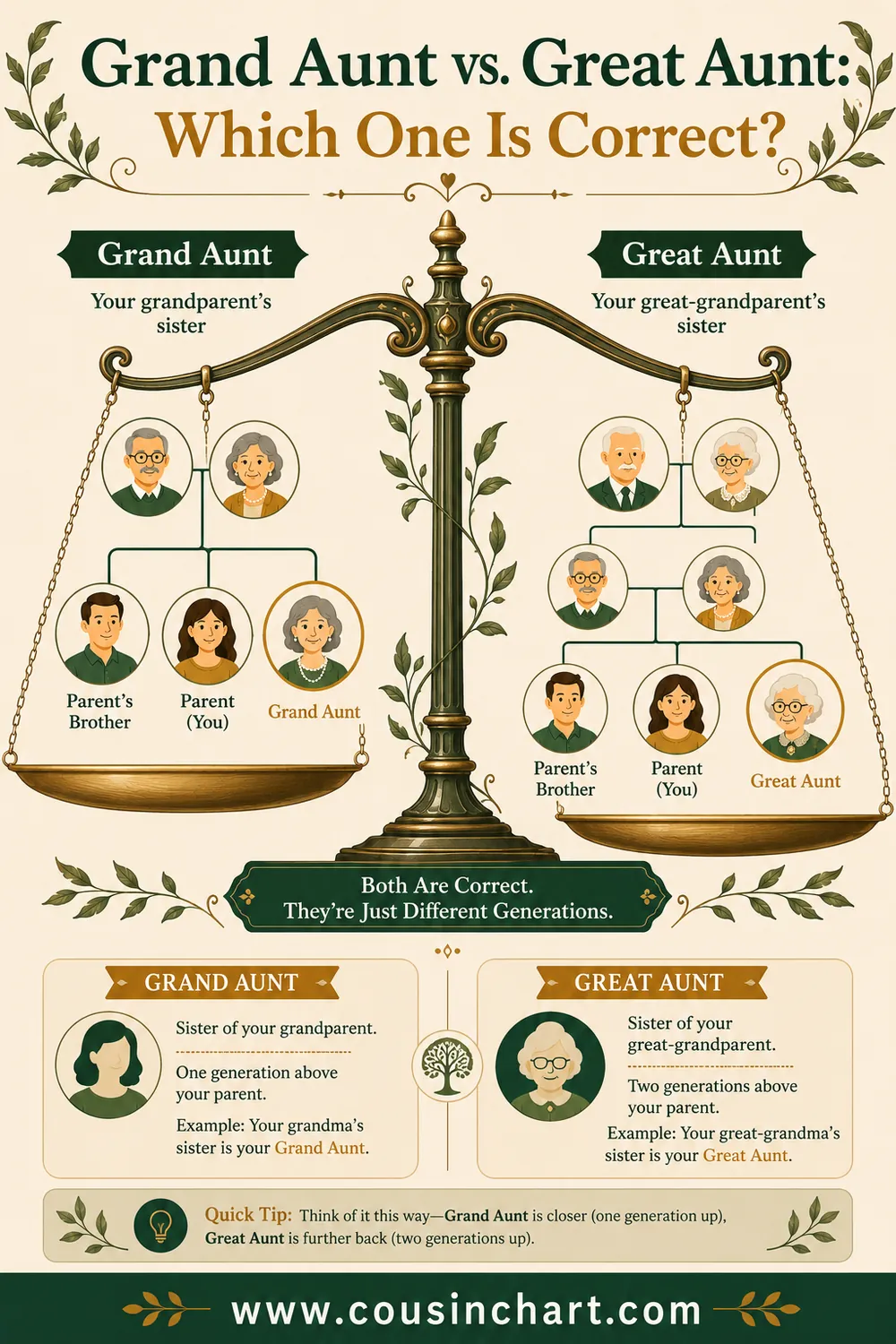
- Grandparent's sibling → great-aunt / great-uncle (many genealogists prefer grand-aunt / grand-uncle)
- Great-grandparent's sibling → great-grand-aunt / great-grand-uncle
Two different dials, two different word families. Cousins scale sideways with numbers (first, second, third) and across generations with "removed." Aunts and uncles scale up with "great." Mixing the dials — "uncle once removed" — is like saying "half past o'clock." Everyone sort of knows what you mean, but the clock has a better way to say it.
The Two People "Uncle Once Removed" Usually Means
When the phrase comes up in real conversations, it's nearly always pointing at one of these:
1. Your grandparent's brother — actually your great-uncle
He's one generation "removed" from your regular uncles in the everyday sense of the word, so the phrase feels natural. The correct term is great-uncle or grand-uncle. He shares about 12.5% of your DNA on average — the same as a first cousin, interestingly. If you're wondering whether "grand" or "great" is more proper, we've settled that debate in grand-aunt vs great-aunt — short version: genealogists like "grand" for the grandparent generation, but "great" dominates everyday speech.
2. Your parent's cousin — actually your first cousin once removed
This is the more common mix-up. Your mom's cousin Ray feels like an uncle: he's your parent's generation, he's been at every holiday, you'd never dream of calling him by his bare first name as a kid. But genealogically he's not an uncle at all — an uncle is a sibling of your parent. Ray is a cousin of your parent, which makes him your first cousin once removed. The "removed" belongs to the cousin term, not to an uncle term. The full explainer lives at first cousin once removed.
The distinction matters for DNA: a true uncle shares ~25% with you, a great-uncle ~12.5%, and a parent's cousin only ~6.25%. Three very different relatives hiding under one fuzzy phrase.
The Aunt-and-Uncle Ladder, Charted
Here's how the whole ladder scales, with the cousin column alongside so you can see the two systems running in parallel:
| Generation of the sibling pair | Sibling of that person is your... | Their child is your... | Avg. shared DNA (blood relatives) |
|---|---|---|---|
| Your parent | Aunt / uncle | First cousin | 25% / 12.5% |
| Your grandparent | Great-uncle (grand-uncle) | First cousin once removed | 12.5% / 6.25% |
| Your great-grandparent | Great-grand-uncle | First cousin twice removed | 6.25% / 3.125% |
| Your 2nd-great-grandparent | Great-great-grand-uncle | First cousin three times removed | 3.125% / 1.56% |
Read one row and the logic clicks: the sibling of an ancestor gets an aunt/uncle-family title, and that sibling's descendants immediately switch over to cousin terms. Aunts and uncles are a one-generation-thick layer; everything below them is cousins.
So Is "Uncle Once Removed" Ever Correct?
As a formal genealogical label — no. You won't find it in kinship charts, DNA match categories, or family tree software. But two honest defenses exist for the phrase:
- As a social title, it works fine. Language belongs to families, not to charts. If your mom's cousin has always been "Uncle Ray," no genealogist is coming to confiscate the title. Many cultures deliberately extend "aunt" and "uncle" to any close adult of a parent's generation — it signals warmth and respect, and it's a feature, not an error.
- As a description, people understand it. "He's sort of an uncle, once removed" communicates "older male relative, roughly my parent's generation, not a literal uncle" perfectly well at a barbecue.
The correct-terms version only matters in three places: genealogy research, DNA match lists, and legal contexts like inheritance, where "uncle" and "first cousin once removed" sit at genuinely different distances. When you're in one of those contexts, use the chart above — or let the family relationship calculator generate the exact term so you don't have to memorize anything.
How to Work Out Any "Uncle-ish" Relative
A three-step check sorts every candidate:
- Is he a sibling of your ancestor? Then he's on the uncle ladder. Count the generations: parent's brother = uncle, grandparent's brother = great-uncle, and add a "great" per generation above that.
- Is he a cousin of your ancestor (or a cousin's descendant)? Then he's on the cousin grid, and "removed" comes into play. Your parent's first cousin = first cousin once removed. Your grandparent's first cousin = first cousin twice removed.
- Did he marry in? Then he's an uncle (or great-uncle) by marriage — full social title, zero shared DNA.
Two minutes with those rules covers every family gathering you'll ever attend. Or ten seconds with the free calculator does the same job with a diagram.
A Reunion Walkthrough: Sorting Four "Uncles" in One Afternoon
Theory is tidy; reunions aren't. Say you're at a family party and four different men have been introduced to you, at some point in your life, as "uncle." Run each through the three-step check:
- Uncle Ben, your dad's brother. Sibling of your parent — step one catches him. A true uncle, ~25% shared DNA, and his kids are your first cousins.
- Uncle Sol, your grandmother's brother. Sibling of an ancestor, one generation higher — still step one. Great-uncle, ~12.5% shared DNA. His grandchildren, running around somewhere near the dessert table, are your second cousins.
- Uncle Ray, your mom's cousin. Not a sibling of anyone in your direct line — step two catches him. First cousin once removed, ~6.25% shared DNA. His daughter is your second cousin, which surprises people who assumed "Uncle Ray's kid" must be some kind of niece-adjacent mystery.
- Uncle Vic, who married your aunt Carla. Step three. Uncle by marriage: full title, zero DNA. If he and Carla divorced, the title would be the family's call — genealogy has no opinion.
Four men, one word, four different genealogical facts. Nothing about the social setup has to change — they can all stay "uncle" forever — but now, when a DNA test or a will needs the technical answer, you can produce it in seconds.
(A fifth variety shows up in blended families: your parent's half-brother is your half-uncle — a genuine blood uncle through one shared grandparent, averaging ~12.5% shared DNA instead of 25%. He passes step one of the check; the "half" just rides along the way it does with half cousins.)
And the reverse question is worth a beat: what are you to each of them? To Ben, a nephew or niece. To Sol, a grand-nephew or grand-niece (great-nephew works too). To Ray — this one's neat — exactly what he is to you: first cousin once removed, because removed cousin terms are their own reciprocal. To Vic, a nephew or niece by marriage. Aunt/uncle terms flip to niece/nephew terms across the generation gap; cousin terms just bounce back unchanged.
Why Families Hand Out Honorary Uncle Titles
If "uncle once removed" is technically wrong, why does nearly every family on earth produce phrases like it? Because most cultures treat "aunt" and "uncle" as respect titles for a generation, not as precise slot labels — and that's a system with its own logic, older and more widespread than genealogical charts.
- In the Philippines, tito and tita stretch cheerfully across parents' cousins, parents' close friends, and often any adult who shows up to enough birthdays. The title marks warmth and seniority, not a chart position.
- Across much of South and Southeast Asia, "uncle" and "auntie" extend to elders generally — shopkeepers and neighbors included. The family term radiates outward as politeness.
- In many Black American and Southern US families, play-uncles and play-aunts are formal enough roles that they come with real obligations — an honorary title with a job description.
- In plenty of Western families, parents simply deputize their own cousins as "Uncle" because "this is my first cousin once removed" is a terrible thing to say to a four-year-old.
Seen this way, "uncle once removed" isn't a mistake — it's a collision between two naming systems that serve different masters. The social system optimizes for respect and simplicity; the genealogical system optimizes for precision. Both are correct at their own jobs. The only real error is using the social title in a context that needs the precise one: a DNA match spreadsheet, a probate filing, a medical family history. There, "Uncle Ray" needs to become "first cousin once removed, maternal side" — and then he can go right back to being Uncle Ray at dinner.
FAQ
Is "uncle once removed" a real genealogical term?
No. "Removed" only applies to cousin relationships, where it counts the generation gap. The people described as an "uncle once removed" are officially either a great-uncle (grandparent's brother) or a first cousin once removed (parent's cousin).
What is my mom's cousin to me — an uncle or a cousin?
A cousin: specifically your first cousin once removed. An uncle must be a sibling of your parent. Calling your mom's cousin "uncle" is a common and perfectly friendly social custom, but the genealogical term is first cousin once removed.
What do I call my grandfather's brother?
Your great-uncle, also written grand-uncle. His children are your first cousins once removed, and his grandchildren are your second cousins.
What's the difference between a great-uncle and an uncle once removed?
"Great-uncle" is the real term for a grandparent's brother. "Uncle once removed" is an informal phrase with no official meaning — people use it for a great-uncle or for a parent's cousin. If DNA or inheritance is involved, pin down which one you mean.
How much DNA do I share with a great-uncle?
About 12.5% on average — the same ballpark as a first cousin or a half-sibling's child. A regular uncle shares about 25%, and a parent's cousin (your first cousin once removed) about 6.25%.
What is my uncle's uncle to me?
If your uncle is your parent's full brother, his uncles are your parent's uncles too — which makes them your great-uncles. The only exception is an uncle by marriage: his relatives belong to his own family tree and have no formal relationship to you at all.
Is my great-uncle's wife my great-aunt?
By marriage, yes — the same convention that makes your aunt's husband "uncle" applies one rung up. She shares no DNA with you, but "Great-Aunt June" is correct social usage everywhere, and even genealogy software will happily record her as a great-aunt by marriage.
Can an aunt be once removed?
Same answer as uncles: not officially. A grandparent's sister is your great-aunt (grand-aunt), and a parent's female cousin is your first cousin once removed. "Aunt once removed" is friendly shorthand, not a chart term.
Get the Right Term Without the Ladder Math
Here's the whole article in two lines: siblings of your ancestors are aunts and uncles, scaled with "great." Cousins of your ancestors are cousins, scaled with "removed." Anyone who married in takes the matching title with "by marriage" silently attached. And when a relative straddles the lines — your grandma's half-brother's stepson, say — skip the whiteboard and open the free family relationship calculator. Tap the path, read the term, and get back to the potato salad.