Viking Ancestry DNA: Can a Test Really Tell You?
The short answer is no, and the reason is more interesting than the marketing: "Viking" describes something people did, not a population they belonged to. It was a seasonal occupation — raiding, trading, settling — carried out mostly by Norse-speaking people between roughly the 790s and 1066. There is no Viking gene, no Viking marker, and no test that can identify one. What a kit can tell you is roughly how much of your ancestry resembles present-day Scandinavians, which is a different and much shakier claim than the box implies. If you want to know how you connect to a specific person rather than to an era, the cousin calculator is the more honest tool.
What made you wonder about Viking ancestry? Tap the closest match.
Tap an option above. In short: the era is unreachable by DNA, but the last 300 years are not.
Why can't a test say "Viking"?
Because the category is historical, not biological, and the timescale defeats the technology.
Viking was an activity. In Old Norse the word referred to going on an expedition. The people doing it were Norse — from what is now Norway, Sweden and Denmark — but most Norse people never went viking at all. Testing for "Viking" is like testing for "sailor".
There is no marker. No stretch of DNA appears in Viking-age raiders and nowhere else. Populations around the North Sea and the Baltic have exchanged ancestry continuously for thousands of years, before and after the period.
The panels are modern. Every ethnicity estimate compares you against reference groups of living people. A "Norway" result means your DNA resembles present-day Norwegians — who are themselves the product of a thousand years of movement since the Viking age ended.
And the era is simply too far back. The Viking period ended roughly 40 generations ago. Autosomal DNA from any one individual that far back is undetectable, which is the fundamental problem no company can engineer around.
What has ancient DNA actually shown?
Quite a lot, and it complicates the popular picture rather than confirming it.
Viking-age Scandinavia was genetically varied. Large-scale sequencing of remains from Viking-age sites across Europe, published in the scientific literature in recent years, found substantial diversity within Scandinavia itself, including ancestry from southern Europe and from further east.
Some people buried as Vikings were not Scandinavian at all. Individuals interred with Viking-age grave goods and in Viking-age contexts have turned out to carry little or no Scandinavian ancestry. Identity in that world was about what you did and who you sailed with, not what a laboratory would say about you.
Movement ran in every direction. Scandinavians settled in Britain, Ireland, Normandy, Iceland, the Baltic and beyond, and people from those regions moved into Scandinavia. The gene flow was two-way.
Which means the archaeology tells you more than a percentage. For this period, place names, grave goods, coin hoards and written sources carry far more information than a consumer test can.
What does your Scandinavian percentage actually mean?
Something real, but recent and imprecise.
It reflects similarity to living Scandinavians. The model asks which mixture of its reference panels best explains your genome. A Scandinavian component suggests recent ancestry from that region, generally within the last few hundred years rather than the last thousand.
Company results differ for the same person. Panels and algorithms vary, so one kit's 12% "Norway" is another kit's 5% "Sweden and Denmark" or a larger "Northwestern Europe". That is normal, and the reasons are set out in the guide to how accurate ethnicity estimates are.
Results also change over time. When a company rebuilds its panel, your number changes even though your DNA has not. That is the method updating, not an error being corrected.
Norse settlement in Britain may not show as Scandinavian at all. Norse settlers in the Danelaw, Ireland and Normandy mixed into local populations over a millennium. Their descendants' DNA today typically reads as British, Irish or French, because that is who they resemble now.
Why is 1,000 years too far for autosomal DNA?
Because inheritance halves each generation and is random, so individual ancestors disappear from your genome quickly.
| Generations back | Approximate date | Ancestor slots at that level | Average share from one ancestor | Detectable? |
|---|---|---|---|---|
| 5 | around 1870 | 32 | ~3.1% | Usually |
| 10 | around 1720 | 1,024 | ~0.1% | Rarely |
| 15 | around 1570 | 32,768 | negligible | Effectively never |
| 20 | around 1420 | over 1 million | negligible | No |
| 30 | around 1120 | over 1 billion | negligible | No |
| 40 | around 820 | more slots than people alive | negligible | No |
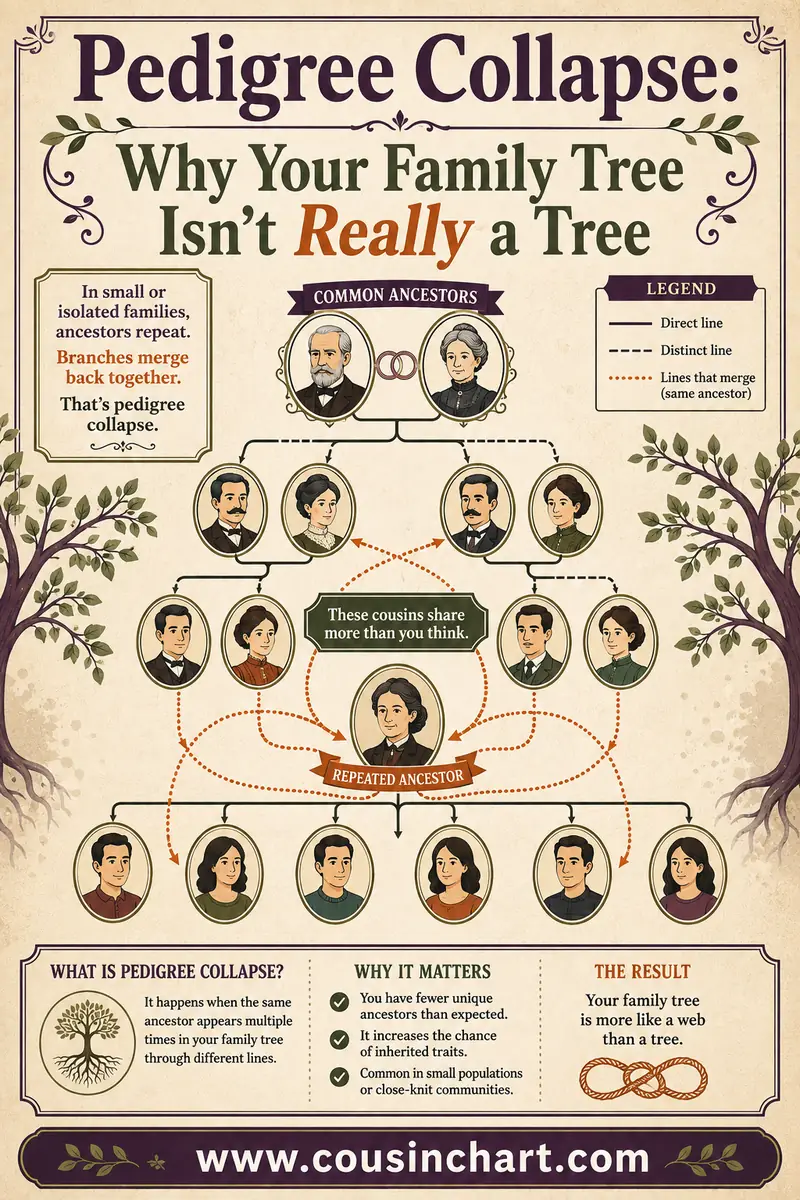
Look at the bottom two rows. At 40 generations your pedigree has more ancestor slots than there were human beings on Earth, which means the same people occupy many slots at once — the effect explained in the guide to pedigree collapse.
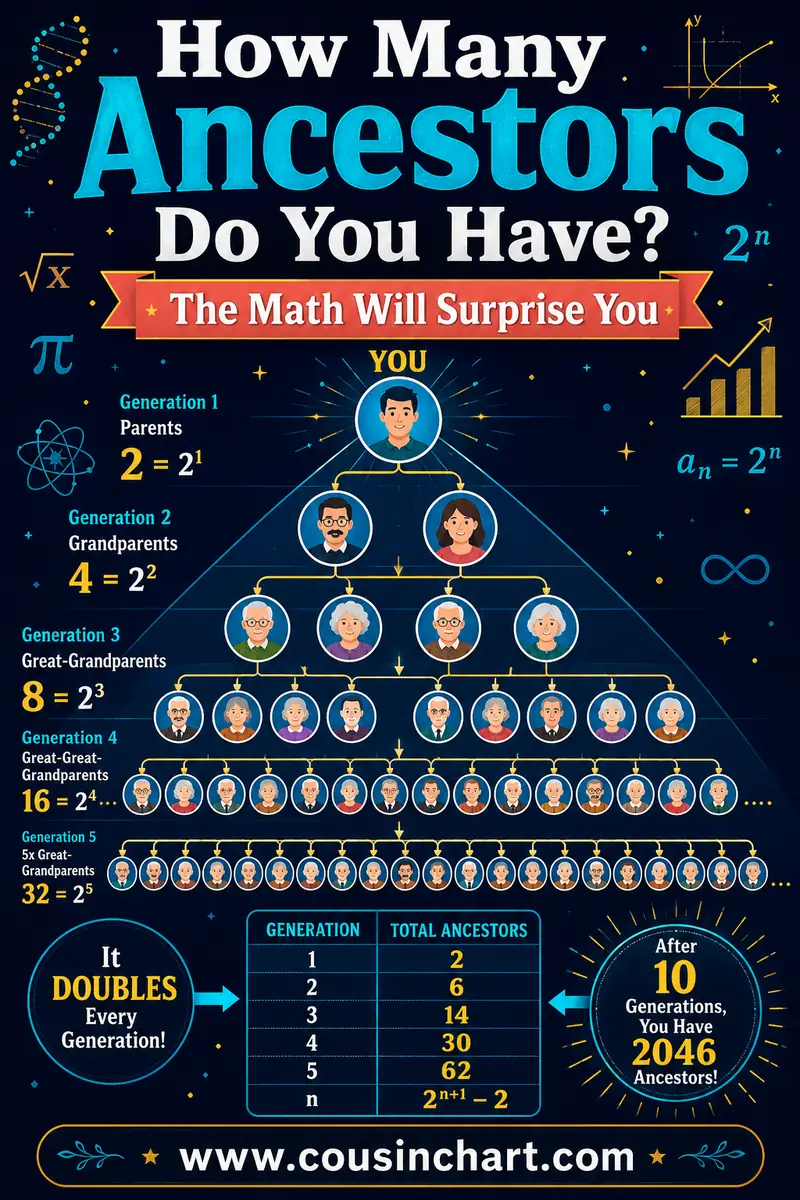
You inherit measurable DNA from only a fraction of your ancestors. Beyond about eight or nine generations, most of the people in your tree contributed nothing detectable to you at all, even though they are genuinely your ancestors. The scale of the tree is laid out in the guide to how many ancestors you have.
So the honest statement is statistical, not personal. Almost everyone with European ancestry probably does descend from Viking-age Scandinavians who left surviving descendants — and from Viking-age Franks, Slavs and Anglo-Saxons too. The mathematics behind that is the same reason we are all cousins.
Do Y-DNA or mtDNA haplogroups prove it?
They come closest of anything available, and they still fall short of proof.
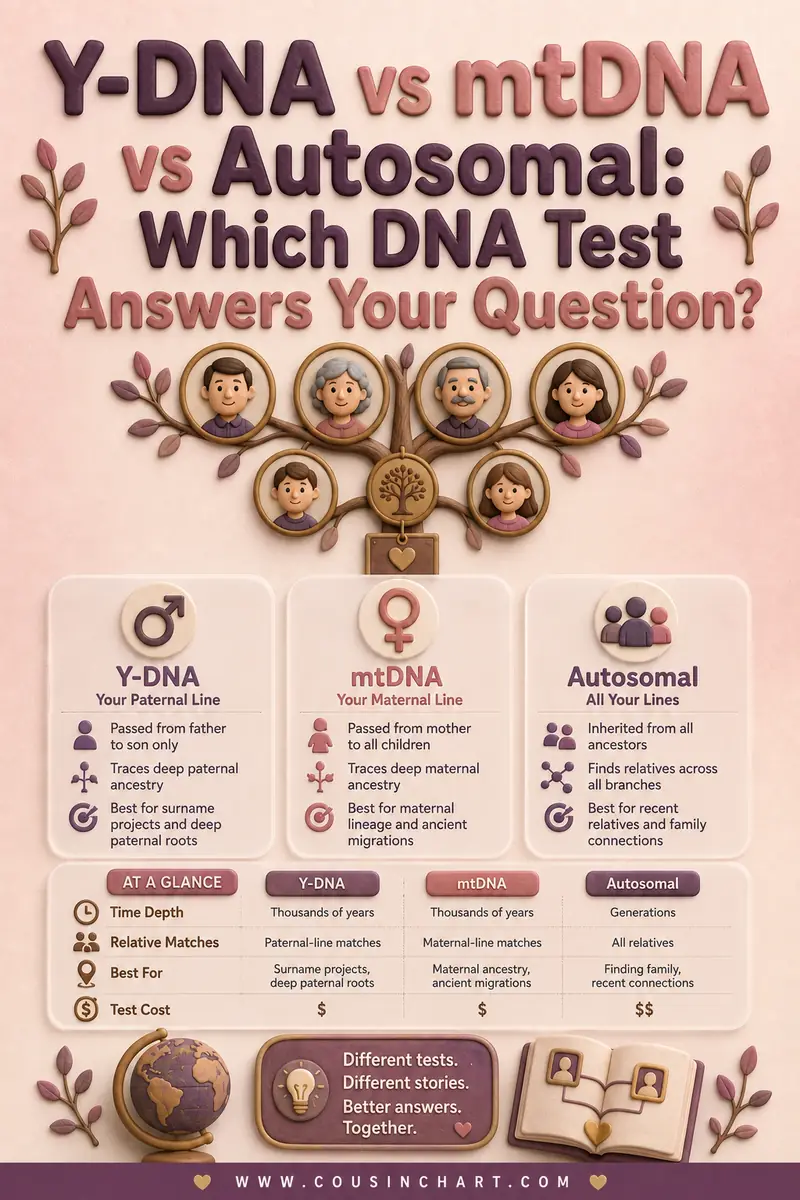
Haplogroups follow one line each. Y-DNA traces the direct paternal line; mtDNA traces the direct maternal line. Each covers a single path through a tree that doubles every generation, as the guide to Y-DNA, mtDNA and autosomal tests explains.
Some lineages are common in Scandinavia. Certain Y-DNA branches occur at high frequency there. But high frequency is not exclusivity — those branches are found across northern and central Europe, and most of them are thousands of years older than the Viking age.
A subclade can suggest a region and an era. With detailed testing, a narrow branch shared with documented Scandinavian lines is genuinely informative about where that one line sat a millennium ago.
But it says nothing about the other 99%. Your Y-DNA line is one ancestor per generation out of hundreds. Someone else's paternal line in the same family may point somewhere completely different.
What about "Viking index" and ancient-match features?
They are fun, and they should be read as entertainment.
They compare you to a handful of excavated genomes. A score tells you how similar your DNA is to particular ancient samples, weighted by whatever method the company chose.
Similarity is not descent. Resembling an individual buried in the tenth century does not mean you descend from them, and it certainly does not identify them as your ancestor.
The sample sets are tiny. A few hundred sequenced individuals stand in for millions of people who lived in that period.
Different companies give different answers. Which is the tell. When a claim is solid, competing methods converge; when it is soft, they scatter.
What would count as real evidence?
Documents, and the ordinary genealogy that produces them.
Parish registers reach back centuries in Scandinavia. Norwegian, Swedish and Danish church books are extensive and often digitized, and they can carry a documented line to the 1600s or earlier.
Farm names and patronymics carry information. Scandinavian naming conventions changed over time and encode a father's name and often a farm; the guide to Scandinavian surnames explains how to read them.
Norse place names map settlement. Endings such as -by, -thorpe and -thwaite across northern England, and Norse-derived names in Ireland, the Isle of Man and Normandy, record where settlement actually happened.
And DNA matching still helps — at the right distance. Shared centimorgans reliably connect you to living cousins within the last several generations, which is where your documented Scandinavian line, if you have one, will actually be found. The DNA match calculator turns that number into a shortlist of relationships.
FAQ
Can a DNA test prove I am descended from Vikings?
No. "Viking" described an activity rather than a population, so there is no Viking marker to test for. A kit can only report how much your DNA resembles present-day Scandinavians, which reflects recent centuries rather than the Viking age of roughly 793 to 1066.
What is the best DNA test for Viking ancestry?
None is meaningfully better, because none can identify Viking ancestry at all. If you want the most useful result, choose on matching database size so you can find living cousins, then research Scandinavian parish registers, which reach back several centuries and name real people.
Does a Scandinavian percentage mean I have Viking ancestors?
It means part of your DNA resembles people living in Scandinavia today, usually reflecting ancestry from the last few hundred years. It is not a measurement of Viking-age descent, and Norse settlers in Britain or Ireland typically show as British or Irish now.
Which Y-DNA haplogroup means Viking?
None does. Some Y-DNA branches are common in Scandinavia, but they occur across northern Europe and predate the Viking age by thousands of years. A haplogroup describes one direct paternal line, not a person's identity or occupation.
Are most Europeans descended from Vikings?
Probably, in the trivial sense that anyone alive in the Viking age who left surviving descendants is an ancestor of most Europeans today. Your pedigree 40 generations back contains more ancestor slots than there were people alive, so distant descent is close to universal rather than special.
Why do my Viking results differ between companies?
Because each company uses its own reference panels, regional boundaries and algorithms, and because ancient-DNA features use different sample sets and scoring methods. Divergence between products is the clearest signal that a claim rests on soft data rather than firm evidence.
Chase the parish register, not the percentage
The Viking age is out of reach for consumer DNA, and no amount of clever marketing changes the arithmetic: 40 generations back, individual ancestors leave nothing measurable behind. What is reachable is the last three or four hundred years, and that is where a real Scandinavian line can be documented — in church books, farm names and patronymics that name actual people with actual dates. Use your test for what it does well, which is finding living cousins who share those ancestors with you. When one of them appears in your match list, the cousin calculator will show you exactly how the two of you are related.