Someone Claims to Be a Long-Lost Cousin: How to Check the Connection
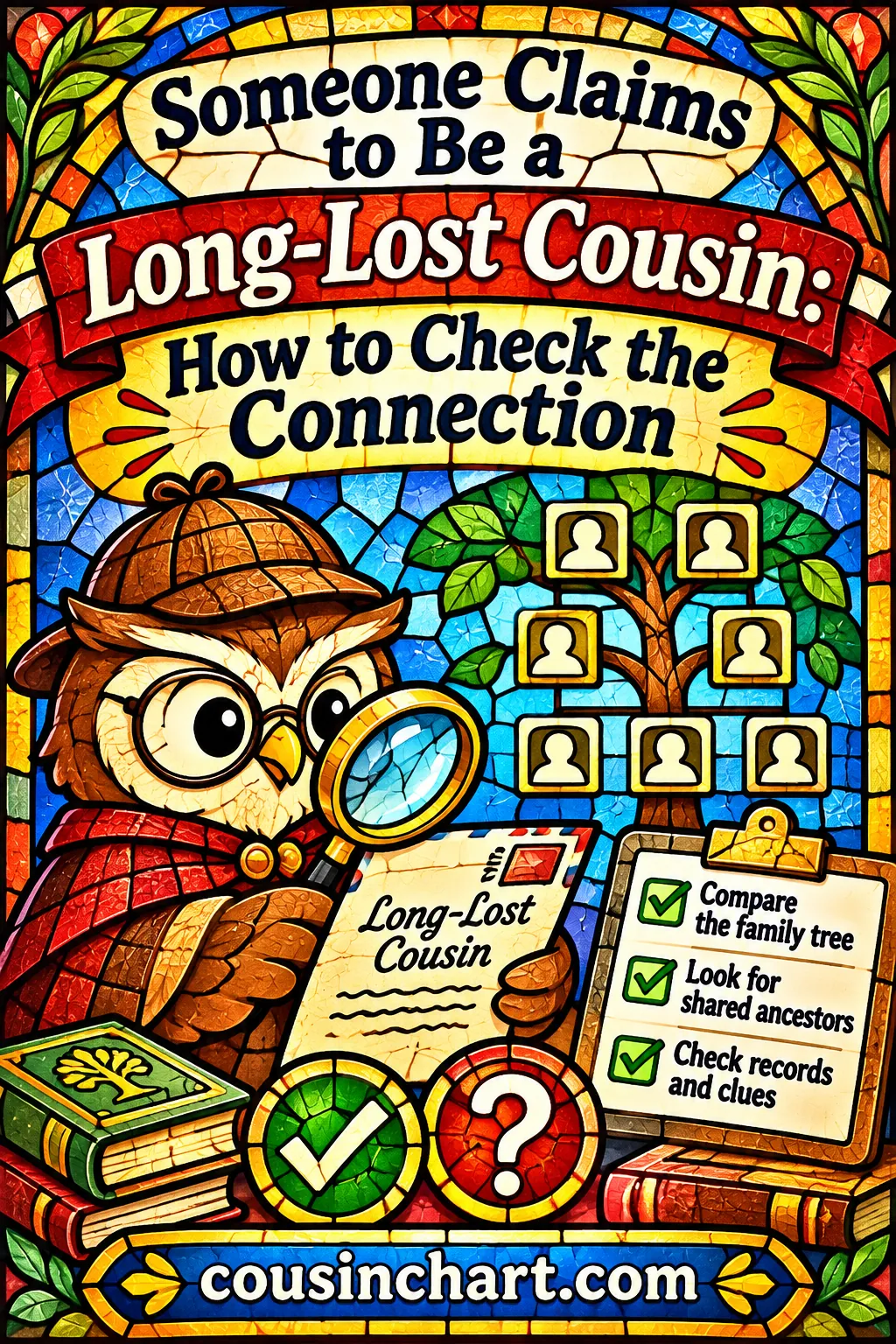
To check a long-lost cousin claim, ask the person to name the ancestor you supposedly share and how they descend from that person, then confirm each generation against your own family records. If the line holds up, the generations tell you exactly what kind of cousin they are. The free Cousin Chart relationship calculator turns those generation counts into a relationship name in seconds.
Most messages like this come from real people doing family history. Some don't. Either way, the same few checks protect you and help you welcome a true relative with confidence. Here's how to do it step by step, with real scenarios, reply wording you can copy, and a clear list of warning signs.
▶ Work it out in the free calculator
Why a Shared Ancestor Is the Whole Test
Every cousin relationship comes from one fact: two people descend from the same ancestor or ancestral couple. First cousins share grandparents. Second cousins share great-grandparents. Third cousins share great-great-grandparents.
That means a genuine claim can always be traced to a specific person. If someone says, "We're cousins," the natural follow-up is, "Through whom?" A real relative doing genealogy will usually be glad you asked, because they want to compare notes too.
A claim with no named ancestor isn't proof of a scam. Some people only have a DNA match and don't know the connection yet. But it does mean there's nothing to verify until a shared ancestor shows up.
What counts as strong evidence
Not all evidence carries the same weight. Here's a rough guide to how much each kind of proof tells you on its own.
| Evidence | How strong on its own | Why |
|---|---|---|
| "My mom said we're related" | Weak | Family stories are a good lead, but they drift over time |
| Same surname | Weak | Many unrelated families share a surname |
| A named shared ancestor | Moderate | Gives you something specific to check |
| A full chain of names, parent to child | Stronger | Each link can be checked against records |
| Records confirming each link | Strong | Obituaries, census households and vital records back up the chain |
| A DNA match at the expected level | Strong | Independent support from biology |
| Records plus DNA plus shared matches on the right branch | Very strong | Several independent sources agree |
You don't need the very top row before you reply warmly. But the further down the table a claim gets, the more confident you can be.
Step 1: Ask for the Line, Not Just the Label
Start with friendly, specific questions. You're not interrogating anyone. You're doing what genealogists do with every new match.
Good questions to ask:
- "Who's the ancestor you think we share?"
- "Can you walk me down your line from that person to you?"
- "Which of their children do you descend from?"
- "Roughly when and where did those people live?"
You want a chain of names, each one a parent of the next. For example: "Our shared ancestors are Joseph and Anna Kowalski. Their son Peter was my grandfather. His daughter Linda is my mom."
What you shouldn't need to give out at this stage is anything about yourself beyond what you choose to share. Let them lead with their line.
Questions you don't have to answer
Be careful with questions that sound like genealogy but double as security details. You don't need to share:
- Your full date of birth
- Your mother's maiden name, if you use it for account security
- Your address or phone number
- The name of your first school, first pet or similar
- Any account numbers, ID numbers or login details
A real cousin can do perfectly good family research without any of that.
A first reply you can copy
If you want a warm reply that still puts the line first, try something like this:
Hi, thanks for reaching out. I love hearing from family. Can you tell me which ancestor you think we share, and walk me down your line from them to you? I'll check it against what I have and share how my side connects.
It's friendly, it shows interest, and it asks for the one thing you need without giving anything away.
Step 2: Check Their Line Against Your Own Records
Now compare the chain they gave you with what you already know.
- Find the shared ancestor in your own tree. Is that person really there? Do the names, dates and places roughly match?
- Check the child they descend from. Did your ancestor actually have a child by that name? Look at census households, obituaries, family Bibles and birth records.
- Follow their line down. Obituaries are especially helpful, because they often list children and grandchildren by name.
- Ask your older relatives. A grandparent or great-aunt may say, "Oh, Peter's daughter Linda. She moved to Ohio." That kind of memory is gold.
If every link checks out, the claim is looking solid. If one link is missing or contradicts your records, ask about it politely. Records have errors, and families have half-siblings, adoptions and name changes. A wrong link isn't automatically a lie, but it does need sorting out.
Building a simple common ancestor chart for the two of you makes this much easier. You put the shared ancestor at the top and draw both lines down, side by side.
Which records confirm which link
Different records answer different questions. Use this as a quick guide to where to look for each link in the chain.
| Link you're checking | Records that often help | What to look for |
|---|---|---|
| Ancestor had a child by that name | Census households, birth or baptism records | The child listed under the right parents |
| That child married and had children | Marriage records, later census households | Spouse's name and children's names |
| Who survived whom | Obituaries | Lists of children, grandchildren and siblings |
| A parent's maiden name | Death and marriage records | Mother's maiden name on the record |
| Living generations | Recent obituaries, family memory | Names that match what they told you |
Obituaries are often the fastest single check, since one can name three generations at once. A free obituary search is a good place to start when you need to confirm who was a child or grandchild of whom.
Spotting name and date differences that are still fine
Small mismatches are normal, especially in older records. These usually aren't a problem:
- Spelling changes. Kowalski, Kovalski and Kowalsky can all be the same family.
- Nicknames. Margaret might show up as Peggy, Maggie or Greta.
- Ages off by a year or two. Census ages were often estimated.
- A middle name used as a first name. "John Henry" might be Henry in every record after childhood.
What isn't fine is a mismatch that breaks the chain, like a child born after the supposed parent died, or a person who appears in two different families at the same time.
Step 3: Count the Generations and Name the Relationship
Once the line looks right, count how many generations each of you sits below the shared ancestor. That gives you the exact relationship.
Using the Kowalski example:
- Joseph and Anna → Peter → Linda → the person messaging you. That's 3 generations.
- Joseph and Anna → your grandmother Helen (Peter's sister) → your dad → you. Also 3.
Three and three means you're second cousins.
If you'd been 3 down and they'd been 2 down, you'd be first cousins once removed. The smaller number sets the cousin level, and the difference sets how many times removed.
| Shared ancestor | Generations (you / them) | Relationship | Typical shared DNA |
|---|---|---|---|
| Your grandparents | 2 / 2 | First cousin | ~866 cM average |
| Your grandparents | 2 / 3 | First cousin once removed | About half of first cousins |
| Your great-grandparents | 3 / 3 | Second cousin | ~229 cM average |
| Your great-grandparents | 3 / 4 | Second cousin once removed | Less again, wide range |
| Your great-great-grandparents | 4 / 4 | Third cousin | ~73 cM average |
| Your 3rd great-grandparents | 5 / 5 | Fourth cousin | ~35 cM average |
DNA figures are averages. Real amounts vary, and the ranges for different relationships overlap a lot, especially for more distant cousins.
Counting mistakes that change the answer
- Counting the ancestor as a generation. Start counting with the ancestor's child, not the ancestor. Grandparents are 2 steps above you.
- Counting from the wrong person. If they say "your grandmother was my aunt," the shared ancestors are your grandmother's parents, not your grandmother.
- Skipping a generation by accident. Write the chain out in full, name by name. It's easy to drop a parent when you count in your head.
- Assuming same age means same generation. A cousin your age can easily be once removed, if one branch had children much younger or older.
Step 4: Use DNA if You've Both Tested
If you've both taken a DNA test with the same company, or uploaded to the same site, DNA can back up the paper trail.
Here's what to look for:
- Do you match at all? First and second cousins almost always share detectable DNA. More distant cousins sometimes don't, so a missing match for a claimed fourth cousin isn't unusual.
- Does the amount fit? Compare your shared cM with the averages for the relationship your paper trail shows. The DNA match calculator lets you enter the cM and see which relationships fit.
- Do you share other matches? If you both match known relatives from the same branch, that's strong support for the claimed line.
A good fit between the paper trail and the DNA is the strongest evidence you'll get. The guide on how to confirm a DNA match covers this in more detail, including what to do when the numbers don't line up.
When the DNA doesn't fit
If you share far more or far less than expected, the relationship may be different from what either of you thought. A half relationship, an unknown adoption or a different branch can all explain it. Treat it as a puzzle to work through together, not as an accusation.
Reading shared matches
Shared matches are the people who match both of you. They're one of the best ways to tell which side of your family a new cousin belongs to. If your new cousin shares matches with your known Kowalski relatives and none with your mom's side, that's a good sign the link runs through the Kowalskis, just as they said. The guide to what shared DNA matches are shows how to read that list.
Real-Life Scenarios, Worked Step by Step
Here's how the checks play out in the kinds of messages people actually get.
Scenario 1: A message that checks out
A woman named Dana writes: "I think we're cousins through the Brennans."
- You ask for the line. She says: "Thomas and Mary Brennan → their daughter Rose → my dad, Frank → me."
- You check your tree. Thomas and Mary Brennan are your great-grandparents. Your grandfather, Edward, was their son.
- You check Rose. Mary Brennan's obituary lists children Edward, Rose and James. Rose's own obituary lists a son, Frank.
- You count. You: Edward → your mom → you, so 3 down. Dana: Rose → Frank → Dana, also 3 down.
- Calculator: 3 and 3, half off. Result: second cousin.
- DNA: You've both tested at the same company and share an amount in the second cousin range.
Every link checks out on paper, and the DNA agrees. Dana is your second cousin.
Scenario 2: A DNA match with no tree
Someone named Chris messages you through a DNA site. You share a few hundred cM. Chris says, "I was adopted and I'm trying to figure out how we're related."
- There's no named ancestor yet, so there's nothing to check on paper.
- The cM amount points to a fairly close relationship, maybe a first cousin once removed or a second cousin, but the ranges overlap.
- Look at your shared matches. If Chris matches your dad's cousins but not your mom's side, the link is probably on your dad's side.
Be gentle here. Chris may be looking for a birth parent, and your family might be part of that story. You can help by sharing which branch the match seems to sit on, without sharing private details about living relatives until everyone is ready. Let Chris set the pace, and check with close relatives before sharing anything about them.
Scenario 3: An inheritance claim
You get an email: "You are the cousin of a man who died abroad. You are due a large inheritance. Please send your details and a processing fee."
- There's no named shared ancestor, only a vague relative.
- Money and personal details come up in the first message.
- There's urgency and a reason to keep it quiet.
This has every red flag at once. Don't reply with personal details, and don't send anything. Real estates are handled by courts and attorneys through official processes, not by surprise emails asking for fees. If you're worried you might really be an heir, talk to someone you trust or a local attorney you find yourself.
Scenario 4: The line that's off by one
Marco writes that his grandfather Paolo was your grandfather's brother. That would make you second cousins.
- You check. Your grandfather's parents had sons named Luigi and Paolo, and a Paolo appears in the right census.
- But Marco's Paolo was born in 1932, and your grandfather's brother Paolo was born in 1905.
That's a gap of a generation. It turns out Marco's Paolo was the son of your grandfather's brother Paolo. Marco is 4 generations down from your great-grandparents, and you're 3.
- Calculator: 3 down to you, 4 down to Marco. Result: second cousin once removed.
Same family, different label. Name reuse across generations is one of the most common reasons a claim looks a little off.
Scenario 5: A half line explains a low match
Jamie says you're second cousins through your great-grandfather Walter. The paper trail checks out, but your DNA match is lower than you'd expect.
You look again. Walter married twice. You descend from his first wife, and Jamie descends from his second.
- Calculator: 3 and 3, half option on. Result: half second cousin.
- Half relationships share about half as much DNA on average, so the lower match fits.
Scenario 6: Someone claims to be your parent's cousin
A man named Ray says he's your dad's first cousin. His mom and your dad's mom were sisters.
- Shared ancestors: your dad's grandparents, which are your great-grandparents.
- Ray: 2 down. You: 3 down.
- Calculator: use the "My dad's cousin" quick-pick, or set 3 for you and 2 for Ray. Result: first cousin once removed.
Your dad is the best person to confirm this one. He may remember Ray from childhood, or at least know the name of his aunt's children.
Scenario 7: Related two ways
Lucy writes that you're second cousins through the Hartmanns. You check, and she's right. But your DNA match is well above the usual second cousin range.
- You look at her other lines. Her great-grandmother was a Weber. So was yours.
- Two Hartmann brothers married two Weber sisters. You and Lucy share both couples.
- Calculator: run it twice, once for the Hartmann couple and once for the Weber couple. Both come out 3 and 3, so second cousin each time.
You're second cousins on two lines, often called double second cousins. That's why the DNA came in high. When a match is bigger than the paper trail suggests, look for a second shared couple before you assume something's wrong.
Scenario 8: The right family, the wrong branch
Sara says she descends from your great-great-grandparents, the Lindqvists, through their son Nils. You find Nils in the family, but your records say he died as a child.
- Ask Sara for the record she has for Nils as an adult.
- She sends a marriage record. The groom's parents are named Lindqvist, but with different first names than your ancestors.
It turns out there were two Lindqvist families from the same parish, and Sara's Nils belongs to the other one. You may still be related further back, but not the way either of you first thought. Sharing records, instead of just trading names, is what cleared it up.
Sharing the News With Your Family
Once you've confirmed a new cousin, the rest of your family will probably want to know. A little care makes it go smoothly.
- Start with the relatives closest to that branch. If the link runs through your dad's mom, tell your dad and his siblings first. They may have memories or photos that add to the story.
- Explain the link with the chart. "Her grandmother and your mom were sisters" is easier to picture with the downloaded chart in hand.
- Ask before you share contact details. Some relatives love new cousins. Others are private, or there may be old family history you don't know about.
- Be ready for surprises. New cousins sometimes reveal half-siblings, adoptions or second marriages that weren't talked about. Go gently, and let each person take it in at their own pace.
If a new cousin uncovers something sensitive, such as an unknown parent or a family secret, it's fine to pause before telling anyone else. You can confirm the facts first and decide later who needs to know.
Red Flags That Call for Caution
Most cousin claims are honest. A few patterns, though, are worth slowing down for. None of these proves anything on its own, but together they're a good reason to pause.
- Money comes up early. A request for a loan, a fee, a gift card, a payment to "release an inheritance" or help with an emergency.
- Urgency or secrecy. "Don't tell the rest of the family yet," or "I need an answer today."
- No specific ancestor. Lots of warm feelings, but they can't or won't name who connects you.
- Inheritance claims. Messages saying you're due money from a relative you've never heard of, especially if they want details or a fee to proceed.
- Requests for personal or security details. Birth dates, maiden names, ID numbers, account logins.
- Moving the chat elsewhere fast. Pushing to switch to a private app before you've confirmed anything.
- A story that shifts. The shared ancestor changes, or the line doesn't match what they said earlier.
If you see these, it's okay to stop replying. Talk it over with a family member or someone you trust before you share anything else. Real relatives will understand a careful approach, because many of them have seen the same kinds of messages.
Green flags of a genuine cousin
It helps to know what a real relative usually looks like, too.
- They name a specific shared ancestor right away, or are happy to work it out with you.
- They share their own line first, without asking for yours.
- They mention records, photos or family stories you can check.
- They're patient when you say you need time.
- They never bring up money.
Protecting living relatives' privacy
Even with a confirmed cousin, it's wise to go slowly with details about living people. Ancestors who have passed away are usually fine to discuss. For living relatives, share names only as needed, skip addresses and birth dates, and ask family members before passing on their contact details.
How to Check It With the Calculator
Once you have a named shared ancestor and a confirmed line, the relationship calculator gives you the exact name.
A claimed second cousin
- Treat the shared great-grandparents as the relatives you both come from.
- Set generations down to you: 3.
- Set generations down to the other person: 3.
- Leave half off, unless the two lines come from half-siblings.
- Result: second cousin.
A claimed cousin who says your grandmother was their aunt
- Your grandmother's parents are the shared ancestors.
- Set generations down to you: 3 (her parents → your grandmother → your parent → you).
- Set generations down to the other person: 2 (her parents → their parent, your grandmother's sibling → them).
- Result: first cousin once removed. This person is your parent's first cousin, so the "My dad's cousin" quick-pick gives the same answer if they're on your dad's side.
If the lines run through half-siblings
Turn on the half relationship option. If your great-grandfather married twice and you descend from different wives, you're half second cousins, not full second cousins. That also explains a lower DNA match.
If the link is only by marriage
Sometimes a "cousin" turns out to be your cousin's spouse, or a step-relative. Set the relation type to marriage or step instead of blood. The calculator shows the connection without implying a shared ancestor.
You can copy the result, download the chart, or print it. Sending the chart to the new cousin is a friendly way to say, "Here's how I think we connect. Does this match what you have?"
Settings for common claims
| What they say | Down to you | Down to them | Half option | Result |
|---|---|---|---|---|
| "Our grandparents were the same" | 2 | 2 | Off | First cousin |
| "Your grandma was my aunt" | 3 | 2 | Off | First cousin once removed |
| "My grandpa and your grandpa were brothers" | 3 | 3 | Off | Second cousin |
| "My grandma and your great-grandma were sisters" | 4 | 3 | Off | Second cousin once removed |
| "We share great-great-grandparents" | 4 | 4 | Off | Third cousin |
| "Same great-grandpa, different wives" | 3 | 3 | On | Half second cousin |
What to Do Next
If it doesn't check out
Sometimes the line just won't come together. A name doesn't appear in your records, the dates are off by a generation, or the DNA says no match where there should be one. That doesn't have to end the conversation, but it does change the next step.
If it looks like an honest mistake, say so kindly. Something like, "I can't find Peter in my great-grandparents' household. Do you have a record that shows him there?" Many mix-ups come from two people with the same name, a stepchild recorded as a child, or a family story that got shuffled over the years. Comparing sources often clears it up.
If you might be related a different way, keep looking together. A DNA match with no clear paper link can still point to a real connection on another branch. Write down the cM amount, the surnames and places in their tree, and any matches you share. Sometimes the answer turns up months later.
If the red flags keep piling up, you don't owe anyone a reply. It's fine to stop, mute or block. If money or personal information was requested, you can report the account on the platform where the message came in.
Keep a short note of what was claimed and what you checked. If another relative gets the same message later, you'll be able to tell them what you found.
Wording for a polite pause
If you need time, or you're not convinced yet, a short message keeps things friendly without committing to anything:
Thanks for the details. I'm going to check this against my family records and ask a few relatives. I'll get back to you once I've had a look.
And if you've decided not to continue:
I've looked through my records and I can't find the connection you described, so I'm going to leave it here. I wish you luck with your research.
You don't need to explain further. A real researcher will understand.
If it checks out: welcoming a real cousin
When the line checks out, the fun part starts. Long-lost cousins often hold the photos, letters and stories your branch lost along the way.
A few easy ways to connect:
- Swap old photos and help each other name the faces.
- Compare what each branch remembers about the shared ancestors.
- Share your tree, at whatever level you're comfortable with.
- Keep living people private until you know each other better.
Take your time. A real relative will still be there next week.
A welcome message
Good news, everything lines up. Your grandmother Rose and my grandfather Edward were brother and sister, which makes us second cousins. I've attached a chart showing how we connect. I'd love to swap photos of the Brennans sometime.
Checklist before you call it confirmed
- A named shared ancestor or ancestral couple.
- A full chain of names from that ancestor down to each of you.
- At least one record supporting each link.
- Generations counted from the ancestor's children, not the ancestor.
- Half option set correctly if two different spouses are involved.
- DNA checked if you've both tested, with shared matches on the right branch.
- No requests for money or security details at any point.
Common Mistakes When Checking a Cousin Claim
- Trusting the surname. It's a starting point, not a link. Confirm with named people.
- Replying with personal details to look friendly. Let them share their line first. You can be warm without giving out your birth date or address.
- Treating one mismatch as proof of a lie. Spelling, nicknames and estimated ages cause small differences all the time.
- Treating one match as proof of a link. A single matching name can belong to two different people. Check the spouse, dates and parents.
- Ignoring a missing DNA match for a close cousin. First and second cousins should match if you tested at the same place. If you don't, look again at the line.
- Forgetting the half option. A second marriage in the family can turn second cousins into half second cousins.
Once a new cousin names the ancestor you share, put the generation counts into the free relationship calculator. It takes seconds, and the chart makes a friendly reply.
▶ Work it out in the free calculator
Frequently Asked Questions
How do I know if someone is really my cousin?
Ask them to name the ancestor you share and list each generation from that person down to them. Check those names against your own family records, and compare DNA if you've both tested. When the paper trail and the DNA agree, you can be fairly confident.
What if they can't tell me how we're related?
They may only have a DNA match and no tree yet. That's common and not a bad sign by itself. You can work it out together by comparing surnames, places and shared matches, but don't share personal details until you find a real link.
Can someone fake being a cousin?
Yes, it happens. Scammers sometimes use a family connection to build trust before asking for money or personal information. A real cousin can name shared relatives and won't need payments or security details from you.
Should I share my family tree with a new cousin?
Sharing deceased ancestors is usually fine and helps you both. Many people keep living relatives private until they know the person better. Share at your own pace.
What if the DNA doesn't match the relationship they claim?
The connection may be different from what either of you thought. It could be a half relationship, a different branch or an unknown adoption. Go back to the shared ancestor and recheck each link before deciding anything.
What if we have the same surname but no shared ancestor?
Then you haven't confirmed a link yet. Many unrelated families share a surname, especially common ones or names from the same region. Keep comparing earlier generations, and use DNA if you've both tested.
Someone says I'm owed an inheritance from a cousin. Is it real?
Be very cautious. Surprise messages asking for personal details or fees to release an inheritance carry several red flags at once. Don't send money or details; talk to someone you trust or a local attorney you find yourself.
How long should verifying a cousin take?
A close cousin can often be confirmed in an evening with one or two obituaries and a call to an older relative. More distant claims can take longer, especially when records are thin. There's no rush, and a real relative will be patient.
Can a new cousin be related to me on more than one line?
Yes. In families from the same town or community, two people can share more than one ancestral couple. Check each line separately in the calculator. Being related two ways often explains a DNA match that's higher than one relationship alone would suggest.