How to Join the DAR: Proving a Revolutionary Ancestor
Joining the Daughters of the American Revolution is not really a membership application. It's a documentation exercise: you prove your own descent from a patriot, one generation at a time, with a primary source for every single link. That's the part people underestimate. Finding a likely ancestor is the easy half — the work is showing, on paper, that your grandmother was your great-grandmother's daughter, and so on back seven or eight generations without a gap. Get that right and the rest is admin. Get one link wrong and the whole file stalls. Before you start, be sure you understand exactly how the line runs, which is what the cousin calculator is for.
Where are you in the DAR process? Tap the closest match.
Tap an option above. Every DAR line is proved one generation at a time, with a source for each.
This is general guidance rather than legal or professional advice, and DAR's own current published requirements are the authority on what its verifiers will accept. Standards for documentation have been raised over the years, so check the society's current guidance rather than relying on what worked for a relative decades ago.
What the application actually asks you to prove
Strip away the forms and the DAR application makes two claims, and you have to evidence both.
Claim one: a named person performed qualifying service to the American cause during the Revolution. That person is the "patriot ancestor", and DAR maintains its own record of who has been accepted and on what evidence.
Claim two: you descend from that person in a direct, unbroken line. Not a collateral connection, not a family tradition — a chain of parent-to-child links, each one evidenced.
Every link needs its own proof. Typically that means a birth or baptism record, a marriage record and a death record for each person in the line, plus something that positively connects them to the next generation.
Membership is open to any woman aged 18 or over who can prove that descent, regardless of the patriot's background — DAR patriots include men and women of many origins, and the society has actively documented service by African American, Native American and other patriots.
Men with the same ancestry join the Sons of the American Revolution instead, using a comparable proof standard.
The proof is the product. Even if you never attend a meeting, what you end up with is a properly sourced, verified line back to the 1770s — far more than most families ever assemble.
What counts as patriot service
The most common reason people never apply is a belief that the ancestor had to be a soldier. That is simply not true.
DAR recognizes military, civil and patriotic service, all within roughly the period from 19 April 1775 to 26 November 1783 — Lexington to the departure of the last British troops.
Military service covers the Continental Line and the state militias, but also naval service, privateering, and service as a surgeon, chaplain or wagoner attached to the forces.
Civil service means holding a public office under one of the new state or local governments — a justice, a sheriff, a town official, a member of a legislature.
Patriotic service is the broadest and least understood category, and it is where a great many ancestors qualify.
| Type of service | Typical examples | Where the evidence usually lives |
|---|---|---|
| Military | Continental Army, state militia, navy, privateer, surgeon, chaplain | Compiled service records, pension files, muster rolls |
| Civil | Justice of the peace, sheriff, legislator, town clerk under a new state government | State and county records, published legislative journals |
| Patriotic | Signing an oath of allegiance, supplying beef, flour, horses or arms, committees of safety | State archives, supply and claims accounts, published oath lists |
| Support | Rendering material aid, nursing, prisoner of war, paying supply tax | Court records, claims files, county tax lists |
Signing an oath of allegiance is often the easiest qualifying act to prove. Many states required them, the lists were kept, and quite a few have been published or indexed.
Paying a supply tax or providing goods counts as material aid. Farmers who never carried a musket appear in supply accounts, and those accounts are exactly the sort of source verifiers accept.
Loyalists and those who took no side do not qualify, and neither does service outside the accepted dates. The details of who served where — and the pension files that describe it — are covered in our guide to finding Revolutionary War ancestors.
Lineal descent: the rule that decides eligibility
Being related to a patriot is not the test. Descending from one is.
Lineal means parent to child, all the way down. You, your parent, their parent, and so on. Every person on the application must be an ancestor of yours.
A collateral relative doesn't qualify you. If the patriot was your great-great-great-grandmother's brother, his service does nothing for your application, however well documented he is. You would need to prove service by an actual ancestor instead — often the brother's father, if he qualifies.
Adopted descent generally doesn't work either, because the society is documenting biological descent. Ask about your specific circumstances rather than assuming.
A Revolutionary patriot is usually your fifth to seventh great-grandparent. That means six to nine generations of documents, which is why the application is a project rather than an afternoon.
Other descendants of that patriot are your distant cousins — commonly fifth to eighth cousins, sometimes closer. If the counting confuses you, degrees of cousinship explained makes short work of it, and it comes up constantly once you're in touch with other applicants.
Any qualifying line will do. You need one provable path, not the most interesting one. Applicants sometimes abandon a famous ancestor with a documentary gap in favor of an unglamorous one whose paperwork is clean.
Proving each generation: what verifiers accept
This is where applications succeed or stall. The standard is higher than the standard for building a family tree for your own satisfaction.
Primary sources beat everything. A civil birth, marriage or death record created at the time by someone with direct knowledge is the gold standard. If you're unsure which office holds what, what vital records are and where they live is the practical starting point.
Civil registration doesn't reach far enough back for most of the line. Statewide vital records generally begin in the late 1800s, so beyond your great-grandparents you'll be working with church registers, county records and family documents.
Wills and probate files are the workhorses of colonial-era proof. A will that names a daughter and her husband proves a relationship that no birth certificate exists for. Our guide to wills and probate records covers how to find them and how to read them without misreading them.
Deeds, tax lists, Bible records, church registers and cemetery records all count, weighted by how close the creator was to the event. A gravestone is evidence; a transcription of a gravestone on a hobby website generally is not.
Compiled trees and unsourced online family trees are not evidence. Neither is a published county history on its own, though either can point you at the record that is.
Cite everything as you go, in a form someone else could follow. Repository, collection, volume, page, date accessed. How to cite genealogy sources sets out a format that will save you re-finding documents you already had.
What an already-proven line saves you
This is the question every prospective member asks, and the answer is "a lot, but less than you'd hope".
The DAR Genealogical Research System is free, public and the first place to look. It indexes patriots, approved descendants and the record copies of past applications. If your surname line was in America by 1776, check it before doing anything else.
Where an established line exists, you generally only document from yourself up to the point where you join it. That can turn nine generations of research into three.
But older applications do not automatically carry. Papers approved decades ago were accepted under looser standards, and points that were never properly proven may have to be documented now before the line can be used again.
A cousin's approved application is a roadmap, not a substitute. It tells you which records exist and where, which is worth a great deal even where you have to repeat the work.
Your join point is usually a shared great-great-grandparent or thereabouts. Working out precisely where your line meets the proven one is the crux, and a one-page printable family tree with both branches drawn side by side is the fastest way to see it.
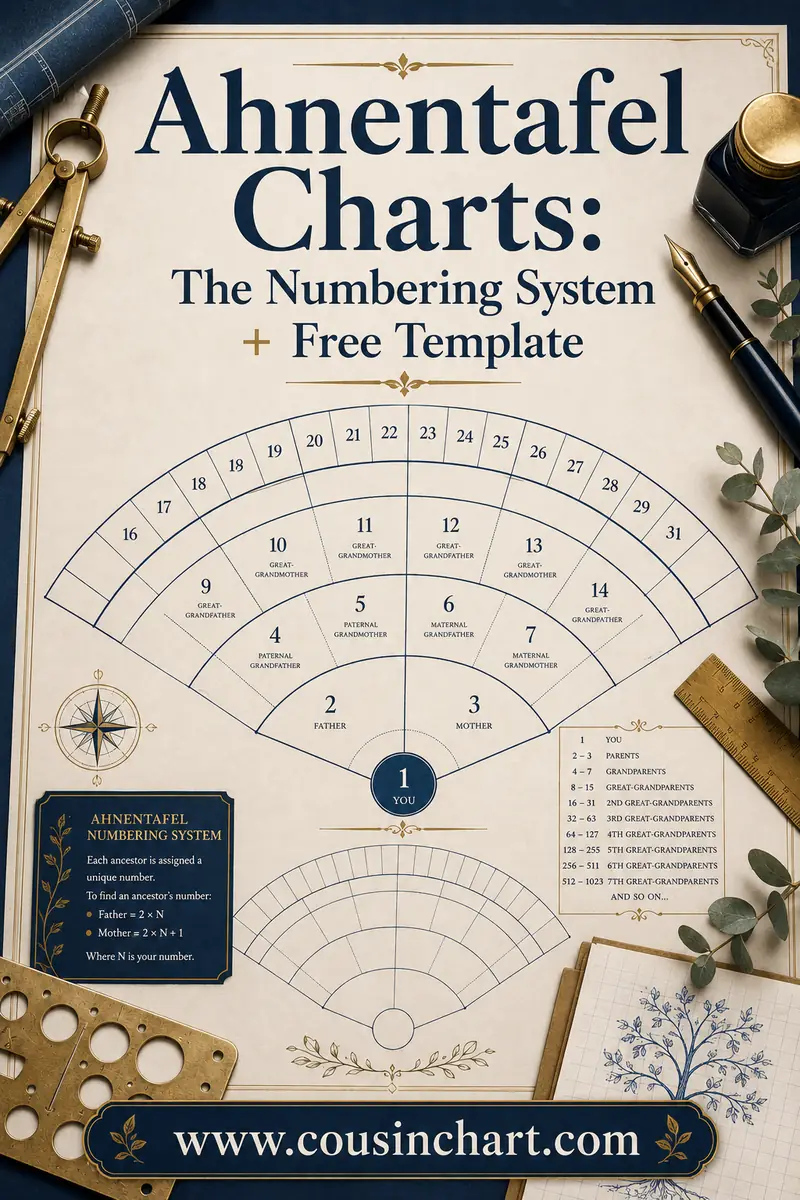
Numbering helps once the generations pile up. An ahnentafel chart gives every ancestor a fixed number, which is how you keep eight generations straight without losing your place.
Working with a chapter registrar
Most successful applications are not solo efforts, and this is the part outsiders don't know about.
Every DAR chapter has a registrar whose role is helping prospective members build their application. They do this repeatedly, they know which sources the national verifiers accept, and they help for free.
The usual route in is the society's prospective member form, which puts you in touch with a chapter near you. From there it's conversations, document gathering and drafts.
Bring what you have, however messy. Names, dates, places, photographs of certificates, and the family stories. Registrars are used to starting from a shoebox.
Expect to be asked for better sources than you thought you needed. That is the registrar doing you a favor — it's far quicker than having the file returned from national verification.
The application then goes to the national society for verification by professional genealogy staff, who either approve it or send back a list of what's missing.
Chapters vary in size and pace. If one isn't a good fit, another may be, and membership can generally be at-large where no local chapter suits.
Costs, timing and the other lineage societies
Plan for a project measured in months, not weeks, and for costs that are modest but real.
There is an application fee plus national and chapter dues, and amounts vary by chapter and change over time — ask your chapter for the current figures rather than relying on a number in an article.
The bigger cost is usually records. Certified copies, county clerk fees, archive copying charges and postage add up quietly across eight generations.
Verification takes months. Volume, the complexity of your line and the quality of your sources all affect it. A clean file that joins an established line moves considerably faster than a brand new patriot.
Once you're a member, additional patriots are supplemental applications — the same evidence standard, but a shorter path, and many members document a dozen or more over the years.
The same discipline works for every other lineage society. The Sons of the American Revolution, the Mayflower Society, the Jamestowne Society, the Colonial Dames and the state first-families organizations all ask the same fundamental question: prove each generation with a source. Only the qualifying ancestor changes.
Which means the work is portable. A well-documented line back to the 1700s can support applications to several societies at once, and that is a far better reason to do it properly the first time than any deadline.
FAQ
Who is eligible to join the DAR?
Any woman aged 18 or over who can prove lineal, biological descent from an ancestor who gave recognized service to the American cause during the Revolution. There is no requirement that the ancestor fought — civil office and patriotic service such as signing an oath or supplying goods also qualify.
What counts as patriot service for a DAR application?
Military service in the Continental forces, militias or navy; civil service in office under a new state or local government; and patriotic service such as signing an oath of allegiance, furnishing supplies, paying a supply tax or serving on a committee of safety, within roughly April 1775 to November 1783.
Do I need documents for every generation?
Yes. Each parent-to-child link between you and the patriot needs evidence — usually birth, marriage and death records, supplemented by wills, probate files, deeds, church registers and census entries for the older generations. Unsourced online family trees are not accepted as proof.
Does it help if a relative is already a DAR member?
Considerably. Where an approved line exists, you generally only document from yourself to the point where you join it. But applications approved under older, looser standards may need previously unproven points re-documented before the line can be used again.
How long does a DAR application take?
Assembling documents typically takes months, and national verification adds several more. A clean application joining an established line is much faster than one establishing a new patriot. Working with a chapter registrar from the start is the single biggest way to shorten it.
Can men join the DAR?
No — DAR membership is for women aged 18 and over. Men with the same ancestry join the Sons of the American Revolution, which applies a comparable proof standard. Both societies maintain public patriot databases that anyone can search, free, without joining.
The line is the point, not the pin
Whether or not you ever pin on a badge, the reason to do this is the line itself. Working generation by generation with a real source for each link forces a standard of proof most family trees never reach, and it leaves you with something durable: a documented path from your own birth certificate back to somebody who signed an oath, drove a wagon of flour, or stood in a militia line in 1777. Start with the free patriot databases, then talk to a chapter registrar before you order a single certified copy. And if you lose your bearings among the greats and great-greats, straighten the line out with the cousin calculator.