Cousin Calculator: How to Work Out Any Cousin Relationship
A cousin calculator works out the exact name for a cousin relationship using two pieces of information: the ancestor you both share, and how many generations each of you sits below that ancestor. The smaller of those two numbers gives you the cousin number (first, second, third), and the difference between them gives you the removal (once removed, twice removed). That's the entire system — everything else is bookkeeping.
If you just want the answer, the free family relationship calculator on our homepage does the counting for you. You pick how each person descends from the shared ancestor, and it hands back the exact term plus a shared-DNA estimate. But it's worth understanding what's happening underneath, because once the rule clicks, you'll be able to work out most relationships in your head at the family reunion.
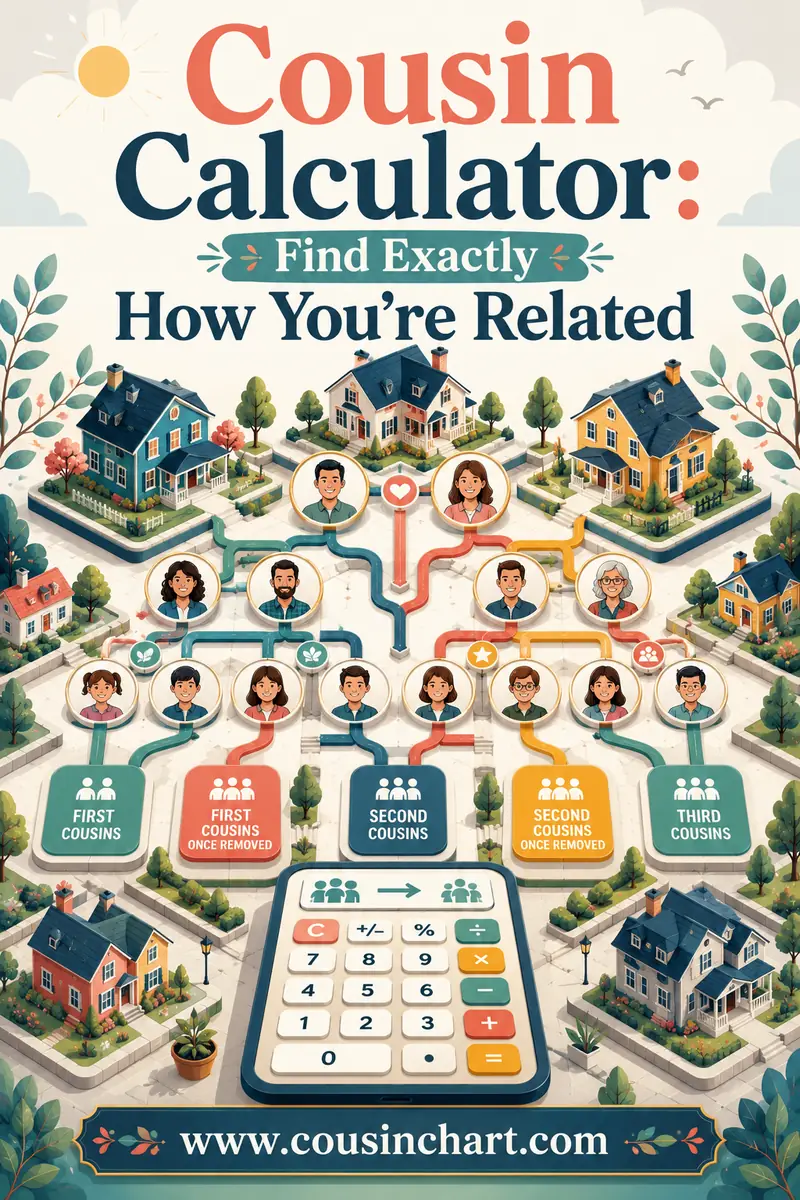
Cousin quick-check. Tap the situation that matches yours:
Your answer will appear here.
What Does a Cousin Calculator Actually Do?
A cousin calculator is a small piece of logic wrapped in a friendly interface. Underneath, it does three things in order.
First, it identifies the most recent common ancestor — the closest person (or couple) that both of you descend from. Second, it counts how many generations separate each of you from that ancestor. Third, it applies two rules to those two numbers to produce a name.
That's genuinely all there is. No database of family names, no guesswork. The calculator is doing arithmetic on generation counts, which is why it can name a relationship as obscure as "fourth cousin three times removed" just as confidently as it names a first cousin.
The reason people reach for a calculator anyway is that the counting is easy to get wrong under pressure. You're standing at a wedding, someone says "we're related through my grandmother's brother," and suddenly you're doing mental arithmetic while holding a drink. The relationship calculator removes the fumbling.
What Counts as a Shared Ancestor?
Everything in cousin math hangs off this one idea, so it's worth being precise.
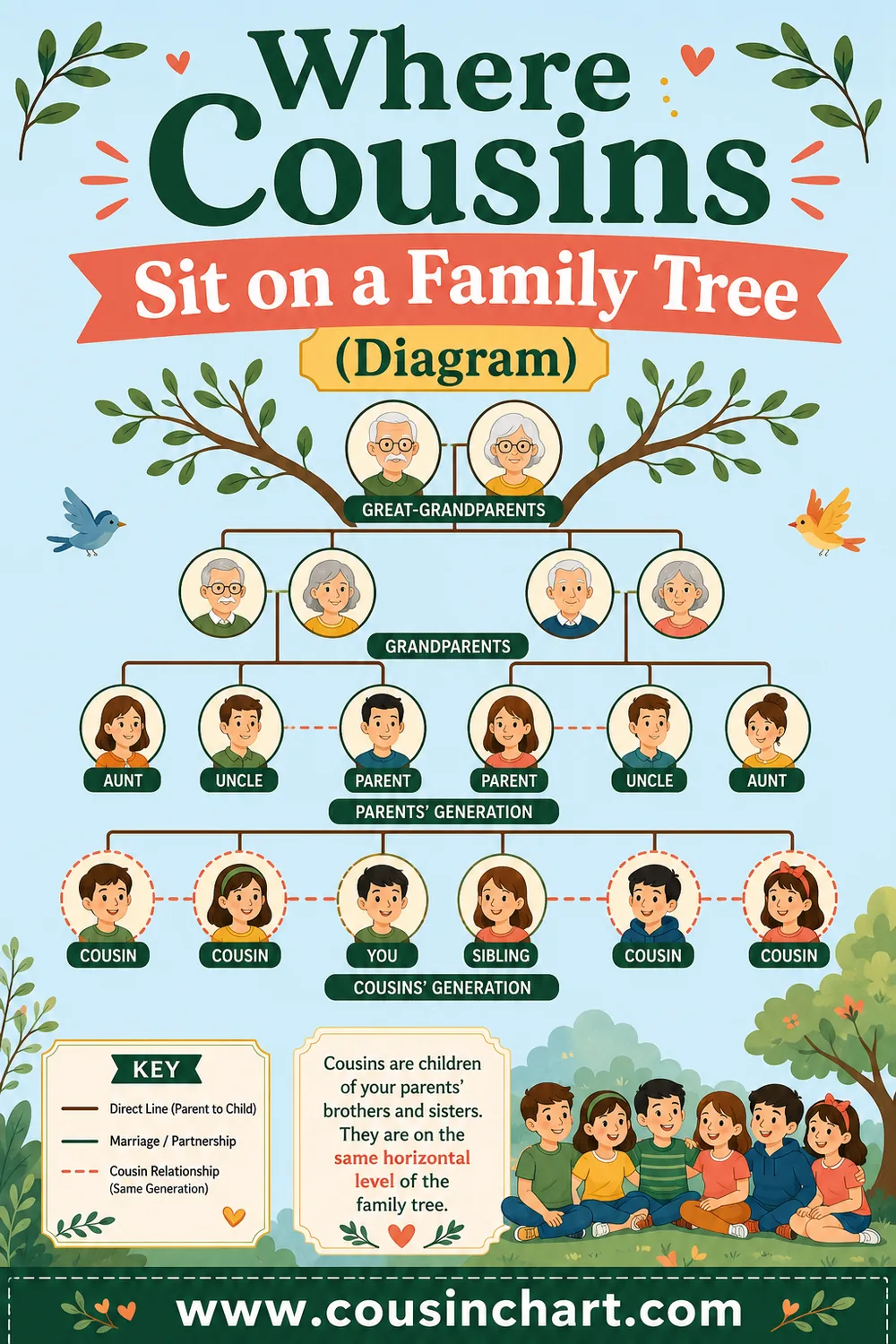
Your most recent common ancestor is the closest ancestor you and the other person both descend from. For first cousins, that's a set of grandparents. For second cousins, a set of great-grandparents. Note the word most recent — you and your second cousin also share great-great-grandparents, and great-great-great-grandparents, and so on up the line. But the relationship is named from the nearest shared pair, not the most distant.
A few practical notes:
- It's usually a couple, not a single person. Full cousins descend from both members of an ancestral couple. When only one ancestor is shared, you get half cousins, which we'll get to.
- The ancestor doesn't need to be alive or known by name. You just need to know how many generations back they sit for each of you.
- You count links, not people. Going from you to your parent is one generation. You to your grandparent is two. Don't count yourself.
If you're building this out on paper, our guide to reading cousins on a family tree shows how the shared-ancestor point looks visually. Once you can spot it on a chart, the numbers get much easier to trust.
How Do Cousin Numbers Work?
Here's the first rule, stated plainly:
The cousin number equals the number of generations from the shared ancestor, counting whichever of you is closer.
So if the nearest generation count is 2, you're first cousins. If it's 3, second cousins. If it's 4, third cousins. The pattern is always one less than the generation count.
That's why the familiar definitions line up the way they do:
- First cousins share grandparents (2 generations each).
- Second cousins share great-grandparents (3 generations each).
- Third cousins share great-great-grandparents (4 generations each).
- Fourth cousins share great-great-great-grandparents (5 generations each).
A useful sanity check: count the "greats" in the shared ancestor's title and add one. No greats (just grandparents) means first cousins. One great means second cousins. Two greats means third cousins. It works all the way up.
The word people trip over is "cousin" itself. In everyday speech, plenty of families call anyone vaguely related "cousin," and that's completely fine. The calculator gives you the genealogically precise term; what your family actually says at dinner is its own valid system.
What Does "Removed" Really Mean?
Second rule, and the one that causes the most confusion:
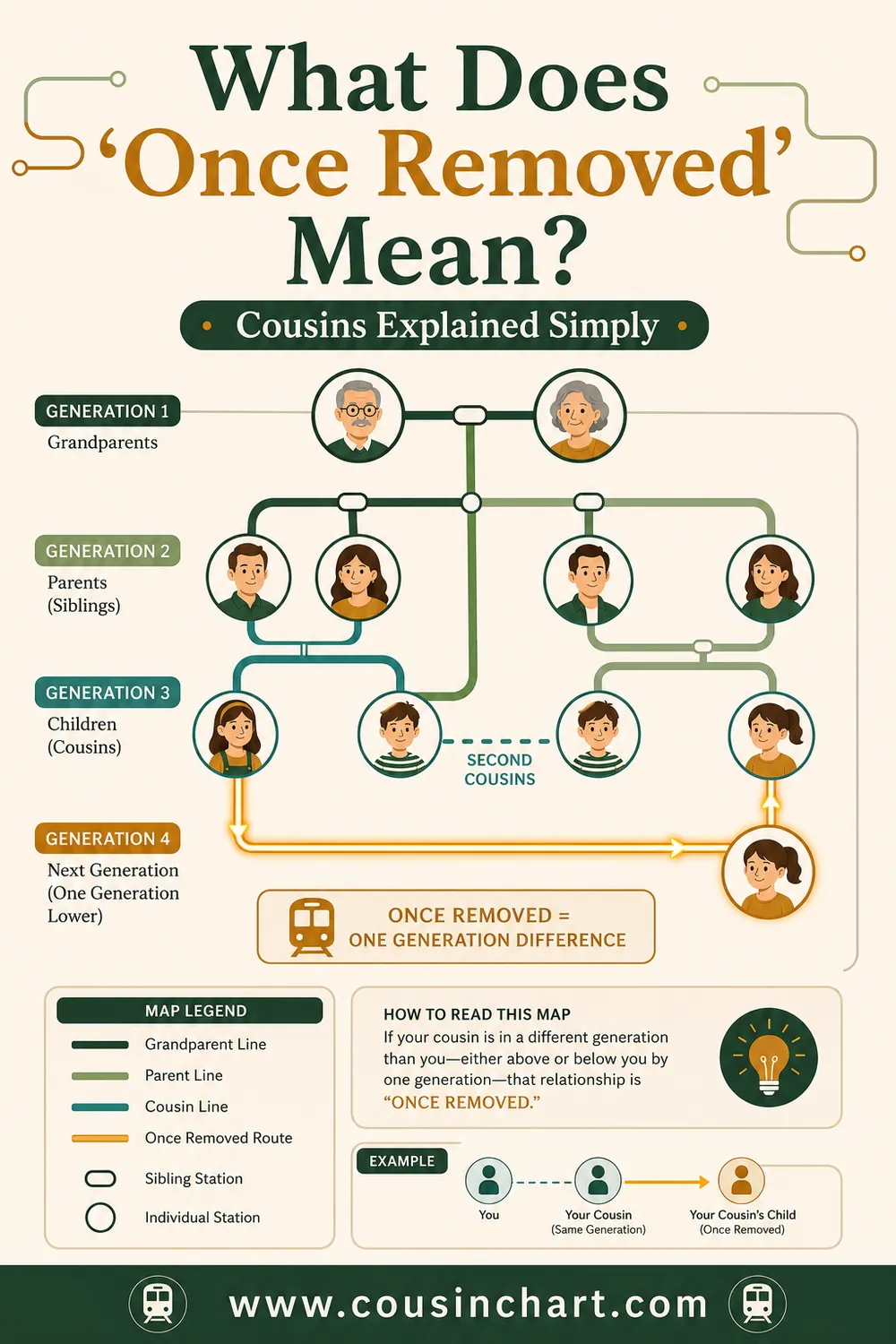
"Removed" is the difference in generations between the two people. It has nothing to do with age.
If you and the other person are the same number of generations from the shared ancestor, nothing is removed — you're plain first, second, or third cousins. If one of you is one generation further down, the relationship is once removed. Two generations of gap makes it twice removed.
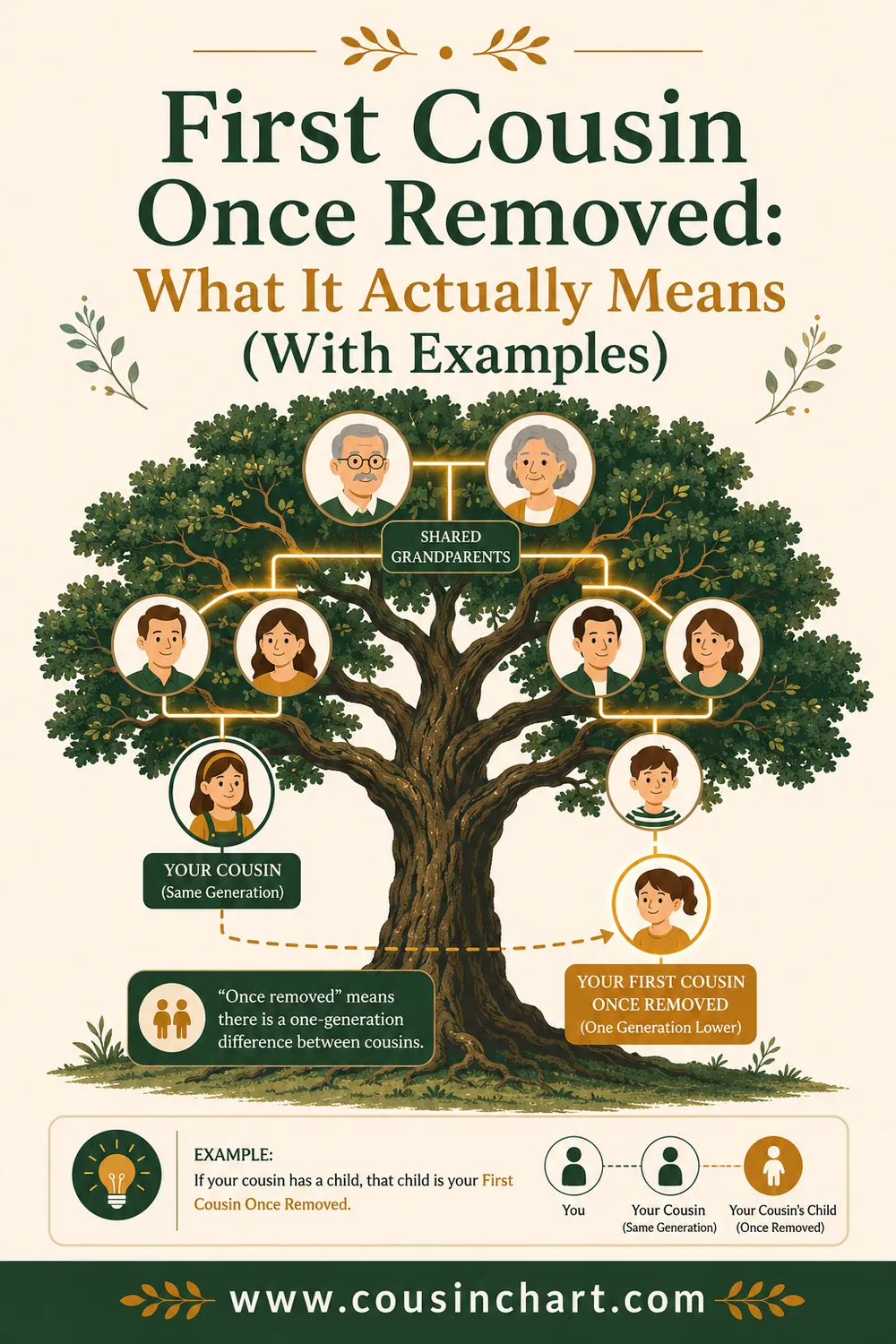
Read that again, because the age thing genuinely misleads people. A first cousin once removed can be forty years older than you or ten years younger. Your first cousin's child is your first cousin once removed. Your parent's first cousin is also your first cousin once removed. Same label, opposite directions, because in both cases the generation gap is exactly one.
It's also worth noting that "removed" doesn't mean distant, estranged, or lesser. It's purely a positional word. Our full breakdown of what once removed means has more on why the term feels so unintuitive in English.
Why the removal never changes the cousin number
A common mistake is to bump the cousin number up when there's a removal — treating your cousin's child as a "second cousin." It isn't. Your cousin's child is your first cousin once removed, because the closer generation count (yours, at 2) still sets the number.
Your children and your cousin's children are second cousins to each other. That's the level where the number actually advances, because now both sides are three generations from the shared ancestors.
How Do You Use the Cousin Calculator Step by Step?
Here's the workflow that gets you a right answer every time, whether you're using the calculator or a napkin.
- Name the shared ancestor. Ask: who is the closest person we both descend from? If two people (a couple), even better — that means a full, not half, relationship.
- Count your generations. From you, step up: parent (1), grandparent (2), great-grandparent (3). Stop at the shared ancestor. Write the number down.
- Count their generations. Same process from the other person. Write that down too.
- Take the smaller number and subtract one. That's the cousin number. 2 → first, 3 → second, 4 → third.
- Subtract the smaller number from the larger. That's the removal. 0 → nothing removed, 1 → once removed, 2 → twice removed.
- Put it together. "Second cousin once removed," and you're done.
The calculator does steps 4 and 5 instantly, but it still needs you to supply steps 1 through 3. Getting the shared ancestor right is the part that matters — if you pick an ancestor that's further back than necessary, every number after that will be inflated.
Worked Example: Your Cousin's New Baby
Your first cousin Maya just had a daughter, Ruby. What is Ruby to you?
- Shared ancestor: you and Maya share grandparents (your parents are siblings). Ruby descends from those same people.
- Your generation count: you → parent (1) → grandparent (2). So 2.
- Ruby's generation count: Ruby → Maya (1) → Maya's parent (2) → grandparent (3). So 3.
- Smaller number: 2. Minus one = first cousin.
- Difference: 3 − 2 = 1 = once removed.
Ruby is your first cousin once removed. And here's the payoff: if you have children, they'll be at generation 3 too, matching Ruby exactly. Your kids and Ruby are second cousins. That's the moment the number advances, and it's the clearest illustration of why removal and cousin number are separate ideas. Our dedicated guide on the first cousin once removed relationship walks through more variations of this exact scenario.
Worked Example: Second Cousin Twice Removed
This one sounds intimidating and takes about twenty seconds.
Say you meet a man named Daniel at a family funeral. Someone explains that Daniel's great-grandmother and your great-great-great-grandmother were the same person. Let's do it properly instead.
- Shared ancestor: a great-grandparent couple for you.
- Your generation count: you → parent (1) → grandparent (2) → great-grandparent (3). So 3.
- Daniel's generation count: he's two generations further down the line than you are — he's at 5.
- Smaller number: 3. Minus one = second cousin.
- Difference: 5 − 3 = 2 = twice removed.
Daniel is your second cousin twice removed. In practice, that means Daniel is roughly two generations younger than you in tree position — though he could easily be older than you in actual years, because families don't have children on a synchronized schedule.
Flip it around and the same label applies: if you were the one two generations lower, you'd still be second cousins twice removed. The label is symmetric. Only the direction differs.
Cousin Degree Reference Table
This is the table to bookmark. Read the left column as your distance from the shared ancestor and the top as theirs.
| Their generations from shared ancestor → | 2 (grandchild) | 3 (great-grandchild) | 4 (2× great) | 5 (3× great) |
|---|---|---|---|---|
| 2 (grandchild) | 1st cousins | 1C once removed | 1C twice removed | 1C 3× removed |
| 3 (great-grandchild) | 1C once removed | 2nd cousins | 2C once removed | 2C twice removed |
| 4 (2× great) | 1C twice removed | 2C once removed | 3rd cousins | 3C once removed |
| 5 (3× great) | 1C 3× removed | 2C twice removed | 3C once removed | 4th cousins |
Two things jump out. The diagonal is where plain cousin relationships live — equal generations, nothing removed. And the table is symmetric across that diagonal, which is the visual proof that removal doesn't care who's older or which direction you count from.
Here's the same information as a shared-DNA reference, using ranges from the Shared cM Project hosted at DNA Painter:
| Relationship | Shared ancestor | Typical shared DNA |
|---|---|---|
| First cousins | Grandparents | ~550–1,300 cM |
| First cousin once removed | Grandparents / great-grandparents | ~200–650 cM |
| Second cousins | Great-grandparents | ~75–360 cM |
| Second cousin once removed | Great-grandparents | ~30–215 cM |
| Third cousins | Great-great-grandparents | ~0–220 cM |
| Fourth cousins and beyond | 3× great-grandparents+ | Often nothing detectable |
What About Half Cousins and Double First Cousins?
Two variations break the tidy pattern, and both show up often enough to be worth knowing.
Half cousins share one ancestor instead of two
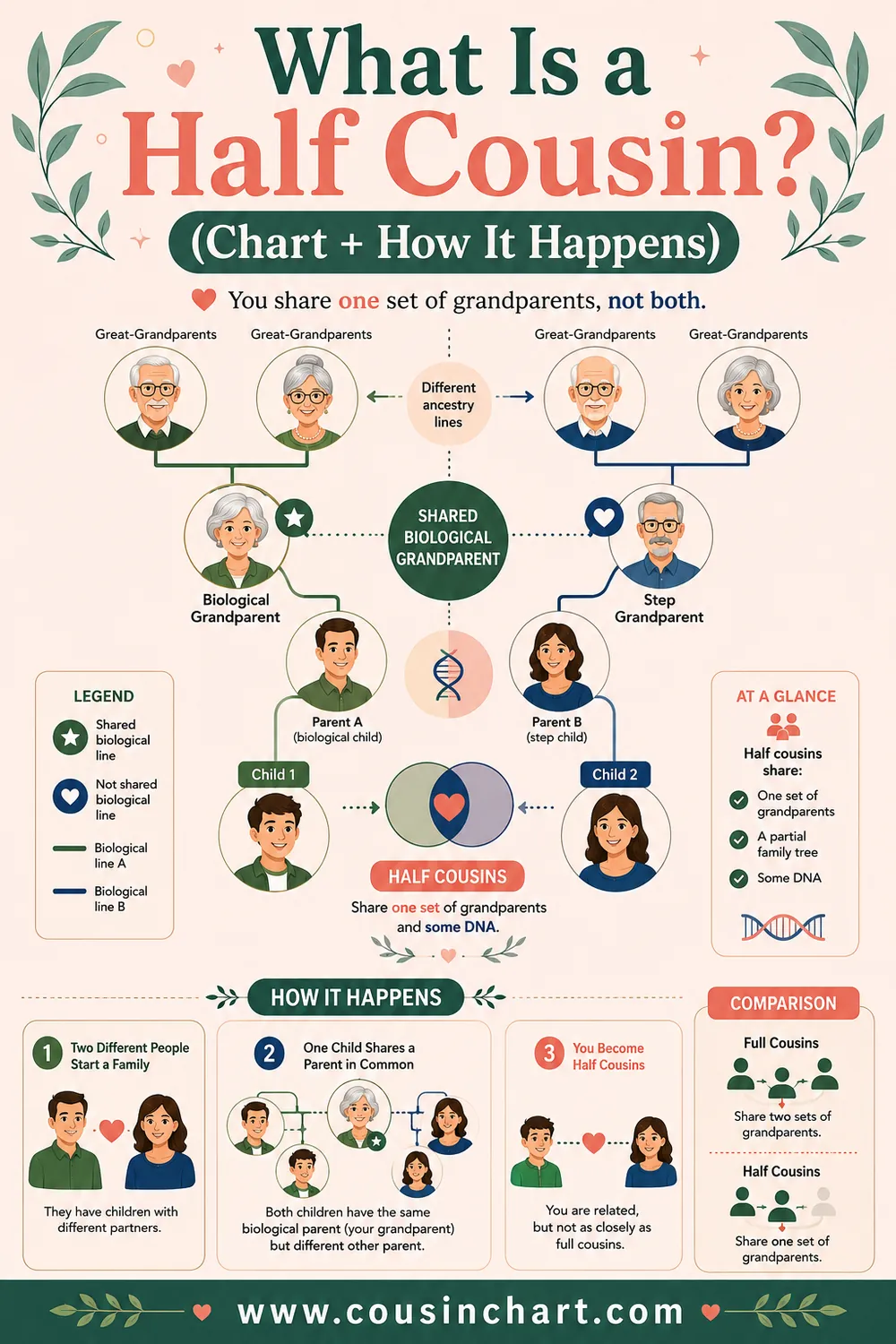
Half cousins share only one ancestor at the relevant level instead of two.
The usual setup: your grandfather had children with two different partners. Your parent came from one marriage; the other person's parent came from the other. You share a grandfather but not a grandmother, so you're half first cousins.
Genetically, that halves the expectation. Where full first cousins typically share somewhere in the 550–1,300 cM range, half first cousins land at roughly half of that — close enough to a full first cousin once removed that DNA alone often can't tell the two apart. That's a real limitation of testing, not a flaw in your reading of the results.
Socially, half cousins are usually just called cousins, and nobody blinks. The "half" prefix is a genealogical precision tool, not a ranking. Our guide to half cousins covers how half relationships propagate down the tree, including half first cousins once removed.
What Are Double First Cousins?
This is the relationship that breaks people's intuition.
Double first cousins happen when two siblings from one family marry two siblings from another family. Say your father and his brother marry two sisters. The children of those two couples share all four grandparents rather than the usual two.
The genetic consequence is dramatic. Ordinary first cousins share about 12.5% of their DNA on average. Double first cousins share roughly double that — around 25%, which puts them in the 1,300–2,600 cM range. That's the same statistical neighborhood as half-siblings, grandparent-grandchild pairs, and aunt/uncle-niece/nephew relationships.
If a DNA test shows a match in that 25% cluster and you can't work out who they'd be, double first cousins is a possibility worth checking — especially in families with a history of marrying within a small community. The term itself is still "double first cousins"; the "double" describes the doubled ancestry, not a doubled cousin number.
What Does the Shared DNA Estimate Actually Tell You?
The DNA figure a cousin calculator gives you is a statistical expectation, not a measurement of your specific case. That distinction matters a lot.
Every generation, DNA gets shuffled and roughly half gets passed along. That halving is predictable on average, but the shuffle is random for any individual pair. Two people who are genuinely second cousins might share 340 cM or 90 cM depending entirely on which chunks happened to get passed down.
The practical consequences:
- Close relationships are reliable. Parent, sibling, and first-cousin ranges barely overlap with anything else. DNA confirms these confidently.
- Distant relationships get ambiguous fast. A 150 cM match could be a first cousin twice removed, a second cousin, a half first cousin once removed, or several other options. DNA narrows the field; it doesn't pick a winner.
- Beyond third cousins, absence proves nothing. Some genuine fourth cousins share no detectable DNA at all. If your tree says you're fourth cousins and the test shows zero, the tree can still be right.
If you're working from a test result rather than a known tree, our shared cM chart explainer shows how to read overlapping ranges properly.
When Can't a Cousin Calculator Give You an Answer?
A cousin calculator answers exactly one type of question: how are two people related by descent from a shared ancestor? Step outside that, and it has nothing to work with.
- Step-relationships. Your stepmother's niece isn't your cousin in any genealogical sense — there's no shared ancestor. Plenty of families call her a cousin anyway, and that's a perfectly good answer, just not a calculable one.
- In-laws. Your cousin's husband is your cousin-in-law conversationally, but that term has no formal definition. Nobody's counting generations there.
- Adoption. An adopted family member is fully family legally and emotionally, and often genealogically documented as such — but the genetic estimate won't apply.
- Unknown ancestors. If you can't identify the shared ancestor, there's nothing to count. That's what DNA-based tools are for instead.
For all the terms that live outside the cousin system — in-laws, steps, and the ones with no tidy English word — our what do I call them tool handles the naming side.
Common Mistakes That Throw the Count Off
A quick list of the errors that come up most:
- Counting yourself as a generation. You are generation zero. Your parent is one.
- Using an ancestor that's too far back. Always the most recent shared ancestor. Going further inflates both numbers.
- Letting age drive the removal. An older person can be your cousin once removed downward in tree position. Age is irrelevant.
- Bumping the cousin number for removals. Your first cousin's child stays first cousin, once removed. The number only advances when both sides move down together.
- Assuming "cousin" means one grandparent pair. Check whether both ancestors are shared before ruling out a half relationship.
- Trusting family labels as genealogy. "Cousin Bea" may well be your mother's second cousin, or a close family friend. Ask how the line runs before you count.
FAQ
How does a cousin calculator work?
It finds your most recent common ancestor, counts how many generations each of you sits below that ancestor, then applies two rules: the smaller generation count minus one gives the cousin number, and the difference between the two counts gives the removal. Two numbers in, one relationship name out.
What is the difference between a second cousin and a first cousin once removed?
Second cousins are on the same generation level and share great-grandparents. A first cousin once removed shares grandparents with one of you, but the two people are one generation apart — like you and your first cousin's child. They're genuinely different relationships, and they sit in different DNA ranges (roughly 75–360 cM versus 200–650 cM).
Does "once removed" mean someone is older or younger than me?
Neither. "Removed" measures generations, not years. Your parent's first cousin and your first cousin's child are both your first cousin once removed, even though one is typically much older and one much younger. Because families have children at different ages, a cousin once removed can easily be older than you in one direction and younger in the other.
How much DNA do first cousins share?
First cousins typically share somewhere between about 550 and 1,300 centimorgans, averaging around 12.5% of their DNA. The wide range is normal — DNA inheritance is random, so two genuine first cousin pairs can land at opposite ends of that spread.
What makes double first cousins different?
Double first cousins result from two siblings marrying two siblings, which means the children share all four grandparents instead of two. They share roughly 25% of their DNA — about 1,300 to 2,600 cM — which overlaps with half-siblings and aunt/uncle relationships in DNA test results.
Can a cousin calculator tell me about step-cousins or cousins-in-law?
No, because those relationships have no shared ancestor to count from. Step and in-law terms are conversational rather than genealogical, and their usage varies by family and culture. Our what do I call them tool covers those terms instead.
Get the Exact Answer in Seconds
Cousin math is genuinely simple once you separate the two rules: the cousin number comes from the shorter distance to the shared ancestor, and the removal comes from the gap between the two of you. Everything else — halves, doubles, DNA estimates — builds on that foundation.
When you'd rather not count at all, the free family relationship calculator takes it from here. Tell it how each of you descends from your shared ancestor and it returns the exact term plus a shared-DNA range, in about the time it takes to say "wait, so what does that make us?"