Cherokee DNA: Testing, Myths and Tribal Enrollment
Here is the part the kit boxes never say out loud: there is no such thing as a Cherokee DNA test. No laboratory can look at your sample and identify a tribe, because tribes are political and cultural communities, not genetic categories. A consumer test can sometimes tell you that some of your ancestry traces to Indigenous American populations. It cannot tell you which nation, which ancestor, or which century — and it carries no weight at all with a tribal enrolment office. If you are trying to work out how a suspected Cherokee ancestor connects to you, the cousin calculator and a paper trail will get you further than a percentage ever will.
What are you hoping the test will do? Tap the closest match.
Tap an option above. The short version: DNA can support a search, but records decide it.
Why does no DNA test say "Cherokee"?
Because tribal identity is not written in the genome.
There is no Cherokee marker. Genetic variation in the Americas does not sort neatly into the boundaries of modern nations. Peoples living close to one another traded, married and moved for thousands of years, and the Cherokee were no exception. There is no segment of DNA that appears in Cherokee people and nowhere else, so there is nothing for a test to look for.
The panels are broad by necessity. The major companies report Indigenous American ancestry as one continental-scale category, sometimes broken into large regions such as North, Central or South America. That is the level at which the data supports a claim. Any product promising a tribal affiliation is selling you a marketing label, not a scientific finding.
Reference data is thin, and for good reason. Building a finer panel would need large numbers of participants with documented deep roots in specific nations. Many Indigenous communities have declined to take part, after a long history of research done to them rather than with them. The result is that Indigenous American ancestry is among the least well resolved categories in every consumer product — a point the live guide to Native American DNA testing covers in detail.
Citizenship is a legal status, not a biological one. Each federally recognized tribe sets its own criteria under its own law. A laboratory has no standing in that process whatsoever.
What does the "Cherokee princess" story usually turn out to be?
Almost every American family with deep Southern roots has a version of it. It is worth being gentle about, because the people who told you were not lying.
There were no Cherokee princesses. The Cherokee had no monarchy and no hereditary royal titles, so the specific word is a giveaway that the story has passed through several tellings. It usually reflects a genuine attempt to explain a dark-haired ancestor, an unusual surname, or a gap in the records.
Sometimes the ancestor was real but not Cherokee. Cherokee was by far the best known tribal name in the nineteenth-century South, so it became the default answer for any Indigenous ancestor, and for a good many who were Choctaw, Creek, Catawba, Lumbee or from a smaller community entirely.
Sometimes the story covered something else. Families under Jim Crow-era racial classification occasionally reframed an ancestor's background in the way that was safest at the time. That is history, not dishonesty, and it is worth handling kindly when you find it.
And sometimes it is true. Plenty of families do document a Cherokee ancestor once they go looking. The point is not to dismiss the story — it is to test it against records rather than a percentage.
What does a DNA test actually report?
One number, at a continental scale, with error bars the interface does not show you.
You get an estimate, not a measurement. Ethnicity results come from comparing your genome statistically against reference panels of living people. Different companies use different panels and different algorithms, which is exactly why the same person gets different figures from two kits, and why a result can change when a company updates its model. That is not a mistake being corrected; it is how the method works, as the guide to how accurate ethnicity estimates are explains.
Small percentages are the least stable part. A trace figure of 1% or 2% sits close to the level at which the model is guessing. Trace results appear and disappear across updates more than any other category, so building a family identity on one is asking a lot of it.
A 0% is not a verdict. It tells you that the test detected nothing at the level it can resolve. It does not tell you that a fifth-generation ancestor never existed.
Matching is the reliable half of the kit. Shared centimorgans between you and a living cousin are measured, not modeled. That part of your results is solid, and it is what the DNA match calculator is built to interpret.
Why might a real Cherokee ancestor leave no DNA in you?
Because autosomal DNA thins out quickly, and it thins out randomly.
You inherit half your autosomal DNA from each parent, but which half is a lottery run afresh in every generation. Averages describe a crowd, not you.
| Ancestor | Generations back | Average share of your autosomal DNA | Realistic chance of detecting it |
|---|---|---|---|
| Grandparent | 2 | ~25% | Certain |
| Great-grandparent | 3 | ~12.5% | Very likely |
| 2nd great-grandparent | 4 | ~6.25% | Likely, but a trace region may be blurred |
| 3rd great-grandparent | 5 | ~3.125% | Hit and miss |
| 4th great-grandparent | 6 | ~1.56% | Often nothing measurable |
| 5th great-grandparent | 7 | ~0.78% | Frequently zero |
Read the last column, not the third. By six or seven generations, it is entirely ordinary to inherit no detectable DNA from a given ancestor at all. Two siblings can differ here: one shows a trace, the other shows nothing, from the same great-great-great-grandmother.
Dilution compounds with panel weakness. A small true amount of Indigenous American ancestry has to be both present and confidently assigned by a panel that resolves this category poorly. Both things have to go right for it to appear.
So a negative result disproves nothing about paper ancestry. If your documents show a Cherokee ancestor five generations back, the documents win. DNA simply has nothing useful to say at that distance.
Which Cherokee tribes are federally recognized, and what do they require?
Three, and their citizenship rules are genuinely different from one another. Requirements are set by tribal law and can be amended, so treat the table as orientation and confirm the current rules with the nation's own enrolment office before you apply.
| Nation | Base roll used | Blood quantum requirement | Where it is based |
|---|---|---|---|
| Cherokee Nation | Dawes Rolls (1898–1907) | None — documented lineal descent only | Tahlequah, Oklahoma |
| United Keetoowah Band of Cherokee Indians | Its own base roll | Minimum quantum of Keetoowah Cherokee ancestry required | Tahlequah, Oklahoma |
| Eastern Band of Cherokee Indians | Baker Roll (1924) | Minimum quantum plus direct lineal descent from an enrolled ancestor | Cherokee, North Carolina |
Everything else calling itself Cherokee is something else. There are many state-recognized or self-described Cherokee groups, and being listed by a state is not the same legal status as federal recognition. Neither confers the other, and neither is established by a DNA test.
Lineal descent means naming the person. Cherokee Nation citizenship requires you to identify a specific ancestor by their Dawes enrolment number and document, with vital records, every link from that person to you. Getting a percentage back from a laboratory does not begin that process, and it does not shorten it.
No commercial test supports enrolment anywhere. This is worth saying flatly because so much marketing implies otherwise. Enrolment is determined by each nation from documented descent, and a test result is not evidence in that determination.
What is blood quantum and does DNA measure it?
No — and this is the single most common misunderstanding in the whole subject.
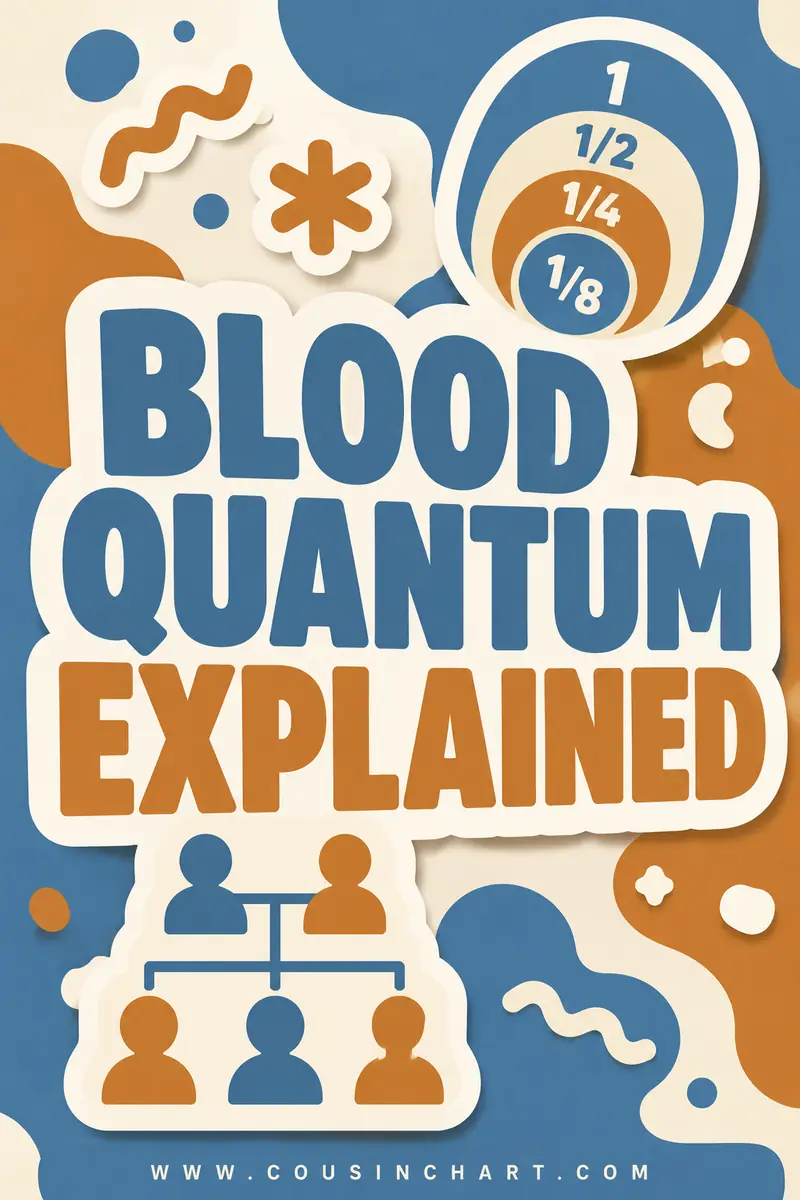
Blood quantum is a bookkeeping fraction. It is calculated from the quantum recorded for your enrolled ancestors on a specific historical roll, then halved down the generations on paper. It is arithmetic performed on documents.
A DNA percentage is a different quantity entirely. It is a statistical estimate of genetic similarity to reference populations. The two numbers can differ substantially in either direction and are not interchangeable, which is why no enrolment office accepts one in place of the other. There is a fuller account in the guide to how blood quantum is calculated.
The original rolls were imperfect. Quantum figures on the Dawes and Baker rolls were often recorded by non-Native officials working quickly, sometimes by appearance or by what a neighbor said. Those numbers still govern descent calculations today.
Which records actually establish Cherokee descent?
The named, dated ones. This is ordinary genealogy, done carefully.
The Dawes Rolls (1898–1907) are the base roll for Cherokee Nation citizenship, listing people enrolled in the Five Tribes in Indian Territory. They are indexed and searchable online at no cost through the National Archives and FamilySearch.
The Guion Miller Roll (1906–1909) recorded applications from people claiming Eastern Cherokee descent for a settlement payment. Tens of thousands applied and most were rejected — but the applications themselves are gold, because each one names parents, grandparents and residences. A rejected application is still a family document.
The Baker Roll (1924) is the base roll for the Eastern Band of Cherokee Indians in North Carolina.
The federal census is where most people should actually start. Work backwards from a living relative through the 1950, 1940, 1930 and 1900 enumerations, checking the race column and any Indian population schedules; the walkthrough on how to search census records covers the mechanics. Reach Indian Territory or the Qualla Boundary in the records, and the tribal rolls become searchable by a name you can trust.
What if the paper trail says no?
It happens often, and it is worth preparing for before you start.
A disproved story is still a real finding. You have replaced a rumor with documented ancestors who lived real lives. That is what the research was for.
Do not claim an identity the records do not support. Buying a certificate from a self-described group, or describing yourself as Cherokee on the strength of a 1% estimate, causes real harm to citizens of the nations — including in scholarships, arts markets and legal protections meant for them.
Keep the search honest and it stays useful. The full method for documenting Indigenous ancestry, including what to do when the trail runs cold, is set out in the guide to proving Native American ancestry with records.
FAQ
Can a DNA test prove I am Cherokee?
No. No commercial DNA test can identify a specific tribe, and no test supports tribal enrolment. Tests report Indigenous American ancestry at a broad continental level at best. Cherokee citizenship is a legal status determined by each nation from documented lineal descent, not from genetics.
Why does my DNA show 0% Native American when my family says we are Cherokee?
Autosomal DNA from any single ancestor halves each generation, so by five or six generations back you may inherit nothing measurable from that person. Reference panels for Indigenous American ancestry are also thin. A 0% result cannot disprove a documented ancestor on paper.
What is the Dawes Roll and why does it matter?
The Dawes Rolls are the citizenship rolls compiled between 1898 and 1907 for the Five Tribes in Indian Territory. Cherokee Nation citizenship today requires documented lineal descent from a person listed on those rolls. They are free to search through the National Archives and FamilySearch.
Does Cherokee Nation require a minimum blood quantum?
Cherokee Nation requires documented lineal descent from an ancestor on the Dawes Rolls with no minimum blood quantum. The Eastern Band of Cherokee Indians and the United Keetoowah Band each apply their own quantum requirements. Confirm current criteria directly with the nation's enrolment office.
Which DNA test is best for detecting Cherokee ancestry?
None is reliably better, because every company uses thin reference data for Indigenous American ancestry. If you test, choose on database size for cousin matching rather than on ethnicity claims, since finding documented relatives is the part of testing that genuinely helps this search.
Were there really Cherokee princesses?
No. The Cherokee had no monarchy and no hereditary royal titles, so the word is a sign the story has been retold many times. That does not automatically mean there was no Indigenous ancestor — only that the detail came from somewhere other than Cherokee tradition.
Trade the percentage for a paper trail
If you take one thing from this: the test result is the least useful part of a Cherokee ancestry search, and the records are the whole of it. Start with a living relative, work backwards through the census one documented generation at a time, and search the Dawes and Guion Miller applications by name once you reach Indian Territory. Use DNA matching for what it genuinely does well — finding living cousins who may hold the roll number, the photograph or the family Bible page you are missing. When one of those cousins turns up in your match list, the cousin calculator will tell you exactly how the two of you connect.