Blood Quantum, Explained: History and How It's Calculated
The most useful thing to understand about blood quantum is that it is arithmetic done on documents, not biology done in a laboratory. Your quantum is worked out from the degree recorded for your ancestors on a specific historical roll, then halved on paper down each generation. There is no blood quantum test. A DNA kit cannot produce the number, an enrolment office will not accept a DNA percentage in its place, and the two figures routinely disagree. Once you know which ancestor and which roll your family's number comes from, the rest is a calculation — and the cousin calculator will keep the generations straight while you do it.
What do you need blood quantum for? Tap the closest match.
Tap an option above. In short: the number comes from a document, never from a sample.
What is blood quantum, in one sentence?
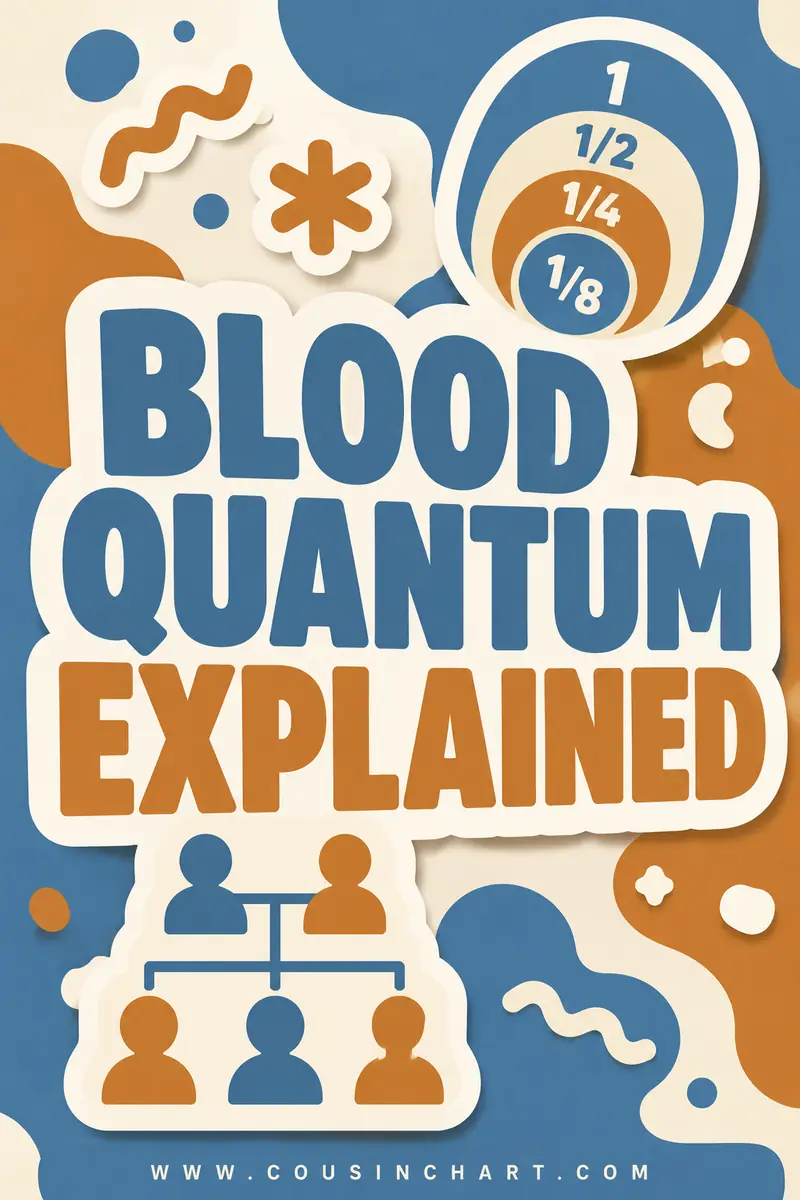
It is the fraction of a person's ancestry that traces to enrolled members of a particular tribe, as recorded on that tribe's base roll and halved down the generations on paper.
It is expressed as a fraction. You will see 4/4, 1/2, 1/4, 1/8, 1/16. Someone described as "full blood" on a roll was recorded as 4/4 for that nation.
It is tribe-specific, not pan-Indian. A person can be 1/4 of one nation and 1/4 of another and hold 1/2 total Indigenous descent while meeting a 1/4 minimum for neither — a genuine and painful situation for many families.
It attaches to a document, not to a person's appearance or upbringing. If your ancestor is not on the base roll the tribe uses, your quantum for that nation is zero, no matter what the family has always known to be true.
And it is not a measurement of anything genetic. This is the point most people arrive here needing. There is no test, and there never was.
Where did the idea come from?
Not from Indigenous nations. It was imposed on them.
Colonial precedent came first. Fractional ancestry rules were used in colonial law long before they were applied to tribes, as a way of sorting people into legal categories with different rights. The mechanism was borrowed, not invented, for Indian policy.
Allotment made it a federal habit. When the Dawes Commission enrolled members of the Five Tribes in Indian Territory between 1898 and 1907, it recorded a degree of Indian blood beside each name — often assessed quickly, sometimes by an official's judgement of appearance or by what a neighbor reported. Those hurried entries still govern descent calculations today, which is why the Cherokee DNA and enrolment guide spends so long on the Dawes Rolls.
The 1934 Indian Reorganization Act embedded it. Federal definitions of who counted as Indian for the Act's purposes included a one-half degree threshold, and many tribal constitutions written in that era adopted quantum minimums under federal encouragement.
The arithmetic has an obvious endpoint. A rule that halves a fraction every generation, applied to communities that marry outside themselves as everyone does, reduces the eligible population over time by design. Many people describe this as its purpose. Whatever the intent, the math is not in dispute.
How is blood quantum actually calculated?
Take the average of both parents' recorded quantum. That is the whole formula.
| Parent one | Parent two | Child's quantum |
|---|---|---|
| 4/4 | 4/4 | 4/4 (full) |
| 4/4 | 0 | 1/2 |
| 1/2 | 1/2 | 1/2 |
| 1/2 | 0 | 1/4 |
| 1/2 | 1/4 | 3/8 |
| 1/4 | 1/4 | 1/4 |
| 1/4 | 0 | 1/8 |
| 1/8 | 0 | 1/16 |
Notice row three and row six. If both parents hold the same quantum, the child holds it too. Quantum only falls when a parent has a lower degree, which is why marrying within the nation preserves eligibility and marrying out reduces it — the demographic pressure this creates on small nations is enormous.
The starting figure is whatever the roll says. Not what your family believes, and not what a test estimates. If a great-great-grandmother is recorded as 1/2 on the base roll, that 1/2 is the input, even if the enumerator got it wrong in 1902.
Some nations count only their own ancestry, others count total Indian blood. This is a real and consequential difference between tribal codes. Always check which rule the specific nation applies.
Documentation is the hard part, not the sum. You need vital records connecting each generation from the enrolled ancestor to you. Birth certificates, marriage records, death records — the ordinary genealogical spine described in the guide to proving Native American ancestry.
Why doesn't it match my DNA percentage?
Because the two numbers are produced by completely different processes and were never meant to agree.
DNA percentages are statistical estimates. A company compares your genome against reference panels of living people and reports the mixture that best explains it. Change the panel or the algorithm and the number changes, which is why the same person gets different figures from two companies and why results shift after an update. The guide to ethnicity estimate accuracy walks through why that is expected rather than a fault.
Inheritance is random, quantum is not. Quantum halves smoothly on paper. Actual DNA does not. Two full siblings with an identical documented quantum of 1/8 can inherit noticeably different amounts of Indigenous American DNA, and one may show a trace where the other shows nothing at all.
The panels resolve this category poorly. Indigenous American reference data in consumer products is thin, partly because many communities have declined to participate in genetic research after a long history of being studied without benefit. A true small fraction can therefore be missed entirely, as the guide to Native American DNA testing sets out.
So a mismatch means nothing is wrong. A documented 1/16 showing 0% on a kit is an ordinary outcome, not a contradiction. The paperwork is the authority here.
Which tribes use blood quantum, and which don't?
There is no single national rule. Each of the 500-plus federally recognized tribes sets its own citizenship criteria under its own law, and those laws can be amended by the nation's own process.
Some use a minimum quantum. Common thresholds are 1/4 or 1/8 of that nation's ancestry, though they range widely.
Some use lineal descent only. Cherokee Nation, for example, requires documented descent from an ancestor listed on the Dawes Rolls with no minimum degree at all.
Some use residency, parental enrolment or a combination. A handful require that a parent was enrolled at the time of the applicant's birth, which is a stricter test than descent alone.
None of them accept a DNA test. This is uniform. Confirm current criteria with the nation's own enrolment office rather than any third-party summary, including this one.
What is a CDIB, and is it the same as membership?
No, and conflating them causes a lot of wasted effort.
A CDIB is a federal certificate. The Bureau of Indian Affairs issues a Certificate of Degree of Indian Blood stating a person's documented degree, based on descent from someone on an approved base roll.
It does not make you a citizen of anything. Tribal citizenship is granted by the tribe. Some nations require a CDIB as part of an application; holding one on its own confers no membership and no voting rights in any nation.
It is used for certain federal programs. Some services and benefits administered federally use the certificate as an eligibility document.
Applications need the same records either way. Whether you are applying for a CDIB or for citizenship, you will be documenting the same chain of birth, marriage and death records back to the same named ancestor.
Why is blood quantum so contested?
Because it uses a colonial instrument to define who belongs to a community — and communities have never agreed on it.
It is measurably eliminationist over time. Applied strictly, quantum minimums shrink the citizen population generation by generation regardless of culture, language or residence.
It cuts across lived identity. People raised in the nation, speaking the language, living on the land, can fall below the threshold, while someone with no connection at all can meet it on paper.
It struggles with multi-tribal families. Children of parents from two nations frequently qualify for neither, despite having more Indigenous ancestry than a child who qualifies for one.
Nations are actively debating it. Several have moved away from quantum toward lineal descent in recent decades, and the debate continues inside many others. It is a live question of sovereignty, and it is theirs to settle.
How do you find the quantum recorded for your family?
Ordinary genealogy, worked backwards, one documented generation at a time.
Start with people you can name. Birth, marriage and death certificates for parents and grandparents establish the recent links, and it is the recent links that most applications actually fail on.
Use the census to bridge to the rolls. Work back through the 1950, 1940, 1930, 1920 and 1900 enumerations, watching the race column and any Indian population schedules; the walkthrough on searching census records covers how those schedules are organized.
Then search the base roll by name. The Dawes Rolls, the Guion Miller applications and the Baker Roll are indexed and free to search through the National Archives and FamilySearch. Note the roll number and the degree written beside the name — that is your starting fraction.
Ask living cousins before you ask an archive. Someone in the extended family often has the roll number, an old CDIB or a photograph with a name on the back. DNA matching is genuinely good at surfacing those cousins, and the DNA match calculator will tell you how closely a new match is likely to be related.
FAQ
Is there a blood quantum DNA test?
No. Blood quantum is calculated from the degree recorded for your ancestors on a tribe's base roll and halved on paper each generation. No laboratory test produces it, and no tribal enrolment office or Bureau of Indian Affairs application accepts a DNA percentage as a substitute for documents.
How do you calculate blood quantum?
Average the two parents' recorded quantum. A child of a 1/2 parent and a non-Native parent is 1/4; a child of two 1/4 parents is 1/4; a child of a 1/2 and a 1/4 parent is 3/8. The starting figure always comes from the degree written on the base roll.
What is the minimum blood quantum for tribal enrolment?
There is no single answer. Each federally recognized tribe sets its own rule, commonly 1/4 or 1/8, while others such as Cherokee Nation require documented lineal descent with no minimum at all. Confirm the current requirement with the specific nation's enrolment office.
Why is my DNA percentage different from my blood quantum?
They measure different things. Quantum halves smoothly on paper; actual DNA inheritance is random, so siblings differ. Reference panels for Indigenous American ancestry are also thin, so a genuine small fraction may not be detected at all. A mismatch is expected, not an error.
Does a CDIB make me a member of a tribe?
No. A Certificate of Degree of Indian Blood is a federal document issued by the Bureau of Indian Affairs recording documented descent. Tribal citizenship is granted only by the tribe under its own law. Some nations require a CDIB as part of an application, but it grants nothing on its own.
Where did blood quantum come from?
It was imposed by federal policy rather than invented by Indigenous nations. Fractional ancestry rules from colonial law were applied during allotment-era enrolment, when the Dawes Commission recorded a degree beside each name, and were embedded further in tribal constitutions written under the 1934 Indian Reorganization Act.
Start with the roll, not the result
Blood quantum only ever makes sense backwards. Find the ancestor, find the roll they appear on, read the degree written beside their name, then halve it forward through documented generations until you reach yourself. Every step of that is a records problem, and every step is solvable with birth, marriage, death and census records that are mostly free to search. A DNA kit sits outside that process entirely — useful for finding living cousins who might hold the missing certificate, useless as evidence of a fraction. When one of those cousins appears in your matches, the cousin calculator will place them in the tree for you.