Native American DNA Testing: What It Can and Can't Tell You
Two things need saying before any result is interpreted. First, consumer DNA tests are unusually poor at detecting Indigenous American ancestry, for reasons that have nothing to do with whether your family story is true. Second, and more important: tribal citizenship is a legal and political status decided by each nation itself, and no commercial DNA test confers, proves or supports enrolment anywhere. A percentage on a pie chart is not evidence of identity, community or citizenship. This page explains why the science is weak here, what a result of 0% and a result of 1% each actually mean, and where to look instead. For working out how a documented ancestor connects to you, the cousin calculator does the relationship math.
What does your result say? Tap the closest match.
Tap an option above. A percentage is not a person, a nation, or a status.
There is no single thing called "Native American DNA"
The phrase itself causes most of the confusion, so it is worth being precise about what is actually being measured.
Indigenous peoples of the Americas are hundreds of distinct nations. They have distinct languages, histories, territories and, genetically, distinct population histories. A test that reports "Indigenous Americas" is grouping all of that into one label because it does not have the data to do otherwise.
Tests do not detect ancestry directly. They compare your genome against reference samples from people whose grandparents all came from a known region, and estimate how much of your DNA most resembles each panel. The output is a statistical estimate, not a reading.
Regional subcategories are geographic, not tribal. "Indigenous Americas — North" or similar labels are drawn from where the reference samples were collected today. They do not identify a nation, a band or a community, and no test claims they do in the small print.
No test can identify a tribe. There is no genetic marker for Cherokee, Lakota, Navajo, Ojibwe or any other nation, and any service or website suggesting otherwise is misrepresenting what the technology does.
The general limits of ethnicity estimates apply here too, only more sharply. The broader picture is set out in the guide to how accurate ethnicity estimates are.
Why the reference panels are small
This is the first of the two reasons a real Indigenous ancestor may not appear in your results, and it is not a technical failing you can work around.
Reference panels depend on volunteers. A company can only compare you against populations that have contributed samples with informed consent. For most world regions this is straightforward. For Indigenous nations in North America it is not.
Many nations have declined to participate in genetic research, and for well-founded reasons. Research has been conducted on Indigenous communities without adequate consent, samples collected for one purpose have been used for others, and findings have been published that contradicted communities' own accounts of their origins without their agreement.
The Havasupai case is the example most often cited. Blood samples given by tribal members for diabetes research in the early 1990s were later used for studies of schizophrenia, inbreeding and population migration. The resulting litigation was settled in 2010, and the case reshaped how many nations view outside researchers.
Data sovereignty is now an active principle. A number of nations have formal research protocols, review boards or outright moratoria on genetic studies, treating genetic data as belonging to the community rather than to the individual sampled.
The practical consequence is a thin panel. Many consumer reference sets for Indigenous American ancestry lean heavily on published samples from populations in Mexico, Central and South America, which are genetically related to but distinct from populations further north. Ancestry from a nation not represented in the panel is likely to be estimated poorly, partially, or assigned somewhere else altogether.
This also explains why the numbers move. Every panel expansion changes the estimate, which is why figures shift between updates — the mechanism is explained in why ethnicity estimates change.
Why a distant ancestor may leave no DNA at all
The second reason is pure inheritance mathematics, and it surprises almost everyone.
You inherit half your autosomal DNA from each parent, but not a tidy quarter from each grandparent. Recombination shuffles the chromosomes each generation, so the contribution of any individual ancestor varies — and beyond a few generations it can reach zero.
A specific ancestor eight or nine generations back may have contributed nothing measurable to you. Not a small amount. Nothing. Your descent from them is real, documented and biological, and their DNA is simply not in your genome.
| Generations back | Relationship | Expected share | Rough chance of inheriting none |
|---|---|---|---|
| 3 | Great-grandparent | 12.5% | Effectively zero |
| 4 | 2nd great-grandparent | 6.25% | Effectively zero |
| 5 | 3rd great-grandparent | 3.1% | Under 0.1% |
| 6 | 4th great-grandparent | 1.6% | About 1–2% |
| 7 | 5th great-grandparent | 0.8% | Roughly 10–13% |
| 8 | 6th great-grandparent | 0.4% | Roughly 30% |
| 9 | 7th great-grandparent | 0.2% | Roughly 45–50% |
| 10 | 8th great-grandparent | 0.1% | Well over half |
These are averages with wide variation. The expected share is what you get on average across many people; any individual can inherit considerably more or considerably less. The same randomness that makes cousin matching imprecise is at work here, and it is described in more detail in how much DNA cousins share.
Cross the two problems and the result is unreliable. An ancestor seven generations back might contribute under 1% of your genome — below the level most tests can distinguish from noise — and that fraction is then compared against a thin reference panel. A negative result under those conditions carries very little information.
What a 0% result actually means
It does not disprove your family history. It means the test found no signal it could confidently assign, which is a different statement entirely.
It also does not confirm the story. Absence of evidence here is genuinely weak evidence either way, and it should not be treated as a verdict in either direction.
Do not test more relatives expecting a different answer, and then discard the answers you dislike. Testing older relatives is genuinely useful — a parent or an aunt carries DNA you did not inherit — but decide in advance what you will accept, or the exercise becomes a search for the result you wanted.
Many family stories of distant Indigenous ancestry do not hold up under documentary research, and some do. Both outcomes are common. A story that turns out to be inaccurate is not a moral failing on anyone's part; family narratives change shape across generations for all sorts of ordinary reasons.
Equally, plenty of documented Indigenous ancestry produces no detectable signal. People with well-evidenced descent recorded on tribal rolls have received results showing 0%, and this is expected rather than anomalous.
Test results are one strand, and the weakest one. The wider set of misconceptions people bring to these tests is covered in DNA testing myths.
What a small percentage means
Below about 1%, treat any figure as noise. Consumer tests generally cannot separate a real minority signal from statistical error at that level, and small trace percentages routinely appear and vanish between algorithm updates.
A few per cent is consistent with a distant ancestor, but names nobody. It does not tell you which ancestor, which line, which nation, when, or whether they were one person or several.
Trace amounts can also arise from population overlap. Some genetic signatures are shared between populations for reasons of deep ancestry, and a thin reference panel makes misassignment more likely, not less.
A percentage is never evidence of identity. Identity, community membership and citizenship are social and legal matters. A number generated by a commercial algorithm has no standing in any of them.
Check the confidence range, not the headline figure. Most services will show a range if you look — a "2%" result presented as 0–5% is telling you something important about how much weight the estimate can bear. The general reliability picture is set out in how accurate AncestryDNA is.
Tribal citizenship is a legal and political status
This is the part that matters most, and it is frequently misunderstood.
Each nation determines its own citizenship. In the United States, federally recognized tribes are sovereign, and each sets its own enrolment criteria through its own constitution and laws. Those criteria vary considerably from one nation to another.
Most require documented lineal descent from a base roll. A base roll is a specific historical list of citizens — for the Five Tribes, the Dawes Rolls compiled between 1898 and 1914; for other nations, their own censuses or rolls. The task is to prove, with documents, an unbroken line of descent from a named person on that list.
No nation accepts a commercial DNA test for enrolment. Not as proof, not as supporting evidence, not as a tiebreaker. Several nations, including the Cherokee Nation, have stated this publicly and repeatedly. A DNA test cannot demonstrate descent from a specific individual on a specific roll, which is what the requirement actually asks for.
A Certificate of Degree of Indian Blood is also documentary. The CDIB issued by the Bureau of Indian Affairs is calculated from documented ancestry recorded on rolls. It is not derived from genetic testing.
Canada works on a similar principle. Registration under the Indian Act, and citizenship in Métis and Inuit registries, rests on documented lineage and community acceptance rather than on genetic results.
Citizenship is also about relationship, not only paperwork. Many nations expect connection to the community, and enrolment is a matter of belonging as much as of descent. This is one reason a purchased test result is regarded, at best, as beside the point.
Blood quantum, in plain terms
You will encounter this phrase, so it is worth knowing what it refers to, without treating it as either a virtue or a target.
Blood quantum is a fraction of documented descent. It expresses how much of a person's recorded ancestry traces to enrolled ancestors of a given nation — one half, one quarter, one sixteenth, and so on.
It originated in United States federal policy, not in Indigenous tradition, and was applied through federal rolls and later legislation. Its history is contested and widely criticised.
Some nations use it, and some do not. Requirements range from a minimum quantum to lineal descent with no quantum threshold at all. It is a matter for each nation to decide.
It is calculated from documents, never from DNA. A blood quantum figure is arithmetic performed on recorded ancestry, and a laboratory result cannot generate or adjust it.
It is not the same as an ethnicity percentage. The two are unrelated: one is a legal-administrative calculation from records, the other a statistical estimate from a genome.
Y-DNA and mtDNA: a narrower tool
These tests answer a much smaller question, and they are sometimes misrepresented.
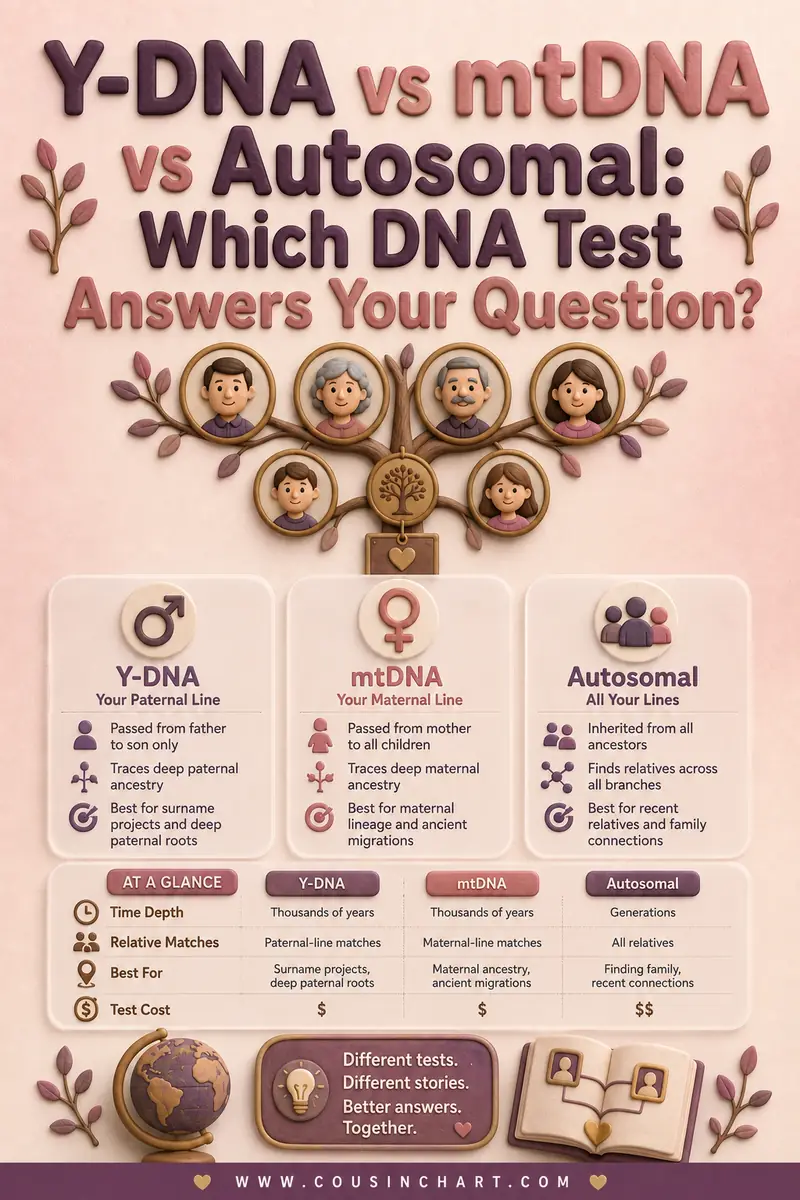
mtDNA follows one direct maternal line. Mother to mother to mother, with no other line included. Y-DNA follows one direct paternal line and is only carried by men.
Certain haplogroups are associated with the founding populations of the Americas — A2, B2, C1, D1 and X2a on the maternal side, Q-M3 and related lineages on the paternal side. Finding one indicates that that single line has Indigenous American origins.
But one line is a vanishing fraction of your ancestry. Ten generations back you have over a thousand ancestral positions and these tests examine exactly two lines. A negative result on both says almost nothing about the rest.
Haplogroup is not tribal affiliation. These lineages are distributed across many nations and across the continent, and they cannot identify a community. The differences between the three test types are explained in Y-DNA, mtDNA and autosomal testing.
And they confer no status. As with autosomal results, no nation accepts a haplogroup as evidence for enrolment.
Where to look instead
Documents answer the questions DNA cannot, and they are the only route that leads anywhere useful.
Start with the census. United States federal censuses recorded race from 1790 onwards, and separate Indian censuses were taken by agencies between roughly 1885 and 1940. The practical approach to searching them is in the guide to searching census records.
Work backwards one generation at a time. Birth, marriage and death records, obituaries, land records, church registers and probate files. Each should name the previous generation and give you the next step.
Look at the rolls and agency records directly. The Dawes Rolls and their application packets, the Guion Miller Roll, Bureau of Indian Affairs agency files and the associated National Archives holdings are largely searchable, and the applications often contain detailed family testimony.
Interview the living relatives who tell the story. Ask where the ancestor lived, when, what their name was and who said so. Stories usually carry a checkable detail somewhere inside them.
Then contact the nation's own enrolment office. They will tell you the exact criteria, the base roll they use and what documents they need. This is the only authoritative source on the question, and it costs nothing to ask.
Be prepared for the answer to be no, and be careful about how the search is framed. Claiming an identity on the strength of a percentage, or approaching a nation as a genealogical puzzle rather than a community, is understandably not well received.
FAQ
Does a 0% result mean my family story is false?
No. It means no confident signal was found. A distant ancestor may have contributed no measurable DNA to you at all, and the reference panels for Indigenous American populations are thin. The result is weak evidence in either direction, so treat it as inconclusive rather than as a verdict.
Can a DNA test tell me which tribe I descend from?
No test can. There is no genetic marker for any particular nation, and the regional labels tests use reflect where reference samples were collected, not tribal affiliation. Only documented descent recorded in that nation's own records can establish a specific connection.
Will a DNA test help me enrol in a tribe?
It will not. Every nation sets its own citizenship rules, and those rules rest on documented lineal descent from a specific historical roll. No nation accepts a commercial DNA test as proof or as supporting evidence, and buying one will not advance an application.
Why did my Indigenous percentage disappear after an update?
Ethnicity estimates are recalculated whenever the reference panel or algorithm changes. Small percentages sit close to the threshold where a real signal cannot be distinguished from statistical noise, so they are the first figures to appear and vanish between versions.
Which test is best for detecting Indigenous American ancestry?
None is reliably good at it, and the differences between the major services are smaller than the underlying limitation. Rather than choosing a test on this basis, spend the money on record access and pursue the documentary trail instead.
What is blood quantum, and does DNA measure it?
Blood quantum is a fraction of documented descent from enrolled ancestors, calculated from official records. It originated in United States federal policy, some nations use it and some do not, and it is worked out entirely from paperwork. No genetic test produces or adjusts it.
Follow the documents, not the percentage
A DNA test is a poor instrument for this particular question: the reference panels are small because many nations have declined, with good reason, to take part in genetic research, and a single ancestor several generations back may have passed you no measurable DNA whatsoever. A 0% result disproves nothing, and a 2% result confirms nothing. What answers the question is paper — census entries, tribal rolls, agency records, application packets and the family documents in somebody's cupboard — followed by a direct conversation with the enrolment office of the nation concerned, which is the only body entitled to decide who its citizens are. Once you have a documented ancestor, work out exactly how they connect to you with the cousin calculator.