Short Word for Cousin: Nicknames and Terms Across Languages
There's no single official short word for "cousin" in English — the word itself is already short — but plenty of families, cultures, and languages have their own casual nicknames and shorter terms that get used instead. Whether you're looking for a cute family nickname or a term from another language, here's the full range of what people actually use.
Casual English Nicknames for Cousin
"Cuz" is by far the most common informal short form in English — a straightforward, widely understood clipped version of "cousin," used casually in speech, texting, and social media across most English-speaking regions.
"Coz" is a common alternate spelling of the same nickname, seen especially in British and Australian English.
"Cous" (sometimes styled "couz") shows up occasionally as a shorter variant, though it's less universally recognized than "cuz."
Family-specific nicknames — a childhood mispronunciation that stuck, a blended name, a shared joke — are extremely common too, and by definition don't generalize beyond that specific family, but they're often the ones that actually get used day to day.
Terms for Cousin in Other Languages
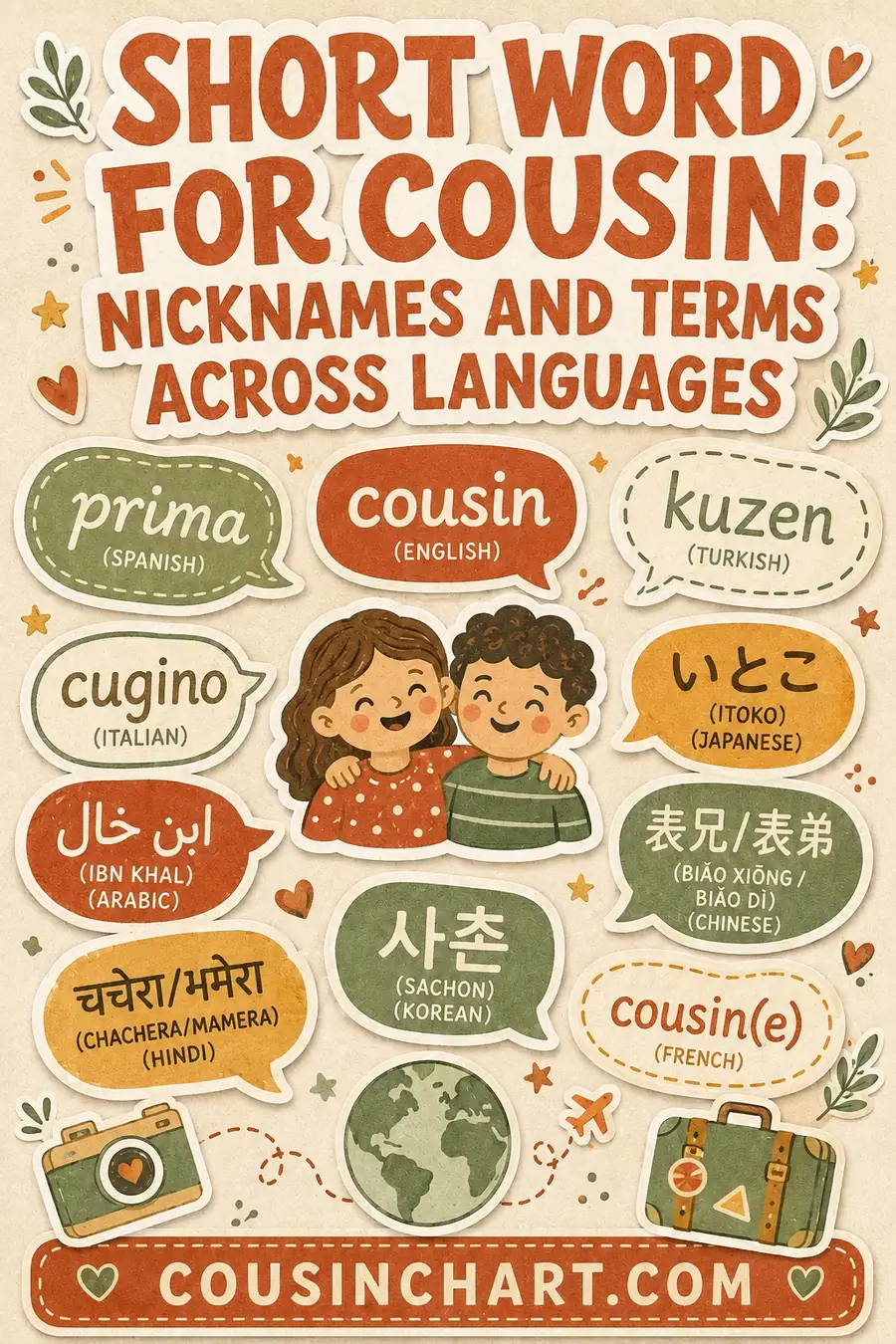
Many languages have shorter or more distinct words than the two-syllable English "cousin":
- Spanish: primo (male cousin) / prima (female cousin) — often shortened affectionately to primo/a with a nickname suffix in casual speech
- French: cousin / cousine — nearly identical to English but pronounced differently
- Italian: cugino / cugina
- German: Cousin / Cousine (borrowed from French) or the native Vetter (male) / Base (female), though the borrowed French terms are more common in modern usage
- Portuguese: primo / prima, same root as Spanish
- Arabic: distinct words exist for cousin depending on which side of the family and which parent's sibling — ibn 'amm (paternal uncle's son) is a well-known example, reflecting how some languages encode more specific family relationships than English does with a single catch-all word
- Mandarin Chinese: no single word for "cousin" at all — instead, distinct terms specify the cousin's gender, age relative to you, and which parent's side of the family they come from (for example, biǎo prefixes for maternal-side cousins, táng prefixes for paternal-side cousins on the father's brother's side)
Why Some Languages Have Shorter or More Specific Cousin Words Than English
English uses one catch-all word — "cousin" — for a huge range of relationships that other languages split apart. A first cousin, a second cousin, and a cousin once removed are all just "cousin" informally in English, whereas Mandarin, Korean, and several other languages have distinct terms that specify generation, gender, and side of the family in the word itself. This isn't really about efficiency — it usually reflects how central extended-family structure and birth order have historically been within that culture's social organization.
Family Nicknames That Aren't "Real" Words But Get Used Anyway
Plenty of families develop their own private cousin nicknames that have nothing to do with any language's actual vocabulary — a mispronunciation from a toddler cousin that stuck for decades, a blended nickname combining two names, or a joke name from a specific family memory. These aren't linguistically "real" short words for cousin in any formal sense, but they're often the actual terms used at every family gathering, and they carry more warmth than any formal or slang term ever could.
When Precision Matters More Than a Short Word
If you're trying to figure out exactly how a specific relative is related to you — not just what to casually call them — a short nickname doesn't help pin down whether someone is a first cousin, a second cousin, or a cousin once removed. A cousin chart walks through the actual generational relationship so you know the precise term, which matters more in contexts like legal questions, genealogy research, or just settling a family debate about who's "really" a first cousin versus a more distant one.
Regional Variations Within English
Even within English, cousin nicknames and usage carry some regional flavor worth noting. In parts of the Southern United States and in some Caribbean English dialects, "cousin" or "cuz" is sometimes used more broadly as a warm, informal term of address for a close friend, not exclusively for an actual blood relative — similar to how "brother" or "sis" gets used informally elsewhere. In some African American Vernacular English and hip-hop-influenced usage, "cuz" has also taken on this broader, affectionate meaning beyond literal family relation, which is worth knowing since it means context matters when interpreting whether someone using the term is referring to an actual cousin or using it as a general term of camaraderie.
Cousin Terms in Sign Language
American Sign Language (ASL) and other sign languages have their own dedicated signs for cousin, generally distinct from other family relationship signs, and some sign languages incorporate handshapes that indicate gender as part of the same base sign, similar to how some spoken languages build gender directly into their cousin vocabulary rather than using a single catch-all term the way standard English does.
Why Some Cultures Distinguish Cousins by Age Relative to You
Beyond gender and family side, several languages (Mandarin Chinese and Korean among them) also encode whether a cousin is older or younger than you directly into the vocabulary word itself, a distinction English doesn't make at all. This reflects the significant cultural weight placed on birth-order hierarchy and age-based respect conventions in those cultures, where how you address and behave toward a family member can shift meaningfully based on whether they're older or younger than you — a social structure baked directly into the language's family vocabulary rather than needing to be established through context or explicitly stated, the way an English speaker would have to specify "my older cousin" as a separate descriptive phrase.
How Naming Cousin Relationships Reflects Broader Family Values
The sheer range in how different languages and cultures handle cousin terminology — from English's single catch-all word to Mandarin's highly specific, generation-and-side-aware system — offers a small but genuine window into how differently cultures organize family structure and closeness. Cultures with highly specific cousin vocabulary tend to also place more formal social weight on extended family hierarchy and obligation; cultures with a single loose term (like English) tend to treat the nuclear family as the primary social unit, with extended cousins occupying a more flexible, informally-defined role. Neither approach is better, but understanding this helps explain why translating family terms between languages is often genuinely harder than translating other vocabulary — the underlying social concept, not just the word, doesn't always map cleanly across cultures.
When Precision in Cousin Terminology Actually Matters
For most everyday purposes, a loosely used "cousin" or "cuz" serves perfectly well, and nobody needs to work out exact generational math at a family barbecue. Precision becomes genuinely useful in a handful of specific situations: legal contexts (inheritance, marriage law, which distinguishes carefully between first and second cousins), genealogical and DNA research (where an accurately identified relationship type helps interpret test results correctly), and occasionally in cultures where cousin terminology carries real social obligations attached to it (in cultures with more specific vocabulary, knowing whether someone is technically a first or second cousin, older or younger, can carry genuine social expectations around respect and address). Outside these specific contexts, a warm "cuz" or simply "cousin" does everything most people need it to.
How Pop Culture Has Shaped "Cuz" as Casual Slang
Beyond its purely descriptive family use, "cuz" has become a broader term of casual camaraderie in music, film, and everyday youth culture over recent decades, often used between close friends who aren't related at all. This dual usage — literal family term and general term of affection — is part of why the word feels so natural and versatile in casual English today, and it's worth being aware of both meanings when interpreting how someone is using it in conversation, since context usually makes clear which sense is intended.
Written Abbreviations, and Why There Is No Official One
There is a real difference between a spoken short form and a written one, and only the spoken versions have caught on widely.
Ask for an abbreviation for cousin and the honest answer is that English never settled on one. There is no standard equivalent of "Dr." or "Mr." for the word, and no dictionary-sanctioned contraction. What exists instead are conventions borrowed from genealogy, where space on a chart is genuinely tight.
In genealogy software and pedigree charts, the standard short abbreviation for cousin is simply C, almost always paired with a number and a removal: 1C for first cousin, 1C1R for first cousin once removed, 2C for second cousin. This is the closest thing to a formal system, and it is understood on every major genealogy platform.
In casual writing - texts, group chats, family trees sketched on paper - people use cuz, cus, or coz. These are phonetic spellings of how the word is spoken rather than true abbreviations, which is why none of them saves much space and why spelling varies from person to person.
In older documents, you will sometimes see "cous." with a period, particularly in nineteenth-century letters and census marginalia. It has fallen out of use entirely and is worth recognizing rather than adopting.
Cousin Bro, Cuzzo, and Other Spoken Forms
Spoken forms do the work that no written abbreviation ever managed, and they carry meaning beyond the family relationship itself.
Cousin bro is the clearest example. Common in Indian English and in South Asian families internationally, it distinguishes a male cousin from a female one in the same way "cousin sister" does, and it also signals closeness - the "bro" is doing the work that English's single ungendered word leaves undone. In many families it is used for cousins raised close enough to feel like siblings.
Cuzzo and cuzzy add warmth rather than precision, the first common in African American English and the second widely used in New Zealand, where "cuzzy bro" carries a similar affectionate weight.
Prima and primo get borrowed into English by Spanish-speaking families for the same reason: they carry the gender the English word drops.
What all of these have in common is that the popular slang for cousin is rarely just a shortcut. It nearly always adds something the plain word cannot - gender, closeness, or a marker of shared background - which is exactly why these forms have survived while written abbreviations never took hold.
Frequently Asked Questions
What does "cuz" mean besides "cousin"? In casual speech, "cuz" is also commonly used as a shortened form of "because" — context almost always makes clear which meaning is intended, since the two uses rarely overlap in the same sentence.
Is there a formal short title for cousin, like "Mr." or "Aunt"? No — unlike aunt, uncle, or grandparent, "cousin" doesn't have a traditional formal title form in English. It's typically used as a plain descriptive term ("my cousin Sarah") rather than as a title attached before a name.
Do other languages always have shorter words for cousin than English? Not necessarily shorter in syllable count, but often more specific — many languages split "cousin" into multiple distinct words based on gender, generation, and family side, which English handles with just one general term plus extra descriptive words when needed (like "second cousin" or "cousin on my mom's side").
What's the most commonly used casual nickname for cousin in English? "Cuz" is by a wide margin the most recognized and widely used informal short form across English-speaking regions, in both spoken conversation and text/social media.
Is "cuz" appropriate to use in formal writing? No — "cuz" is strictly informal, appropriate for casual speech, texting, and social media, but not for formal writing, professional communication, or any context requiring standard English.
Do other Romance languages besides Spanish, French, and Italian use similar cousin words? Yes — Romanian ("văr/verișoară") and other Romance languages generally share the same Latin root as the examples covered above, though the exact modern form varies by language.
Why does English use one word for cousin while some languages use many? This largely reflects historical differences in how central extended family structure has been to a culture's social organization — languages with elaborate cousin vocabularies generally come from cultures where extended family roles and birth order have carried more formal social significance over a long history.
Are there regional American accents where "cousin" itself gets shortened differently than "cuz"? Some regional dialects favor slightly different informal contractions, though "cuz" remains the most broadly recognized and widely used short form across American English dialects specifically.
Is there a difference between "cuzzo" and "cuz" as nicknames? "Cuzzo" is a slightly more elaborated, playful variant of "cuz," commonly heard in certain regional and cultural speech patterns, but it carries the same essential meaning and casual, affectionate tone as the shorter form.
Are there any modern slang terms for cousin beyond "cuz" gaining popularity? Language evolves quickly in casual and online speech, and new informal variants do occasionally emerge, though "cuz" remains by far the most stable and widely recognized short form at this point.
Do sign languages other than ASL have their own distinct sign for cousin? Yes — each national or regional sign language generally has its own distinct family-relationship vocabulary, including a dedicated sign for cousin, developed independently rather than borrowed directly from spoken-language terms.