Poorhouse and Almshouse Records
Here is the part nobody expects: the poorhouse admission register often holds more personal detail about an ancestor than any other document they ever appeared in — age, birthplace, marital status, occupation, physical condition, the names of relatives, who brought them in and where they were buried. These are the records that cover the people hardest to trace, because poverty leaves so few other marks: no deed, no will, no estate, sometimes no gravestone. And an admission is not a verdict on anyone. Most were short stays forced by a single event — a husband's death, a broken leg, a bad winter, old age with no children left. If a register names relatives you cannot immediately place, the cousin calculator will work out how they connect.
Where should you look first? Tap the closest match.
Tap an option above. These registers describe people the rest of the record set leaves out.
What a poorhouse was, and who ended up in one
The names change by place and period: almshouse, poorhouse, poor farm, county home, county infirmary, workhouse in Britain and Ireland. The institution is broadly the same.
It was public relief with a roof. From the early 1800s most US counties ran an institution where people with no means could live, usually working on an attached farm. Britain and Ireland had the parallel workhouse system, reorganized in England and Wales in 1834 and never popular.
The residents were not a single type of person. Registers are full of widows over 70, men injured at work, people with epilepsy or dementia at a time when nothing else existed for them, women abandoned mid-pregnancy, and whole families burnt out or wiped out by an epidemic.
Most stays were short. People came in for a winter, recovered, and left. Registers routinely show admission and discharge within weeks, and repeat admissions for the same person over years — which is a record of a difficult life, not a permanent state.
Money is why the paperwork is so good. Every inmate cost a county or a parish money, and the authority that paid always wanted to know whether somebody else was legally liable — another county, another town, a son, a father. That single financial question produced the detail genealogists now depend on.
One thing to hold onto while you read. These documents were written by officials paid to manage cost, and their language reflects it. The person in the ledger was somebody's mother. Read the record for its facts and leave its judgements where you found them.
Why the detail is so much better than you expect
Liability required identification. To charge the cost to the right place, the clerk had to establish where a person legally belonged, which meant birthplace, years of residence and often a full movement history.
Family was pursued for the money. Poor laws made adult children liable for destitute parents, and fathers liable for their children. So registers and overseers' minutes name sons, daughters and spouses, with the places they were living — which makes the record a family finder, not just a personal one.
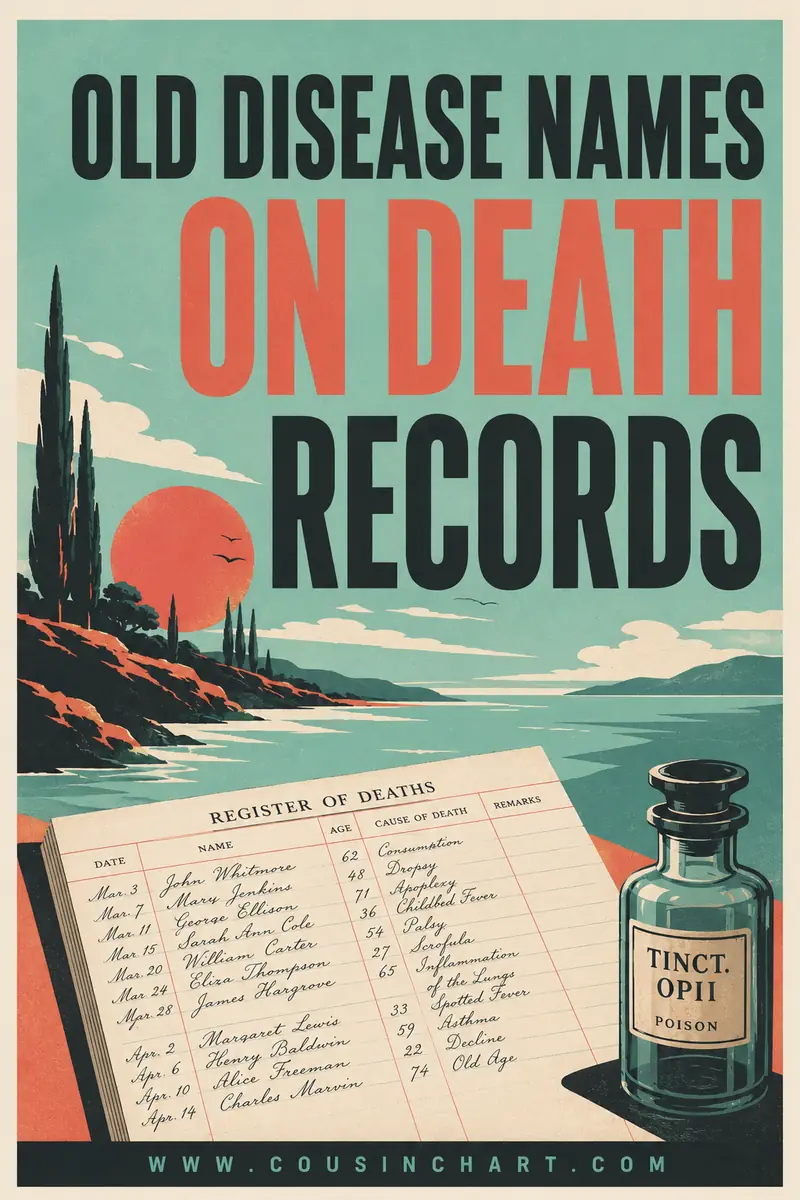
Medical condition was recorded because it affected care. Entries note blindness, deafness, lameness, "feeble", "insane", pregnancy, and cause of death. Some of that vocabulary is now archaic or offensive; our guide to old disease names on death records decodes the medical terms you will meet.
Immigrants were asked how long they had been in the country. Nineteenth-century registers in port counties often record nationality and years in the United States, which narrows an arrival date without a passenger list.
And the entries are dated to the day. Unlike a census, an admission register gives an exact date for a person's presence — often the only precise date attached to them anywhere.
What an admission register actually records
Coverage varies by county and decade, but a good nineteenth-century register will hold most of this.
| Field | Typical content | Why it matters |
|---|---|---|
| Name and age | Full name, age in years | Often the only stated age between two censuses |
| Nativity | State or country of birth, sometimes town | Points at where to search next |
| Years in the country | For immigrants, years in the US and in the state | Narrows arrival to a few years |
| Marital status | Single, married, widowed, deserted | "Deserted" flags a spouse who left and can be traced |
| Occupation | Trade or last employment | Distinguishes people of the same name |
| Condition | Age, illness, disability, pregnancy | Explains the admission; use with care |
| Cause of pauperism | Often blunt: "intemperance", "misfortune", "old age" | An official opinion, not a fact |
| Admitted by | The official, relative or overseer who brought them | Frequently names a relative |
| Discharge or death | Date, and to whom discharged | Dates a death when no certificate exists |
| Burial | Plot or grave number in the institution ground | Points to an unmarked pauper cemetery |
Not every register has every column, and some are little more than a name and a date. When the register is thin, the overseers' account books beside it usually are not.
Settlement examinations: a life story under oath
If you are researching English, Welsh or colonial New England ancestors, this is the record to want.
A settlement examination was taken to decide who paid. Under the old poor law, a person belonged to a specific parish or town, and only that place had to relieve them. When a stranger applied for help, officials examined them under oath about where they belonged.
So the person told their life story. Where they were born, who they were apprenticed to and for how long, where they had worked and rented, when and where they married, and the names and ages of their children. It is autobiography, taken down verbatim, from people who left no other written trace.
Removal orders show the movement. If the examination decided another parish was liable, a removal order sent them there, naming the destination — which hands you the family's earlier home directly.
Bastardy examinations name fathers. Where a child was born outside marriage, the mother was examined and the father named so he could be pursued for maintenance. It is often the only place a father is named at all, and the related bonds are held with the county court records.
In the US these are strongest in New England. Massachusetts, Connecticut and New Hampshire towns kept "warning out" records — a legal notice that the town would not be responsible for a newcomer. Being warned out did not mean being expelled, and the lists are excellent for dating arrivals.
Outdoor relief and the records before the house
Most poor relief never involved an institution at all, and those records are older.
Outdoor relief was help given at home. A load of firewood, a barrel of flour, a pair of shoes for a child, a doctor's bill paid, a coffin. Overseers of the poor recorded every payment against a name.
The accounts are annual and itemised. Read them in sequence and you can watch a widow's circumstances year by year, or spot the winter a man was too ill to work.
They frequently name who was paid to provide care. A neighbor boarding an elderly woman, a woman nursing a sick man — and the person paid is often a relative.
Coffin and burial payments date deaths. "Paid for coffin for the widow Kerr, $2.50" is a death record, in a county with no death registration.
And they run earlier than any almshouse. Town and parish poor accounts survive from the 1600s in some places, well before the institutions were built.
Children, and where they went instead
Children in destitute families were rarely left in the house for long.
Pauper apprenticeship was the standard answer. A child was bound out by indenture to a master until 18 or 21, in return for keep, some schooling and a set of clothes at the end. The indenture names the child, the age, usually a parent, and the master.
That indenture is a genealogical record. It can be the only document naming a child's mother, and it explains a child appearing in an unrelated household on the next census.
Some children went to an orphanage or were placed out west. Placing agencies took children from institutions and from families in crisis; the orphanage and orphan train records page covers those registers, which are held by the agencies rather than the county.
Children born in the house were registered there. Many almshouses had a maternity ward in all but name, and births were recorded in the register with the mother's name. If your ancestor's birthplace is a county institution, that is why.
Do not assume the family broke up permanently. Many parents reclaimed children after a crisis passed, and a child bound out at nine can be back with siblings at twenty.
Where the records are, and what is closed
County archives and clerks hold most US almshouse records, sometimes under "county home", "county infirmary" or "poor farm". Ask by all of those names, because a modern clerk may not recognize "almshouse".
State archives have taken in a lot of it. New York, Pennsylvania, Ohio and Massachusetts in particular. State boards of charities also collected annual statistical reports which sometimes name individuals.
FamilySearch has scattered digitized registers, cataloged under the county and then "Poorhouses, poor law, etc." It is worth searching that heading explicitly.
The 1880 census has a special schedule. Alongside the 1880 population census, enumerators completed supplemental schedules covering paupers and people in institutions, and many survive in state archives. They name individuals with details the main schedule omits.
British and Irish workhouse records sit in county record offices, with large digitized sets on the main subscription sites. Admission and discharge registers, creed registers and workhouse school registers all survive in quantity.
Access is often restricted for recent decades. Where a register continued into the twentieth century, or where medical detail is recorded, archives commonly close the volume for 75 to 100 years. Ask the archive rather than assuming; some will search a closed volume on your behalf for a direct ancestor.
Reading these records fairly
The language is of its time and frequently cruel. Registers use words for disability, mental illness and unmarried motherhood that are not acceptable now. They are evidence of what an official wrote, nothing more.
"Cause of pauperism" is an opinion. A clerk's one-word verdict — "intemperance", "idleness" — was often written about a stranger after five minutes' conversation. Treat it as you would any other unsourced claim.
Look for the event behind the admission. Check the date against a death in the family, an epidemic, a mill closure, a hard winter. Poverty almost always has a trigger, and finding it turns a shameful-looking entry into an understandable one.
Share it in the family with context, not as a headline. A relative who hears "she was in the poorhouse" hears something very different from "she was widowed at 34 with four children and the county took them in for a winter."
And use it for what it is: a breakthrough record. For families that own nothing and appear nowhere, an almshouse register with a birthplace and a relative's name is often the exact document that ends a stalled search — which is why it belongs on any serious brick wall checklist. If the entry ends in a death, look for the institution's own burial ground through free cemetery records, because pauper graves were usually numbered rather than marked.
FAQ
What information is in a poorhouse admission register?
Typically the name, age, birthplace, marital status and occupation, the physical or medical condition on admission, who brought the person in, the stated cause of admission, and the date of discharge or death. Nineteenth-century registers in immigrant areas often add nationality and years in the country.
Where can I find US almshouse records?
Start with the archive or clerk of the county where the person lived, asking for "county home", "county infirmary" or "poor farm" as well as almshouse. Many have been transferred to state archives, and FamilySearch has digitized scattered registers under each county's poor law heading.
Was being in a poorhouse a permanent thing?
Usually not. Registers show many stays of a few weeks or a single winter, and repeat admissions across years. Admission was normally triggered by a specific crisis — widowhood, injury, illness, old age without surviving children — rather than a permanent status.
What is a settlement examination?
A sworn statement taken by poor law officials to decide which parish or town was legally responsible for relieving someone. The person recounted their birthplace, apprenticeships, employment, marriage and children, so the document reads as a short autobiography. They are strongest in England, Wales and colonial New England.
Why are some poorhouse records closed to researchers?
Because many registers continued into the twentieth century and record medical and mental health information about people who may still be living or recently deceased. Archives commonly close such volumes for 75 to 100 years, though some will search a closed volume for a documented direct ancestor.
Are poorhouse burials recorded anywhere?
Usually in the institution's own register and in a numbered plot in an attached burial ground, rather than under a headstone. Some counties later mapped these grounds, and volunteer memorial projects have transcribed surviving plot books, so search the institution name as well as the person.
The record that finds the people nobody else recorded
Poorhouse and almshouse registers are uncomfortable to open and unusually generous once you do. They give an exact date, a stated age, a birthplace, a condition, a relative's name and often a death — for people who left no deed, no will and no stone. If a family disappears from your research between two censuses, and they had no property, this is the shelf to check before you conclude the records were lost. Read the entries for their facts, hold the clerk's judgements loosely, and remember that most of the people in those pages were having the worst year of their lives, not living a whole one. When an entry hands you a son, a brother or an overseer with the family surname, the cousin calculator will tell you how they fit.