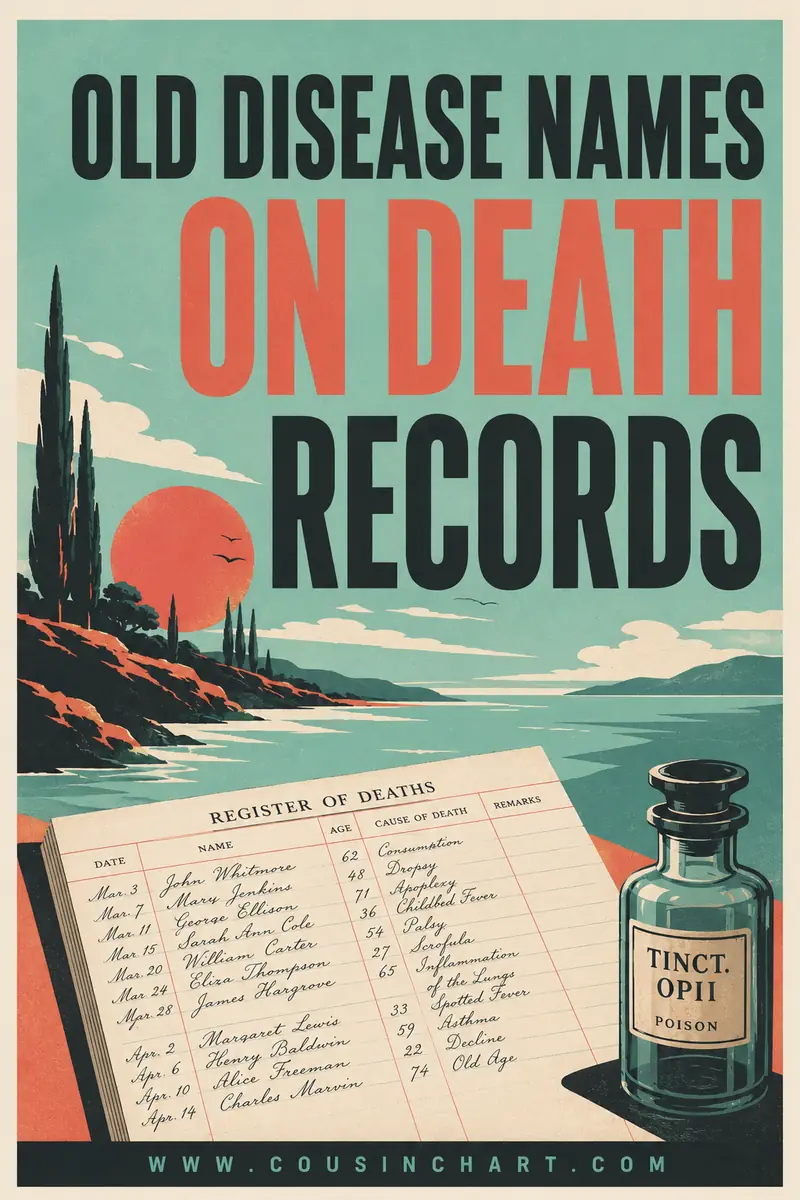
Old Disease Names on Death Records, Decoded
You finally get the death certificate, and the cause is a word nobody uses any more. Consumption. Dropsy. Quinsy. Here is the translation table you came for — and one caution that matters more than any single term. A great many old causes of death are symptoms rather than diagnoses, and the person who wrote them was often not a doctor. "Dropsy" describes swelling, not a disease; "convulsions" describes a fit, not what caused it. A registrar, an undertaker or a grieving relative supplied many of these words, sometimes days after the death, sometimes from a neighbor's account. Read them as clues about how someone died, not as medical fact. And if the certificate hands you informants and relatives you cannot place, the cousin calculator will sort out how they connect.
What does the certificate say? Tap the closest match.
Tap an option above. The word tells you how it looked, not always what it was.
The decoding table
This covers the terms you are most likely to meet on nineteenth- and early twentieth-century US and British death records.
| Old term | What it usually meant |
|---|---|
| Consumption, phthisis, decline | Pulmonary tuberculosis |
| Galloping consumption | Rapidly progressing tuberculosis |
| Scrofula, king's evil | Tuberculosis of the lymph nodes in the neck |
| Dropsy, hydrops | Edema — fluid retention, usually from heart or kidney failure |
| Apoplexy | Stroke |
| Softening of the brain | Cerebral degeneration or the after-effects of stroke |
| Palsy | Paralysis, or a tremor |
| Quinsy | Abscess beside the tonsil, which could block the airway |
| Putrid or malignant sore throat | Usually diphtheria |
| Croup | Airway obstruction in a child, often caused by diphtheria |
| Lung fever, winter fever | Pneumonia |
| Pleurisy | Inflammation of the lining of the lungs |
| Ague | Malaria, or any fever with recurring chills |
| Bilious fever | Fever with vomiting or jaundice — typhoid, malaria or hepatitis |
| Ship fever, jail fever | Typhus |
| Brain fever | Meningitis or encephalitis, sometimes typhus |
| Grippe, la grippe | Influenza |
| Bloody flux | Dysentery |
| Summer complaint, cholera infantum | Severe infant diarrhea, usually in hot months |
| Marasmus, inanition | Wasting and malnutrition, most often in infants |
| Childbed or puerperal fever | Bacterial infection of the womb after childbirth |
| Milk sickness | Poisoning from milk of cows that ate white snakeroot |
| Lockjaw | Tetanus |
| Mortification | Gangrene |
| Falling sickness | Epilepsy |
| St Vitus's dance | Sydenham's chorea, following rheumatic fever |
| Chin cough, hooping cough | Whooping cough (pertussis) |
| Water on the brain | Hydrocephalus |
| Yellow jack, black vomit | Yellow fever |
| Catarrh | Inflammation of the nose and throat — a heavy cold |
| Dyspepsia | Indigestion |
| Nostalgia | Severe homesickness, recorded chiefly in Civil War soldiers |
| Debility, senility, old age | General decline without a specific cause identified |
| Visitation of God | A sudden death with no cause established, used by coroners |
For the Latin, legal and relationship words that appear elsewhere on the same documents — relict, infant, natus, obiit — see our guide to old genealogy terms. This page stays with the medical vocabulary.
Consumption, and why it appears everywhere
Tuberculosis was the leading cause of death in the nineteenth century. In many places it accounted for something like one death in five. If your tree has several deaths recorded as consumption, that is not a coincidence and it is not a family curse.
It is infectious, not hereditary. This is the point that changes how you read a family. TB spreads by close contact and crowded housing, so it moved through households — a mother, then two children, then an aunt who nursed them. Victorians frequently believed it ran in the blood, and it does not.
The names multiply. Phthisis, decline, wasting, hectic fever and marasmus in adults all often mean the same disease. Scrofula is the same organism in the lymph nodes.
The timing is slow and visible in the records. TB kills over months or years, so a "consumption" death is often preceded by a person disappearing from work records, moving in with a relative, or being described as ailing in letters.
And it clusters in time and place. Cross-check the deaths in a family against the years and the address. Several TB deaths in one house over five years is a housing story as much as a medical one.
Fevers, and why they all sound alike
Before laboratory diagnosis, doctors named fevers by what they could observe.
The pattern of the fever was the diagnosis. Intermittent, remittent, continued, bilious, putrid — these describe how the temperature behaved and what color the patient was, because that was the available evidence.
So one modern disease has many old names. Typhoid appears as bilious fever, gastric fever, enteric fever, slow fever and continued fever, depending on the doctor and decade.
And one old name covers several modern diseases. "Ague" is usually malaria but was applied to any recurring fever with chills, and malaria was widespread in the American South and Midwest and in parts of England well into the 1800s.
Season and geography narrow it. Summer infant diarrhea, autumn typhoid from contaminated water, winter pneumonia and influenza, malaria near marshland. The month on the certificate is genuinely diagnostic information.
Epidemics leave fingerprints in the records. A cluster of deaths in one town in one season — cholera, yellow fever, diphtheria, the 1918 influenza pandemic — will show up in the burial register and in the local paper, and a free newspaper or obituary search will usually confirm it in a few minutes.
Childbirth and infancy
These are the hardest entries to read, and the most common.
Childbed fever, or puerperal fever, was a bacterial infection of the womb after delivery, spread largely on the unwashed hands of attendants. It killed healthy women within days of a normal birth, and it was a leading cause of death among women of childbearing age until antisepsis and later antibiotics.
"Died in childbed" may mean several things. Hemorrhage, obstructed labor, eclampsia (recorded as convulsions or "fits of pregnancy"), or infection afterwards.
Look for the child on the same page. A mother's death and an infant's death within days of each other are usually one event, and finding both fixes the birth date.
Infant deaths were often labeled by symptom. Convulsions, teething, summer complaint, cholera infantum, marasmus. Very few were really caused by teething; most were dehydration from severe diarrhea, or an infection.
Infant mortality was appallingly high and it was normal. In many nineteenth-century communities a fifth or more of children died before their first birthday. Families expected it, named later children after dead ones, and did not always record the short lives at all — which is why a gap of four years between siblings usually hides somebody.
The terms that are not diagnoses at all
Say this out loud before you record any old cause of death in your tree.
Convulsions, fits, spasms. A description of the body at the end, not a cause. In infants usually a fever convulsion from an underlying infection.
Debility, decline, exhaustion, senility, old age. These mean the person grew weaker and died. Frequently a polite entry for a cause nobody investigated.
Teething, dentition. Recorded in enormous numbers, and almost never the actual cause. Infants died of infection and dehydration during the period when they were also teething.
Visitation of God. A coroner's phrase for a sudden death with no evident cause. It could cover a heart attack, an aneurysm or a sudden infant death.
Intemperance. Sometimes accurate, sometimes a judgement about a person the registrar disapproved of. Treat it like any other unsourced opinion.
Accident, injury, drowning, burns. These are real causes and they point straight at an inquest file, which is often the fullest account of any death in your tree.
Who wrote the cause, and how much to trust it
This determines how much weight the entry can carry.
Check the informant. Most certificates name the person who reported the death and their relationship. A doctor who attended is one thing; a neighbor reporting a death three days later is another. That name is also a genealogical clue in its own right.
Attendance matters. Many forms have a line for whether a physician attended and for how long. "Not attended" means the cause is somebody's best guess.
Registration was late in most places. US states began requiring death registration at very different times, mostly between the 1880s and the 1910s, and early compliance was poor. Our overview of what vital records are sets out those dates, and free death record searches covers where to look.
Before registration, the cause is rarely recorded at all. Church burial registers, undertakers' books and cemetery records may give a date and an age but nothing more — though those same sources are how you find the death in the first place, as our page on free cemetery records explains.
And the handwriting is the last obstacle. Cause of death is usually the hardest word on the page, because it is the one term you cannot predict from context. If you cannot make it out, our guide to reading old handwriting has the method — and searching the letters you are sure of alongside "old medical term" will often settle it.
What a cause of death can tell you next
It dates and locates an epidemic. Match the death against local newspapers and the neighbors' burial dates. If half a street died the same month, you have found the event.
It explains a family breaking up. A mother dead of childbed fever explains children appearing with grandparents in the next census, or in an institution.
It points at an inquest. Accidental, violent or sudden deaths generated a coroner's file with witness testimony, which is often the only detailed account of an ancestor's life you will ever read.
It can flag an occupational disease. Miners' phthisis, potters' rot, grinders' asthma and "consumption" in dusty trades all describe lung disease caused by work. That tells you the trade even when no record states it.
But be careful with hereditary conclusions. Most old causes are infectious or environmental, not genetic, and a chain of TB deaths says nothing about your own health. Historical records are not a family medical history, and any real health question belongs with your doctor rather than with a certificate from 1883.
FAQ
What does consumption mean on a death certificate?
Pulmonary tuberculosis. It was the leading cause of death in the nineteenth century, and also appears as phthisis, decline, wasting or galloping consumption. It is an infectious disease spread by close contact, not an inherited one, which is why it often killed several people in one household.
What is dropsy?
Dropsy is the old word for edema — visible swelling caused by fluid retention, usually in the legs or abdomen. It is a symptom rather than a disease, and the underlying cause was most often congestive heart failure or kidney failure.
What was milk sickness?
Poisoning caused by drinking milk or eating butter from cows that had grazed on white snakeroot, which contains the toxin tremetol. It affected settlers in the American Midwest in the early nineteenth century, could kill whole families, and disappeared once the cause was understood.
Are old causes of death reliable?
Only partly. Many are symptoms rather than diagnoses, laboratory testing did not exist, and the cause was often supplied by a relative or registrar rather than an attending doctor. Check whether the certificate names a physician and how long they attended before relying on the entry.
What was childbed fever?
Puerperal fever, a bacterial infection of the womb after childbirth, frequently transmitted on the hands of birth attendants. It killed within days of an otherwise normal delivery and was a leading cause of death among women of childbearing age until antiseptic practice and antibiotics.
Should I worry about an inherited disease if it appears repeatedly in my tree?
Repeated old causes such as consumption or fevers reflect infection and living conditions, not inheritance. Historical death records are too vague and too unreliable to serve as a family medical history. Take any genuine health concern to your doctor rather than drawing conclusions from certificates.
Reading a death record for everything it holds
The cause of death is the line everyone looks at, and it is rarely the most reliable one on the page. Decode it, then read the rest properly: the informant and their relationship, the attending physician, the burial place, the parents' names and birthplaces where the form asks for them. Those fields are usually more trustworthy and more useful than the cause, because somebody knew them first-hand. Treat "consumption" as a strong clue about how a family lived, and "convulsions" as a description of a moment rather than an explanation. And when the certificate hands you an informant with a surname you half recognize, run it through the cousin calculator — informants were nearly always relatives, and that name is often the next branch of the tree.