Family Tree Templates for Large Families
Standard family tree templates fail on large families for one reason: they grow sideways faster than paper does. A four-generation chart with two children per couple fits comfortably on a sheet. The same chart with six children per couple needs roughly eight times the width, and no amount of shrinking the text rescues it. The fix is not a bigger printer — it is choosing a format built to scale, and deciding before you draw whether you are recording ancestors, descendants, or everyone. This page covers which layouts survive large families, how to split a chart across pages properly, and the decisions worth making first. To confirm how two relatives connect before you plot them, use the cousin calculator.
How big is your family? Tap the closest match for the format that will hold it.
Tap an option above. Format choice matters more than paper size.
Why standard templates break
The arithmetic is worth seeing, because it explains why shrinking the font never works.
A standard tree doubles each generation going back. Two parents, four grandparents, eight great-grandparents, sixteen beyond that. Four generations is fifteen boxes — comfortable on one sheet.
Going forward, it multiplies by the number of children. A couple with six children, whose children each have four, produces 24 grandchildren. Add one more generation and you are past a hundred people.
Width is what runs out, not height. Generations stack downward neatly; it is the sideways spread that defeats the page. A row of forty boxes at legible size is roughly three metres wide.
Which is why the answer is a different shape, not a bigger sheet or smaller type. Below eight or nine point, a printed chart stops being readable at arm's length, and that is the practical floor.
Formats that actually scale
Four that handle size, each suited to a different question.
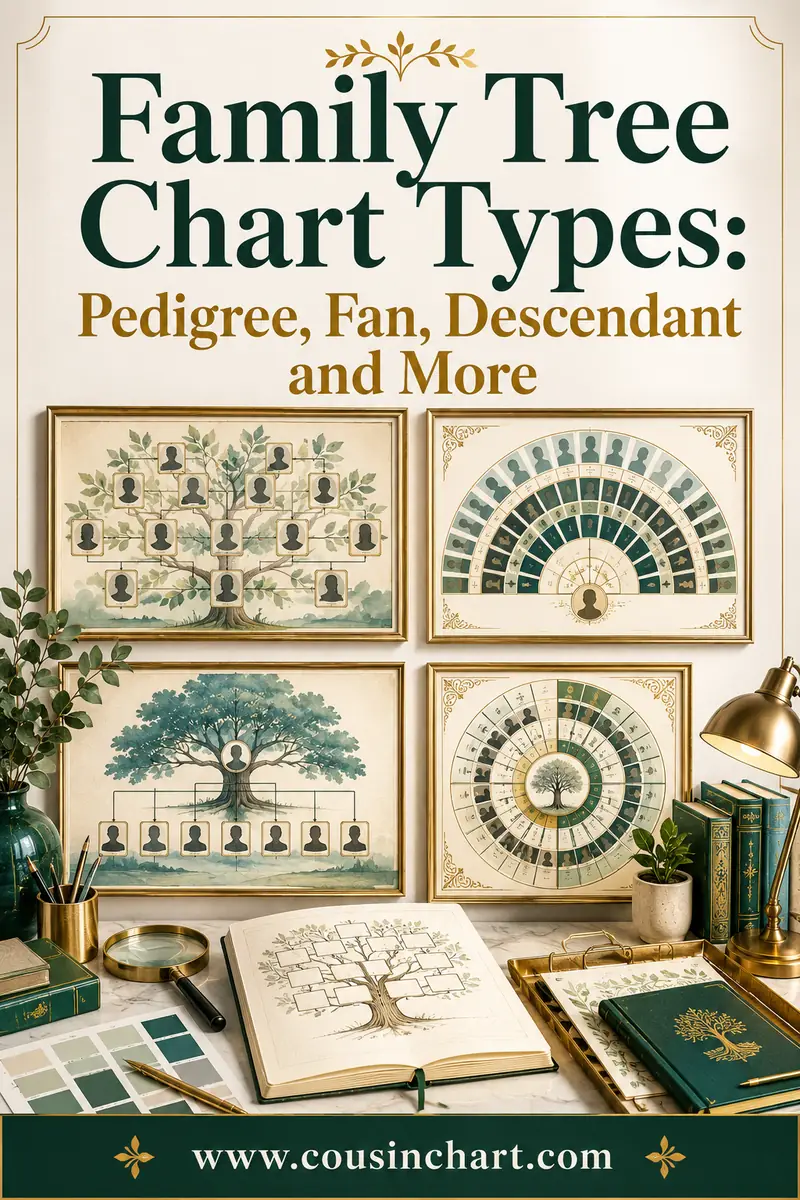
Fan charts (and bow-tie charts). Ancestors arranged in a semicircle or full circle radiating outward. Because each generation gets a ring rather than a row, the available space grows with each generation instead of staying fixed. A fan chart fits six or seven generations of ancestors where a rectangular tree manages four. Best for ancestors, not descendants.
Descendant charts. Start with one couple at the top and work down. These still spread sideways, but they let you chart one ancestral couple's entire line without the doubling problem — the layout options are in descendant chart template.
Indented outlines. A text list, indented by generation, with numbering. Ugly by comparison and enormously more scalable — hundreds of people fit in a few pages, and it prints on ordinary paper. This is what most serious genealogists actually keep.
Ahnentafel numbering. A numbered ancestor list where each person's number determines their position (father = 2×, mother = 2×+1). Compact, unambiguous, infinitely scalable, and readable by anyone who knows the system.
The trade-off is always the same: the more people a format holds, the less it looks like a family tree. Decide which matters more before you start — the full comparison is in family tree chart types.
Decide the scope before you draw
The single most useful step, and the one people skip.
Ancestors or descendants? These need different charts, and trying to do both on one sheet is the commonest cause of an unusable result. A tree that goes up and down from one person is called an hourglass or bow-tie chart, and it works only for a small number of generations each way.
All lines, or one? A direct-line chart follows only your own ancestors — no siblings, no aunts, no cousins. It stays small indefinitely. An all-inclusive chart grows without limit.
How many generations? Four is comfortable. Five is a stretch on one sheet. Six or more needs a fan chart or a split.
Living people, or only the deceased? Many people deliberately stop before the living generation for privacy, particularly on charts that will be shared or posted.
Spouses, or only blood relatives? Including every spouse roughly doubles the box count on a descendant chart.
Write these five decisions down before drawing anything. Every large chart that gets abandoned was abandoned because one of them was left open.
Splitting across multiple sheets
The standard solution when one page genuinely cannot hold it.
Give every sheet a number and a title — "Sheet 3: descendants of Thomas and Mary Ellis".
Use continuation markers. Where a branch runs off the edge, write "continues on sheet 5" in the box, and on sheet 5 write "continued from sheet 3". This is the convention, and it is what makes a multi-sheet chart navigable rather than a pile of paper.
Repeat the linking person on both sheets. The person at the join should appear at the bottom of one and the top of the next, so a reader can orient themselves without cross-referencing.
One branch per sheet is usually the cleanest division — each of the original couple's children gets their own page.
Keep a master index sheet listing which surname or branch is on which page.
And number the people, not just the sheets. A simple numbering scheme means you can find anyone without scanning every page — and it is what turns a big chart into something usable rather than decorative.
Physical formats worth considering
Sometimes the answer is bigger paper after all.
| Format | Roughly | Suits |
|---|---|---|
| A4 / Letter | Standard sheet | 3–4 generations, small families |
| A3 | 2 × A4 | 4–5 generations |
| A2 | 4 × A4 | 5 generations, or 4 with large sibling groups |
| A1 / A0 | Poster | Display charts, reunions |
| Tiled A4 | Any size | Print at home, tape together |
| Roll / banner | Continuous | Very wide descendant charts |
Tiling is underrated. Most software will print an oversized chart across multiple A4 sheets with overlap marks, which you tape together. It costs nothing beyond paper and produces a wall chart.
Print shops handle A1 and A0 cheaply, and that is the practical route for anything intended to be displayed at a reunion.
Landscape almost always beats portrait for a tree, since the problem is width.
And consider fabric or vinyl for something that will be rolled, transported and reused — paper charts do not survive being passed around a family gathering.
Layout decisions that buy space
Small choices that add up to a chart that fits.
Rotate it. Running generations left-to-right instead of top-to-bottom often fits a wide family into a taller page. Many templates offer both orientations.
Abbreviate consistently. "b." for born, "m." for married, "d." for died. Dates as years only — full dates triple the width of every box.
Drop the boxes. Names on ruled lines take far less room than names in rectangles, and read just as clearly.
Vary the box width rather than sizing every box to the longest name.
Stagger the rows. Offsetting alternate boxes vertically lets them sit closer horizontally.
Use a key for repeated information — birthplaces, for instance, as numbered references to a legend rather than written into every box.
And put the largest sibling group in the middle of the layout rather than at one edge, which balances the spread instead of pushing everything one way. The general printable options are in printable family tree.
When a drawing is the wrong answer
Worth saying plainly, because it saves a lot of frustration.
Above roughly a hundred people, a drawn chart stops being the useful record and becomes a display piece. That is a legitimate thing to want — but keep the actual data somewhere else.
Software handles scale that paper cannot. A family tree program stores thousands of people, generates charts on demand, and lets you print whichever slice you need. The free options are compared in free family tree makers.
A spreadsheet works too, and is often underrated: one row per person, columns for parents, dates and notes. It scales infinitely and sorts.
The practical pattern most people land on: keep the full record in software or a spreadsheet, and print a selected chart — one branch, or the direct line, or four generations — for the wall.
And the chart on the wall does not have to be complete to be worth having. A beautiful four-generation direct-line chart is more likely to be looked at than an exhaustive one nobody can read.
Blended and complicated families
Size is not the only thing that breaks a template.
Multiple marriages widen a chart considerably, since each union needs its own connector and its own children hanging beneath it.
Half-siblings need to be visibly distinguished from full siblings, or the chart misleads.
Adoption should be marked — commonly with a dashed connecting line — so the record is accurate without being exclusionary.
Step-relationships have no place on a descent chart at all, strictly speaking, but families frequently want them included. A separate household grouping, drawn as a dashed box, is the usual compromise.
Cousins marrying creates loops that a standard tree cannot draw without a line crossing back on itself. Mark it with a note rather than trying to draw it.
All of these are covered more fully in blended family tree template, and the sideways relatives that inflate large charts in extended family tree template.
FAQ
What family tree template works for a large family?
A fan chart for lots of ancestors, a descendant chart or indented outline for lots of descendants. Standard rectangular templates run out of width fast, and no amount of shrinking the text fixes that.
How do I fit a big family tree on one page?
Often you cannot, and the better answer is a format that uses space more efficiently — a fan chart — or splitting across numbered sheets with continuation markers. Rotating the chart to run left-to-right also buys real space.
How many generations fit on one sheet?
Four comfortably on A4 or Letter, five at a stretch. A fan chart fits six or seven in the same area because each generation gets a ring rather than a fixed-width row.
How do you split a family tree across pages?
One branch per sheet, each numbered and titled, with "continues on sheet X" markers where a branch runs off the edge. Repeat the linking person on both sheets so readers can orient themselves.
What is an ahnentafel chart?
A numbered ancestor list where each person's number fixes their position — a person's father is double their number, their mother double plus one. It is compact, unambiguous and scales to any size, but it is read rather than displayed.
Should I use software instead of a template?
For anything over about a hundred people, yes — keep the full record in software or a spreadsheet, then print whichever slice you actually want on the wall. The two jobs are different.
Pick the shape, then the paper
Large families break standard templates because trees grow sideways and paper does not. The fix is choosing a format built for scale — a fan chart for ancestors, a descendant chart or indented outline for descendants — and deciding your scope before you draw: ancestors or descendants, all lines or the direct one, how many generations, and whether living people are included. Split across numbered sheets when you must, and keep the complete record in software while printing only the slice worth displaying. To name any relationship before you plot it, use the cousin calculator.