Is It Against the Law to Marry Your Cousin? State-by-State Answer
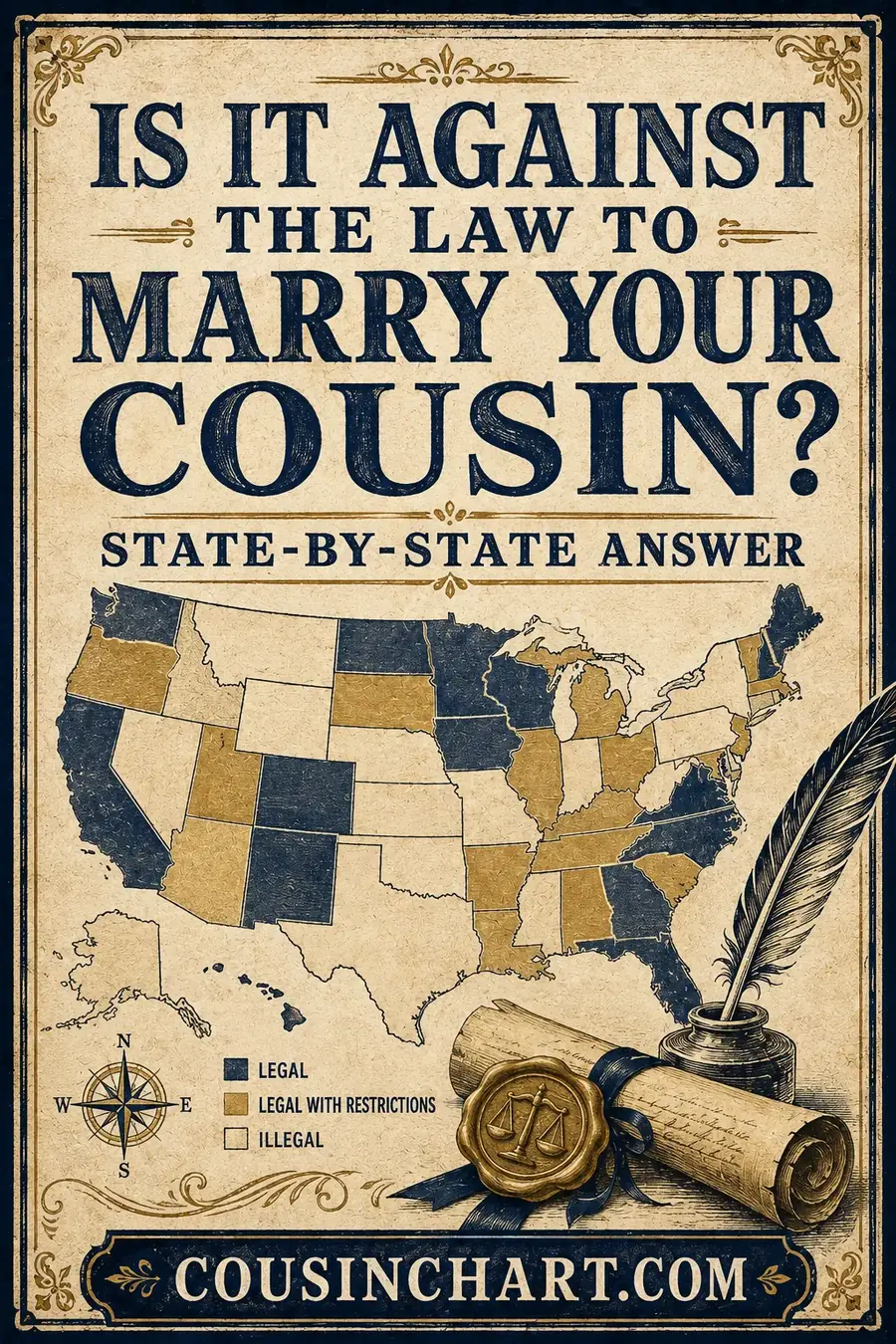
There's no single national answer — cousin marriage law in the US is set entirely at the state level, and it ranges from fully legal with no restrictions, to legal only under specific conditions, to a criminal offense. Roughly half of US states allow first cousin marriage outright, while the other half restrict or ban it, which makes this one of the more genuinely state-dependent legal questions in US family law.
The Three Categories of State Law
States where first cousin marriage is fully legal, no special conditions required: Alabama, Alaska, California, Colorado, Connecticut, Florida, Georgia, Hawaii, Maryland, Massachusetts, New Jersey, New Mexico, New York, North Carolina, Rhode Island, South Carolina, Tennessee, Texas, Vermont, and Virginia (roughly — always verify current law directly with the state, since legislation does change).
States that allow it only under specific conditions, most commonly requiring one or both parties to be past reproductive age, or requiring genetic counseling: Arizona, Illinois, Indiana, Maine, Utah, and Wisconsin are among the states with conditional allowances, typically tied to age or infertility.
States where first cousin marriage is banned outright: a significant number of states, including Kentucky, Michigan, Minnesota, Missouri, Nevada, Ohio, and Washington, among others, prohibit first cousin marriage entirely with no exceptions.
Because state legislatures do occasionally revisit these laws, always confirm current status directly with the specific state's marriage license office before relying on any list, including this one, for a real decision.
Why the Laws Vary So Much by State
Cousin marriage laws in the US largely trace back to a wave of state-level bans passed in the late 1800s, driven partly by early (and since largely discredited or heavily qualified) concerns about genetic risk, and partly by broader social attitudes of the era. States that industrialized and urbanized earlier tended to pass bans; more rural or agriculturally-organized states more often left cousin marriage legal, partly reflecting smaller, more isolated communities where cousin marriage was historically more common and normalized.
What About Second Cousins?
Second cousin marriage is legal in nearly every US state, including many of the states that restrict or ban first cousin marriage. This is because the actual genetic relationship between second cousins is significantly more distant than between first cousins (second cousins share roughly 3.125% of DNA on average, versus about 12.5% for first cousins) — see define 2nd cousin for the full breakdown of how that relationship is actually calculated. If you're unsure whether a specific relative counts as a first or second cousin, working out the exact relationship matters a great deal here, since the legal treatment is genuinely different.
The Genetic Risk Question, Briefly
The historical justification for these bans centered on elevated risk of genetic conditions in children of first-cousin couples. Modern research has generally found the increased risk is real but smaller than the popular perception — commonly cited studies put the increased risk of a serious birth defect at roughly 1.7-2.8 percentage points above the general population baseline for first-cousin couples, a real but relatively modest increase, not multiples higher as sometimes assumed. This research is part of why several states now allow cousin marriage conditionally (contingent on genetic counseling, or restricted to couples past typical reproductive age) rather than banning it outright.
Cousin Marriage Around the World
Cousin marriage is far more restricted in the US than in much of the world — it remains common and legal in large parts of the Middle East, parts of Africa, and parts of Asia, where it's often woven into cultural and family traditions around maintaining close family ties and property within a family line. The US, UK, and a number of European countries are on the more restrictive end globally, though practices and laws vary considerably even within those regions.
How These Laws Actually Get Enforced
Cousin marriage restrictions are typically enforced at the point of applying for a marriage license, where a county clerk's office may ask about family relationship as part of standard application questions in states where cousin marriage is restricted or banned. In practice, enforcement varies significantly by jurisdiction and isn't always rigorously checked, especially since most people don't proactively disclose a cousin relationship unless specifically asked, and clerks generally aren't investigating family trees beyond the application itself. That said, relying on lax enforcement rather than actual legality is a real legal risk — a marriage that shouldn't have been permitted under state law can potentially be challenged or voided later, which is exactly why consulting a family law attorney in the relevant state is genuinely important for anyone considering this rather than just assuming enforcement gaps make the question moot.
A Brief Global Perspective on the Genetic Risk Data
The genetic risk figures cited earlier (roughly 1.7-2.8 percentage points of increased risk for a serious birth defect) come primarily from research on isolated first-cousin marriages, and the actual population-level risk can shift somewhat depending on additional factors — whether cousin marriage is a repeated pattern across multiple generations within the same family line (which does meaningfully increase risk further) versus a single, isolated instance. Public health researchers in countries and communities where cousin marriage remains common and culturally normalized have studied this extensively, generally finding that a single generation of first-cousin marriage carries a real but moderate increased risk, while repeated cousin marriage across several consecutive generations compounds that risk considerably more. This distinction is often lost in more casual discussions of the topic, which tend to treat "cousin marriage" as a single undifferentiated risk category rather than one that varies with family history.
Historical Examples of Cousin Marriage in Prominent Families
Cousin marriage has a long, well-documented history among prominent historical families, particularly European royal families, where marrying within an extended family network was often a deliberate strategy to preserve alliances, titles, and property within a bloodline. Charles Darwin, notably, married his first cousin Emma Wedgwood — a historical fact often cited in discussions of the topic, partly because Darwin himself later expressed concern about the health effects on his own children, adding a somewhat ironic personal dimension to a scientist whose broader work touched on heredity and inheritance.
The Broader Conversation Around Cousin Marriage Laws
Cousin marriage law in the US remains an area some legal scholars and geneticists argue is due for reconsideration, given that the genetic risk data doesn't support an outright ban as strongly as the laws might suggest, and given that several developed countries with strong public health systems permit cousin marriage without restriction. This isn't a settled debate, and state legislatures have moved in different directions on it even in recent years — some loosening restrictions with added conditions like required genetic counseling, others maintaining strict bans. If this is a topic that matters to you personally, staying aware that these laws are not fixed permanently, and can and do change, is worth keeping in mind rather than assuming current law in your state will remain unchanged indefinitely.
What to Do If You're Genuinely Considering This
If you and a cousin are seriously considering marriage and want to move forward responsibly, the practical steps are straightforward even though the emotional and family dynamics involved often aren't: confirm your specific state's current law directly with a family law attorney or your state's marriage license office (never rely solely on a general article like this one for a decision this significant), consider genetic counseling if children are part of your future plans, particularly if you're first cousins rather than more distantly related, and be prepared for the fact that family and social reactions to cousin marriage vary enormously depending on your specific community and culture, which is a separate consideration from the legal question entirely.
How to Check Your Own State Before You Rely on Any List
The question is it legal to marry your first cousin has no national answer, and it has no permanent one either - state legislatures revisit these statutes more often than people expect, and published lists go stale quietly. If anything real depends on the answer, verify it directly rather than trusting any summary, including this one.
Three checks, in order of reliability:
The county clerk or marriage license office in the county where you would apply. They process applications against current law every working day, the call is free, and the question is a routine one for them. This is the fastest reliable answer available to a member of the public.
The state's own statute. Every state publishes its marriage code online, usually under a title like "Marriage" or "Domestic Relations," with prohibited degrees of relationship listed explicitly. Read the section itself rather than a summary of it, and check the effective date at the top of the page.
A family law attorney licensed in that state, which becomes worth the cost the moment the situation is not simple - a prior marriage performed elsewhere, an adoptive rather than biological relationship, an immigration filing, or an inheritance question attached to the marriage's validity.
Two situations that specifically need professional advice rather than a list: marrying in one state while living in another, and any half-cousin or step-relationship, which statutes handle inconsistently.
Frequently Asked Questions
Does federal law address cousin marriage in the US? No — there is no federal law on cousin marriage. It's entirely a matter of individual state law, which is exactly why the legality of a cousin marriage can change simply by crossing a state line.
If cousin marriage is illegal in my state, can I get married in a different state instead? Generally, states recognize marriages legally performed in another state, even if that specific marriage wouldn't have been allowed under the home state's own laws — but this area of law can be complex and does vary, so consulting a family law attorney in your specific state is strongly advised before relying on this approach.
Is first cousin marriage more common in certain US states or regions? Some Southern and Appalachian states have historically had somewhat higher rates of cousin marriage, often tied to smaller, more geographically isolated rural communities in past generations, though rates have declined significantly nationwide with increased mobility and larger dating pools.
How is "cousin" defined for these marriage laws — does it include second cousins? These laws overwhelmingly target first cousins specifically. Second cousin marriage is legal in nearly all US states, including most that restrict or ban first cousin marriage, because the two relationships are genetically and legally treated quite differently.
Do adoption relationships count the same as biological ones under cousin marriage laws? This varies by state and is a genuinely complex legal question — some jurisdictions treat adoptive relationships identically to biological ones for marriage law purposes, while others distinguish between them, so this specifically requires direct legal consultation rather than a general answer.
Can cousin marriage laws change after a couple is already married? A marriage legally performed under the laws in effect at the time generally remains valid even if the law changes afterward, though this is another area where consulting an attorney is advisable given real jurisdictional variation.
Are there religious or cultural exemptions to state cousin marriage bans? No — state marriage laws generally apply uniformly regardless of religious or cultural practice, meaning a religious tradition that permits cousin marriage doesn't override a state's civil legal restriction on it.
Does military service affect cousin marriage laws in any state? No — cousin marriage laws apply based on state residency and jurisdiction, not military status, so serving in the military doesn't change which state's laws apply to a couple's marriage eligibility.
Are there any US territories with different cousin marriage rules than the states? Yes, US territories generally set their own marriage laws independently, similar to states, so it's worth checking the specific territory's regulations directly rather than assuming they mirror any particular state's approach.
Do any US states specifically require genetic counseling before allowing cousin marriage? Yes — a handful of states with conditional allowances specifically require genetic counseling as part of the conditions for permitting first cousin marriage, reflecting the modern research-based approach some legislatures have taken rather than an outright ban.
Has any US state fully repealed its cousin marriage ban in recent years? Some states have adjusted their laws to add conditional allowances (age or genetic counseling requirements) rather than fully repealing bans outright, reflecting a gradual, incremental shift rather than sweeping nationwide change.