Identifying Military Medals, Insignia and Uniforms
A medal in a drawer is one of the few family objects that can hand you a name, a service number, a regiment and a war in a single afternoon. The reason is the edge: many British and Commonwealth campaign medals were issued with the recipient's number, rank, name and unit stamped or engraved around the rim, which makes them the most self-documenting heirloom most families own. US medals are almost never named, so there you work from the ribbon, the device and the uniform instead. Either way, the order is the same — identify the award, then the unit, then go to the records. And do not polish anything. To place the man or woman who earned it in your tree, use the cousin calculator.
What are you looking at? Tap the closest match.
Tap an option above. Identify the award, then the unit, then the record — and never polish.
Start with the object, not with the family story
Family memory about military service is affectionately unreliable, and the medal is the harder evidence.
Almost every family has a story that overstates the award. "He won a medal for bravery" very often turns out to mean a campaign medal that everyone in the theater received — which is not a lesser thing, but it is a different thing, and it sends you to different records. Start from what the metal actually says.
Photograph the whole group as found, before you touch it. Front, back, edge, ribbons, the box, and any paperwork in with it. If the medals are mounted in an order, keep that order recorded — mounting order tells you something, and it gets scrambled the moment anything is handled.
Do not take a group apart. Medals earned by one person and kept together are worth far more, and mean far more, as a group than as individual pieces. The same is true of a medal and its original box, forwarding slip or certificate.
Write down what the family says anyway, including the bits you suspect are wrong. "Great-grandad was at Gallipoli" may be misremembered, but it is a starting hypothesis, and half-right stories are common — right war, wrong battle.
Then work outwards. Award, then unit, then service record, then the man. That order works because each step narrows the next one, and skipping to a name search in a national database with no unit is how people spend a month on the wrong John Smith.
Campaign medals versus gallantry awards
This is the distinction that decides which records will help you.
| Type | Given for | How many | What it tells you |
|---|---|---|---|
| Campaign medal | Serving in a particular war or theater | Very many — often hundreds of thousands | Where and when he served |
| Clasp or bar on a campaign medal | A specific battle or period within it | Fewer | A specific action or date range |
| Long service / good conduct | Years served without blemish | Moderate | Length and pattern of service |
| Gallantry award | A specific act of bravery | Few | An individual citation, often published |
| Order or decoration | Distinguished service, often by rank | Few | Usually a named entry in an official gazette |
| Commemorative / unofficial | Anniversaries, associations, purchase | Any | Nothing about service — check carefully |
Campaign medals are the genealogical workhorse. They are common precisely because everyone present received one, and that is exactly why they place your ancestor in a theater at a date. A British First World War pair or trio, for instance, identifies a man's number, rank and unit on the rim and matches to surviving medal index records.
Gallantry awards come with paperwork. Because they were awarded individually, they were announced officially and often carry a written citation describing what happened. If your ancestor has one, there is very likely a published entry naming him, and sometimes a paragraph of narrative — the single richest thing you can find.
Watch for commemorative medals sold to veterans and families. These look official, are often well made, and were bought rather than awarded. Anything commemorating an anniversary, or issued by an association rather than a government, is not evidence of service.
And watch for someone else's medals. Families acquire medals by marriage, purchase, inheritance from a neighbor, or simply because a box got mixed. A named medal that does not match any surname in your tree is a real possibility, and it is worth checking before building a whole branch on it.
The edge: naming and engraving
If your medal is named, most of the hard work is already done for you.
Look at the rim under raking light. Hold the medal edge-on with a lamp low and to the side, and turn it slowly. Naming is shallow and worn medals hide it well. A 10x loupe helps enormously.
British and Commonwealth naming typically reads: number, rank, initials and surname, unit. So you may get a service number, "PTE", initials, a surname, and a regiment abbreviated — enough to search a service record index directly. Naming styles differ by campaign: impressed capitals, engraved script, and machine-engraved styles each belong to particular issues, which is itself a dating clue.
Some issues were never named, including many Second World War British campaign stars, which were issued unnamed to British recipients while several Commonwealth countries named theirs. An unnamed star is not a fake — it is normal.
US medals are almost never named. American practice was to issue campaign and service medals without individual naming, so identification runs through the ribbon, any attached devices, the uniform, and the discharge paperwork rather than the object. Purple Hearts are the notable exception, as many were engraved with the recipient's name.
Beware re-naming. Common medals are sometimes erased and re-engraved with a more interesting name. Signs are a rim that is thinner or flatter at the naming, a slightly small diameter, file marks, or lettering that does not match the known style for that issue. If a medal seems remarkable, that is the moment to ask a specialist rather than to celebrate.
Ribbons, clasps and devices
Where there is no name, the ribbon does the identifying.
Every ribbon pattern belongs to exactly one award. Colors and stripe widths are specified, so a ribbon bar with no medals attached is still fully identifiable. Photograph ribbons in daylight against a white background — indoor lighting shifts color badly, and "crimson versus red" can be the whole answer.
Ribbons fade and stain. A ribbon that has hung in a frame near a window for fifty years may be several shades off. Compare the underside where it folds over the suspender, which is usually unfaded.
Clasps and bars name battles or periods. A campaign medal with three clasps is a much more specific document than the same medal without them, because each clasp is a defined action or date range. Record the clasps in the order they are fitted.
Small devices on the ribbon carry meaning. An oak leaf, a rosette, a star, a numeral or a letter attached to a ribbon usually indicates a mention in dispatches, a repeat award, a specific campaign or a particular qualification. These are small, easily lost, and disproportionately informative.
Mounting style is a clue too. Court mounting, swing mounting and the order in which medals sit follow rules of precedence, and a group mounted in the correct order was probably assembled by or for the recipient rather than thrown together later.
Matching insignia to a unit
The unit is the bridge between the object and the archive.
Cap badges are the most identifiable single item. Regimental cap badges are well documented, and a clear photograph of front and back will usually get you a name from a collectors' reference or forum within a day. The back matters: slider fittings, lugs, and the maker's name all help date the badge and flag reproductions.
Shoulder titles, collar badges and buttons narrow it further. A shoulder title gives the regiment; a collar badge sometimes gives the battalion or corps; buttons often carry regimental designs.
Formation patches place a soldier in a larger structure. Divisional and corps patches, common in both world wars and central to US practice, identify the formation someone served in, which in turn tells you which war diaries and unit histories to read.
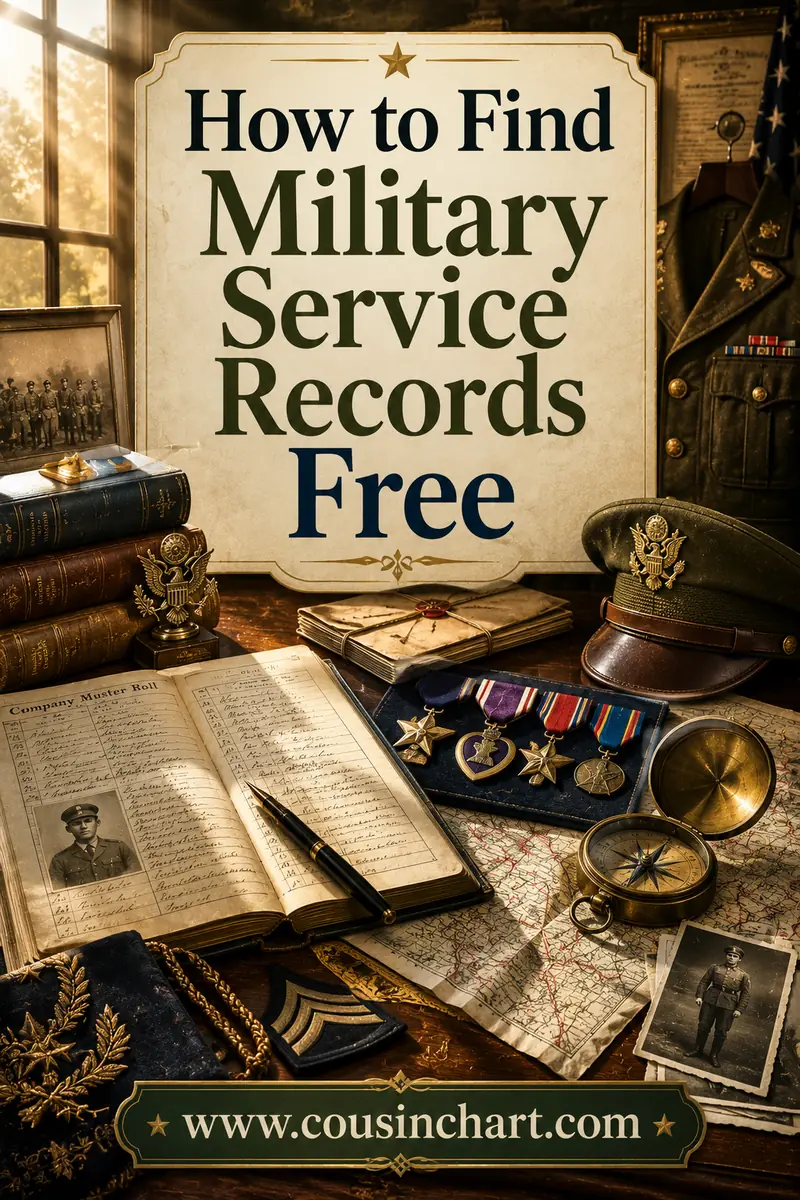
US insignia works through a different stack: branch-of-service collar insignia (infantry crossed rifles, artillery crossed cannon), a shoulder sleeve insignia for the division, distinctive unit insignia for the regiment, plus rank chevrons. Together these give branch, division and rank.
Reproductions are everywhere, and mostly harmless. Cap badges have been copied for the collector market for decades. It matters for value, and it matters for evidence — a badge bought at a fair in 1975 tells you nothing about your ancestor. Where a badge came from is worth recording alongside what it is.
Reading a photograph of a uniform
Most families have more uniform photographs than they have uniforms.
Work from the shoulders down. Rank insignia sits on the sleeve, shoulder or collar depending on the country and era. Get the rank first, because it constrains everything else.
Then the collar and headgear. Cap badge and collar insignia give the arm of service or regiment. Headgear shape itself dates a photograph usefully — peaked caps, forage caps, berets, side caps and steel helmets all have datable periods of use.
Then the sleeve, which is full of small information. Trade and skill badges, wound stripes, overseas service chevrons and good conduct stripes each carry a specific meaning, and several of them are countable — a set of service chevrons literally counts years abroad.
Zoom in rather than guessing. A phone photograph of the original at high resolution, cropped to the badge, will often show detail the naked eye cannot. Scanning at 1200 dpi is better still.
Use the photograph's own dating clues too — the format, the studio imprint, the mount and the backing all narrow the date independently of the uniform, which is a useful cross-check.
Post a good scan and ask. Military insignia identification is one of the areas where enthusiast forums are genuinely excellent and answer quickly, provided you give a sharp, well-lit, uncropped image and say what country and rough era you think it is.
From the medal to the record
The object gets you a name and a unit. The archives do the rest.
Go to the service records next. A number and a regiment from a medal rim is exactly what military record indexes are built around, and military records search sets out which collections exist, what survived, and what to do about the records destroyed in wartime and archive fires.
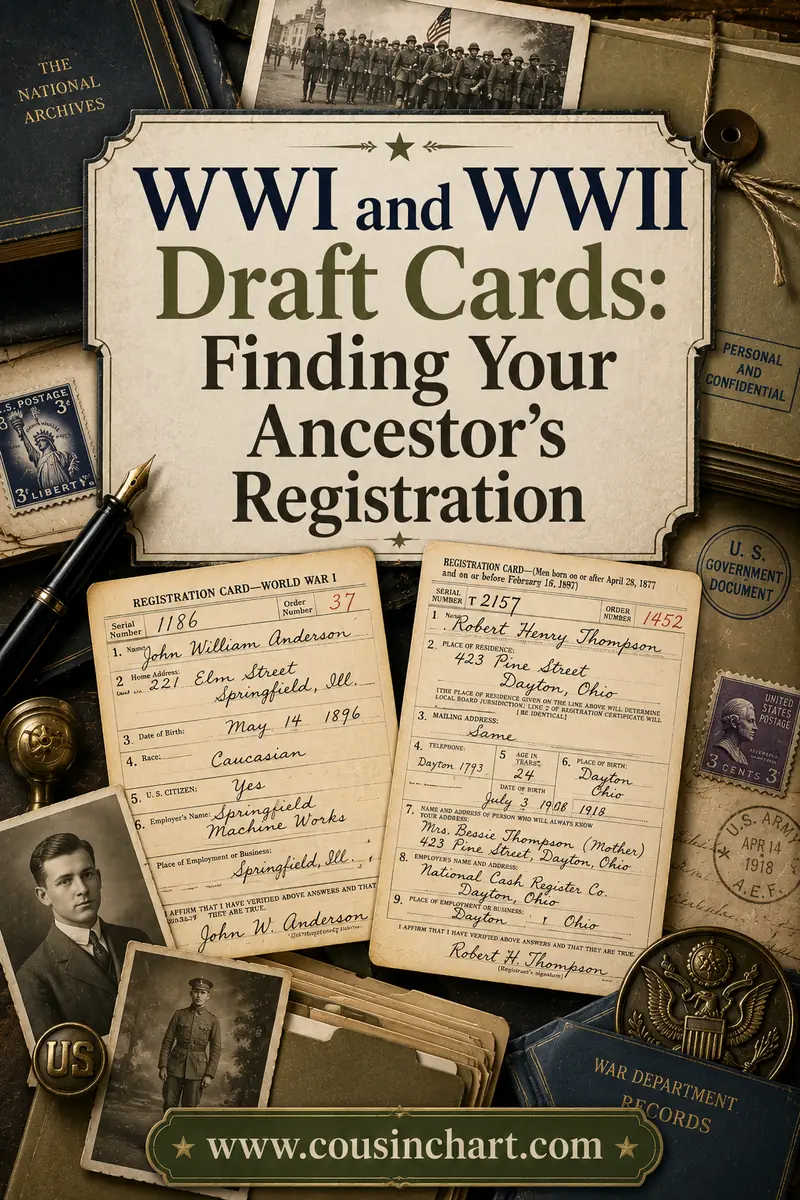
Match the medal to the war before you search. A campaign medal effectively dates the service, which tells you which body of records applies — Civil War ancestors, Revolutionary War ancestors and the twentieth-century collections behind WW1 and WW2 draft cards are separate research problems with separate finding aids.
Then read the unit's own records. War diaries, muster rolls, ships' logs and unit histories will not usually name a private soldier, but they tell you exactly where his unit was on any given day, which is the next best thing and often more vivid than a service record.
Check the grave and the memorial. Headstones and memorial registers frequently record rank, number and unit, and cross-check what the medal says — Find a Grave search is a fast way in.
Record the medal as an object as well as evidence. Photographs, marks, condition and provenance belong in the same inventory as everything else you have inherited, alongside the approach in identifying family heirlooms.
Do not polish them, and other ways value is lost
Worth saying flatly, because well-meant tidying does more damage than neglect.
Polishing destroys both value and evidence. Medals acquire an even darkened surface over decades. Polish strips it, leaves fine scratches, dulls the crispness of the design, and — the serious part — can wear the naming on the rim until it is unreadable. That naming is the only thing tying the medal to your ancestor. Once it is gone, it is gone.
Do not re-ribbon "to smarten it up". An original, worn ribbon is part of the object. Replacing it removes evidence and reduces value, and the fitting and fold pattern of an original ribbon can itself be informative.
Do not split a group, and do not sell one medal from it. A named group to one man is a document. Broken up, it is a handful of common medals.
Do not seal them in a frame with foam and tape. Adhesive foam, ordinary card and non-archival backing stain metal and rot ribbon. If you want to display them, use a case with inert materials, keep it out of direct light, and accept that display always costs some condition.
Storage that works: a dry indoor cabinet, each medal in a soft inert pouch or its original box, ribbons flat rather than folded tightly, and no rubber bands — rubber gives off sulfur compounds and tarnishes silver quickly.
If a medal is genuinely corroded or damaged, get an opinion before doing anything. Conservation is a real skill, and the wrong first attempt takes the option away.
FAQ
How do I find out who a medal belonged to?
Check the rim first. Many British and Commonwealth campaign medals are named around the edge with the recipient's number, rank, initials, surname and unit, which searches directly against service record indexes. US medals are almost never named, so identify the award and unit from ribbons, devices and insignia instead.
What is the difference between a campaign medal and a gallantry award?
A campaign medal is issued to everyone who served in a particular war or theater, so it tells you where and when someone served. A gallantry award is given for a specific act of bravery, was awarded in far smaller numbers, and usually has an official published announcement and a written citation.
Should I clean or polish old military medals?
No. Polishing removes the natural darkened surface, leaves scratches, and can wear away the naming engraved on the rim — the only link between the medal and your ancestor. It also reduces value substantially. Store medals dry and dark, and consult a specialist about any corrosion.
How can I identify a regiment from a cap badge?
Photograph both the front and the back in good light. The front design matches published regimental references and collector forums, usually within a day. The back — slider, lugs and any maker's name — helps date the badge and flags post-war reproductions made for collectors.
Can I identify a uniform from an old photograph?
Often yes. Work from rank insignia on the sleeve or shoulder, then the cap badge and collar insignia for the regiment, then sleeve badges for trade, wounds and years of overseas service. Scan the original at high resolution and crop to each badge rather than guessing from the whole image.
Are unnamed medals fake?
Not necessarily. Many Second World War British campaign stars were issued unnamed as standard, and US practice was generally not to name campaign medals at all. Naming was a matter of policy for each issue, so an unnamed example may be entirely correct for that award.
The rim first, the archive second
Take the medals out of the drawer, photograph them exactly as they are, and turn each one edge-on under a lamp before you do anything else — the naming on the rim is worth more than everything else in the box put together. Identify whether each award is a campaign medal or a gallantry award, because that decides which records will name your ancestor. Match the insignia to a unit, then take the number, rank and regiment into the service records. And leave the polish, the new ribbons and the framing kit in the cabinet: a dark, honest medal with readable naming is worth more, in every sense, than a bright one that has lost its name. Then place the person who earned it with the cousin calculator.