Family Tree Examples: 12 Real Layouts to Copy
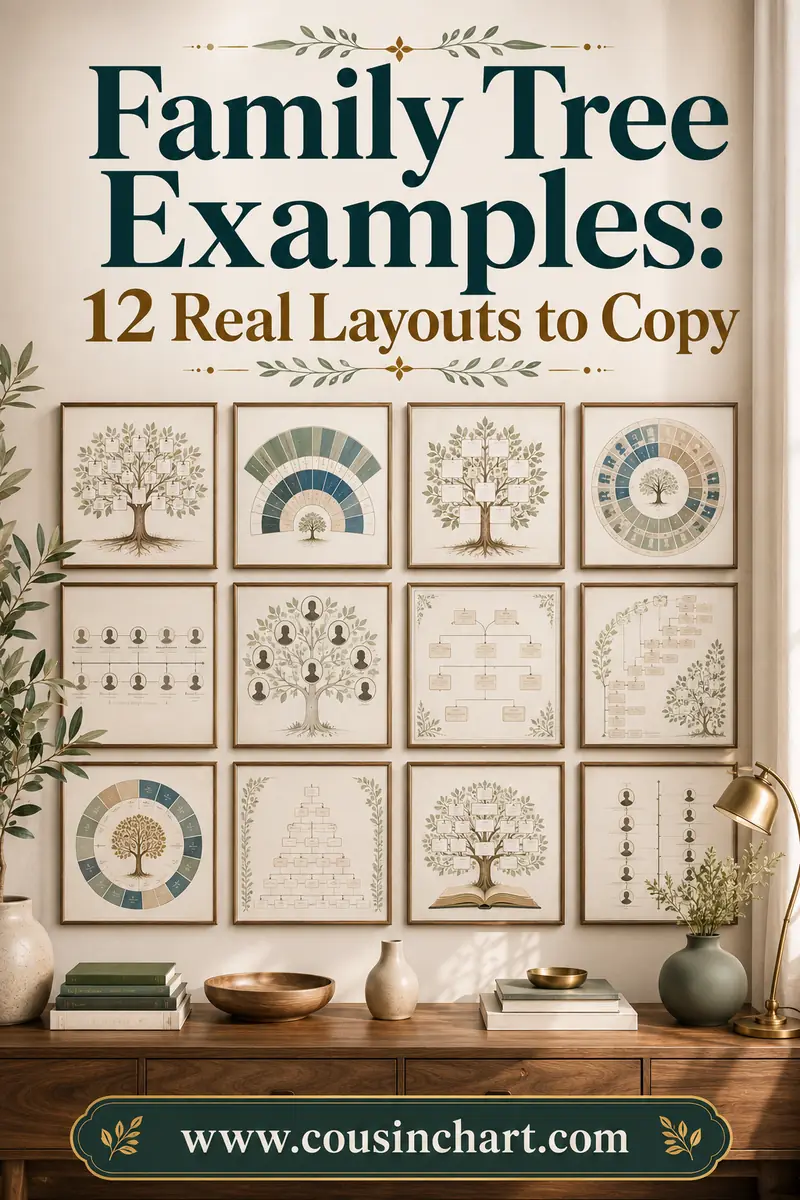
The fastest way to make a family tree is to copy a layout that already works — and the right example depends on head count: a 3-generation tree holds 7 people, a 4-generation chart holds 15, and a whole-family reunion tree can run past 60. Below are 12 real family tree examples, each with its box count, paper orientation, and the situation it fits, so you can match one to your family and start writing names.
Every structured layout here has a matching fill-in PDF in our free printable chart pack. And before you ink anyone into a box, remember the golden rule of tree-building: when you're not sure how someone connects, check it with the free relationship calculator first — erasers only fix pencil.
Free printables for this page
Download a blank PDF (US Letter or A4) — free, no sign-up — or customize it in the maker above before printing.
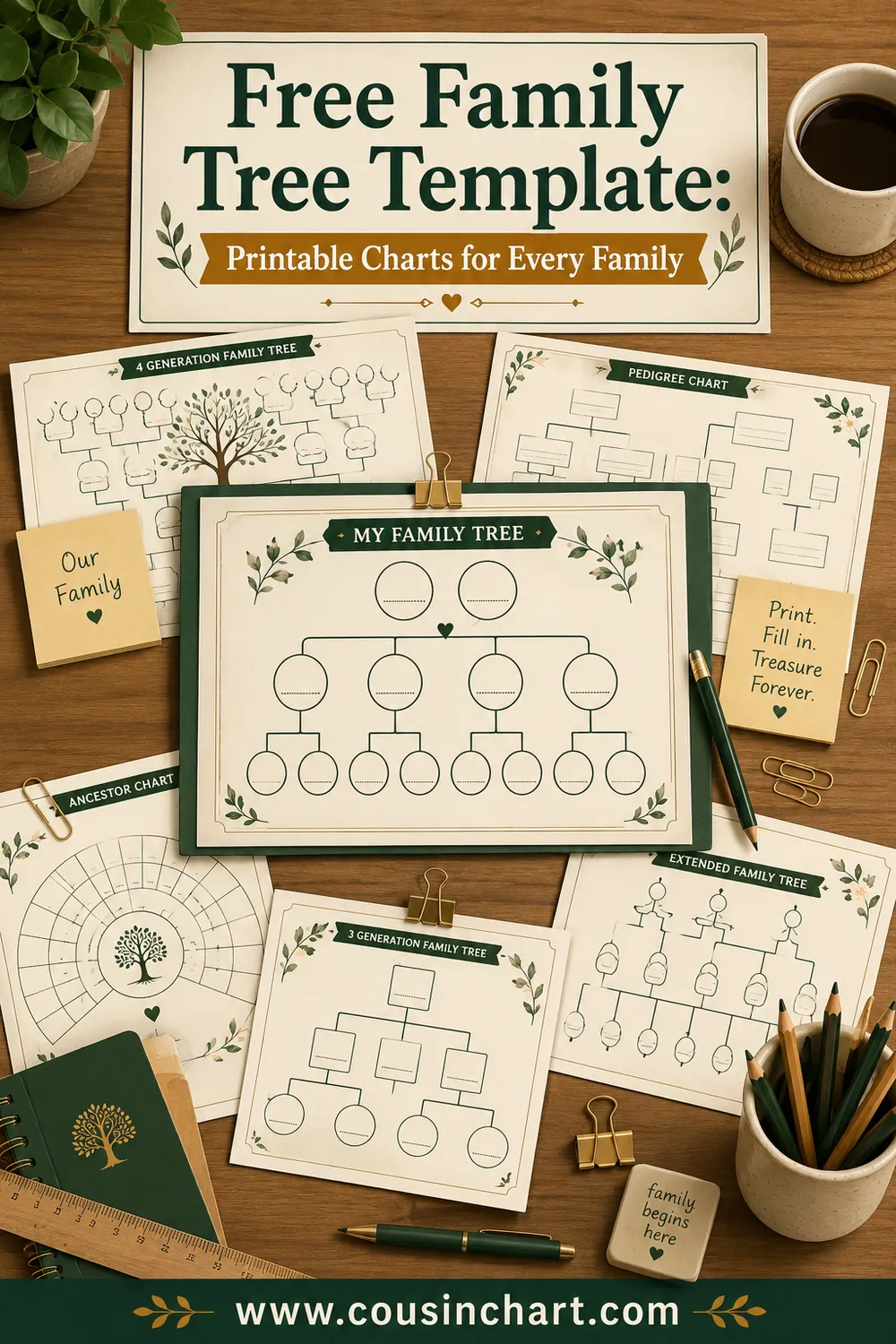
 3-Generation Family TreeYou, parents and grandparents. Portrait, big boxes, 10 minutes to fill.
 5-Generation Pedigree Chart
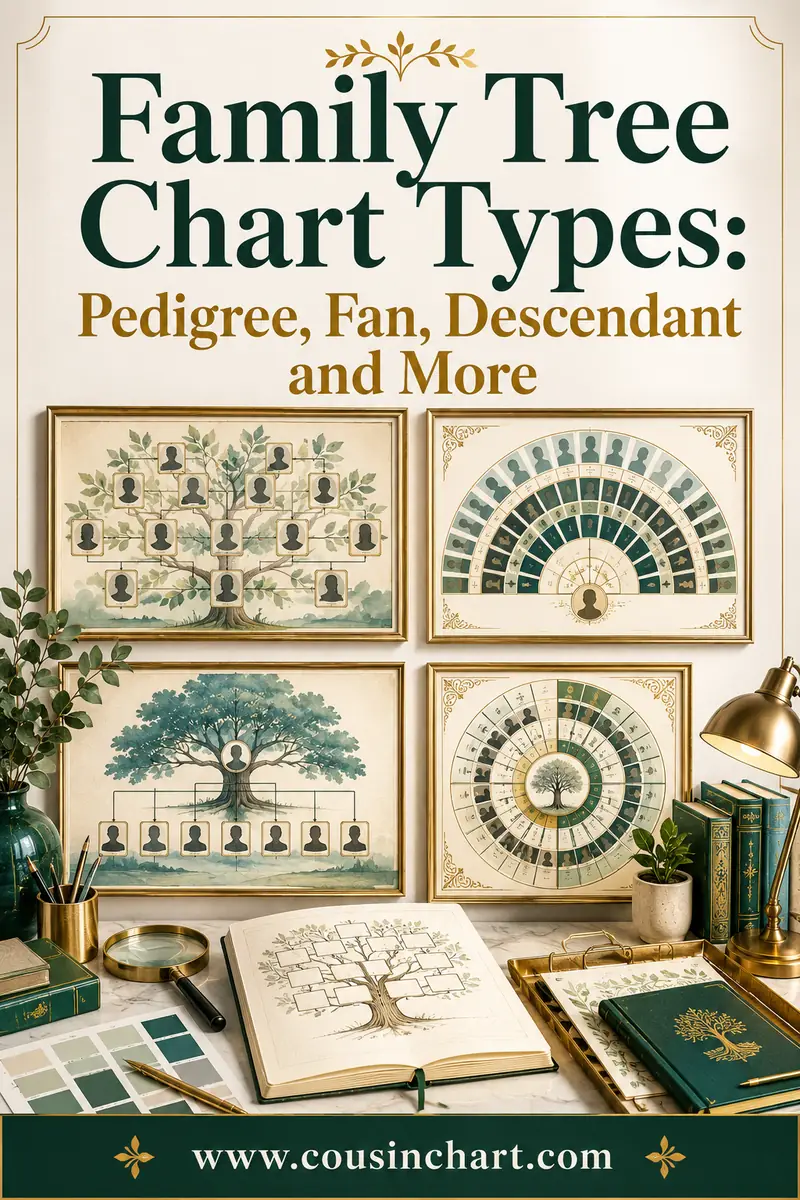
 Blank Fan Chart (5 Generations)
 Descendant Chart
 Bow Tie Family Tree
 Extended Family Tree
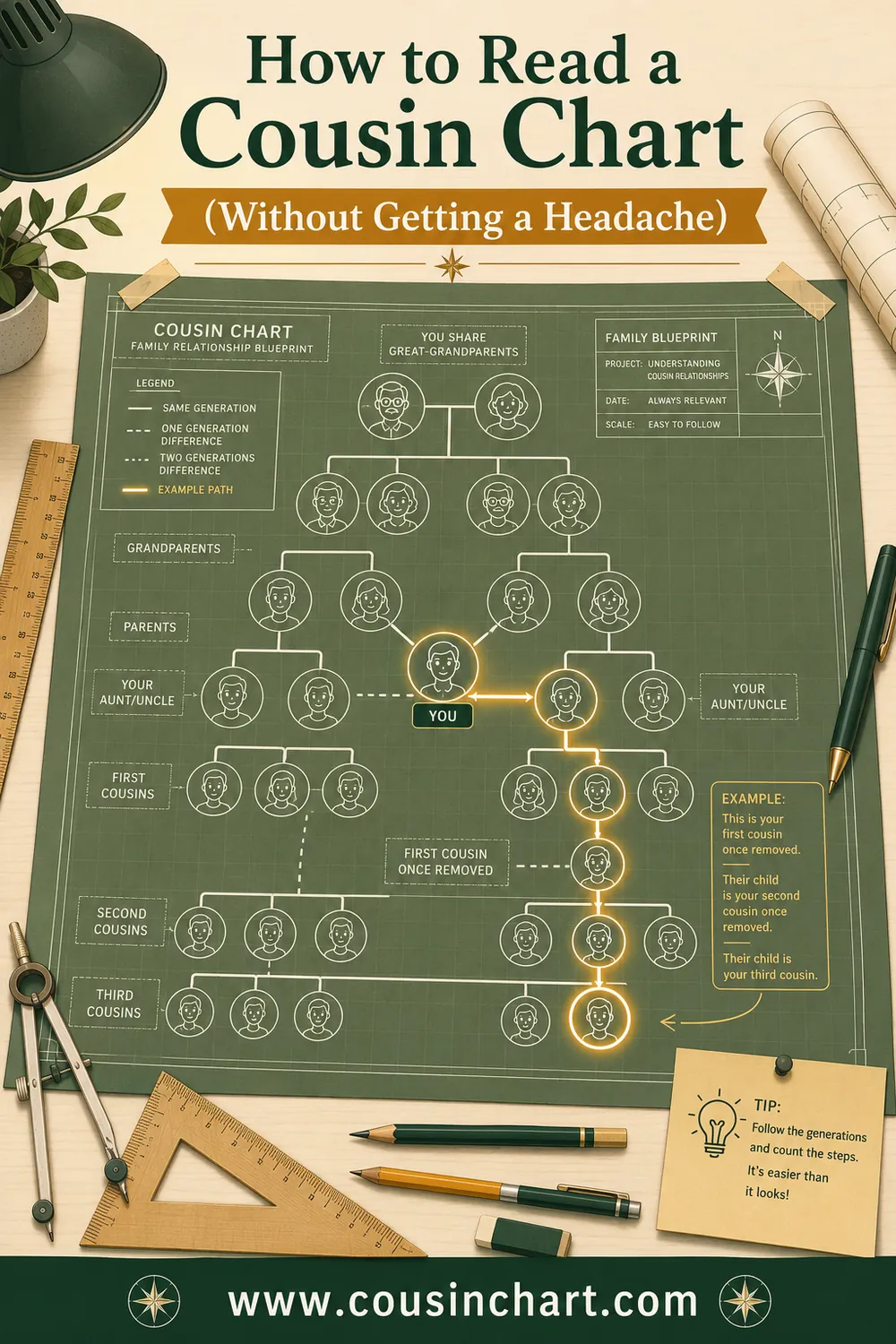
Relationship quick-check: tap a phrase to see who that person is before you place their box.
Tap a phrase above to see the answer.
Work out any family relationship →The 12 examples at a glance
| # | Example | People | Orientation | Best for |
|---|---|---|---|---|
| 1 | 3-generation basic tree | 7 | Portrait | Kids, first attempt |
| 2 | 4-generation ancestor chart | 15 | Landscape | Most adults |
| 3 | 5-generation research chart | 31 | Landscape 11×17" | Genealogy work |
| 4 | 5-generation fan | 31 | Portrait | Framing, gifts |
| 5 | Tree with siblings | 9–15 | Portrait | School projects |
| 6 | Extended tree with aunts/uncles/cousins | 20–40 | Landscape poster | Family walls |
| 7 | Photo tree | 7–15 | Portrait | Gifts, nurseries |
| 8 | Descendant reunion chart | 30–60+ | Wide landscape | Reunions |
| 9 | Blended family tree | Varies | Landscape | Step/half families |
| 10 | Bow tie wedding tree | 15–31 | Landscape | Weddings, couples |
| 11 | Kids' handprint/apple tree | 5–10 | Portrait | Preschool |
| 12 | Ancestor timeline tree | 15 | Portrait, tall | History lovers |
Examples 1–4: the classic ancestor layouts
1. The 3-generation basic tree — 7 boxes
One box for you at the bottom, two parents above, four grandparents on top. Portrait page, big boxes, done in one sitting. This is the layout schools assign and the one in every simple family tree roundup, because a child can complete it from memory. Copy it exactly when the goal is "finished today."
2. The 4-generation ancestor chart — 15 boxes
The most-copied layout in genealogy: you, 2 parents, 4 grandparents, 8 great-grandparents, arranged left-to-right on a landscape page. The 8-box column still leaves room to write "b. 1898, Ohio" under each name. If you print one example from this page, print this one — it's the chart most adults can nearly finish and the doorway to real research.
3. The 5-generation research chart — 31 boxes
Adds the 16 great-great-grandparents. On Letter paper the boxes drop to name-and-year size, so the example worth copying prints at 11×17". Genealogists number every person (you're 1; each father is double his child's number) so that person 16's line can continue on a fresh sheet. Copy this when you've caught the research bug.
4. The 5-generation fan — 31 wedges
Same 31 people bent into a semicircle: you at the center point, five arcs radiating out. It reads at a glance and frames beautifully — this is the example to copy for a wall piece or an anniversary gift. Write surnames only in the outer arc; the wedges get narrow.
Examples 5–8: the wide layouts (where cousins live)
5. The tree with siblings — 9 to 15 people
Take example 1 and add brothers and sisters beside you, plus your parents' other children if you're making it for a child. Siblings share your row, connected by a horizontal line to the same parents. This is the layout most school projects actually want — teachers expect siblings, which pure ancestor charts omit.
6. The extended family tree — 20 to 40 people
Grandparents at the top; their children (your parent, aunts, uncles) in the middle row with spouses; all the cousins along the bottom. Three generations, but wide — landscape poster territory past about 25 people. It's the layout that finally shows kids why cousins are cousins: everyone on the bottom row shares the top-row grandparents. When the bottom row starts asking what their kids will be to each other (second cousins), point them at the calculator.
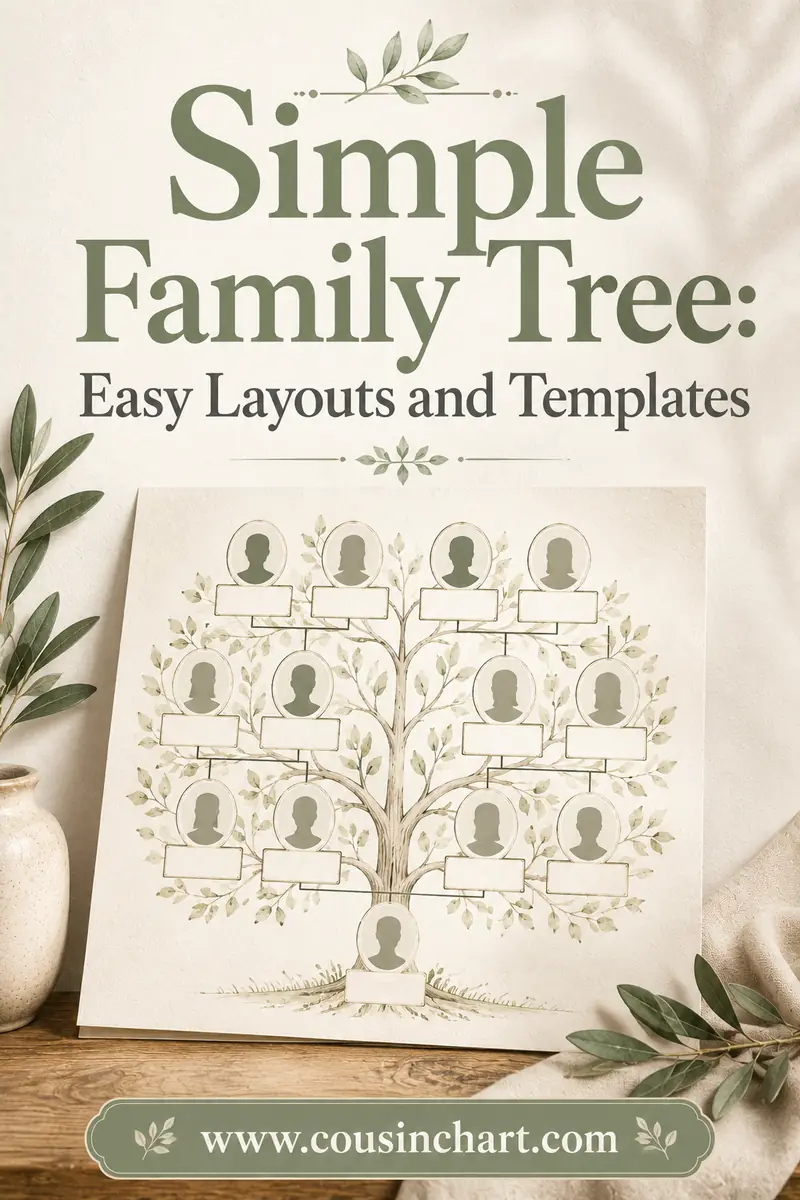
7. The photo tree — 7 to 15 people
Any of examples 1, 2 or 5 with circular photo frames instead of text boxes, names underneath. Portrait orientation, and the classic version puts the couple or child at the trunk of a literal illustrated tree. Copy this for gifts — grandparents cry, reliably. Layout tips and printables: family tree template with pictures.
8. The descendant reunion chart — 30 to 60+ people
Flips direction: great-grandparents in a single box at top, their children in the second row, and so on down to the newest baby. Spouses attach with double lines; each family group hangs below its parents. It's the only example where everyone at the reunion appears, which is why it gets taped to the pavilion wall. Build it one branch per page and join the pages sideways.
9. The blended family tree
The example that rescues real families: each marriage gets its own connection line, children hang from their biological pairing, and step-relationships use dashed lines. So dad's box connects solidly to his first spouse (their kids below) and to his second spouse (those kids below that line), with step-siblings visible but never mislabeled. Landscape, generous spacing, pencil first — blended trees always need a second draft.
10. The bow tie wedding tree
The couple in the center; one partner's 15-person ancestor chart extending left, the other's extending right. Landscape, symmetrical, and the single best wedding or anniversary layout because it literally shows two families joining. A 4-generation version (15 per side, 30 total plus the couple) fits an 18×24" poster with room for a title.
11. The kids' handprint or apple tree
A drawn trunk with a leaf, apple, or handprint per family member — no rigid rows, which is the point. Preschoolers add anyone they love, in any order, including the dog. Copy the loose structure and resist the urge to correct it into a chart; there are decades ahead for that.
12. The ancestor timeline tree
A tall portrait layout where each generation's row is labeled with its era — you (2000s), parents (1970s), grandparents (1940s), great-grandparents (1910s). Same 15 people as example 2, rearranged to teach history: suddenly great-grandpa's row lines up with the First World War. Wonderful for school-age kids and for family tree chart type nerds who want something different on the wall.
How to copy any of these well
- Count your people first, then pick the example that fits — not the other way around.
- Match the orientation. Tall families of ancestors want landscape; sibling-heavy families want width; photo trees want portrait.
- Keep generations in strict rows. Every layout above works because each row is one generation. The moment an aunt floats above her row, the tree lies.
- Verify the tricky connections — half-relatives, the removed cousins, grandma's stepsister — with the free CousinChart calculator before writing them in.
- Print a blank from our chart pack and trace your plan in pencil before committing to the good cardstock. All the structured examples above have matching PDFs in the free family tree template collection.
Mixing examples: the combinations that work
Real projects usually blend two of the layouts above, and some pairings are proven:
- Photo tree (7) + timeline rows (12). Circular portraits arranged by era — the nursery-wall favorite, because the baby's photo sits beneath four generations of faces at the same age.
- Reunion chart (8) + blended lines (9). Big descendant charts almost always need the dashed step-lines and double marriage bridges; families are blended, and the reunion chart that pretends otherwise gets corrected loudly at the picnic.
- Bow tie (10) + fan halves (4). A wedding display where each side of the bow tie is drawn as a quarter-fan — striking, compact, and the two families' arcs literally meet in the middle.
- Sibling tree (5) + photo boxes (7). The school-project deluxe: three generations, brothers and sisters included, faces glued in. It's the version teachers photograph for next year's example board.
The one combination to avoid: ancestor chart logic with descendant chart direction on the same page. A tree that doubles upward and branches downward from the middle needs hourglass discipline (one center person) or it turns to spaghetti.
FAQ
What does a basic family tree example look like?
Seven boxes in three rows: you at the bottom, your two parents above, four grandparents at the top, with lines connecting each child to both parents. It fits portrait Letter paper and is the standard first tree for kids and adults alike.
How many people should a family tree include?
Whatever the layout holds cleanly: 7 for 3 generations, 15 for 4, 31 for 5. Whole-family layouts with aunts, uncles and cousins commonly run 20–40 people and need poster-size paper. Count your people, then choose.
Do family tree examples include aunts, uncles, and cousins?
Ancestor-chart examples don't — they show direct ancestors only. Extended, descendant, and kids' tree layouts do. If cousins matter for your project, copy examples 6 or 8 above rather than a pedigree chart.
What's the best family tree example for a school project?
The tree with siblings (example 5): three generations plus brothers and sisters, portrait page, big boxes. Teachers expect siblings included, and it's finishable in one evening from family knowledge.
How do you show divorce or step-family on a family tree?
Give each marriage its own line and hang children from their biological pairing; mark step-links with dashed lines. Blended-family layouts (example 9) exist precisely because standard charts have no second-marriage slot.
Pick your example and print it tonight
Somewhere above is your family's shape — 7 boxes or 60, portrait or poster. Grab the matching fill-in PDF from the free CousinChart chart pack, print at actual size, and start with the names you know. When you hit the box you can't label — the cousin's kid, the step-grandma, the mystery at the reunion — the free relationship calculator hands you the exact term in seconds.