English Genealogy Beyond the Census: Parish Registers, GRO and Probate
Most people work the English census until it runs out in 1841 and then stop, which is a shame, because the good stuff starts there. The single most useful and least-known fact in English research: the General Register Office's own online index gives you the mother's maiden name on every birth from 1837, and the age at death on every death from 1837 — details that FreeBMD and the old printed indexes only carry from 1911 and 1866 respectively. That one difference collapses brick walls. Beyond it lie parish registers running to 1538, a probate system that splits neatly at 1858, and a marriage law that quietly forced nonconformists into the parish church for eighty years. As the branches multiply, the cousin calculator keeps the relationships straight.
What has your English research run into? Tap the closest match.
Tap an option above. English records go back to 1538 — the census is only the doorway.
Civil registration and the GRO index most people miss
Civil registration of births, marriages and deaths in England and Wales began on 1 July 1837. Every event since then should be in the General Register Office's national index.
Should be — with one caveat for the early years. Registration was the registrar's duty, not the parent's, and there was no penalty for failing to register a birth until the Births and Deaths Registration Act 1874 took effect in 1875. Estimates of missing early births vary, but a missing 1840s birth is common enough that you should always check the baptism as well.
The GRO's own index is better than the free copies. Register a free account at the GRO site and you can search:
- Births 1837 to 1922, showing the mother's maiden name for every year. FreeBMD, which transcribes the printed quarterly index, only shows it from September 1911.
- Deaths 1837 to 1887, showing age at death for every year. The printed index only recorded age from 1866.
That maiden-name field is the tool. If you know a couple married and want their children, search the GRO birth index by the mother's maiden name and the surname together, in a district, across a date range. You get the whole sibling set, including children who died young and never reached a census.
FreeBMD still matters — it is fully free, covers marriages, and runs later than the GRO index in some series. Use both: FreeBMD to browse, GRO to get the extra field.
Ordering certificates. The GRO sells PDF copies of historic birth and death entries more cheaply than paper certificates, usually delivered within a few working days. Marriage entries are ordered separately, from the local register office or the GRO.
Parish registers: the four-hundred-year backbone
English parish registers begin in 1538, when Thomas Cromwell ordered every parish to record baptisms, marriages and burials. Survival from that date is patchy — many parishes start in the 1550s or later, after a 1598 order that registers be copied onto parchment.
Two dates change the format. Hardwicke's Marriage Act of 1754 introduced printed marriage registers with signatures and witnesses. Rose's Act of 1812 introduced printed, columned registers for baptisms and burials, so from 1813 you get the father's occupation and the family's abode on every baptism.
Before 1813, expect one line. "1748 May 3, John son of Thomas Hallam, baptised." No mother, no occupation, no address. This is where reconstructing a family means reading the whole parish, not searching a name.
Bishop's Transcripts are the second copy. Each year the parish sent a copy of its register to the diocese. Where the original is lost or water-damaged, the transcript may be your only text — and occasionally it records an entry the parish book omitted.
Where to search. Ancestry and Findmypast hold licensed images of most county record office collections. FreeREG offers volunteer transcriptions at no cost, and FamilySearch has an enormous free index of English baptisms and marriages. Many county archives now publish their own free indexes as well.
The nonconformist problem, and how to solve it
Between 25 March 1754 and 30 June 1837, almost everyone in England had to marry in the parish church. Hardwicke's Marriage Act voided marriages performed elsewhere, exempting only Quakers and Jews. Roman Catholics, Baptists, Methodists and Congregationalists all went through an Anglican ceremony, whatever they did afterwards in their own chapel.
So a "missing" nonconformist marriage is usually in the parish register. This is the single most useful thing to know about eighteenth-century English dissent.
Baptisms are the opposite. Nonconformists baptised in their own chapels, and those registers were surrendered to the state in 1837 and again in 1857. They now sit at The National Archives in series RG 4 and RG 8, are indexed and digitized, and include Quaker, Baptist, Independent, Methodist and some foreign Protestant congregations, plus the Bunhill Fields burial ground.
Roman Catholic registers mostly stayed put. They were not surrendered, so they remain with the diocese, the mission or a Catholic archive. Our church records guide explains how to trace a congregation and request access.
Quaker records are a genealogist's dream. Friends recorded births rather than baptisms, listed both parents fully, and kept meticulous registers of marriages and burials, with a national digest index.
Probate: everything changes in 1858
| Period | Who granted probate | Where to search | Cost |
|---|---|---|---|
| Before 1858 | Church courts — archdeaconry, diocese, or the Prerogative Court of Canterbury | TNA Discovery for PCC wills; county record offices for local courts | Free to search |
| PCC wills 1384–1858 | Prerogative Court of Canterbury | The National Archives, indexed and digitized | Free search, small fee to download |
| 1858 onward | The Principal Probate Registry, one national system | The GOV.UK Find a Will service | Free search, small fee for a copy |
| Death duty registers 1796–1903 | Inland Revenue | The National Archives | Free search |
Before 1858, wills were church business. Which court proved a will depended on where the property lay: a single archdeaconry for most people, the diocese for property across two archdeaconries, and the Prerogative Court of Canterbury (PCC) for estates spread across dioceses, for the wealthy, and for people who died abroad or at sea. The PCC series is fully indexed and digitized at The National Archives.
After 1858, one calendar covers everyone. The annual National Probate Calendar lists name, address, occupation, date and place of death, the executors and the estate value, and it is searchable free on the government's Find a Will service with images of the calendar pages.
The calendar entry alone often answers your question. It gives an exact death date and a precise address, and executors are nearly always relatives — a widow, a son, a brother-in-law described as such.
Death duty registers are the underrated set. From 1796 the Inland Revenue tracked estates for tax, recording who actually received what, sometimes years after probate, with annotations about beneficiaries who died in the meantime. Our general guide to wills and probate records covers reading and citing them.
Poor law records: where the poorest ancestors hide
The irony of English records is that the poorer your ancestor was, the more the state wrote about them.
Settlement examinations are sworn life histories. Under the settlement laws, a parish was liable only for its own people, so anyone asking for relief elsewhere was questioned: where were you born, who were your parents, where have you worked, when did you marry, what are your children's names and ages. Then it was written down and signed.
Removal orders record the destination. When a parish decided someone belonged elsewhere, it ordered them removed, naming the parish they were sent to — which is often the parish you have been hunting for.
Bastardy bonds and examinations name the father. A single mother was examined to identify the father, who was then bonded to pay maintenance. These records name people that no baptism register would.
Workhouse and union records continue after 1834. Admission and discharge registers, creed registers and settlement papers from the poor law unions carry family groups, ages and birthplaces. See our guide to poorhouse and almshouse records for how to find and read them.
All of it lives in the county record office, usually cataloged under the parish or the poor law union, and increasingly indexed online by the archive itself.
Manorial, land and court records
Manorial records can reach behind the parish registers. Copyhold land was held "by copy of court roll", and every transfer — usually a death or an inheritance — was recorded in the manor court, naming the heir and the relationship. Some manorial series run from the 1200s. The Manorial Documents Register at The National Archives tells you what survives and where.
Quarter sessions catch ordinary people. Alehouse licenses, jurors' lists, land tax assessments, oaths, apprenticeship indentures and criminal cases all sit in the quarter sessions papers at the county record office.
Land tax assessments (1780–1832) work as a poor man's census. They list, parish by parish and year by year, the owner and the occupier of each property — so you can watch a tenancy pass from father to son.
Apprenticeship records name a father. An indenture states the apprentice's father, his parish and often his trade, which fixes a family in place at a date between parish register entries.
Reading English records without misunderstanding them
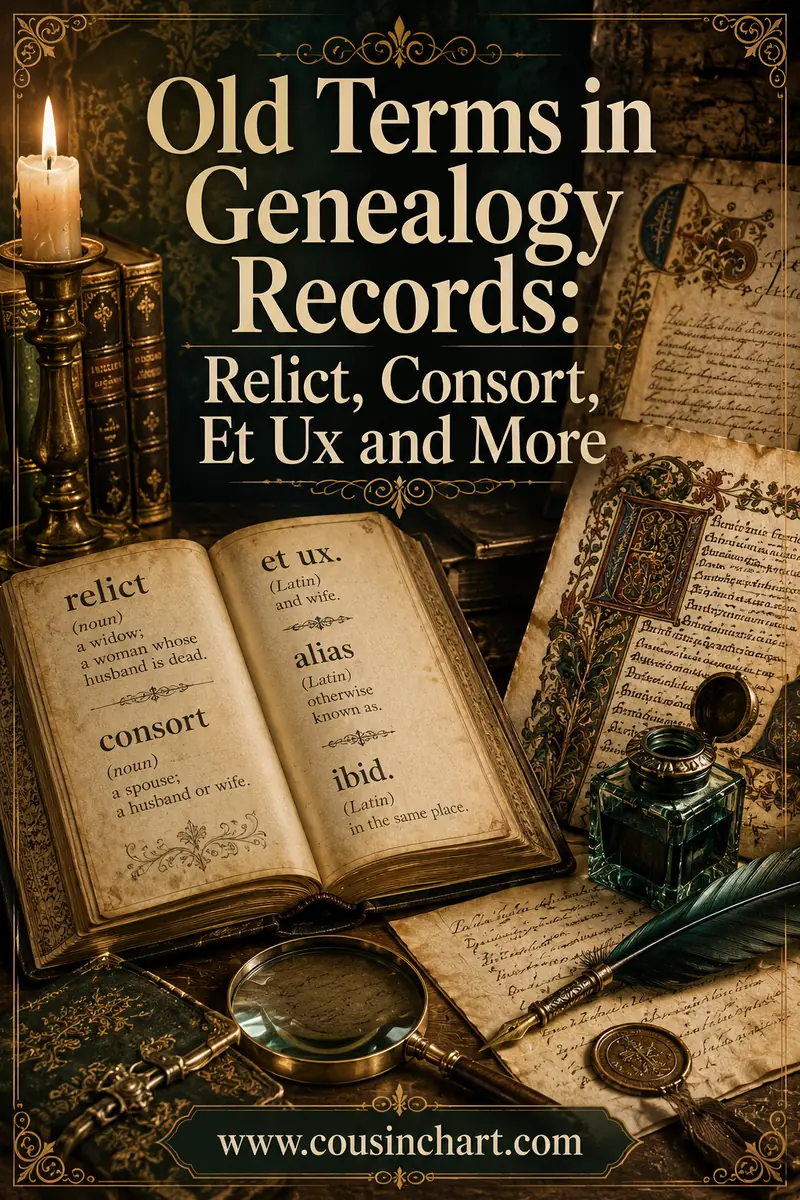
Old kinship words do not mean what you think. In a will before about 1800, "cousin" can mean almost any relative, "nephew" occasionally means grandson, "in-law" can mean step-relation, and "natural son" means an illegitimate one. Our glossary of old genealogy terms sets out the traps, and the relationship calculator helps you test whether the relationship a document states is actually possible with the dates you have.
Dates before 1752 need care. England used the Julian calendar and began its legal year on 25 March until 1752. So a date written "12 February 1731" in a register means February 1732 in modern reckoning, and is usually written 1731/2. When the switch happened, eleven days were dropped from September 1752.
Surnames were written as heard. A clerk who had never seen a name wrote it phonetically, so one family can run through five spellings in three generations. Our list of English surnames and their meanings covers the origins and the common variants.
The census is the doorway, not the house. We have covered the years, coverage and search method separately in our UK census records guide, which is where to start if you have not yet worked the 1841–1921 returns and the 1939 Register.
FAQ
What is the difference between the GRO index and FreeBMD?
FreeBMD transcribes the printed quarterly indexes, so it shows a mother's maiden name only from late 1911. The GRO's own online index, free to search with an account, shows the mother's maiden name on births back to 1837 and age at death back to 1837.
When did English parish registers start?
In 1538, by order of Thomas Cromwell. Survival varies: many parishes have registers only from the 1550s or later. Entries stayed brief until Rose's Act of 1812, after which printed columns record the father's occupation and the family's abode.
Why can't I find my nonconformist ancestor's marriage?
Because between 1754 and 1837 Hardwicke's Marriage Act required nearly everyone in England and Wales to marry in the Church of England, exempting only Quakers and Jews. Look for the marriage in the parish register even when the family were lifelong Baptists or Methodists.
Where can I search English wills for free?
For wills proved after 1858, the GOV.UK Find a Will service searches the National Probate Calendar free and shows the calendar image. For wills proved before 1858 in the Prerogative Court of Canterbury, search The National Archives Discovery catalog free.
What is a Bishop's Transcript?
An annual copy of a parish register sent by the incumbent to the diocese, kept from the late 1590s into the 1800s. Where the parish register is lost or damaged, the transcript may be the only surviving text, and it sometimes contains entries the original omitted.
How do I trace a poor English ancestor with few records?
Use poor law papers at the county record office. Settlement examinations are sworn life histories giving birthplace, parents, work and children. Removal orders name the destination parish, bastardy examinations name fathers, and workhouse registers list family groups with ages.
Past the census and into the parish chest
English research has a bad habit of stopping where the census stops. Push past it and the country turns out to keep some of the deepest records in the world: registers from 1538, a probate system indexed back to 1384, manor courts naming heirs since the middle ages, and poor law examinations that recorded a laborer's whole life because a parish did not want to pay for him. Start with the GRO index for its extra fields, take the maiden names it gives you back into the parish registers, and let the wills state relationships in their own words. When those relationships pile up into cousins several times removed, the free CousinChart relationship calculator will name every one of them.