How Accurate Is DNA Paternity Testing?
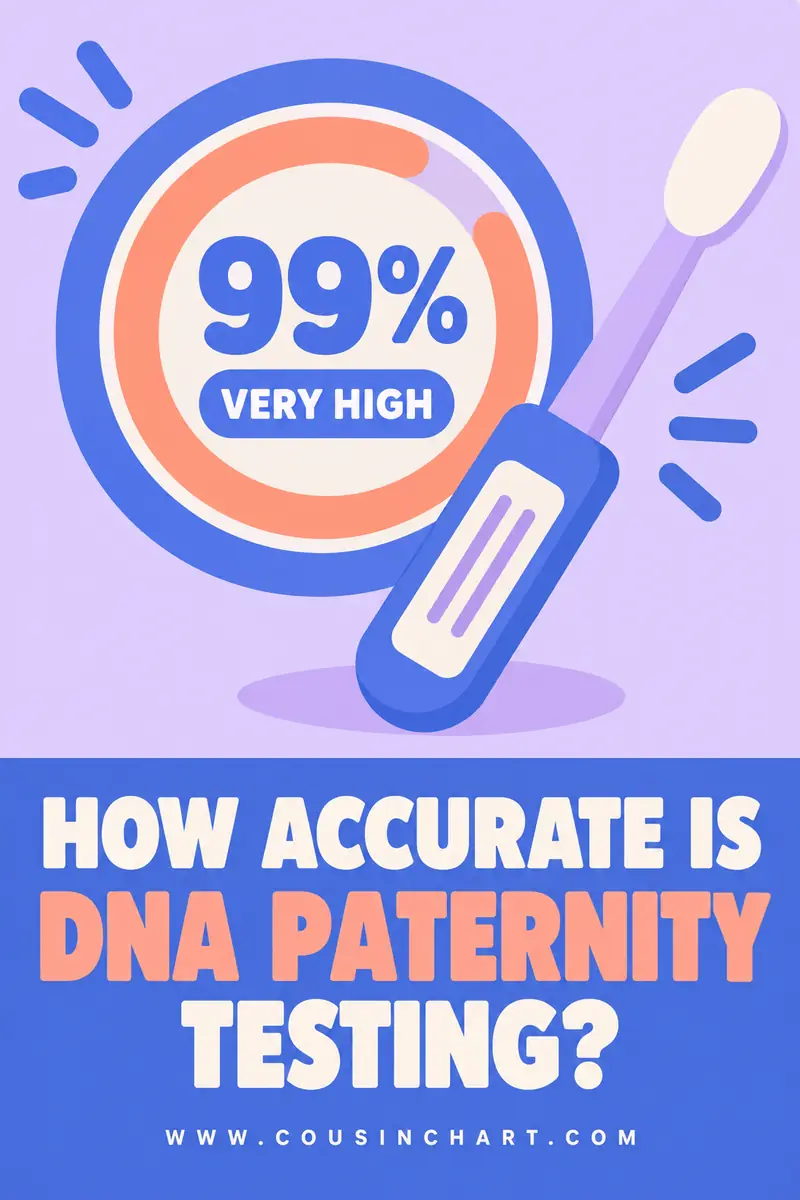
Paternity testing is the most reliable relationship test that exists, and the numbers reflect it: an accredited laboratory typically reports a probability of 99.9% or higher when a man is the father, and 0% when he is not. An exclusion is effectively certain. An inclusion is as close to certain as a statistical statement gets, with one specific weakness worth knowing about — a close male relative of the true father can also produce a very high probability. Everything else people worry about, from laboratory error to sample mix-ups, is far less likely than that. If you are trying to interpret a relationship from consumer DNA results rather than a formal test, the DNA match calculator is the right starting point.
What kind of paternity question is it? Tap the closest match.
Tap an option above. In short: exclusions are certain, inclusions are near-certain, relatives are the catch.
How accurate is a paternity test?
Accredited laboratories generally report a probability of paternity of 99.9% or higher for an inclusion, and 0% for an exclusion.
An exclusion is essentially definitive. If the tested man is not the biological father, his DNA will contradict the child's at multiple independent markers. That is not a close call — it is a plain mismatch.
An inclusion is a probability, but a very strong one. The report states how much more likely the results are if this man is the father than if a random unrelated man of the same population is. That ratio produces the percentage.
You will never see 100%. Not because the science is weak, but because the calculation compares against other possible men, and no test can rule out every untested individual on Earth. A laboratory offering 100% probability of paternity is overselling.
The remaining uncertainty is almost entirely about relatives. Which is the part worth planning for, and the part most people are never told about.
What does the laboratory actually compare?
Short, repeating sections of DNA, checked one by one — and the logic is simpler than it sounds.
Tests examine a panel of markers. Most accredited relationship tests look at a set of short tandem repeats, commonly around 16 to 24 or more locations across the genome. Modern panels have grown larger over time.
At each marker, a child has two values — one from each parent. Subtract the mother's contribution and the remaining value must have come from the biological father. If the tested man does not carry it, he is excluded at that marker.
One mismatch is not an exclusion. Occasionally a marker mutates between parent and child. Laboratories therefore require mismatches at several markers before reporting an exclusion, which is a deliberate safeguard rather than hedging.
More markers means more confidence. Each additional marker that matches multiplies the odds against coincidence, which is how probabilities reach the 99.99% range.
Why does testing the mother help?
Because it removes half the problem before the comparison even starts.
Her sample identifies the maternal half. Once the laboratory knows which values came from her, the paternal half is isolated cleanly, and the alleged father is compared against exactly the right target.
Motherless tests still work well. Most laboratories can produce a conclusive result without her, and many tests are run that way. They simply carry a slightly higher chance of an ambiguous marker.
Her participation matters more in awkward cases. Related possible fathers, unusual marker patterns and rare mutations are all easier to resolve with her included.
Same principle, more strongly, further out. It is why a grandparent DNA test is so much stronger when the mother takes part — the fewer unknowns, the sharper the answer.
When do close relatives break the result?
This is the one genuine weakness in an otherwise excellent test, and it comes up more often than people expect.
| Possible fathers | Can a standard test separate them? | What to do |
|---|---|---|
| Two unrelated men | Yes, easily | Standard test is conclusive |
| A father and his son | Usually, with a full marker panel | Disclose the relationship in advance |
| Two brothers | Often, but not always | Test both men, or request extended markers |
| An uncle and a nephew | Usually | Disclose; consider testing both |
| Identical twins | Not with standard marker testing | Specialist deep sequencing may be needed; ask first |
| One man, unknown others | Yes for the tested man | The report only speaks about who was tested |
Brothers share many markers. Two full brothers inherit from the same parents, so a test on one can return a high probability even if the other is the true father. Testing both resolves it.
Identical twins are the hard case. Standard relationship panels cannot distinguish them, because their marker profiles are the same. Specialist sequencing methods exist but are not routine, and you should ask a laboratory directly before assuming anything.
Always disclose a possible related father. Laboratories can add markers or design the comparison differently, but only if they know. Withholding it is the most common way a technically correct report ends up misleading.
The same logic applies to sibling questions. It is why confirming a half-sibling is statistically harder than confirming a father, as the guide to DNA tests for half-siblings explains.
What is the difference between a legal and an at-home test?
The laboratory work is usually identical. What changes is everything around the sample.
Chain of custody is the whole distinction. For a legal test, a neutral collector checks photo identification, takes the swabs, seals them and documents every handover. That paper trail is what makes the result admissible.
Home kits cannot verify who was swabbed. So their reports carry wording such as "for peace of mind only" and are not accepted by courts, immigration authorities or benefits agencies.
You cannot upgrade one afterwards. If there is any chance the result will be needed officially, pay for the legal version first. Repeating the test later costs more than doing it properly once.
Check accreditation, not advertising. Look for a laboratory accredited for relationship testing by a recognized body, and confirm that whoever needs the result accepts it. Consumer ancestry kits are not paternity tests at all, a point covered among the common DNA testing myths.
Can paternity be tested before birth?
Yes, and the standard method no longer requires a needle.
Non-invasive prenatal paternity testing uses the mother's blood. Fetal DNA circulates in the mother's bloodstream, and laboratories can analyze it from around the seventh to ninth week of pregnancy alongside a sample from the alleged father.
It costs considerably more than a postnatal test. Often several times more, and it is rarely covered by insurance.
Invasive alternatives exist but are not used for this. Amniocentesis and chorionic villus sampling carry a small procedural risk and are performed for medical reasons, not paternity questions.
Ask providers direct questions. What accreditation they hold, what gestational age they need, what their reported accuracy is for their own method, and what happens if the sample fails. Reputable providers answer all four without hesitation.
What if the alleged father is not available?
There are good options, and they follow a clear hierarchy.
Test his parents. Both paternal grandparents together can reconstruct a great deal about their son, which is why grandparentage testing is the usual fallback.
Test his full siblings. An avuncular test compares the child with an aunt or uncle. It is less powerful than a direct test, and more tested relatives improve it.
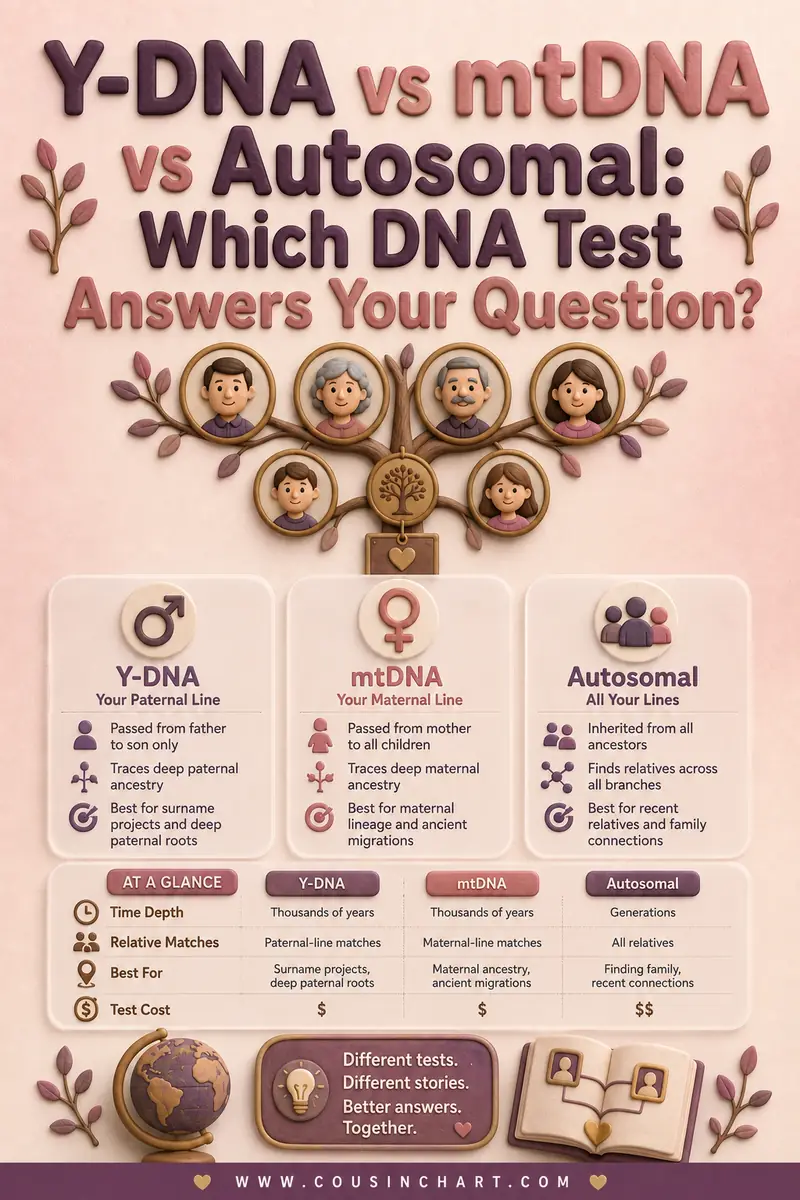
Y-DNA works for a male child. If the child is male, his Y chromosome should match that of the alleged father's paternal line. It confirms the line rather than the individual, since brothers and cousins on that line share the same signature — the limitation described in the guide to Y-DNA, mtDNA and autosomal tests.
Consumer databases sometimes answer it outright. If relatives have tested at a major company, the pattern of matches can identify a paternal line without any formal test, which is the method described in the unknown parent DNA search guide.
What can go wrong, and how do you avoid it?
Not much, and most of it is avoidable at the booking stage.
Choosing the wrong product. The commonest and costliest mistake: buying a home kit when a court needs a legal one.
Not disclosing related possible fathers. Tell the laboratory before testing, always.
Poor sample collection. Follow the swab instructions exactly — no eating, drinking or smoking beforehand, and let swabs air-dry. A failed sample means a delay, not a wrong answer.
Recent transfusions or transplants. Both can affect certain sample types. Mention either to the laboratory in advance.
Misreading a sibling result as a paternity result. They are different tests with very different statistical power, as the comparison of half-siblings and full siblings makes clear.
And plan for the human side. A result changes relationships regardless of which way it lands. Decide in advance who will be told, and consider having support in place for the day the report arrives.
FAQ
How accurate is a DNA paternity test?
Accredited laboratories typically report a probability of paternity of 99.9% or higher when the tested man is the biological father, and 0% when he is not. Exclusions are effectively definitive; inclusions are statistical statements that stop short of 100% by design.
Can a paternity test be wrong?
Genuine laboratory errors are rare at accredited facilities. The realistic risks are a close male relative of the true father producing a high probability, an undisclosed identical twin, or samples being collected from the wrong person in an unsupervised home test.
Does the mother need to be tested?
No, but it helps. Testing her identifies which half of the child's DNA is maternal, leaving the paternal half isolated for comparison. Motherless tests are routine and usually conclusive; including her reduces the chance of an ambiguous marker result.
Can two brothers be told apart by a paternity test?
Usually, with a full marker panel, but not always. Full brothers share many markers, so disclose the possibility before testing. The laboratory can extend the panel or test both men. Identical twins cannot be separated by standard marker testing at all.
Is a home paternity test as accurate as a legal one?
The laboratory analysis is generally the same. The difference is chain of custody: legal tests use supervised collection with verified identification, which makes the report admissible. Home kits cannot confirm who provided the samples, so they carry no official standing.
Can paternity be established if the alleged father has died?
Yes, usually through his relatives. Testing both his parents gives the strongest indirect result, followed by full siblings in an avuncular test. If the child is male, Y-DNA can confirm the paternal line, though it cannot identify which man on that line was the father.
Get the right test the first time
Paternity testing is one of the few areas of genetic genealogy where the technology genuinely delivers what it promises — an exclusion you can rely on absolutely, and an inclusion at 99.9% or better. The mistakes are almost never scientific. They are buying a home kit when an agency needs a legal one, failing to mention that two possible fathers are brothers, or assuming a consumer ancestry result carries the same weight. Decide first what the report is for, choose an accredited laboratory accordingly, and tell them everything about the family situation up front. For questions about relationships further out than father and child, the cousin calculator will show you what a shared DNA figure can and cannot settle.