DNA Tests for African Ancestry: What Works Best
If you are testing to reconnect a family line broken by slavery, here is the honest answer up front: the match list will do far more for you than the ethnicity map will. Regional estimates for African ancestry have improved a lot, but they still resolve to large areas rather than peoples, and no autosomal test names a specific ethnic group with confidence. What genuinely moves a search forward is a big matching database, a documented tree built backwards from the 1870 census, and the patience to work the two together. The DNA match calculator is built for the part that actually pays — turning a shared centimorgan figure into a shortlist of possible relationships.
What do you want the test to do? Tap the closest match.
Tap an option above. Short version: buy database size, not the ethnicity map.
Which test should you actually buy?
For most people researching African ancestry, an autosomal test at the company with the largest match database is the right first purchase, with a free upload of the raw file to every other site that accepts one.
Autosomal is the workhorse. It looks at DNA inherited from all your ancestral lines and matches you against every other tester in that company's pool. That is the mechanism that finds living cousins, and cousins are what break brick walls.
Database size beats feature lists. A slightly better ethnicity algorithm is worth very little if the cousin who holds your great-grandmother's photograph tested somewhere else. The general trade-offs between the major kits are laid out in the guide to the best DNA tests for ancestry.
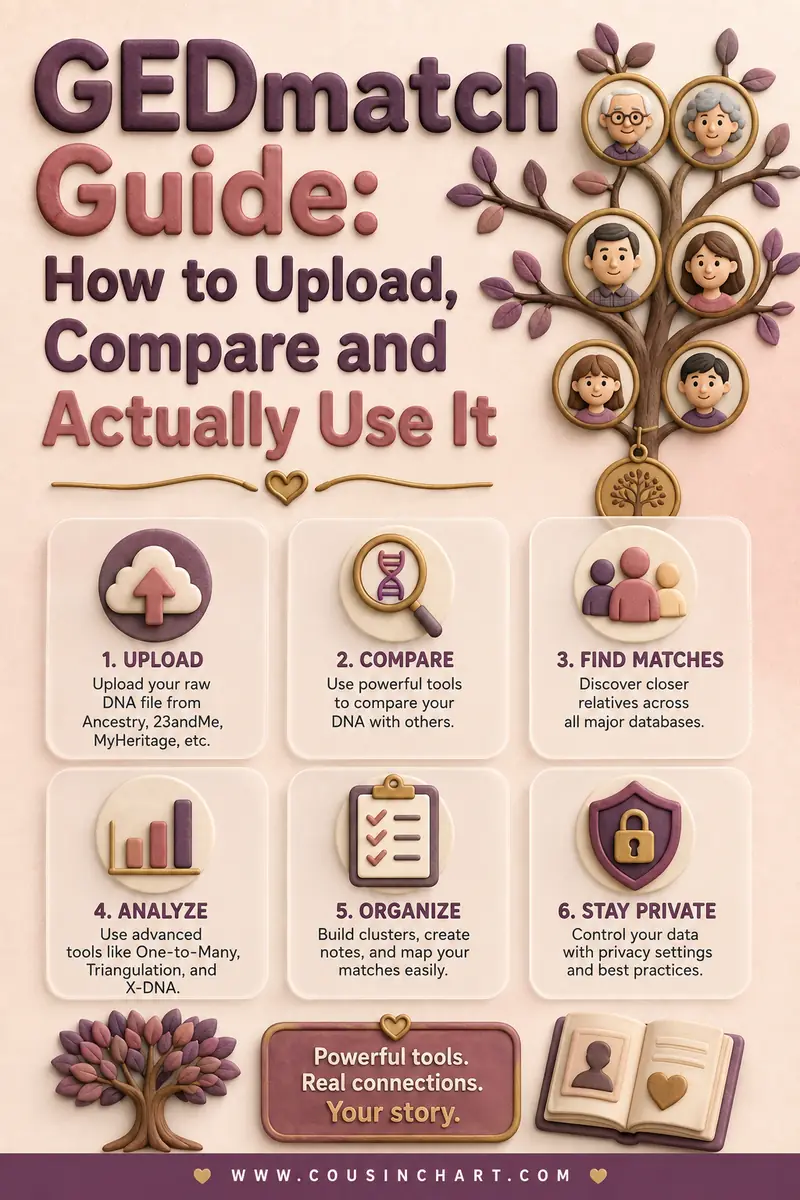
Then upload the raw file. Most companies let you download your raw data and upload it elsewhere, often free for matching. One test can therefore appear in several databases, and GEDmatch adds tools the consumer sites do not offer.
Buy the lineage tests later, if at all. A Y-DNA or mtDNA test answers a narrow question very well. It is a poor first purchase because it cannot find the broad cousin network you need.
Why do African ethnicity estimates look so broad?
Because the underlying reference data supports regions, not peoples — and because the history being reconstructed was deliberately deracinating.
Estimates are models, not measurements. Every company compares your genome against reference panels of living people with documented roots in a region, then reports the mixture that best explains it. Different panels and different algorithms give different answers for the same person, which is why two kits disagree and why results change after an update. The mechanics are covered in the guide to how accurate ethnicity estimates are.
African genetic diversity is enormous. There is more genetic variation within Africa than in the rest of the world combined, which sounds like it should make the estimates sharper. It does the opposite for consumer products, because a panel would need far more sampling to resolve that variation than any company currently has.
Ethnic groups are not genetic boxes. Peoples across West and West-Central Africa have intermarried, migrated and reorganized for centuries. A result naming a modern country is naming a border drawn in the nineteenth century, not a lineage.
The trade concentrated origins in a few regions. For most African Americans, results cluster in West and West-Central Africa — Senegal to Angola — because that is where the transatlantic trade drew from. A result that mirrors that pattern is confirming history, not identifying a home village.
And a European or Indigenous percentage is not an error. It reflects documented family history, much of it non-consensual, and it is one of the reasons results can land emotionally.
What can a lineage test really tell you?
A great deal about one line, and nothing about the rest.
mtDNA follows the direct maternal line. Your mother, her mother, her mother, back indefinitely. Everyone has it, men included, but only women pass it on.
Y-DNA follows the direct paternal line. Father to son. Only men carry it, so a woman researching her father's paternal line needs a brother, father, paternal uncle or paternal male cousin to test.
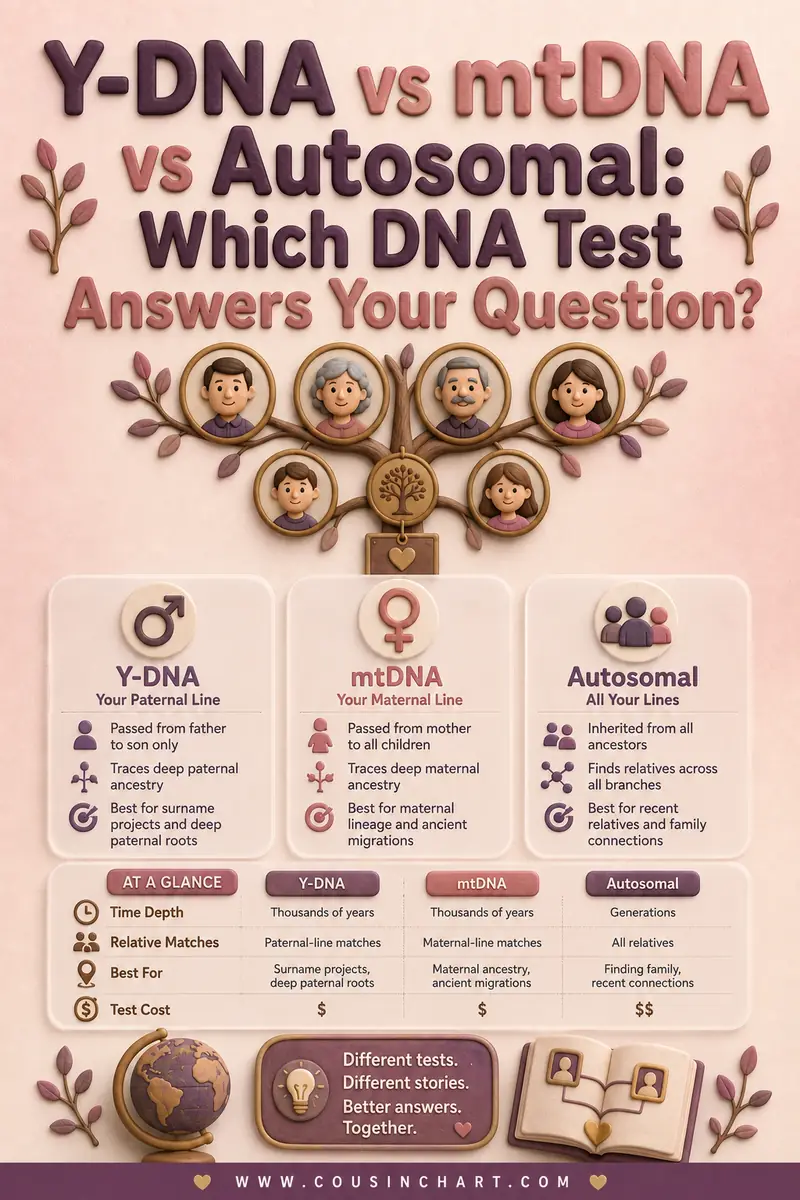
Each covers a vanishing fraction of your ancestors. Eight generations back you have 256 ancestral slots; mtDNA covers one of them and Y-DNA covers one. The difference between the three test types is set out in the guide to Y-DNA, mtDNA and autosomal testing.
Some services match your lineage to present-day African populations. They compare your haplotype against a database of samples from living people and report which groups share it. Read that result carefully: it means people in that group today carry a closely related lineage, which is evidence of shared deep ancestry on that one line. It is not a certificate that your ancestor belonged to that ethnic group, and a different database would return a somewhat different list.
It is still moving to receive. Just be clear about what you have been told, and what you have not.
How do the options compare?
| Test type | What it covers | What it is good for | Main limitation |
|---|---|---|---|
| Autosomal (all major consumer kits) | Every ancestral line, fading with distance | Finding cousins, building trees, regional estimates | Broad African regions; unreliable beyond ~5–6 generations |
| mtDNA | Direct maternal line only | Deep maternal origin, confirming a maternal link | One line out of hundreds; no recent-generation detail |
| Y-DNA | Direct paternal line only | Surname studies, confirming a paternal link | Men only; one line out of hundreds |
| Raw-data upload to a second site | Same autosomal data, new match pool | Extra matches at little or no cost | No new DNA; depends on who tested there |
| Third-party tools such as GEDmatch | Uploaded autosomal files from many companies | Segment comparison, clustering, deeper analysis | Smaller pool; a learning curve |
Read the last column first. Every one of these has a real limit, and the limits are what people are usually not told before they buy.
No single kit does all four jobs. Matching, regional estimation, maternal line and paternal line are separate products for a reason.
Why do match databases matter more than the map?
Because a cousin can hand you a name, and a map cannot.
Documentation of enslaved ancestors is fragmentary. Before 1870 most enslaved people appear in records only as an age, a sex and a value in someone else's property list. That is the wall, and the African American genealogy guide sets out the free records that get you to it.
Matches cross that wall in a way records struggle to. A cluster of matches sharing a surname or a county points at a family line even when no document names your ancestor. It tells you where to look next.
Matches also surface white descendants of enslaving families. Those trees are often well documented and can identify the plantation, the county and the estate papers where your ancestor may appear as property. It is difficult material to work with and it is frequently the only route through.
Shared matches are the real tool. Grouping your matches by who else they match reveals family lines before you can name them, which is why the shared centimorgan figure matters — put it into the DNA match calculator to see what relationships fit.
How do communities and clusters help?
The big companies now group testers by network as well as by region, and for this research the groupings are often more useful than the percentages.
Community groupings come from matching, not from panels. They are built by finding testers who match each other unusually often and share documented origins, then naming the resulting cluster after a place and era.
They can be strikingly specific. Where regional estimates give you a stretch of coastline, a community grouping may point at a US state and a period — the kind of detail you can take straight into county records.
Treat them as a research lead. They describe where a network of your relatives lived, not where you personally are from.
They improve as more people test. Unlike an ethnicity panel, these get sharper simply from database growth, which is another argument for testing where the crowd is.
How do you combine DNA with the records?
In one direction: records first, DNA as the bridge.
Build a documented tree to 1870 before anything else. The 1870 federal census is the first to name formerly enslaved people as individuals, and the 1870 census guide explains how to work it. Everything DNA does afterwards depends on having that tree to hang matches on.
Then attach matches to known branches. For each significant match, ask which of your documented lines they could sit on. Shared matches usually answer it faster than trees do.
Chase surnames and counties, not percentages. A repeated surname across several unexplained matches is a lead. A 3% regional figure is not.
Test the oldest generation while you can. Every generation up the tree carries DNA that has been lost by the next one. A great-aunt's kit is worth more than your own, and this is the one decision people most often regret leaving too late.
How do you spend the least for the most?
The order of purchase matters more than the brand.
One autosomal kit, at the largest database, is the whole first step. Wait for a sale; the major kits are discounted repeatedly through the year.
Upload the raw file everywhere that takes it. This is the highest-value free action in genetic genealogy — several extra match pools for the cost of a download.
Spend the second sum on relatives, not on features. A second kit for an elderly relative beats an upgrade for yourself every time.
Leave lineage testing until you have a specific question. When you have a documented maternal or paternal line you want to confirm or extend, an mtDNA or Y-DNA test earns its price. Bought first, it usually disappoints.
FAQ
What is the best DNA test for African ancestry?
For most people, an autosomal test at the company with the largest matching database, followed by free uploads of the raw file to other sites. Match lists find living cousins who break brick walls; ethnicity estimates for Africa resolve only to broad regions, not to specific ethnic groups.
Can a DNA test tell me which African tribe I am from?
Not reliably. Autosomal tests report large regions such as West or West-Central Africa. Lineage tests can match your maternal or paternal haplotype to present-day populations, but that shows shared deep ancestry on one line among hundreds, not membership of an ethnic group.
Why does my African ancestry show as a whole region rather than a country?
Because reference panels sample far less of Africa's genetic diversity than would be needed to separate neighboring populations, and because peoples have intermarried and migrated across modern borders for centuries. Country names on a results map reflect nineteenth-century borders, not ancestral communities.
Why do I have European ancestry in my results?
For most African Americans this reflects documented family history during and after slavery, much of it coerced. It is an expected result rather than an error, and the percentage says nothing about which specific ancestor it came from without matching evidence to support it.
Should I test at more than one company?
Test once, then upload your raw data file free to every site that accepts it. That places you in several match pools for the price of one kit. Buying a second full test only makes sense if a company you want does not accept uploads.
Will a DNA test break through the 1870 brick wall on its own?
No. DNA identifies cousins and family clusters; records identify people. The reliable method is a documented tree back to the 1870 census, then matches used to point at the counties, surnames and estate papers most likely to name your enslaved ancestor.
Buy the database, then work the tree
The kit that helps most is simply the one with the most people in it, because this research is won by finding relatives rather than by reading a map. Test once at the largest database, upload the raw file free everywhere else, and put your second budget into an elderly relative rather than a premium feature. Then do the slow half: a documented tree back to 1870, matches grouped by who they also match, and surnames chased through county records. When a promising match appears and you need to know how they could fit, the cousin calculator will turn a shared number into a shortlist of real relationships.