What Is a Sixth Cousin? How Sixth Cousins Are Related
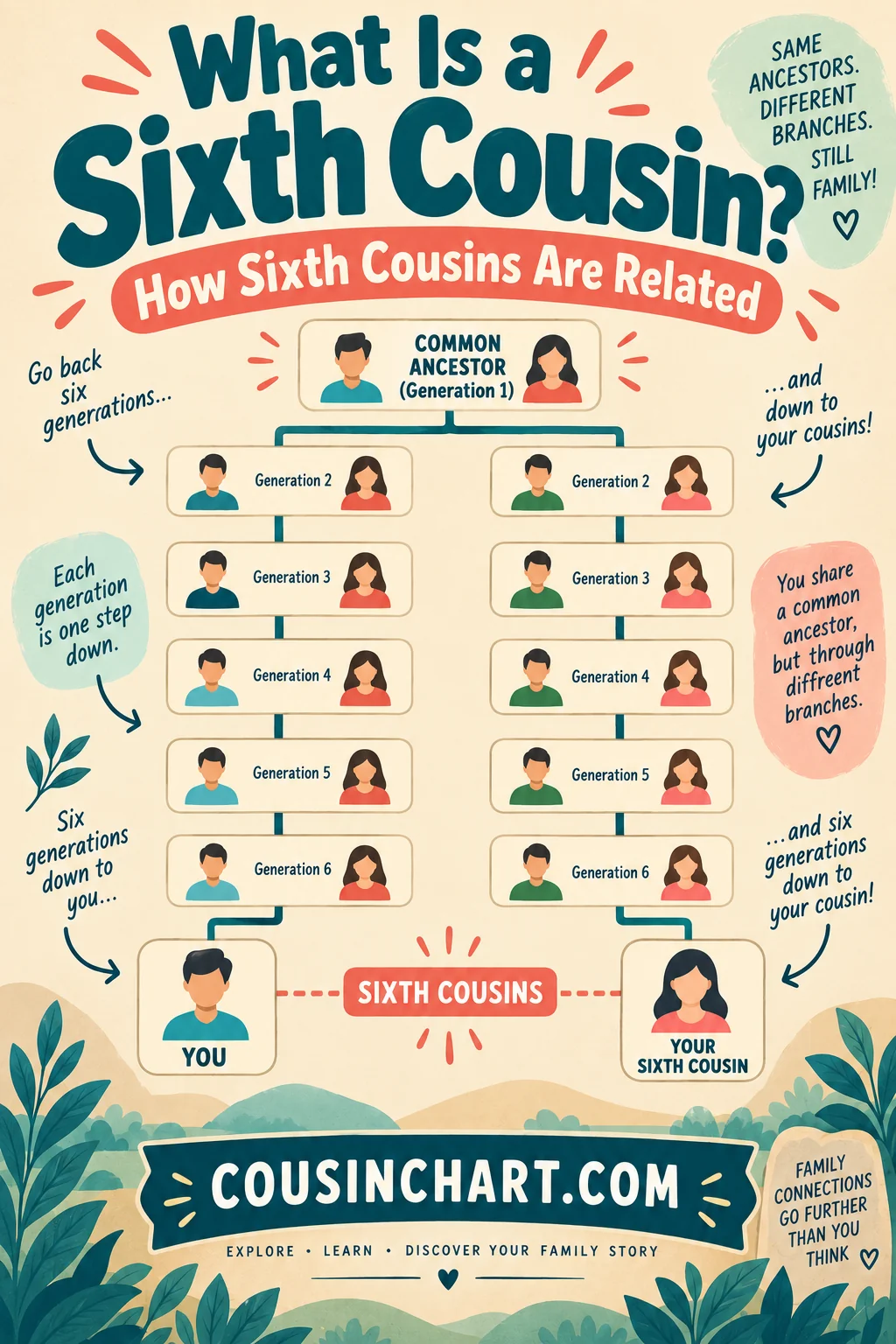
A sixth cousin is someone who shares a set of 5x-great-grandparents with you, with each of you standing exactly seven generations below that couple. The relationship is completely real and completely provable on paper. It is also, in genetic terms, close to invisible: the great majority of true sixth cousins share no DNA that any consumer test can detect, and the small amount they are expected to share on average is well below the threshold at which a test can tell a real segment from noise.
That is the whole story of this degree, and it is a genuinely different story from the one told at third or fourth cousin. This is the point on the ladder where paper genealogy and genetic genealogy stop agreeing.
Sixth Cousin Meaning: The Definition in One Line
The sixth cousin meaning is fixed by a counting rule, not by custom, and the rule is the same one that defines every other cousin degree:
- Cousin number = the number of generations from the nearer person up to the shared ancestral couple, minus one
- Removals = the difference between the two people's generation counts
Both sixth cousins are seven generations below the shared couple. Seven minus one is six. The difference between seven and seven is zero, so there is no removal. That is all a sixth cousin is.
The relationship is symmetrical. You are their sixth cousin and they are yours, regardless of who is older. Across seven generations of births, branches drift badly out of step with each other, so your sixth cousin might be eighty years old or eight.
The Shared Ancestor: Your 5x-Great-Grandparents
Your 5x-great-grandparents are your great-great-great-great-great-grandparents. Count the greats: five, plus grandparents, which puts them seven generations above you.
Walk the path. That couple had children. One of them is your 4x-great-grandparent, and the line continues down through your 3x-great-grandparent, 2x-great-grandparent, great-great-grandparent, great-grandparent, grandparent, parent, and finally you. Now go back to the top and follow a different child of that same couple down through the same number of births. The person who arrives at your generation is your sixth cousin.
The pattern across the whole ladder is perfectly regular. Each cousin degree pushes the shared ancestors back exactly one more generation.
| Cousin degree | Shared ancestors | Generations each of you is below them |
|---|---|---|
| 1st cousin | Grandparents | 2 |
| 2nd cousin | Great-grandparents | 3 |
| 3rd cousin | 2x-great-grandparents | 4 |
| 4th cousin | 3x-great-grandparents | 5 |
| 5th cousin | 4x-great-grandparents | 6 |
| 6th cousin | 5x-great-grandparents | 7 |
| 7th cousin | 6x-great-grandparents | 8 |
If you would rather not count greats in your head, a cousin relationship calculator will take the two generation counts and give you the degree and the removal directly.
How Far Back That Really Is
Seven generations is further than most people picture. Using a generation length of roughly 25 to 30 years, your 5x-great-grandparents were born somewhere in the region of 175 to 210 years before you. For someone born in the late twentieth century, that puts the shared couple in the early 1800s.
You have 128 ancestors at that level — 64 couples, and each of those couples is a potential source of sixth cousins. That number is why the answer to "how many sixth cousins do I have" is enormous, and why the answer to "can I prove it with DNA" is usually no. Both facts come from the same arithmetic.
How Much DNA Do Sixth Cousins Share?
The direct answer to how much dna do sixth cousins share is: on average about 0.012 percent of the genome, which is roughly 0.8 centimorgans — and in the majority of individual cases, exactly zero.
Three separate things need to be laid out to make that number honest.
The theoretical expectation. Expected cousin sharing halves at every step down the ladder. First cousins average about 12.5 percent, second cousins 3.125 percent, third cousins about 0.78 percent, fourth cousins about 0.195 percent, fifth cousins about 0.0488 percent, and sixth cousins about 0.0122 percent. Measured against a total autosomal genome of roughly 6,800 centimorgans, that expectation works out to well under a single centimorgan.
The detection threshold. Consumer DNA tests do not report segments below roughly 6 to 8 cM, because at shorter lengths the false positive rate becomes unusable — two unrelated people routinely appear to "share" a 4 cM segment purely by chance in how the algorithms phase and compare data. So the expected sharing between sixth cousins is not merely small. It sits roughly an order of magnitude below the floor of what any test will report at all.
The observed range. Where sixth cousins are detected, the shared amount is typically somewhere between about 10 and 60 cM. That sounds like a contradiction of the 0.8 cM expectation, and the resolution matters: those pairs are detected precisely because they are the rare outliers who inherited an unusually long surviving segment. Every sixth cousin pair sharing nothing is absent from that dataset, because neither person ever appeared in the other's match list.
Here is the degree in context:
| Relationship | Expected shared DNA | Expected in cM | Odds of any detectable DNA |
|---|---|---|---|
| 3rd cousin | ~0.78% | ~53 cM | around 90% |
| 4th cousin | ~0.195% | ~13 cM | roughly 45–50% |
| 5th cousin | ~0.0488% | ~3.4 cM | roughly 10–15% |
| 6th cousin | ~0.0122% | ~0.8 cM | roughly 2–5% |
| 7th cousin | ~0.003% | ~0.2 cM | around 1% or less |
Read the last column rather than the first. Something like 95 percent of genuine sixth cousins will never appear in each other's match lists. They are still relatives. The DNA simply did not make the journey.
The Two Reasons DNA Fails at This Distance
It is worth being precise about why, because "the amount gets smaller" is only half of it. Two independent things have to go right for a sixth cousin match to exist, and both usually go wrong.
First, you may have inherited nothing from that ancestor. DNA is not passed down in even slices. Each generation, the genome is cut and recombined into a few dozen chunks, and which chunks you get is a coin flip repeated many times. By seven generations back, you have 128 ancestors but far fewer surviving stretches of ancestral DNA to go around. The consequence is well established: there are ancestors at that depth from whom you carry no measurable DNA at all. It is entirely ordinary to have inherited zero detectable DNA from a specific 5x-great-grandparent — meaning a match with their other descendants is impossible before you even start.
Second, even if you both inherited something, it has to be the same something. Suppose you did keep a fragment from that couple, and your sixth cousin kept a fragment too. If yours came from a stretch of chromosome 4 and theirs came from chromosome 17, you share nothing detectable. To register as a match, the two of you must independently have retained overlapping pieces of the same ancestral chromosome, and that overlap must still be long enough to clear the reporting threshold after fourteen generations of recombination — seven on your side, seven on theirs.
Those two filters are what turn a real, documented relationship into a genetic non-event.
What a "6th Cousin" Label in a Match List Actually Means
Testing companies do not know your genealogy. They predict a relationship from the total centimorgans shared, and at low totals that prediction is a very wide bucket. A 20 cM match might be labeled fifth to eighth cousin, or simply "distant cousin," because 20 cM is genuinely compatible with a large range of possible connections.
Two consequences follow.
A match labeled sixth cousin usually is not a sixth cousin. Given how unlikely detection is at that degree, a distant match with a real shared segment is far more often explained by a closer connection you have not documented — a fourth cousin line through a branch nobody in your family talks about, or two separate distant links that happen to add up.
A confirmed sixth cousin usually does not appear as a match at all. If you have proven the paper trail and the test shows nothing, nothing has gone wrong. That is the expected outcome, occurring in roughly nineteen cases out of twenty.
Endogamy Changes the Numbers Completely
Everything above assumes a population where distant ancestors do not repeat. In communities that have married largely within themselves for many generations — geographically isolated populations, and several well-documented cultural and religious groups — the same ancestors appear in a pedigree over and over.
In that situation two people can be sixth cousins several times over through different lines at once, and small amounts of shared DNA accumulate from many independent distant connections. Total shared centimorgans then run far higher than the table above predicts, and a "6th cousin" prediction can be badly misleading in either direction. If your family comes from such a population, treat every distant match estimate as a starting hypothesis rather than an answer.
How Many Sixth Cousins Do You Have?
Far more than you could ever meet. A rough model shows why.
You descend from 64 ancestral couples at the 5x-great-grandparent level. Suppose, purely as an illustration, that each couple in each generation produces on average two and a half children who go on to have children of their own. Seven generations of that growth from one couple gives roughly 600 living descendants at your generation. Multiply by 64 couples and you are somewhere around 39,000 sixth cousins. Nudge the average family size up to three and the figure passes 100,000.
Those are model outputs, not a census, and the real number is lower than the raw multiplication suggests because the same people get counted more than once when family lines cross. The point stands regardless of the exact figure: sixth cousins number in the tens of thousands, which is another way of saying the label describes a very large category of people rather than a specific relative.
Sixth Cousin Once Removed
A sixth cousin once removed is your sixth cousin's child, or your parent's sixth cousin. One person is seven generations below the shared ancestral couple and the other is eight, so the removal is one. The "sixth" comes from the nearer of the two counts: seven generations minus one.
Both directions carry the same name, which is a common point of confusion. Your sixth cousin's child and your parent's sixth cousin are both sixth cousins once removed to you, even though one is a generation younger and the other a generation older.
Genetically, each removal roughly halves the already tiny expectation. A sixth cousin once removed shares an expected 0.006 percent, around 0.4 cM. Twice removed halves it again. At that point the arithmetic is more of a formality than a measurement.
Are Sixth Cousins Related?
Yes. Are sixth cousins related is a genealogical question, and the answer does not depend on a test result. If you can trace both lines to a common couple, you are related by descent, exactly as documented, whether or not a single base pair survived the trip.
Three different frames are worth keeping separate:
| Frame | Are sixth cousins related? |
|---|---|
| Genealogical | Yes, precisely and provably, through documented descent |
| Genetic | Usually undetectably, and often not at all |
| Legal | Yes in principle, but at a distance no jurisdiction regulates |
On the legal point: marriage restrictions in the United States and comparable jurisdictions reach at most to first cousins, and in many places not even that far. No legal system anywhere restricts marriage between sixth cousins, and given that most people cannot name their fourth cousins, most sixth cousin pairs never know the relationship exists.
Proving a Sixth Cousin Link
Since DNA will not do it for you, the proof is documentary, and it is ordinary genealogy work: build both lines down from the shared couple, generation by generation, with a record for each link. Birth, marriage and death registrations, census returns, parish registers, wills naming children, land transfers, and probate files are what carry the burden here.
The practical difficulty is that a sixth cousin link requires seven verified generations on each side. A single unsourced guess anywhere in those fourteen steps invalidates the whole chain, and errors that would be harmless in a second cousin connection propagate into thousands of false relatives at this depth. Sourcing every link matters more here than anywhere else on the ladder.
Frequently Asked Questions
How much DNA do sixth cousins share? About 0.0122 percent on average, roughly 0.8 centimorgans, which is far below the 6 to 8 cM floor at which consumer tests report a match. In practice most sixth cousin pairs share no detectable DNA at all, and only around 2 to 5 percent show up in each other's match lists.
Are sixth cousins really related if a DNA test shows nothing? Yes. Relationship is defined by descent from a common ancestor, not by detectable shared DNA. A documented paper trail to a shared set of 5x-great-grandparents establishes the relationship completely, and a blank test result at this distance is the normal expected outcome rather than a contradiction.
What ancestors do sixth cousins share? A set of 5x-great-grandparents, meaning great-great-great-great-great-grandparents, with each cousin standing seven generations below that couple. You have 64 such ancestral couples, so sixth cousins can arise through any of 64 separate lines.
What does sixth cousin once removed mean? It means the two people are one generation apart within a sixth cousin relationship — your sixth cousin's child, or your parent's sixth cousin. One person is seven generations below the shared ancestors and the other is eight, and the term applies in both directions.