4 Generation Family Tree Template (Free Printable)
A 4 generation family tree template holds 15 people on one landscape page: you, your 2 parents, 4 grandparents, and 8 great-grandparents. It's the chart most adults should print first — nearly everyone can fill three of the four generations from memory, and the eight great-grandparent boxes are where family knowledge gets interesting. The free printable version is in the CousinChart chart pack: Letter/A4 landscape, fill-in boxes, no signup.
Below: the exact layout and box math, the fill-in order that works, the phone-call trick that completes the top row, and what to do when the chart surfaces a relative you can't name. That last job belongs to the free relationship calculator — describe the path, get the term, keep writing.
Free printables for this page
Download a blank PDF (US Letter or A4) — free, no sign-up — or customize it in the maker above before printing.
 4-Generation Pedigree Chart
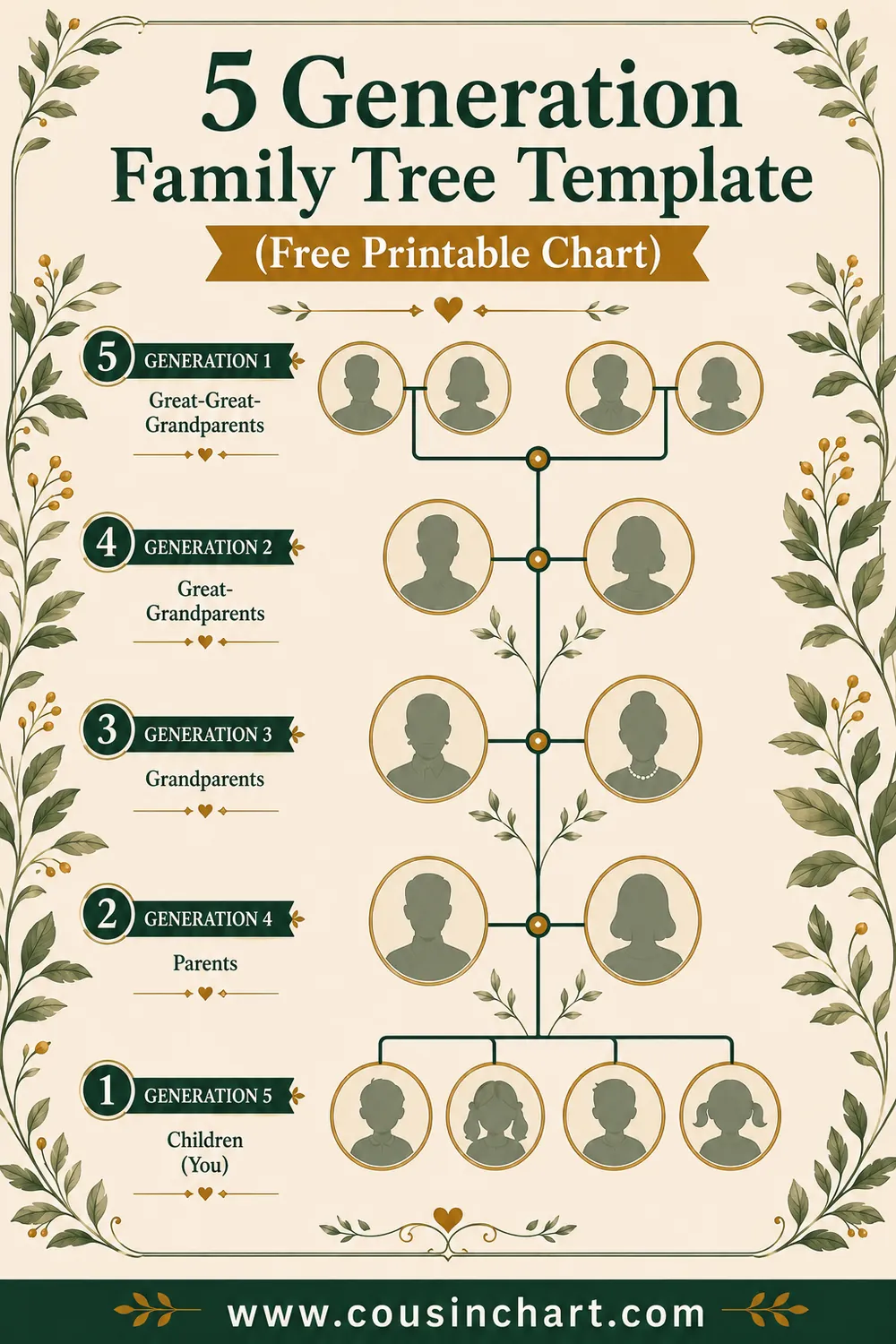
 5-Generation Pedigree Chart
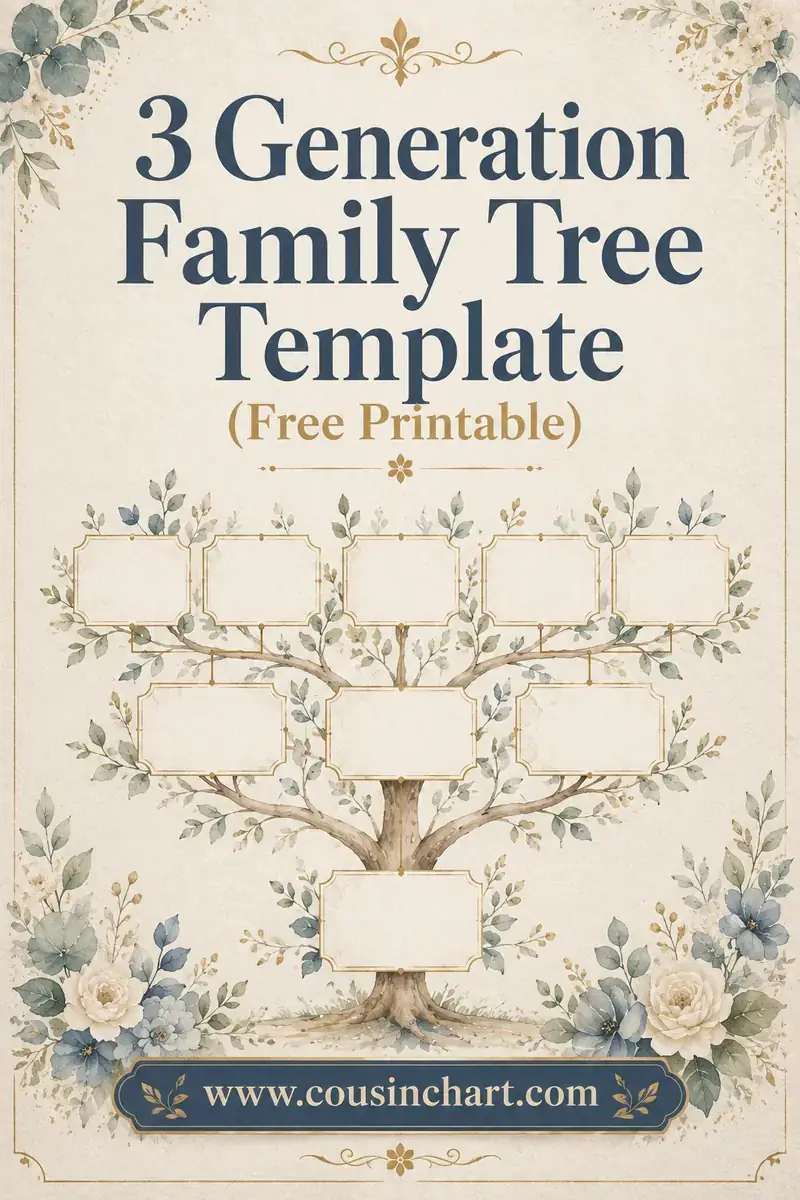
 3-Generation Family TreeYou, parents and grandparents. Portrait, big boxes, 10 minutes to fill.
 Blank Fan Chart (5 Generations)
Relationship quick-check: tap a phrase to see who they are on a 4-generation chart.
Tap a phrase above to see the answer.
Work out any family relationship →The layout: 15 boxes, four columns, landscape
Four generations means 1 + 2 + 4 + 8 = 15 boxes. The standard layout runs sideways — you at the left edge, generations marching right — because the 8-box great-grandparent column needs the page's long dimension:
| Column | Generation | Boxes | Who |
|---|---|---|---|
| 1 (left) | 1 | 1 | You |
| 2 | 2 | 2 | Parents |
| 3 | 3 | 4 | Grandparents |
| 4 (right) | 4 | 8 | Great-grandparents |
Father's line takes the upper half of the page, mother's the lower — so your father's father's father occupies the top-right box and your mother's mother's mother the bottom-right. Each box in column 4 is roughly 1.2" wide by 0.7" tall: comfortable for a name and a birth year, which is exactly what generation four usually consists of.
Some templates rotate this into a portrait "tree" with you at the bottom and eight boxes across the top. Same 15 people, same math; the sideways version simply gives every box more width, which matters most in the generation where names are longest ("Wilhelmina Vandermeulen" needs the inches).
Fill-in order: memory first, then one phone call
- Columns 1–2 from memory. You and your parents — full names, maiden names for the women, birth years. Two minutes.
- Column 3 mostly from memory. All four grandparents. The common gap is a grandmother's maiden name; flag it rather than guess.
- Column 4 by interview. Here's the honest statistic of family history: most people can name two or three of their eight great-grandparents cold. The other five or six live one phone call away — a parent or grandparent can usually fill the whole column. Ask each name and one anchor fact ("about when was she born? where?") because a name with a year is researchable and a bare name isn't.
- Mark the unknowns visibly. An empty box or a penciled "?" is a to-do list. Genealogists prize empty boxes; they're the map of what to find next.
That single interview call is the real reason to print this template soon rather than someday. Every great-grandparent name lives in somebody's memory right now, and the somebody is usually over seventy.
Why 4 generations is the sweet spot
- It's completable. Fifteen names is a weekend project, not a hobby commitment. Finished charts get framed; ambitious ones get drawered.
- It reaches the record boundary. Great-grandparents for most adults today were born roughly 1880–1930 — inside census, immigration, and civil-registration coverage. Every name in column 4 is a doorway into actual documents.
- It explains your cousins. The top row is the second-cousin row: anyone else descended from those eight people is your second cousin (or closer). Fill the chart and you've effectively mapped your entire second-cousin universe — and when someone asks what a specific descendant is to you, the CousinChart calculator resolves it in one pass.
- It still fits home printers. One Letter page, no copy shop required. The 5 generation family tree template doubles the top row to 16 and starts demanding 11×17" paper; four generations is the last size that's fully domestic.
The interview call: eight questions that fill the top row
Column 4 lives in living memory, so treat the phone call as the main event. Call the oldest relative on each side with the chart in front of you and work through these:
- "What were your grandparents' full names — all four?" (For a parent, their grandparents are your great-grandparents; one question can fill half the row.)
- "What was each grandmother's maiden name?" The single most valuable fact per syllable in genealogy.
- "About when was each of them born? Even a guess — 'before the war,' 'around 1900' — helps."
- "Where were they born, or where did the family say they came from?"
- "What did they do for a living?"
- "Did any of them go by a different name day to day?" (Immigrant generations often carried a formal name and an everyday one — knowing both is how you'll find them in records.)
- "Who else would know the ones you don't?" Every interview should end with a referral.
- "Is there a family Bible, a box of papers, or old photos anywhere?" This question has produced more genealogy than every website combined.
Write answers straight onto the chart in pencil, including the "about 1895"-grade guesses — flag them with a tilde (~1895) so future-you knows they're approximate. And record the call if the relative's comfortable with it; the stories between the answers are the part no chart holds.
Verifying column 4 against records
Family memory fills the row; documents firm it up. Three record types confirm nearly every great-grandparent:
- Your grandparents' birth certificates each name two of them, usually with the mother's maiden name — four certificates covers the full row.
- Marriage records for your grandparents typically list both fathers' names and sometimes both mothers'.
- Census returns from 1900–1950 catch most great-grandparents as household heads or elderly parents living with children — ages, birthplaces, immigration years included.
When a document contradicts the phone call, believe neither automatically: write both versions on the chart and let a second record break the tie. Memory rounds years and prettifies spellings; clerks misheard names. The chart with two pencilled candidates is more honest than the chart with one confident error.
Three uses beyond the binder
- The anniversary/birthday gift. A completed 15-box chart in decent handwriting, framed, for the parent or grandparent whose line it shows. The interview to fill column 4 doubles as the visit they actually wanted.
- The starter chart for the family group chat. Photograph your half-filled chart and post it with "who can fill in the blanks?" — the empty boxes provoke corrections and stories no open-ended question ever gets. (Pin the blank to the family Pinterest board while you're at it; cousins doing school projects will find it.)
- The reunion baseline. Print one per household at the reunion; every chart shares the same top row, which makes the second-cousin connections physically visible across tables. Pair with pencils and stand back.
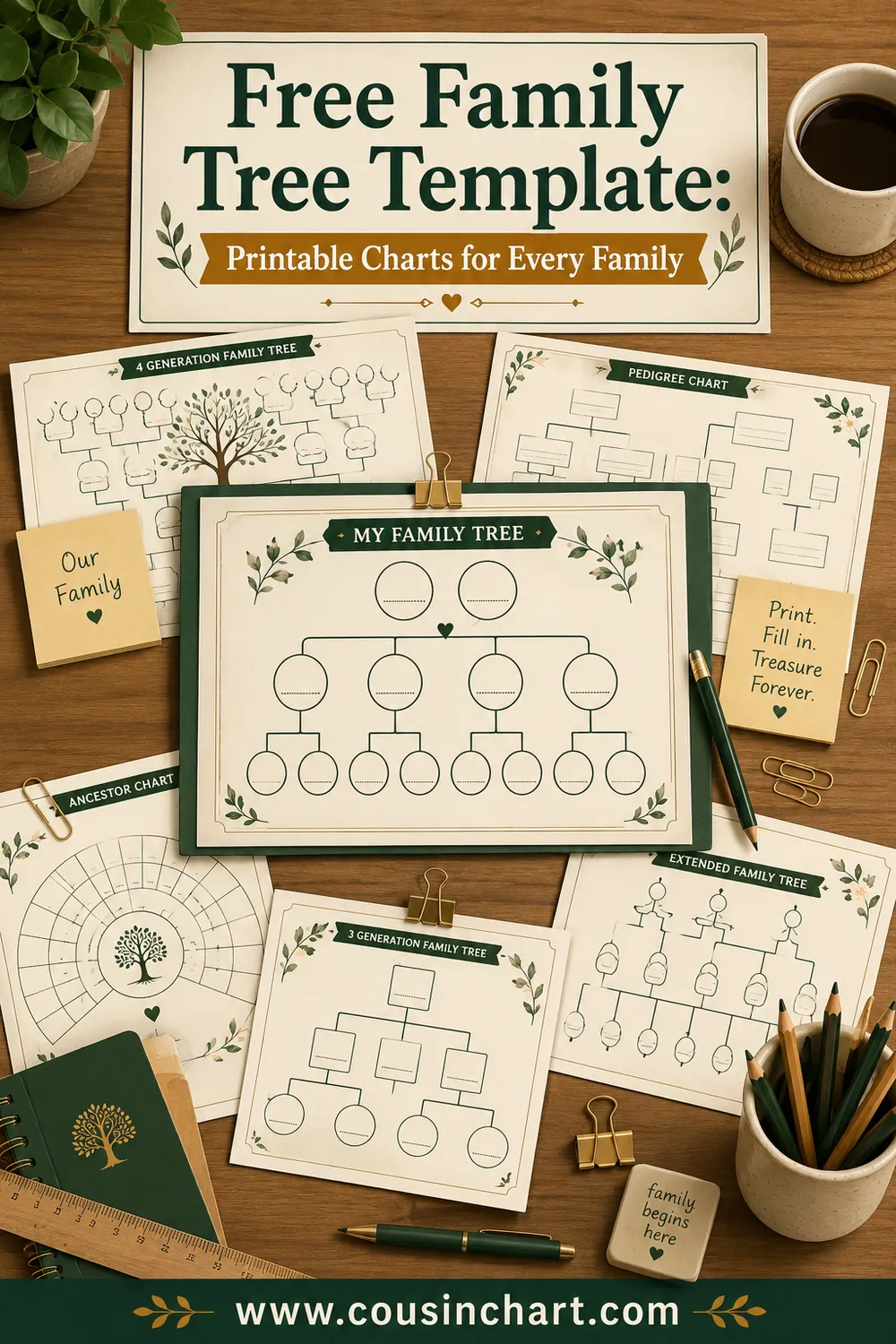
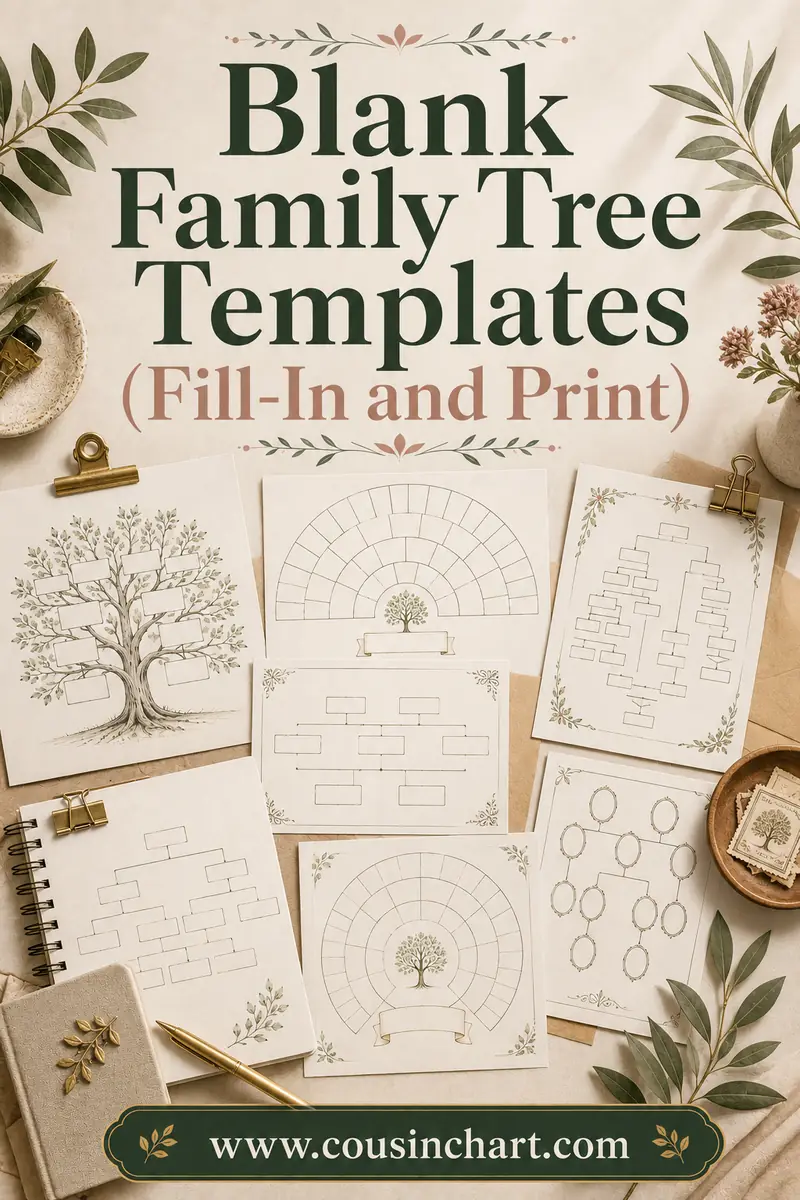
If you want the same 15 people without the fill-in structure — decorative versions, photo layouts — the wider free family tree template collection has those, and the blank family tree template guide covers pure fill-in variants at every size.
Four-generation pitfalls (and the cheap fixes)
- The two-Marys problem. Column 4 is where common names start colliding — two Mary Sullivans born five years apart in the same county. The fix is anchoring every name to a spouse and a place before accepting it: "Mary Sullivan who married Patrick Doyle, of Cork" is findable; "Mary Sullivan, b. ~1890" matches half of Ireland.
- Swapped couples. It's startlingly easy to write a great-grandmother beside the wrong great-grandfather when four couples share a column. Fill couples as pairs, always — never a column of eight men then a column of eight women.
- The married-name trap. If a great-grandmother appears under her married name, her box dead-ends — there's no thread to her parents. Chase the maiden name through a marriage record before calling her line done.
- Family-lore inflation. Column 4 is where "we're related to someone famous" stories live. Write the story in the margin, not the boxes; margins hold legends, boxes hold evidence.
- Skipping the flags. Approximate dates without tildes and guessed spellings without question marks harden into "facts" by the third photocopy. Mark uncertainty now — it's one pencil stroke.
When the chart raises questions the chart can't answer
Fifteen boxes of direct ancestors, zero boxes for everyone else — which means the moment a great-aunt, a cousin's kid, or a "great-grandma's brother's grandson" enters the conversation, the template shrugs. That's by design (ancestor charts trade breadth for depth), and it's what the calculator half of this site is for. Describe any path — my great-grandmother's brother's great-grandchild — and the free relationship calculator returns the term (that one's your third cousin) plus the logic. Chart for the spine, calculator for the branches.
FAQ
How many people are on a 4 generation family tree?
Fifteen: you, 2 parents, 4 grandparents, and 8 great-grandparents. Each generation doubles, and the total is always one less than a power of two — which is why the counts run 7, 15, 31 as charts grow.
Who goes in the top row of a 4 generation template?
Your eight great-grandparents — four couples, one per grandparent. Conventionally your father's line fills one half of the chart and your mother's the other, so each great-grandparent sits directly beyond the grandparent they produced.
Should a 4 generation family tree be portrait or landscape?
Landscape. The great-grandparent generation needs eight boxes in one row or column, and only the page's long dimension gives those boxes enough width for full names and dates.
How do I find my great-grandparents' names?
Ask the oldest relatives first — a single phone call usually fills most of the row. Then verify with records: your grandparents' birth or marriage certificates each name two great-grandparents, and census records from 1900–1950 catch most of the generation as adults.
What's the difference between a 4 generation and a 5 generation template?
One more doubling: the 5-generation chart adds your 16 great-great-grandparents for 31 people total. It's the standard research chart, but the boxes shrink and it prints best at 11×17" — start at four generations and graduate when the top row fills.
Fifteen boxes, one phone call
Print the free 4-generation template from the CousinChart pack, fill the first three columns from memory tonight, and make the call that completes the top row this week — that's the whole project, and it's the most genealogy-per-hour you'll ever get. Then, when the finished chart makes someone ask exactly what great-grandma's sister's grandson is to them, hand over the free relationship calculator and enjoy being the family that knows.