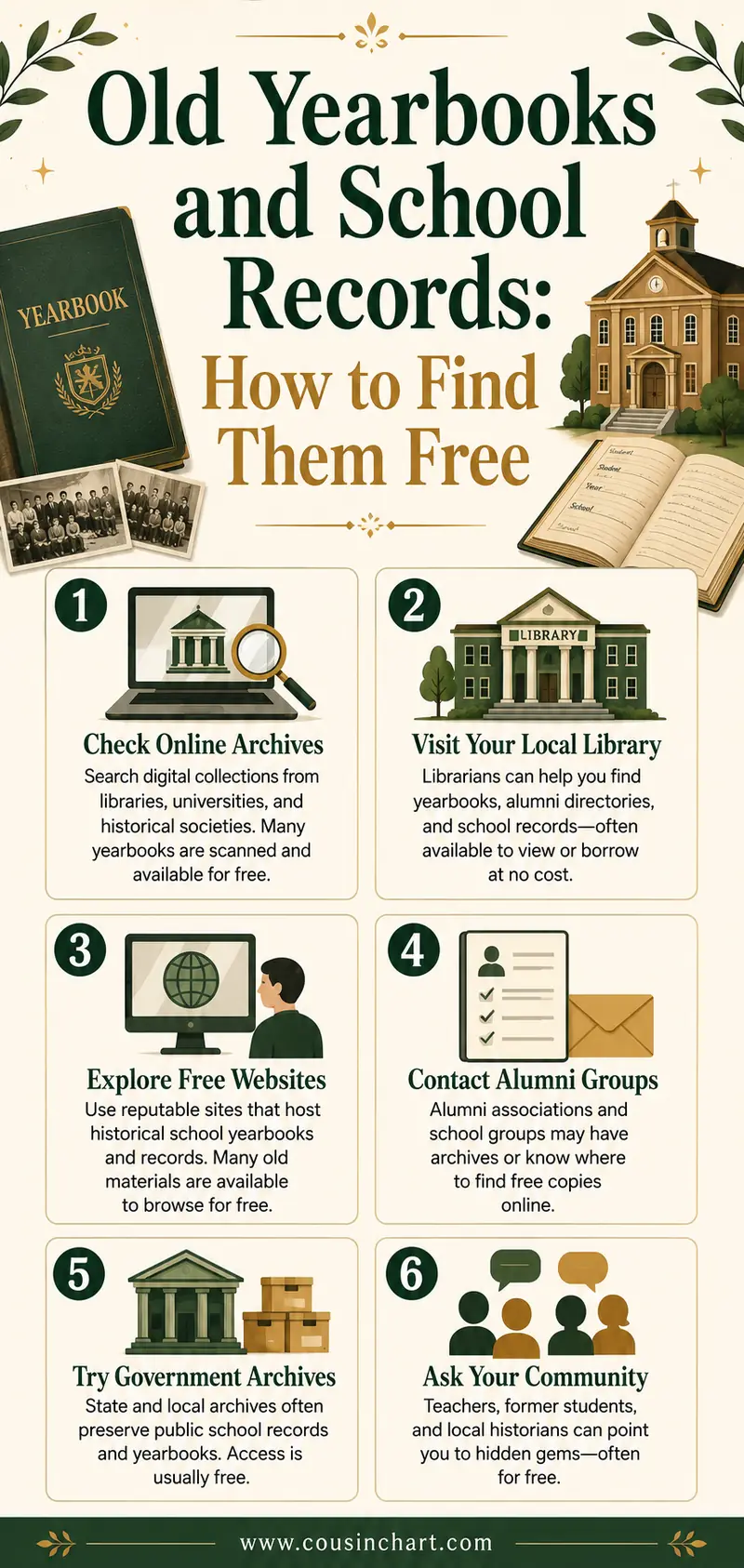
Old Yearbooks and School Records: How to Find Them Free
You can find old yearbooks online free through the Internet Archive, Classmates.com's browsable scans, and the digitized collections that hundreds of public libraries and universities have quietly posted — no subscription needed for most of them. Yearbooks are one of the few records that show an ancestor's face as a young person, plus clubs, nicknames, and sometimes the only surviving candid photos of them.
This guide covers the free sources worth checking first, the offline routes people forget (alumni offices answer emails!), and the school records beyond yearbooks — enrollment ledgers and school censuses — that can crack open a family line. And when a yearbook caption introduces someone described as "cousin of…," the free relationship calculator on our homepage will tell you what that makes them to you.
Relationship quick-check: spotted a familiar surname in an old yearbook? Tap a phrase to see who they'd be to you.
Tap a phrase above to see the answer.
Work out any family relationship →Why yearbooks are worth hunting down
Most genealogy records reduce a person to names and dates. A yearbook hands you a portrait at seventeen, a nickname the family forgot, the debate club, the varsity letter, and a senior quote in their own voice. For 20th-century ancestors, a yearbook is often:
- The only photo of them before adulthood
- Proof of where the family lived in a specific year (useful between censuses, like city directories)
- A source of siblings and cousins — flip to the other grades and scan for the surname
- A way to date mystery photos — match the hairstyle and clothing against dated portraits, a trick from our photo-dating guide
The free sources, ranked by hit rate
| Source | Cost | What you'll find |
|---|---|---|
| Internet Archive (archive.org) | Free | Tens of thousands of scanned yearbooks donated by libraries |
| Classmates.com | Free to browse scans (account required) | Huge U.S. high school collection, strongest 1930s–1990s |
| Public library digital collections | Free | Often complete runs for local schools |
| University digital archives | Free | College yearbooks, usually full-text searchable |
| State digital libraries / DPLA | Free | Aggregated school collections statewide |
| Ancestry "U.S. School Yearbooks" | Paid (free at many libraries) | The largest indexed, name-searchable set |
| E-Yearbook.com | Paid | Deep high school coverage when free sources miss |
Internet Archive
Search `"[school name]" yearbook` or `"[town name]" high school yearbook`, then use the "texts" filter. Many volumes are full-text searchable, which means the OCR can catch a name in a caption even when you don't know the school. Coverage is uneven but constantly growing as libraries scan their local shelves.
Classmates.com
Known as a reunion site, but its yearbook scanner project is genuinely useful: hundreds of thousands of volumes, free to flip through page by page after creating a free account. Names aren't reliably indexed, so treat it like microfilm — pick the school and year, then browse the alphabetical portraits.
Libraries, big and small
Public libraries are the sleeper hit. Search `"[town] public library" yearbook collection` — many have digitized every local school's run and posted it free. If the scans aren't online, the reference desk will usually check a name in the physical copy and email you a phone photo of the page. Librarians love this stuff.
Ancestry's collection — free through your library
Ancestry's U.S. School Yearbooks collection (roughly 1900–2016) is the only truly name-searchable national index, and most decent-sized library systems offer Ancestry Library Edition free on their computers. One lunch-break visit can pull every indexed appearance of a surname across the country.
Beyond yearbooks: school records with real genealogy weight
Yearbooks are the fun part. These are the substantive ones:
- School census records. Many states counted school-age children annually — name, age, parent or guardian, address. For families that dodged other records, a school census can be the only document naming all the kids in one place. Look in state archives and county courthouse collections.
- Enrollment and attendance ledgers. These sometimes list a parent's name, birth date, and prior school — gold when a family moved around. Held by district offices, county historical societies, and state archives.
- College alumni files. University archives keep registration cards, alumni directories, and sometimes correspondence. Email the archivist with a name and rough years; answers are usually free.
- Report cards and transcripts. Recent ones are restricted by privacy law (FERPA in the U.S.), but records for long-deceased students are often released to family — call the district office and ask their policy.
A 15-minute search plan
- Nail down the school. Use the family's address in a census or city directory year, then identify the local high school — town histories and old newspapers name them.
- Hit the Internet Archive with the school name plus "yearbook."
- Browse Classmates for the school and the graduation year (birth year + about 18).
- Search the town library's site for a digitized collection; email the reference desk if not.
- Check nearby grades. Found your person? Scan two grades up and down for siblings and cousins — same surname, same school, high odds of relation.
- Log what you find. Nicknames and club photos have a way of matching unlabeled pictures in the family shoebox later.
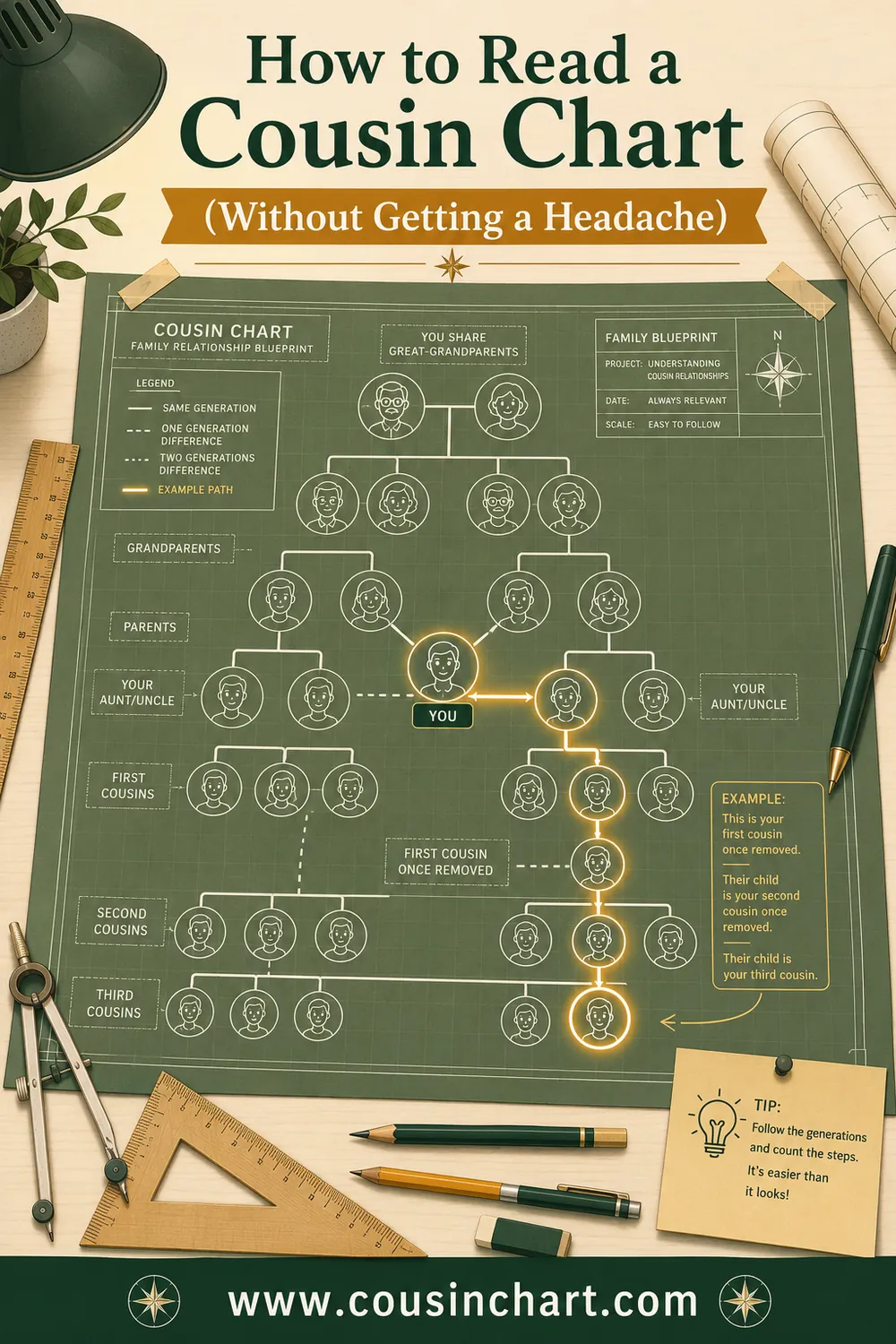
That last step is where relationships sneak up on you. Two students with grandmothers who were sisters are second cousins — and if one is your grandparent, their schoolmate cousin's grandchildren are your third cousins. When the branches get tangled, the CousinChart calculator untangles them faster than a scratchpad.
Squeezing every clue out of a yearbook page
Once you've found your person, slow down — a yearbook page carries more evidence than the portrait. Work through it like a checklist:
- The name form. Yearbooks often print the full formal name ("Margaret Anne Kowalski") that the family never used and other records abbreviate. That middle name can be the tiebreaker between two same-named women in the census.
- The nickname. "Peggy" under the photo explains why you couldn't find "Margaret" in the city directory index. Nicknames in captions are how family stories reconcile with official records.
- The activity list. "Glee Club 2, 3, 4; Typing Club 4" tells you which other pages of the book she appears on. Flip to every listed club — group photos catch people the portrait section missed, including siblings.
- The senior quote and ambitions line. Books from the 1920s–1950s often printed a planned career or college. That's your lead for the next record: nursing school registries, university alumni files.
- The ads in the back. Family businesses bought yearbook ads. "Compliments of Kowalski's Bakery, 412 Pulaski Ave" is an address, an occupation, and proof the business survived that year — three facts genealogists pay subscription money for.
- The faculty section. Teachers stayed for decades. A teacher sharing your surname may be an aunt or an older cousin working at the family's neighborhood school — run the possibility through the relationship calculator once you've confirmed the connection on paper.
Photograph or scan the whole page plus the title page (school, city, year). A clipped face with no source is a mystery you're creating for the next generation.
No yearbook? Try the substitutes
Plenty of schools — small, rural, or early — never printed one, and some years simply didn't survive. The gap-fillers:
- Graduation lists in newspapers. Local papers printed the full commencement roll every spring, often with honors and planned colleges. Search June editions in a free newspaper archive for the graduation year.
- Commencement programs. Historical societies and library vertical files keep these; they list every graduate the yearbook would have.
- Alumni newsletters and reunion booklets. Published decades later, these often include "where are they now" notes — marriages, moves, and death dates you won't find elsewhere.
- Class photos. Before yearbooks, schools took a single class photograph. These survive in local historical society collections, usually labeled by teacher and year, sometimes with every child named on the back.
A quick word on sharing what you find
Yearbook pages are a joy to post in the family group chat, and mostly that's fine — these are decades-old publications of record, and a grandparent's senior portrait delights everyone. Two courtesies keep it clean: stick to relatives who have passed or who'd plainly enjoy it (your uncle may not want his 1978 perm recirculated), and when you share to public trees or social media, crop to your own family member rather than posting classmates' faces wholesale. Credit the school and year in the caption — partly good manners, partly so the cousin who sees it can find the book themselves.
FAQ
Can I find yearbooks from outside the United States?
Coverage is thinner but growing. Canadian yearbooks appear on Internet Archive and in provincial digital libraries; UK and Irish school records tend to survive as admission registers rather than photo yearbooks. Start with the national library's digital portal for the country in question.
Where can I find old yearbooks online for free?
Start with the Internet Archive, Classmates.com (free account, free browsing), and your town's public library digital collection. State digital libraries and university archives fill the gaps. Ancestry's paid collection is free to use inside most public libraries.
Are old yearbooks name-searchable?
Sometimes. Ancestry's collection is indexed by name; the Internet Archive relies on OCR full-text search, which catches clearly printed names but misses stylized fonts. Classmates is browse-only, so you'll flip pages like microfilm.
How do I find which school my ancestor attended?
Find the family's home address in a census or city directory for their teenage years, then identify the school serving that neighborhood. Local histories, old newspapers, and the town library can confirm which high school existed at the time.
Can I get school records for a deceased relative?
Often, yes. U.S. privacy law (FERPA) protects living students, but many districts release records of long-deceased ones to relatives, and state archives hold old enrollment ledgers and school censuses with no restrictions. Ask the district office and the state archive both.
What years do online yearbook collections cover?
The sweet spot is roughly 1900 through the 1990s, with the deepest coverage mid-century. Earlier schools produced fewer yearbooks; recent decades are restricted for privacy. College yearbooks reach further back — many universities published them from the 1880s.
Put a face on the family tree
Somewhere in a scanned yearbook is a seventeen-year-old with your chin, holding a clarinet. Go find them — the Internet Archive is open all night. And when the caption next to them says "with cousin Ruth" and you're left wondering what Ruth is to you, the free CousinChart relationship calculator settles it in one click: pick the path, get the name.