Simple Family Tree: Easy Layouts and Templates
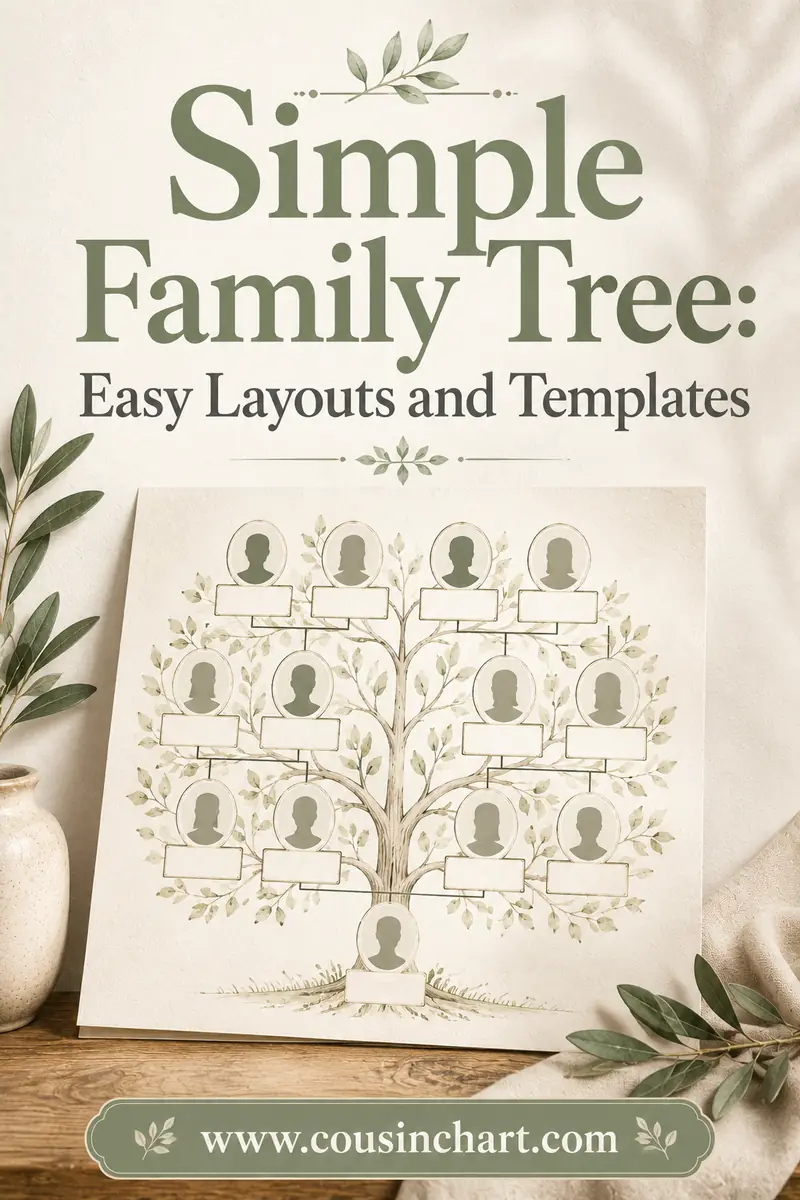
A simple family tree is a 7-box chart: you at the bottom, your two parents above you, and their four parents on top. That's three generations on one portrait page, finishable from memory in about ten minutes — and it's the layout behind our free printable, which you can grab from the CousinChart chart pack and fill in with a pencil tonight.
This guide keeps everything at that "one page, one pencil" level: the two simple layouts worth knowing, exactly who goes in which box, and how to add siblings without wrecking the structure. If anyone's connection stumps you along the way — "wait, is grandpa's brother my great-uncle or my granduncle?" — the free relationship calculator answers it faster than the family group chat will.
Relationship quick-check: tap a phrase for the simple answer.
Tap a phrase above to see the answer.
Work out any family relationship →The two simple layouts (and when each one wins)
| Layout | Boxes | Generations | Page | Time to fill |
|---|---|---|---|---|
| Starter tree | 7 | 3 (you → grandparents) | Portrait Letter/A4 | ~10 minutes |
| Next-step chart | 15 | 4 (adds great-grandparents) | Landscape Letter/A4 | An evening + one phone call |
The 7-box starter tree
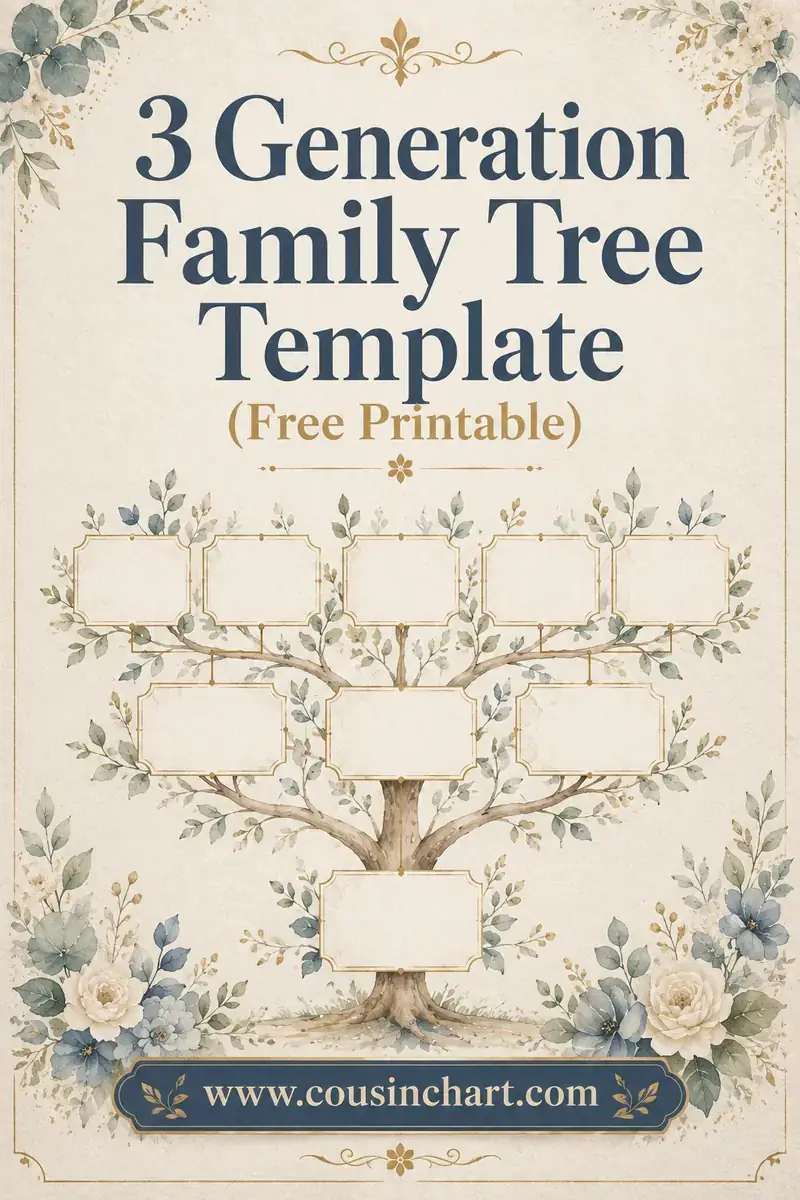
Three rows. Bottom row: one box, you. Middle row: two boxes, your parents. Top row: four boxes, their parents. Draw the connecting lines child-to-parents and you're done — that's the entire architecture. Because everyone alive usually knows these six people, this is the tree that gets finished, which beats every ambitious tree that doesn't. It's also the standard school assignment; our 3 generation family tree template is the printable version with boxes sized for kid handwriting.
The 15-box next step
Add one more row: eight great-grandparents across the top. The page flips to landscape to fit them. This is the version for adults who found the 7-box tree too easy — most people can name two or three great-grandparents cold, and the empty boxes make excellent questions for the oldest relative you can reach this week. One phone call typically fills half the top row.
Who goes where: the only three rules
- One row = one generation. You and your siblings share a row. Your parents, aunts and uncles share a row. All four grandparents share the top. The moment someone floats between rows, the tree stops making sense.
- Lines connect children to parents. Nothing else. No lines between cousins, no lines to aunts — kinship flows through parent-child links, and the tree shows exactly that.
- Write names people will recognize in 30 years. "Elena Martinez (Grandma Ellie), b. 1948" — full name, maiden name for married women, and a birth year. Nicknames alone expire.
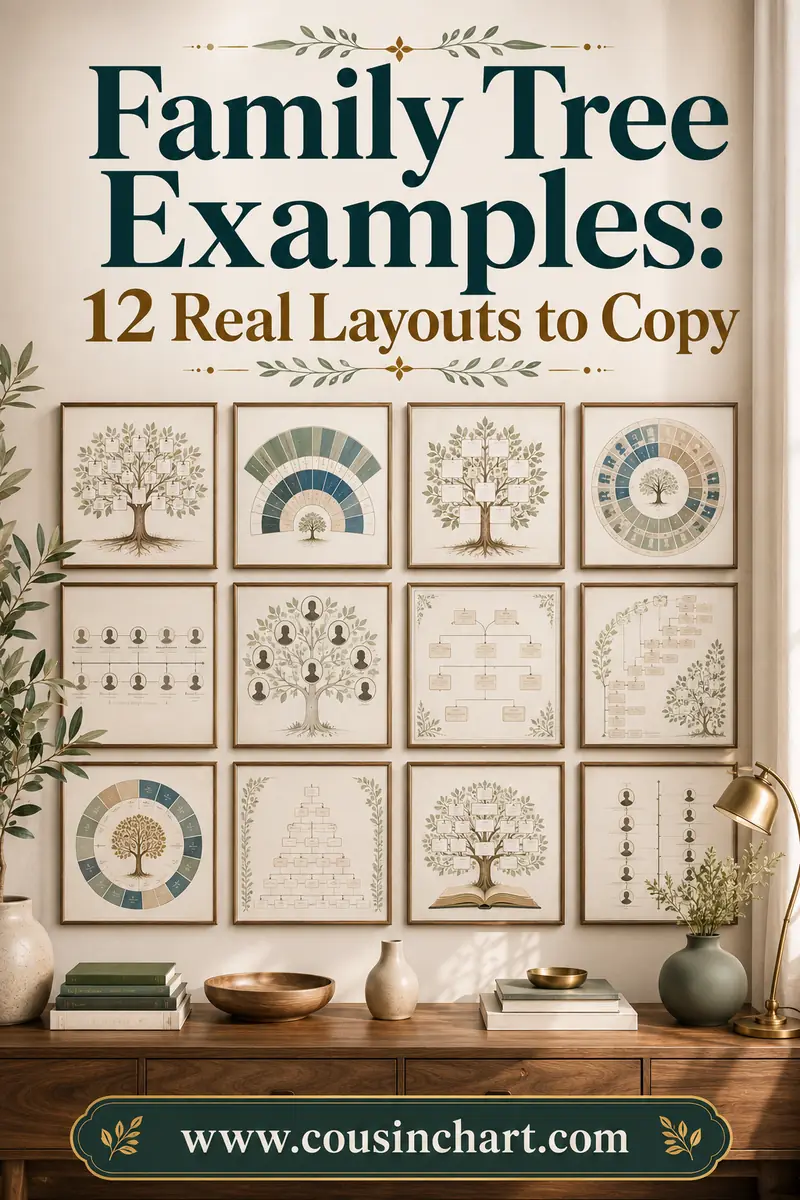
That's genuinely all a simple tree requires. Everything else — pedigree numbering, source citations, fan arcs — belongs to bigger charts, and you can meet those in our family tree examples roundup when you're ready.
Adding siblings without losing the simplicity
The 7-box tree shows your direct line only. To include brothers and sisters, widen your own row: one box per sibling, all connected upward to the same two parents. A family with three kids becomes a 9-box tree; still one page, still simple.
Two tips keep it clean:
- Order siblings oldest to youngest, left to right. It's the convention, and it answers "who's the big sister?" at a glance.
- Resist adding cousins. Cousins require adding your aunts and uncles and their spouses, which doubles the page and turns a simple tree into a wall chart. If the kids ask how cousins fit, that's a perfect moment for the cousin calculator instead of a redraw.
Print it or draw it?
Both work, and the honest answer is: print the frame, hand-write the names.
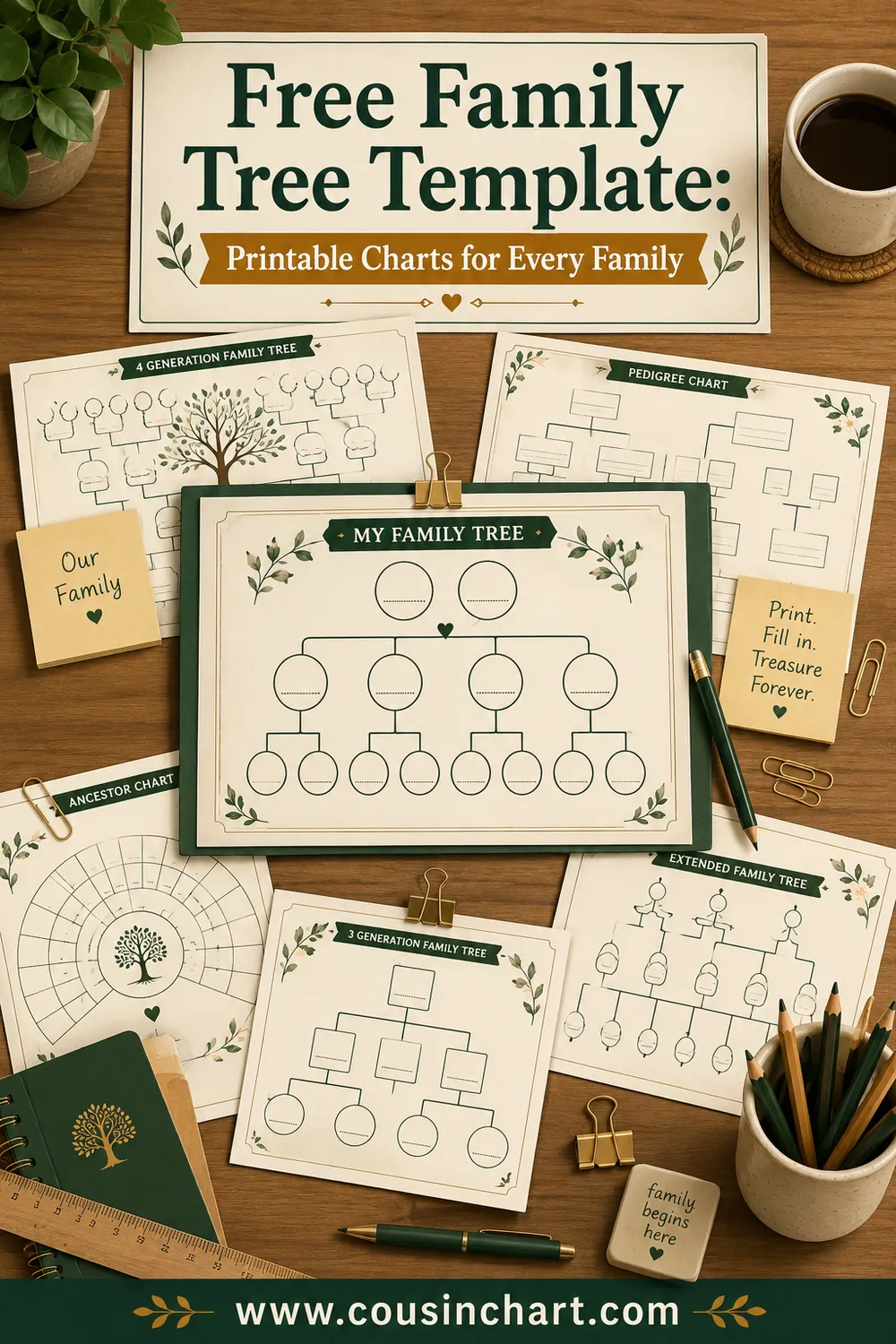
- Printing gets you straight boxes and correct spacing — grab the free PDF from the CousinChart chart pack (the free family tree template page has every size). Print at 100% scale so boxes stay full width.
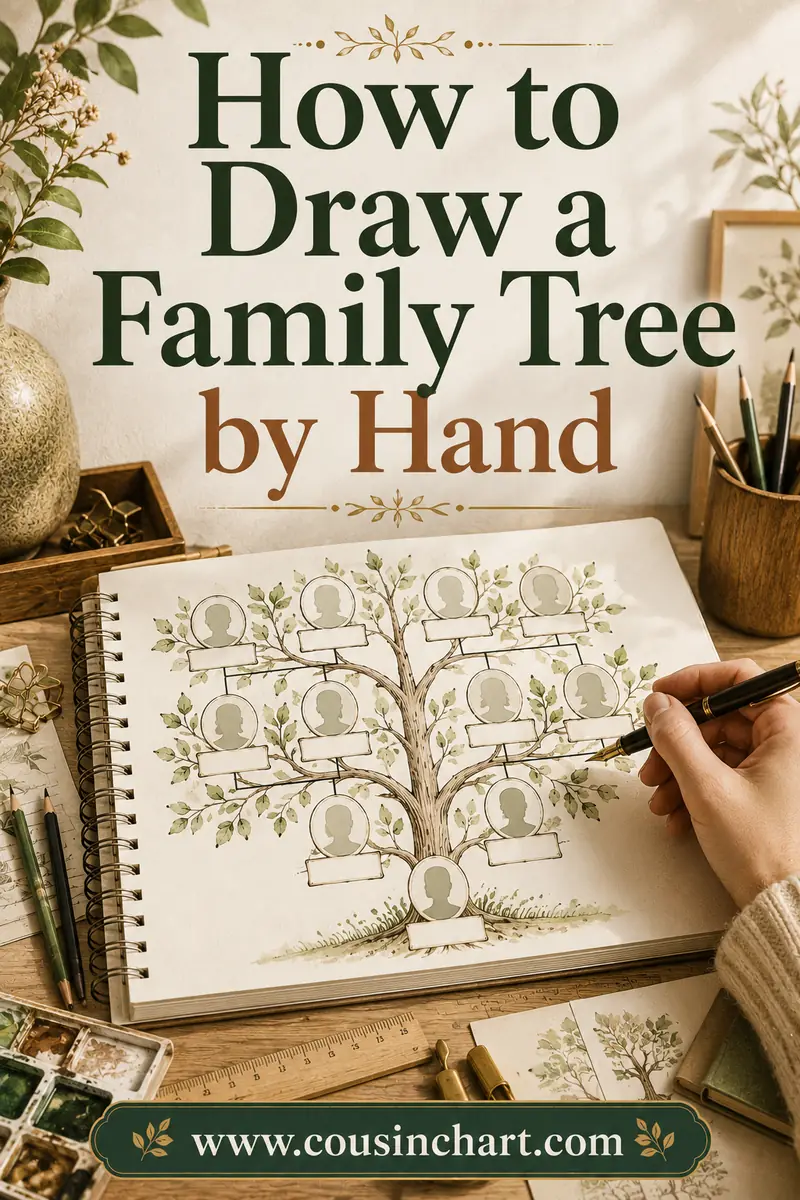
- Drawing is better for kids' projects and for anyone who enjoys it — a ruler, a pencil, and the row counts above are all you need. Our how to draw a family tree guide has the measurements worked out.
- Either way, pencil first. Every family tree ever made has needed at least one correction, usually a birth year, occasionally an entire grandparent.
Three simple trees people actually make
- The school project. 7 or 9 boxes, portrait, photos glued in the boxes. Done in one evening, graded well, kept forever.
- The grandparent gift. The 15-box chart filled in neat handwriting, framed. Costs a few dollars; lands like an heirloom. (Fill the top row by interviewing the recipient first — the gift is also the excuse.)
- The reunion ice-breaker. A big blank tree on the table and a box of pencils. Relatives fill in their own branches, argue warmly about dates, and someone inevitably opens the relationship calculator to settle what second-cousin-once-removed means.
When your family doesn't fit seven tidy boxes
Plenty of families don't match the two-parents-four-grandparents diagram, and the simple tree bends fine — the trick is deciding what the chart is for before adjusting it. If it's about who raised you, put those people in the parent boxes, whatever the birth certificates say: a grandmother who raised you belongs in a parent box on that chart, full stop. If it's about bloodlines (say, for medical history), keep biological parents in the boxes even if they weren't around, and note the raising family alongside. Single-parent families simply fill one side and leave the other blank or brief. Blended families give the remarried parent a second line, with step-parents labeled honestly rather than squeezed into grandparent slots. A chart can only answer one question at a time — "who raised me" and "whose genes are these" are different trees, and it's perfectly normal to make both.
The 30-minute interview that finishes the chart
The gap between a half-filled simple tree and a finished one is almost always one conversation. Call or visit the oldest relative who'll pick up, chart in hand, and ask these in order:
- "What was Grandma's full name before she married?" (Maiden names are the number-one missing fact on simple trees.)
- "When and where was she born — even roughly?"
- "And her husband — full name, birth year?"
- "Same questions for the other side: Grandpa's parents' names?"
- "Any names I've spelled wrong so far?" (Show them the chart. This question produces corrections and stories.)
Write answers in pencil directly on the tree while they talk. The chart makes the conversation concrete in a way "tell me about the family" never does — people correct a visible mistake instantly, and every correction comes wrapped in a story about the person. Thirty minutes typically fills every box a 7- or 15-box tree has, plus a margin full of leads you didn't ask for.
From finished tree to family keepsake
A completed simple tree is worth thirty minutes of finishing work:
- Photograph it immediately. Paper charts attract coffee. A phone photo in good light is your backup and the version that goes to the family group chat — where it will collect at least one more correction, guaranteed.
- Photocopy blanks before the original fills up. Cousins will ask. Or point them at the free PDFs so everyone's chart matches at the next gathering.
- Frame the good one. A hand-filled 7-box tree in a thrift-store frame is a real gift — especially if the handwriting belongs to a child or a grandparent. The imperfection is the value.
- Date it. "Filled in with Grandma, July 2026" in the corner turns a diagram into a record of an afternoon. Twenty years on, that line is the part everyone touches.
FAQ
What is the simplest family tree format?
A 7-box, 3-generation chart: you at the bottom, two parents in the middle, four grandparents on top, on one portrait page. It's the format schools use and the fastest tree to finish from memory.
How many boxes does a simple family tree need?
Seven for three generations, fifteen for four. Each generation doubles — 1, 2, 4, 8 — so box counts are always one less than a power of two. Add one box per sibling if you widen your own row.
Should a simple family tree include aunts, uncles, and cousins?
Usually no — that's what keeps it simple. Direct ancestors only: parents and grandparents. Siblings are the one easy addition. Cousins require adding whole aunt-and-uncle branches, which belongs on a bigger extended-family layout.
Does the mother's side go on the left or the right?
There's no fixed rule — pick a side and stay consistent. A common convention is father's line on the left (or top), mother's on the right (or below), matching how printed pedigree charts arrange them.
What should I write in each box?
Full name (maiden name for married women), birth year, and death year if it applies — "MARTINEZ, Elena, b. 1948." Add photos if the tree is a gift or a school project.
Can I make a simple family tree online instead?
Sure — any design tool or document app can draw seven boxes. But for a chart this small, paper is honestly faster: no accounts, no learning curve, and relatives will happily correct a printed page passed across the table in a way they never do with a screen.
Ten minutes, seven boxes, done
Print the simple tree from the free CousinChart chart pack — or rule seven boxes on whatever paper is nearest — and fill in the six people you already know. That finished page has a way of growing: a great-grandparent row here, a sibling row there. And the first time someone at the table asks how the cousins connect, the free relationship calculator turns the question into a ten-second answer.