How to Build Your Family Tree: A Beginner's Step-by-Step Guide
To build a family tree, start with yourself and work backwards one proven generation at a time: write down what you already know, interview your oldest living relatives, gather the documents sitting in your own house, and only then go looking for records online. Prove each generation before you climb to the next, and write down where every fact came from. That's the whole method — everything else is detail.
It sounds slow. It is slower than clicking "accept" on a hundred hints from somebody else's online tree, and it's also the only way to end up with a tree that's actually yours and actually right. Grab a blank chart from our free printable family tree pack before you start — filling in boxes by hand is still the fastest way to see where the holes are.
Where are you right now? Tap the stage you’re at to see exactly what to do next.
Tap a stage above to see your next move.
Print a blank family tree chart →What "building a family tree" actually involves
A family tree is two things at once, and beginners usually only picture the first one.
The first is the chart — the pretty diagram with boxes and lines that you frame or post in the family group chat. That's the output.
The second is the evidence behind the chart — the certificates, census pages, obituaries and interview notes that make each box more than a guess. That's the actual work, and it's what separates a family tree from a family rumor.
Most people who quit genealogy quit because they only did the first part. They built a beautiful 200-person tree in a weekend by copying online trees, then discovered a year later that one wrong link three generations back had grafted a stranger's family onto theirs. Every hour after that point was wasted. Building slowly, with sources, is genuinely faster over a year.
The one rule that governs everything
Start with yourself and work backwards, one generation at a time.
Never start from the famous person you've been told you're descended from and try to work down to yourself. That's how you fall in love with a conclusion and then bend evidence to fit it. Work backwards, prove each link, and if the famous relative is real you'll arrive there honestly. Most family legends turn out to be half-true, and the true half is usually more interesting than the story.
Step 1: Write down what you already know
Before any website, before any subscription, take a blank chart and fill in everything in your own head. Start with a pedigree chart for your direct line, and a family group sheet for each household — one page per couple, with all their children.
For each person, aim to record:
- Full name, including middle names, and the maiden name for every married woman
- Birth date and birthplace (town, county, state or country — county matters enormously for record-hunting)
- Marriage date and place
- Death date, place, and burial location
- Occupation and religion, if you know them
Write only what you actually know. Don't guess. If you think Grandma was born "around 1932 somewhere in Ohio," write exactly that — "abt 1932, Ohio?" — rather than picking a date that will harden into fake fact by next Tuesday.
Use a question mark, not a guess
Genealogists develop a fondness for the question mark. An honest "?" tells future-you that a fact is unproven. A confident-looking date with no source behind it tells future-you nothing, and you'll waste days trying to remember where it came from. This is the single cheapest habit in the hobby.
Step 2: Search your own house before you search the internet
Home sources are the records nobody else on earth has, and they're free. Before you spend a penny on a subscription, spend an afternoon opening boxes.
What to look for:
- Vital documents — birth, marriage and death certificates, divorce papers, adoption paperwork
- The family Bible — the pages between the testaments often carry births, marriages and deaths written down at the time
- Funeral and memorial cards, obituary clippings, cemetery receipts
- Military papers — discharge papers, service records, medals, letters home
- Photographs, especially anything written on the back — a name, a place, a photographer's studio stamp
- Letters, diaries, address books, school reports, passports, naturalisation certificates, deeds, insurance policies
Photograph or scan everything as you go, even the boring items. An old address book is a map of who your family stayed in touch with, and those names come back to help you later.
The photo trick beginners skip
Turn every photograph over before you file it. The back of a photo can carry a name, a date, a studio name that pins down a town, or a note in handwriting you can match to other documents. If nothing's written, note who gave it to you and what they said about it — and then go look at our guide to dating old family photos to narrow the era from clothing, mounting and card stock.
Step 3: Interview your living relatives — this week
Every other source in this guide will still exist in five years. Your 88-year-old great-aunt is the exception. Interviewing living relatives is the one task in genealogy with a genuine deadline, and it's the task beginners consistently postpone.
Keep it warm and simple. One hour, a voice recorder (your phone is fine — ask permission first), and a short list of open questions rather than a rapid-fire quiz.
Questions that work:
- Tell me about your parents. What were they like?
- What do you remember about your grandparents?
- Where did the family live when you were small? Who else lived nearby?
- Who were you named after?
- Was there anyone the family didn't talk about?
- Do you have any photographs, letters or papers I could copy?
That last one matters twice: you get documents, and you get the stories attached to them.
How to handle what they tell you
Family memory is evidence, not gospel. Dates drift, two great-uncles merge into one, and a "cousin" may be nobody's cousin at all. Record what they said, exactly as they said it, and mark it as testimony. Then go looking for a record that confirms or corrects it. When memory and a document disagree, you don't automatically believe the document — you look for a third source and work out which one is more likely to be right.
Also, be kind about the sensitive parts. Illegitimacy, adoption, a first marriage nobody mentions, a relative who left and never wrote — these come up constantly in family history. If someone doesn't want to talk about something, let it go. The record office will still be there.
Step 4: Move to free records before paid ones
Now you've got a spine of names, dates and places, you can start searching records. Start free.
FamilySearch is free to use with a free account, run by The Church of Jesus Christ of Latter-day Saints, and it holds an enormous collection of digitised census, vital, church and probate records worldwide. For most beginners it's the single most useful site in existence, and our FamilySearch guide walks through searching it properly. Some images are viewable only at a family history center or affiliate library because of contract restrictions — that's normal, not a bug.
Other genuinely free options worth knowing: national and state archive websites, Find a Grave for burials, free newspaper archives, and the free indexes many paid sites publish. Our roundup of free genealogy websites covers the ones worth bookmarking, and tracing a family tree for free explains how far you can realistically get without paying.
Ancestry, MyHeritage and Findmypast are paid. They're excellent, their record sets overlap only partly, and a subscription is a real expense. Wait until free searching has stalled, then consider one — or check whether your public library offers free in-library access, which many do.
Which record answers which question
| What you need | Best first record | What it gives you |
|---|---|---|
| A whole household in one snapshot | Census (US federal, taken every 10 years) | Names, ages, birthplaces, occupations, who lived together |
| An exact birth date | Birth certificate or church baptism register | Date, place, parents' names, mother's maiden name |
| A mother's maiden name | Marriage record or a child's birth record | The surname that unlocks the next family line |
| A death date and next of kin | Death certificate, obituary, cemetery record | Date, cause, informant, burial place, surviving relatives |
| Land, wealth and family relationships | Wills and probate | Named heirs — often the clearest statement of who was related to whom |
| Color, context, unexpected names | Newspapers | Weddings, funerals, court cases, visits from out-of-town relatives |
Census records are usually the best starting point because one page hands you an entire household plus approximate birth years and birthplaces for everyone in it. In the US, individual census returns are released after 72 years — which is why the 1950 census became available in 2022. Be aware of the gap: the 1890 US federal census was destroyed following a 1921 fire, so almost nothing survives for that year. It's the most famous brick wall in American genealogy and it is not your fault.
Step 5: Record the source of every single fact
This is the step that separates a tree you can trust from a tree you'll have to rebuild.
Every time you add a fact, write down where it came from. Not a vague "Ancestry" — enough detail that a stranger could find the same document:
- Which website or archive
- Which collection, and for which place and year
- The page, entry, certificate or roll number
- The date you accessed it
- Where your copy of the image is saved
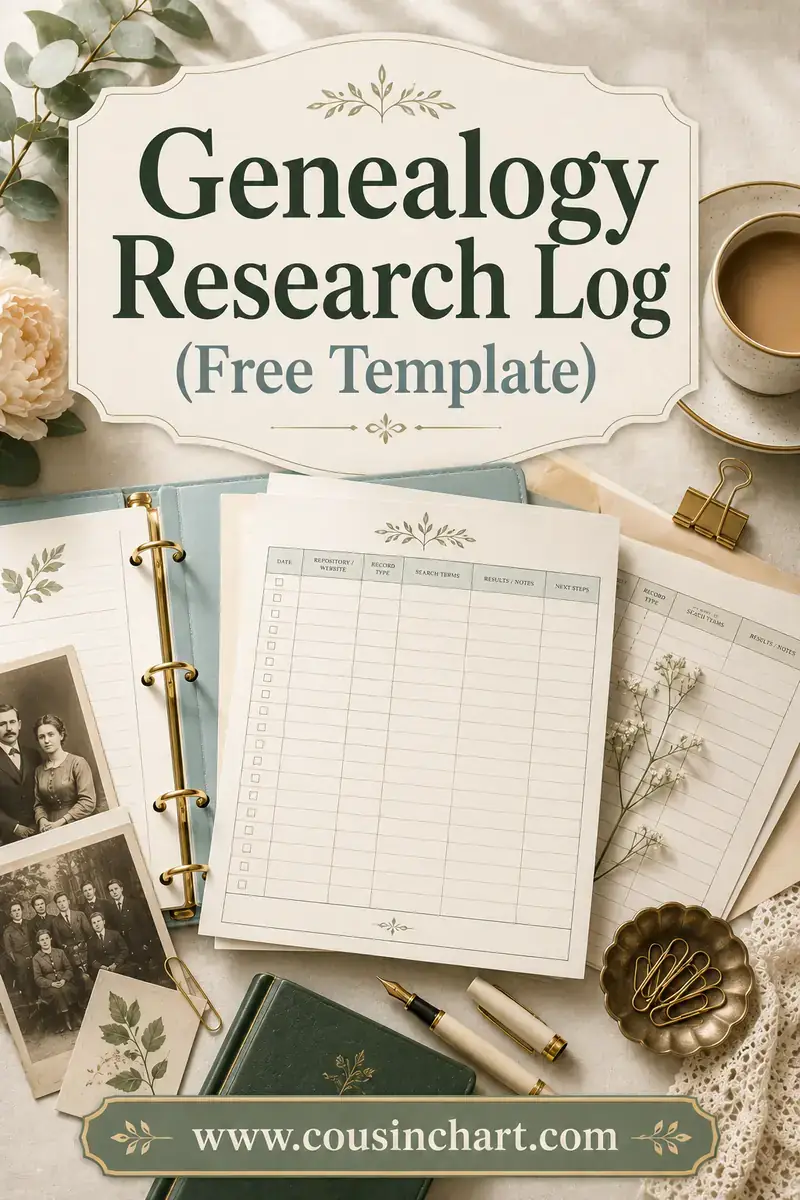
Yes, it feels fussy on day three. On day three hundred, when two records disagree about a birth year, the citation is the only thing that lets you weigh them against each other. A dedicated genealogy research log makes this painless — you log the search itself, including the searches that found nothing, so you never repeat a failed hunt a year later.
The recognized benchmark for all of this is the Genealogical Proof Standard: a reasonably exhaustive search, complete and accurate source citations, analysis and correlation of the evidence, resolution of any conflicts, and a soundly written conclusion. You don't have to be a certified genealogist to borrow the habit. Just cite as you go.
Step 6: Set up a system before you have a mess
You will accumulate files faster than you expect. Decide early how you'll store things and stick to it: by surname, by family group, or by the numbered Ahnentafel system used on Ahnentafel charts. Use one consistent file-naming pattern — `SURNAME_Firstname_1900-census.jpg` reads perfectly in five years — and back everything up in at least two places, one of them off-site or in the cloud.
Our guide to organizing genealogy research compares the systems properly. The important part is picking one in week one rather than week fifty.
What a realistic first three months looks like
Progress in genealogy is lumpy. Some evenings you leap two generations; some evenings you spend two hours proving that the John Miller you found is the wrong John Miller. Both are the job.
| Weeks | Focus | Realistic outcome |
|---|---|---|
| 1 | Write down what you know; print blank charts | 3 generations sketched, gaps marked |
| 2 | Home sources; scan everything | A folder of documents and photos, plus new names |
| 3–4 | Interviews with the oldest relatives | Stories, corrections, and a few surprises |
| 5–8 | Free record searching, census-first | 4–5 generations with dates and places attached |
| 9–12 | Fill gaps, resolve conflicts, cite properly | A smaller tree than you hoped, and a much more solid one |
If you're at five well-documented generations after three months, you're doing well. Trees that hit twelve generations in two weeks are almost always copied, and usually wrong somewhere in the middle.
Where does a DNA test fit in?
Sooner or later someone will tell you to just take a test. DNA is a genuinely powerful tool, but it's a supplement to documentary research, not a substitute for it — and it works best when you already have a paper tree to hang matches on.
What a test can realistically do:
- Confirm or break a documented link. If the paper says you descend from a particular couple, matches descending from that couple's other children should show up. Their absence is meaningful.
- Find living cousins who hold photographs, letters and family knowledge you'd never find in an archive.
- Break through adoption and unknown-parentage walls, where records are sealed or nonexistent.
- Suggest where to look when a line runs out — clusters of matches often point at a surname or a region.
What it can't do: hand you a family tree. An ethnicity estimate is an interesting statistical inference, not evidence of a specific ancestor, and it shifts as testing companies update their reference panels. A match list without a documented tree is just a list of strangers.
The practical order is: build three or four documented generations first, then test if you want to. When matches start arriving, the question you'll actually need answered is "how are we related?" — shared centimorgans point to a range of possible relationships rather than one, and our DNA match calculator turns a shared-DNA number into the realistic list of relationships it could represent.
Two honest notes: tests cost money, results take weeks, and matches take real work to use. And DNA occasionally reveals things families didn't know or didn't discuss — a different biological father, an unknown sibling. Most testers are glad they tested. A few aren't. Go in knowing that.
Beginner mistakes that cost people years
- Copying online trees without checking. Hints and other people's trees are leads. Follow them to the underlying record; if there is no underlying record, don't add the person.
- Assuming a matching name is a matching person. Common names repeat within the same town and often within the same family. Confirm with a second identifier — age, spouse, place, neighbors.
- Ignoring the women. Maiden names are how you cross into a new family line. A tree of surnames only is half a tree.
- Skipping the siblings. Researching just your direct ancestors throws away the evidence that breaks brick walls. The FAN principle — friends, associates and neighbors, popularised by genealogist Elizabeth Shown Mills — says to research the whole cluster around your ancestor. Ancestors move, but they move with people they know.
- Trusting an indexed transcription over the image. Indexes contain typos and misread handwriting. Always open the actual image if it exists.
- Modern spelling loyalty. Spelling wasn't standardised. Search phonetically, use wildcards, and expect the same family to appear under three spellings in four documents.
- Not writing down dead ends. A search that found nothing is a result. Log it or you'll run it again next spring.
When you hit a wall (and you will)
Some walls come down with a change of angle: search a neighbouring county, try the spouse instead of your ancestor, read the whole census page rather than the one line, check probate and land records, look for the family in a newspaper.
Some walls come down years later when a new collection is digitised. And some never come down at all. Records burned, courthouses flooded, whole registers went missing, and enslaved ancestors were deliberately recorded without surnames or not recorded at all. An honest genealogist has a list of ancestors they may never identify. That isn't failure — it's the shape of the surviving evidence.
Meanwhile, keep going sideways. Documenting your ancestor's brothers and sisters builds a picture that often reveals the parents you couldn't find directly.
FAQ
Where do I actually start a family tree?
Start with yourself. Write your own name, birth date and birthplace, then your parents, then your grandparents — only facts you genuinely know. Then gather documents from your own house and interview your oldest relatives. Online searching comes fourth, not first, because you need names, dates and places to search with.
Do I need to pay for a subscription to build a family tree?
No, not at the start. FamilySearch is free with a free account and covers a huge range of records, and many archives publish free indexes and images. Ancestry, MyHeritage and Findmypast are paid and genuinely useful, but wait until free sources stall. Many public libraries offer free in-library access to the paid sites.
How far back can I realistically get?
For most families with US or Western European records, the 1700s to early 1800s is a common practical limit, and getting there takes years rather than weeks. It depends entirely on what survived: parish registers, land records and probate can carry some lines further, while destroyed records, migration and enslavement can stop a line abruptly.
Should I use software, a website or paper?
Any of them, as long as you're consistent and you back up. Paper charts and family group sheets are excellent for seeing gaps; a program or online tree is better for handling hundreds of people and generating reports. Many researchers do both — print charts to think with, software to store.
How do I know if a record is really about my ancestor?
Match on more than a name. Look for agreement across at least two independent identifiers — age or birth year, place, spouse, parents, children's names, occupation, neighbors. If two records conflict, don't just pick the one you like; find a third source and reason it through, then write down your reasoning.
What if my relatives disagree about the family story?
Record both versions with who said what, and treat them as competing evidence rather than deciding immediately. Family memory is often right about the shape of a story and wrong about the details. Documents usually settle dates; interviews usually explain motives. You need both.
Start with one blank chart
The biggest tree in your family started as one page with your name at the bottom. Print a blank chart, fill in what you know tonight, mark the gaps with question marks, and call the oldest relative you can reach this week. That's a real family tree, properly begun.
Grab a chart from our free printable family tree collection to get started — and when someone in the tree turns out to be your grandmother's cousin's daughter and you can't name the relationship, our family relationship calculator will sort it out in two clicks.