How to Trace Your Family Tree for Free, Step by Step
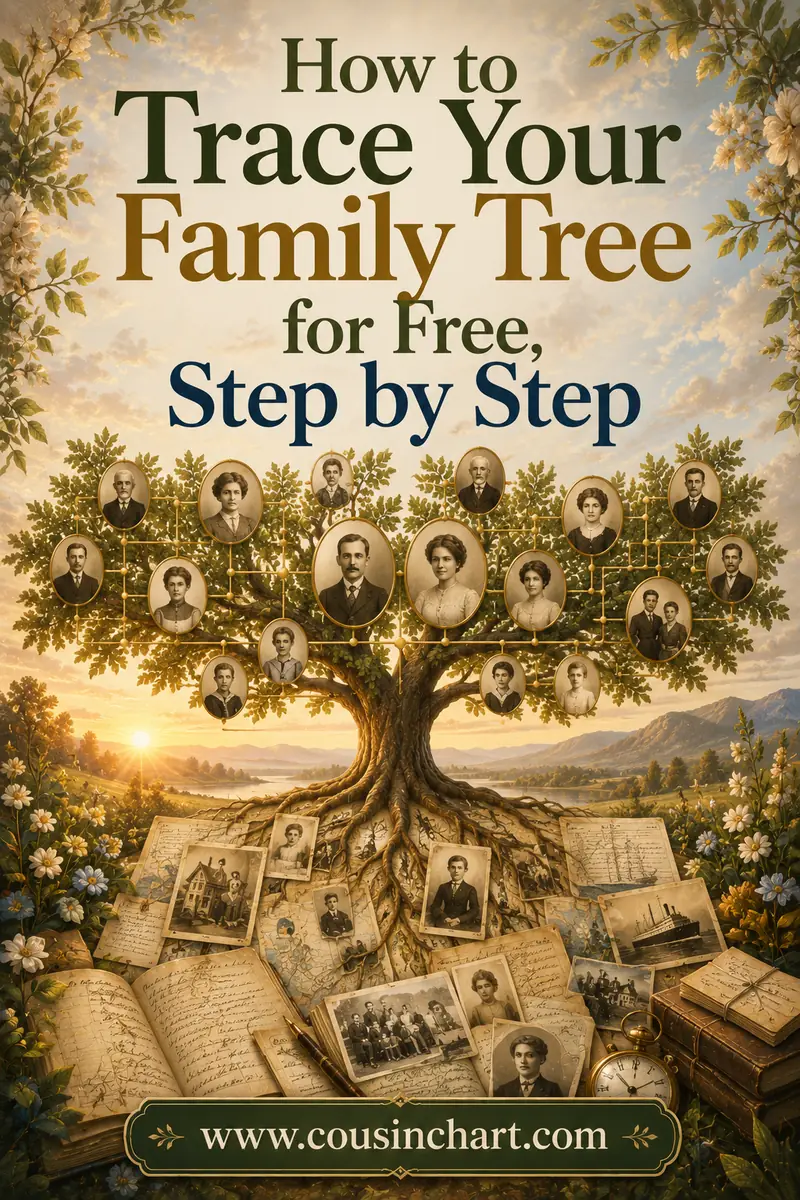
Here's how to trace your family tree free: write down what you know, interview your relatives, then verify and extend each generation using free records — FamilySearch, the US census, Find a Grave, and free newspapers — working backward one proven parent-child link at a time. Most Americans can document four to six generations, back to the mid-1800s, without spending anything.
This is the complete method in eight concrete steps, in order, with the exact free source for each move. No subscription is required at any point — where paid sites offer shortcuts, I'll note the free route instead. And from the very first evening, keep the free relationship calculator on our homepage handy: trees generate "what exactly is a first cousin once removed?" questions immediately, and it answers them in one click.
Which record should I search? Tap what you already know about an ancestor and get the free next step.
Tap a button above to get a starting point.
Map how you're related to them →Step 1: Write down what you already know
Start with yourself and work outward: your birth date and place, your parents', your grandparents' — full names, maiden names, dates, places, as precisely as memory allows. Pencil in the uncertain bits with question marks. This 30-minute exercise is the actual foundation of the tree; every later record either confirms or corrects a line of it.
Rule one of genealogy applies from this moment: work from the known to the unknown. You build backward from yourself, proving each link — never forward from a rumored famous ancestor.
Step 2: Interview your relatives (this month, not someday)
Your oldest relatives hold facts no database has: maiden names, the town in the old country, why the family moved, who's buried where. They are also, bluntly, a source with a deadline. Bring a recorder, ask open questions, and let stories wander — details hide in tangents. We keep a full list of questions to ask grandparents exactly for this.
Ask specifically about documents: family Bibles, certificates, naturalization papers, military discharge papers, funeral cards, photo albums with names on the back. Someone in every family is the keeper. Find them.
Step 3: Raid the house
Before searching anything online, mine what the family already owns: certificates, obituary clippings, letters, yearbooks, photo backs. Each is primary or near-primary evidence, and each carries search keys — an exact date, a street address, a parish — that make the online steps ten times easier.
Step 4: Chart it
Put everything on a pedigree chart — you at the left, parents, grandparents, and so on. Free printable charts abound, or use FamilySearch's free tree builder. The chart's real job is showing you the empty boxes: that's your research list, prioritized by whichever gap bothers you most.
As in-laws, half-relations, and cousins start attaching to the chart, name them precisely — the free CousinChart calculator converts any path ("my grandfather's half-sister's son") into the correct term so your notes never say "some kind of cousin."
Step 5: Open FamilySearch and verify a generation
Create a free account at FamilySearch.org — the largest free record collection anywhere (full guide here) — and search your most recent deceased ancestors. Confirm what memory claimed: a death index entry, a marriage record, a census line. Attach or save each find with its source noted.
The habit to build immediately: one fact, two sources. Memories drift and clerks erred; when two independent records agree, you can build on the link.
Step 6: Walk the censuses backward
The US federal census is the backbone of free American research. Find each family in 1950, then 1940, 1930... every decade back to 1850, when schedules first listed every household member by name (1790–1840 name only heads of household; most of 1890 burned). Censuses are free on FamilySearch and archives.gov, and each one hands you ages, birthplaces, occupations, immigration years, and the children present that decade. Our census search guide covers tactics; the decade walk alone typically carries a tree back to the mid-1800s.
Step 7: Close out each life with free death and grave records
For every ancestor, anchor the endpoints:
| Free source | What it gives |
|---|---|
| Find a Grave / BillionGraves | Burial place, dates, headstone photo, plot neighbors |
| SSDI (free on FamilySearch) | Birth and death dates, deaths mostly 1962–2014 |
| State death indexes | Many free via state archives or FamilySearch |
| Chronicling America newspapers | Obituaries naming the whole surviving family |
Obituaries are the underrated star: a single 1938 obit can list every child with married names and towns — a generation's worth of leads in three column inches.
Step 8: Follow the special trails — immigration, military, land
The census plants flags; free records let you chase them. An immigration year in the census points to free passenger lists (Ellis Island's database, FamilySearch indexes) and then naturalization records. A veteran mark points to free draft cards on FamilySearch and service and pension indexes. A homestead state points to free federal land patents at the BLM's General Land Office site. Our 25 free genealogy websites list maps every trail to its free source.
Keep it free: the discipline
- FamilySearch before any paywall — the same core records usually exist there free.
- Library card as skeleton key — Ancestry Library Edition, HeritageQuest, and often newspaper archives, free at thousands of libraries.
- Pay only for endpoints — a certificate copy fee when a vital record is the only proof of a parent-child link. That's genuinely the only near-mandatory cost in early research.
- Cite as you go — "1920 census, ED 312, sheet 7A" takes ten seconds now and saves re-finding it in five years.
When you hit the inevitable wall
Every line stalls somewhere. The free-toolkit fixes, in order of success rate: research the siblings (their records name the same parents), read the census neighbors (families clustered — the household next door is often in-laws), question your last link (half of brick walls are one wrong assumption a generation down), and go county-level (USGenWeb volunteers and state archives transcribed things no national site indexed). Patience beats subscriptions here, too.
The five beginner mistakes that cost you months
Free research fails for the same handful of reasons paid research does. Dodge these and you'll outpace people with three subscriptions:
- Grabbing the wrong same-named person. Every county had two John Millers, and one of them was born three years off from yours. Before you claim a record, check that the age, birthplace, and household members all fit — a matching name alone proves nothing.
- Copying someone else's online tree as fact. Public trees are leads, not evidence; the same wrong grandfather gets copied ten thousand times. Use them for hints, then verify against actual records before anything enters your chart.
- Losing the maiden names. A married woman with no maiden name is a dead-end branch. Chase her marriage record, her children's death certificates, and her obituary until the maiden name surfaces — half of your ancestry hangs on those names.
- Expecting one spelling. Your ancestors didn't spell their surname consistently, and the clerks did worse. Meyer, Myer, Mayer, and Maier can be one man; search all of them before declaring anyone missing.
- Jumping the ocean too early. The classic burnout move is hunting Irish or German records before pinning down the exact origin town from American sources — the obituary, the naturalization file, the church register here. The old country can wait until the new one has given up its clues.
FAQ
Can I really trace my family tree completely free?
Yes, substantially: censuses, Find a Grave, the SSDI, free newspapers, passenger lists, draft cards, and FamilySearch's billions of records are all free. Most American families can document back to the mid-1800s at zero cost; the only common expense is optional certificate copy fees.
How far back can I trace my family for free?
Typically four to six generations for American lines — to the 1850 census era — on free sources alone. Beyond that depends on the country of origin: Western European church records (many free on FamilySearch) can reach the 1600s or 1700s.
What's the best free website to trace your family tree?
FamilySearch.org — free indexed records at massive scale, a free tree builder, and free digitized documents. Supporting cast: archives.gov for censuses, Find a Grave for burials, and Chronicling America for newspapers.
Do I need a DNA test to trace my family tree?
No. DNA is optional — useful for confirming paper research and finding living cousins, but it can't replace records, and its match labels ("2nd–3rd cousin") are estimates spanning several possible relationships. Build the documented tree first.
How do I start if I know almost nothing about my family?
Interview relatives before touching any website — even one conversation usually yields names and places enough to find the family in the 1950 census, and everything cascades from there. Records confirm memories; memories aim the records.
How much time does this take?
Less than you'd fear, if you go in order. The write-down-and-interview steps are a weekend; the census walk for one family line is a few evenings. A steady hour or two a week reliably produces a documented four-generation tree within a couple of months — and the interviews should happen first regardless, because they're the only step with a deadline.
How do I figure out what distant relatives are called?
Count back to the shared ancestor and use the naming rules — or skip the mental math entirely: the free relationship calculator turns any path, like "my great-grandmother's brother's granddaughter," into the exact term (that one's a second cousin once removed).
Your tree is eight steps away
Tracing your family tree free isn't the compromise version — it's the standard method: memory, interviews, home papers, then the great free record sets, one proven generation at a time. Start tonight with step one and a phone call. And as the branches multiply, let the free CousinChart relationship calculator name every cousin, great-aunt, and once-removed you discover along the way.