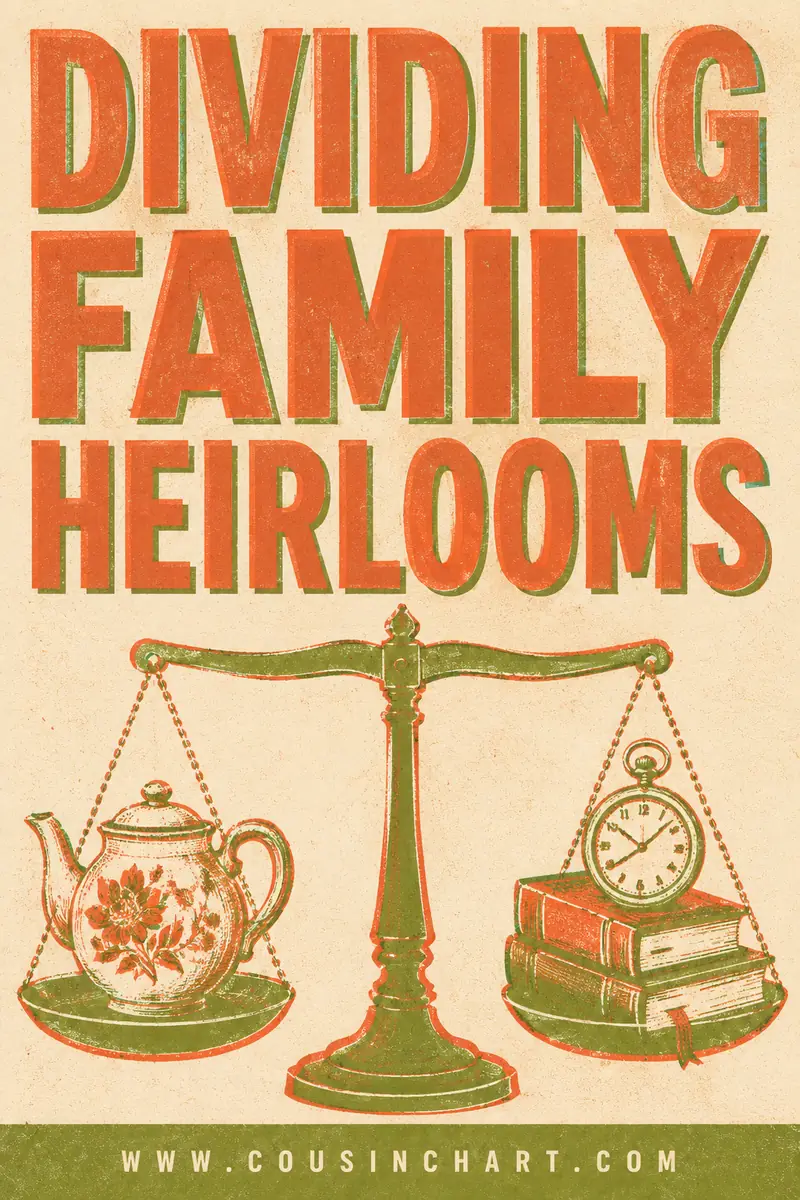
Dividing Family Heirlooms Without a Family Feud
Estates rarely fall apart over money. They fall apart over a ring, a clock, a set of photographs, a chair nobody has sat in for twenty years. The reliable fix is not fairness in the abstract — it is agreeing on a method before anyone says what they want, and writing down who received what and why. A process chosen in advance takes the argument out of the room, because from then on people are following a rule rather than competing. And do the photographing first, so that whatever happens to the objects, the family keeps a record of all of them. If you are working out who is entitled to what across a wider family, the cousin calculator will place everyone.
Where are you in this? Tap the closest match.
Tap an option above. Agree the method before anyone says what they want.
Why this is harder than it should be
It helps to know that the difficulty is normal, and that it is not really about the objects.
Grief attaches itself to things. The teapot is not a teapot for a while — it is the kitchen, the smell of the house, being fourteen. That is why people who would never argue about a bank balance will argue about a jug, and why "it's only a jug" is the least helpful sentence anyone can say.
Objects carry old family arithmetic. Who was closest, who visited, who did the caring, who moved away, who was the favorite. A sibling asking for the ring is sometimes asking whether they mattered as much. Nobody says that out loud, and it is usually what the argument is about.
Timing makes everything worse. The division typically happens within weeks of a death, in a house full of the person's things, between exhausted people who have not slept. That is the worst possible moment to make permanent decisions, and it is when most of them get made.
Sentimental value does not track money. The most fought-over item in most estates is worth very little. Two siblings can both be entirely reasonable and both want the same worthless thing, and no valuation resolves that.
Nobody in this is being unreasonable on purpose. Assume that as a working position even when it is hard to believe. Most estate conflicts are two people who each feel they are being treated unfairly, both sincerely.
Do it before the death, if you can
This is the single most effective thing on the page, and the one people avoid.
Ask the person whose things they are. A parent who says, plainly and in advance, "the clock goes to Michael, the ring to Ruth, and I want the photographs copied for everyone" ends the argument before it starts. Not because it is legally binding — often it is not — but because it is unarguable in a way that a sibling's preference never is.
The conversation is easier than you think, and it does not have to be morbid. Try it object by object rather than as a Big Talk: "Where did this come from? Who should have it?" Many older people are relieved to be asked. Being asked what happens to your things is a form of being taken seriously.
Write it down and let everyone see it. A list in the person's own handwriting, or typed and signed, dated, with a copy to each child. Openness while everyone is alive prevents the discovery of a surprise later, which is where suspicion breeds.
Ask a lawyer how to make it stick where you live. In many US states you can attach a separate written list of personal property to a will and update it without redoing the will, and some other jurisdictions have similar mechanisms. In others, specific gifts have to be in the will itself. It is a short question to a solicitor and it costs very little — see also wills and probate records for what these documents look like.
Record the stories at the same time. Whose it was, where it came from, what it was used for. That takes an hour with a phone recording, and it is the part that cannot be recovered afterwards.
Methods that actually work
Any of these is better than "let's just talk about it". Pick one, in writing, before anyone names an object.
| Method | How it works | Best for |
|---|---|---|
| Rotating choice | Draw an order, then take turns picking one item each, reversing each round | The default — simple, visibly fair |
| Sealed bids in points | Everyone gets the same number of points to spend secretly across items | Where a few items are wanted intensely |
| Drawing lots | Items grouped into equal lots, then lots drawn at random | Large quantities of similar things |
| One divides, the other chooses | One sibling makes two piles, the other picks a pile | Exactly two people |
| Cash auction between siblings | Bid real money; the winner's bid comes off their share | Where values differ a lot and cash exists |
| Buy-out at valuation | One takes the item, others take equivalent value | A single high-value item, like a house or a ring |
| Rotation of custody | The item moves between households on an agreed cycle | One irreplaceable item everyone loves |
Agree the rules before you look at the objects. This is the whole trick. Once someone has said "I want the clock", every rule proposed afterwards is read as being for or against the clock. Decide the method cold.
Decide first what is not in the pool. Anything specifically left in the will, anything already given away, anything jointly owned, anything a spouse has a claim to. Sort that out separately before the family process starts.
Decide whether value is being equalised at all. Some families divide strictly by value; many deliberately do not, and treat the personal items as sentimental and outside the money. Both are fine. What causes trouble is when different siblings assume different answers.
Write the agreed method in a message to everyone before the day. Not because anyone is untrustworthy, but because memory of a verbal agreement diverges under stress.
Rotating choice, in practice
The workhorse method, and worth setting out properly.
Draw for order randomly — names out of a hat, in front of everybody, or a dice roll on a video call. Randomness is what makes it feel fair; anything that looks like a decision about who goes first will be resented.
Then reverse each round. If the order is A, B, C in round one, make it C, B, A in round two, and alternate. Straight repetition heavily favors whoever drew first.
One item per turn, and no swapping mid-round. Slow, and that is the point. Speed is where mistakes and hurt feelings come from.
Allow passes. Someone who does not want anything in a round should be able to say so without penalty, and should not have things pushed on them because "it's your turn".
Do it in person or on video, with the items visible. Photographs of every item, numbered, sent round in advance means people are choosing from the same information. Somebody choosing from memory while another is standing in the house is not the same game.
Take a short break every half hour. People get tired and dig in. A cup of tea has resolved more estate disputes than any legal letter.
Sealed bids, lots and the awkward cases
When rotating choice does not fit the situation.
Sealed bids in points work well when a handful of items matter enormously. Each sibling gets, say, 100 points, and privately allocates them across the whole list. Highest bid takes the item. It lets someone spend almost everything on the one thing they truly want and quietly concede the rest — which is often exactly what people want to do but cannot say out loud.
Set a tie rule in advance. Equal bids go to a coin toss, or the item rotates, or it goes to whoever has received least so far. Deciding this after a tie is how the method fails.
Drawing lots suits volume. With hundreds of ordinary household items, group them into roughly equal boxes or piles and draw for them. Nobody has the energy to negotiate over four hundred objects, and pretending otherwise means it never gets done.
Where two people want one irreplaceable item, separate the value from the meaning. Get a neutral valuation, let one take the object and the other take equivalent value from elsewhere. If money is not the issue, agree custody rotation with a written note, or have a good copy made — a jeweller can copy a ring, and a photograph can be printed at full size.
Where siblings are spread across countries, account for shipping honestly. A heavy piece of furniture is not the same gift to a sibling in another hemisphere, and pretending otherwise is a hidden unfairness.
Where step-siblings and half-siblings are involved, or where entitlement runs sideways through cousins, sort the legal position out separately and first. Estate shares among cousins and proof of heirship cover how entitlement is actually established, which is a different question from who should have the teapot.
Photograph everything before it scatters
The step that gets skipped, and the one that pays off for a century.
Photograph every item before anything is chosen. On a plain surface, in daylight, with a number card beside each. Include the marks and the underside. An afternoon of work.
Number the photographs and build one shared list. Item number, description, whose it was originally, who has it now, and the story if anyone knows it. A spreadsheet in a shared folder is perfect.
This solves three problems at once. People choose from the same information rather than from who is standing in the house; the family keeps a complete record even after the objects go to four different homes; and nobody has to rely on memory about what was in the estate.
Send everyone the full set of photographs afterwards. Every sibling then owns an image of everything, including the things they did not get. That is worth far more than it sounds, and it takes the edge off missing out.
Scan and copy the flat things rather than dividing them. Photographs, letters, certificates and documents should be digitized so that everyone gets a set — see how to preserve old family photos for handling and storage, and digitizing old home movies for film and tape. Nobody needs to lose the family photographs in a division; they can all be copied.
Record marks and provenance while you are there. If anything looks valuable, the notes you take now are what an appraiser needs later — identifying family heirlooms covers what to look for and, crucially, why nothing should be cleaned first.
The things nobody wants
Usually more than half of it, and a source of guilt out of all proportion.
Most household contents have almost no resale value, including brown furniture, formal dinner services, silver-plate canteens and figurine collections. That is a market fact, not a judgement on the person who owned them, and it surprises nearly everyone.
Nobody has to keep anything out of loyalty. Keeping a closet you dislike in a room you need does not honor anyone. A photograph of it, with a note about whose it was, preserves what actually matters.
Offer widely before disposing. Cousins, grandchildren, old neighbors, the person who cared for them. Things that mean nothing to a son sometimes mean a great deal to a niece.
Take one small thing for use, rather than five for storage. The mug you drink from every morning does more remembering than a box in a loft ever will.
Give the local relevance a chance. A local museum, historical society or specialist collection will sometimes want a work uniform, a trade tool, a shop ledger or a set of local photographs that a house clearance would skip.
Set a deadline for undecided items, agreed by everyone — say, three months in one person's garage, then a defined decision. Open-ended storage is how one sibling ends up resentfully keeping everything.
When to bring in someone neutral
There is no shame in this, and it is cheaper than the alternative.
Bring in a neutral valuer early if money is contested. A single independent valuation that everyone agreed to commission in advance removes the "you got the good one" conversation permanently. Agree the appraiser together, before the figures exist.
Consider a mediator or a professional estate divider if talks have stalled. These people exist specifically for personal property, they charge far less than litigation, and their real value is procedural — someone in the room who is not a sibling.
Use the executor properly. If there is one, they have a legal duty to administer the estate, and they can and should insist on a process. Being the executor and a grieving child at once is genuinely hard; asking for help is reasonable.
Know when to stop. If the legal cost of contesting an item would exceed its value, and it usually would, that is worth saying out loud calmly. Some people need permission to let something go.
Repair is possible later. Families do recover from this. A sibling who receives, five years on, a photograph of the object they wanted with a note about why it went where it did, often finds that most of the sting has gone.
FAQ
What is the fairest way to divide belongings between siblings?
Agree a method before anyone names an item. Rotating choice — draw an order randomly, take turns picking one item each, and reverse the order every round — is the most widely used and the easiest to see as fair. Sealed bids in points work better when a few items are wanted intensely.
Should we divide heirlooms before or after our parent dies?
Before, if that is at all possible. A parent's own written list of who gets what removes almost every later argument, because it is unarguable in a way a sibling's preference is not. Ask a lawyer how to make such a list effective where you live.
What if two siblings want the same item?
Separate the value from the meaning. Get one neutral valuation you both agreed to commission, then let one take the item and the other take equivalent value elsewhere. If money is not the point, agree a written rotation between households, or have a good copy or full-size photograph made.
How do we divide family photographs fairly?
Do not divide them at all. Scan the collection at high resolution and give every sibling a complete digital set, then decide separately who stores the originals — usually whoever has the most stable, dry indoor space. Copies in several households also protect against fire and flood.
Who legally decides who gets what?
The will decides, and the executor administers it. Where there is no will, the local rules of intestacy set entitlement by relationship. Family agreement covers only what the law leaves open, so establish the legal position first and run the family process on what remains.
Is it worth paying a mediator to divide an estate?
Often yes. A mediator or professional estate divider costs far less than contested legal proceedings and much less than a broken relationship. Their real value is procedural: someone in the room who is not a sibling, holding everyone to a method that was agreed in advance.
Agree the method, then photograph everything
Two decisions do most of the work here. Choose the method before anyone says what they want — rotating choice with a random draw and reversed rounds handles the great majority of estates — and photograph and list every item before a single thing leaves the house. That gives everyone the same information to choose from, and it leaves the family with a complete record even after the objects have gone to four different addresses. Copy the photographs and papers rather than splitting them. Be slow, take breaks, and assume everyone in the room is trying to be fair, because they usually are. If entitlement across the wider family is part of the picture, work out exactly how everyone is connected with the cousin calculator.