1930 Census Records: Search by Name Free
You can search the 1930 census by name free on FamilySearch.org — complete index, every original page image, free account, no payment. Taken as of April 1, 1930, it's the census of the early Depression: about 123 million Americans, recorded with home values, occupations on the edge of the crash, and one famously charming question no other census asked — "Does this household have a radio set?"
This guide covers the free name search, the columns unique to 1930 (age at first marriage is a quiet superstar), the veteran codes that point to military files, and the search tricks for a census whose households were packed with doubled-up relatives. Speaking of which: Depression-era households are relationship puzzles by design, and the free family relationship calculator on our homepage solves each "wait, who is this cousin?" in a click.
Which record should I search? Tap your 1930-era question for the free answer.
Tap a situation above to see where to search.
Map how you're related to them →The 1930 census at a glance
The fifteenth census caught America eight months after the October 1929 crash — early enough that the full Depression hadn't yet registered in the questions, late enough that its answers preserve the "before" picture of millions of families. Census day: April 1, 1930.
What it asked, beyond the standing columns (name, relationship to head, sex, race, age, birthplaces of each person and both parents, occupation and industry, school, literacy):
- Home owned or rented, and its value or the monthly rent — the era's household balance sheet.
- "Radio set?" — a yes/no that has delighted researchers ever since, and a genuinely useful class marker: in 1930, a radio was a significant purchase.
- Age at first marriage — replacing 1910's marriage-number question, and sneakily more powerful (below).
- Veteran status and which war — with codes: WW (World War), Sp (Spanish-American), Civ (Civil War), Phil (Philippine Insurrection), Box (Boxer Rebellion), Mex (Mexican Expedition).
- Immigration year, citizenship status (Al/Pa/Na), and whether able to speak English; mother tongue for the foreign-born.
- Whether at work yesterday — the first tremor of unemployment measurement, with a separate unemployment schedule for those out of work.
Two coverage notes worth knowing. The 1930 count also produced a special enumeration of merchant seamen on separate crew schedules — if a sailor ancestor is "missing" at home, he may be listed with his vessel. And as with 1920, the census counted people where they lived on April 1, which in 1930 meant boom-and-bust boomtowns: families chasing oil-field, mining, and construction work appear in places the family story never mentions, so search the state, not the hometown.
How to search the 1930 census by name, free
- Open the 1930 collection on FamilySearch.org (free account).
- Enter name + state, birth year ±3. Common surname? Add a spouse's or parent's given name to the search — household matching is the index's strength.
- Open the page image. Age at first marriage, veteran codes, home values, and the radio column live only on the scan.
- Record the citation: state, county, enumeration district, sheet, line.
- Sweep the neighbors — Depression families clustered, and the married daughter is rarely more than a few pages away.
When the index fails, work the standard ladder from our census search guide: the household's most unusual first name, phonetic surname variants, no-surname searches within a county, or address browsing by enumeration district (grab the street address from a 1929–31 city directory first).
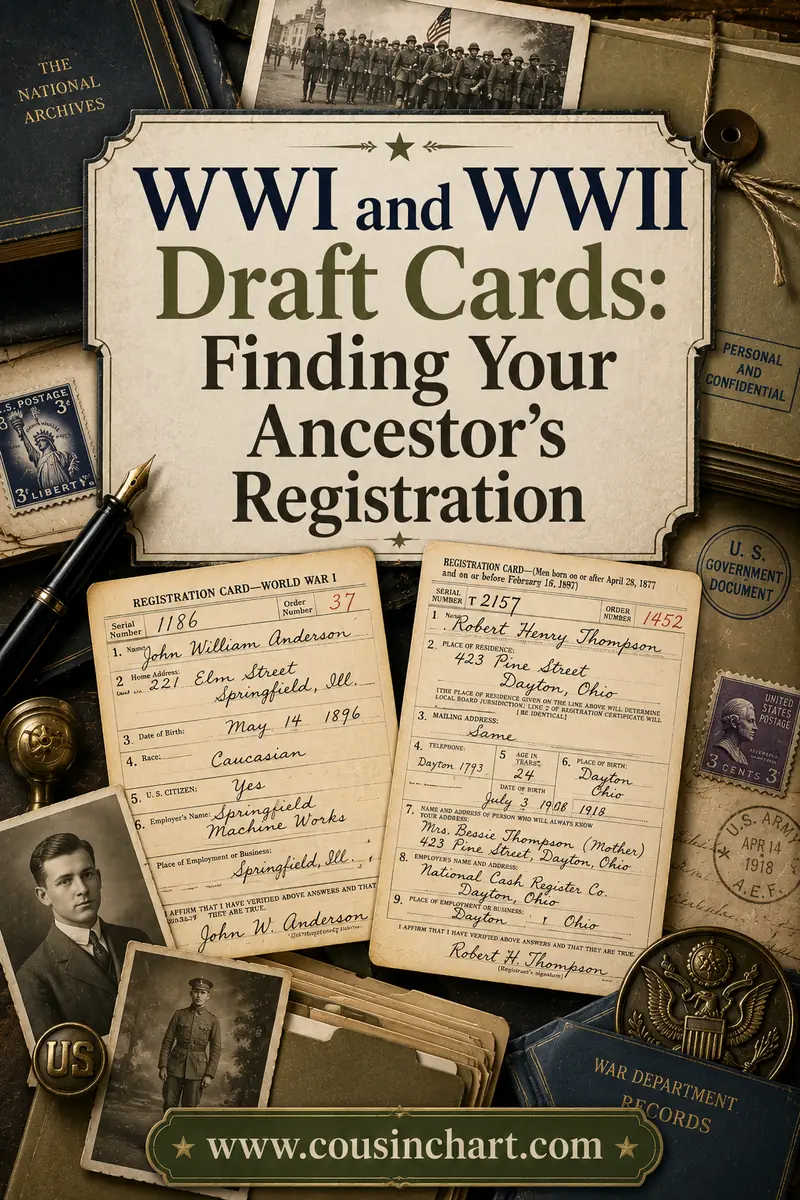
One more disambiguation tool specific to this era: WWI draft registration cards. Nearly every man born between about 1873 and 1900 registered in 1917–18, giving exact birth date, address, occupation, and next of kin — free on FamilySearch. When three John Kowalskis of the right age live in one city in 1930, the draft cards usually say which is yours. Our draft cards guide covers them fully.
Age at first marriage: the quiet superstar column
1930 didn't ask "how many times married?" — it asked each married person's age at their first marriage. Genealogically that's better:
| Person | Age in 1930 | Age at first marriage | First married ~ |
|---|---|---|---|
| Frank | 54 | 22 | 1898 |
| Mary (his wife) | 41 | 26 | 1915 |
Frank's first marriage dates to about 1898 — but Mary's to about 1915. If they claim a long marriage to each other, the numbers clash; the honest reading is that Frank was married before. Now you're hunting an 1898 marriage record, a first wife's death or a divorce, and possibly older half-siblings of Mary's children. This one column reveals remarriages that the family never mentioned — and when it does, the resulting half- and step-relationships are exactly what the free CousinChart calculator is built to name (half first cousins, step-grandparents, and all).
Depression households: everyone under one roof
Read 1930 households expecting compression. Unemployment was climbing, and families absorbed it the old way: adult children stayed home, widowed parents moved in, and unemployed brothers-in-law took the back bedroom. Field notes:
- "Lodger" and "boarder" often meant kin paying token rent — check surnames, birthplaces, and ages against the wider family before dismissing anyone.
- Three-generation households are everywhere. A "grandson" with no parent present usually signals a widowed or divorced child elsewhere — or a daughter who died, with her husband's family holding the other children. Follow up in 1940.
- Watch the veterans column across the household — a Civ-coded grandfather and a WW-coded father in one house is two pension/service paper trails in one stop.
From 1930 forward and back
- Back to 1920: cross-check immigration years and catch the household before the doubling-up.
- Forward to 1940: the next census (free at the National Archives and FamilySearch) adds income, education, and the invaluable "where did you live in 1935?" question — the bridge that carries your 1930 households through the Depression decade.
- Sideways into the paper trail: the veteran codes point to pension and service files; the home-value column hints at deeds and mortgages; the "not at work" marks point to the 1930 unemployment schedules.
Worked example: the remarriage the family never mentioned
The 1930 census, Akron: Walter Griggs, 51, age at first marriage 21; Cora Griggs, 38, age at first marriage 30; children Ruth 17, Harold 15, and Betty 6.
Run the arithmetic. Walter first married around 1900 (1930 − 51 + 21). Cora first married around 1922. Ruth and Harold were born about 1913–1915 — inside Walter's first marriage, before Cora's first. So Ruth and Harold are Walter's children by an earlier wife; Betty (born ~1924) is Walter and Cora's daughter together; and the household contains two stepchildren and a half-sibling group no column states outright.
Follow-ups, in order: hunt Walter's ~1900 marriage record and the first wife's death (or divorce) around 1920–22; check the 1920 census for Walter's earlier household with the first wife; and find Cora's ~1922 marriage record for her maiden name. Descendants of Ruth and descendants of Betty, comparing trees today, are half cousins — sharing Walter but not a grandmother — and the free CousinChart calculator handles exactly that distinction when DNA results start asking questions.
This is 1930's signature move: no census before or after makes hidden remarriages this computable from a single page.
FAQ
Where can I search the 1930 census by name for free?
FamilySearch.org offers the complete 1930 census with a full name index and page images, free with a free account. Ancestry Library Edition at public libraries provides a second index of the same pages free in-branch.
What day was the 1930 census taken?
April 1, 1930. Every answer describes the household as of that date — babies born later in 1930 won't appear until the 1940 census.
Did the 1930 census really ask about radios?
Yes — it's the only U.S. census that asked whether the household owned a radio set. Beyond the charm, it's a useful economic marker for the era.
What do the 1930 veteran codes mean?
WW = World War, Sp = Spanish-American War, Civ = Civil War, Phil = Philippine Insurrection, Box = Boxer Rebellion, Mex = Mexican Expedition. Any code signals that service and possibly pension records exist.
How do I find a marriage year from the 1930 census?
Subtract each spouse's "age at first marriage" from their current age and subtract the result from 1930. If the two spouses' implied years don't match each other, one of them was probably married before.
Why is the 1930 household so crowded?
The early Depression pushed families to consolidate: grown children stayed home, grandparents moved in, and relatives appeared as "lodgers." Treat every extra person as a potential relative until the records say otherwise.
Tune in to 1930 tonight
The 1930 census is a free, name-searchable portrait of America on the Depression's doorstep — radios, rents, veterans, and remarriages included. Search it on FamilySearch, do the age-at-first-marriage math, then follow the family into 1940. And when the crowded households start producing half-siblings, step-kin, and mystery grandchildren, the free CousinChart relationship calculator will name every last one of them exactly.