1900 Census Records: How to Search Free
The 1900 census is free to search on FamilySearch.org — complete index, every page image, no payment ever. Taken as of June 1, 1900, it's arguably the most information-dense census in American history: it's the only U.S. census that records each person's month and year of birth, and it adds years married, how many children each mother bore and how many were living, immigration year, and citizenship status. Genealogists routinely call 1900 their favorite census, and this guide shows why.
Below: the free search steps, every high-value column decoded, and how to use 1900's unique "memory questions" to reconstruct the decade lost with the destroyed 1890 census. And because 1900 households brim with in-laws, boarders, and grandchildren, keep the free family relationship calculator on our homepage open — it converts every household connection into your exact relationship term.
Which record should I search? Tap your 1900-era question for the free answer.
Tap a situation above to see where to search.
Map how you're related to them →Why 1900 is the genealogist's favorite census
The twelfth census asked questions no census asked before — and some never asked again:
- Month and year of birth, for every single person. Not just an age: "Mar 1867." No other U.S. census does this. For ancestors born before statewide birth registration (most of the country), the 1900 census is frequently the most precise birth evidence in existence.
- Number of years married. Simple subtraction dates the wedding.
- Mother of how many children / number of those children living. Two small numbers with enormous power: they reveal children who died young — including 1890s babies who, thanks to the 1890 census loss, appear in no census at all.
- Year of immigration, years in the U.S., and naturalization status ("Al" alien, "Pa" first papers filed, "Na" naturalized). The single fastest free route to a passenger-list search — see our Ellis Island guide.
- Plus the standards: relationship to head, race, sex, occupation, months unemployed, literacy, English ability, school attendance, and home ownership (owned/rented, mortgaged/free, farm/house).
The 1900 count also reached further than any before it. It was the first federal census to cover Hawaii (annexed in 1898), it enumerated military personnel and civilians serving overseas — including soldiers in the Philippines — on separate military schedules, and it used a special Indian Population schedule with extra columns (tribe, and each parent's tribe) in Native communities. If an ancestor seems to be "missing" from the family's home county in 1900, a soldier son abroad or a family on a special schedule is worth checking before you blame the index.
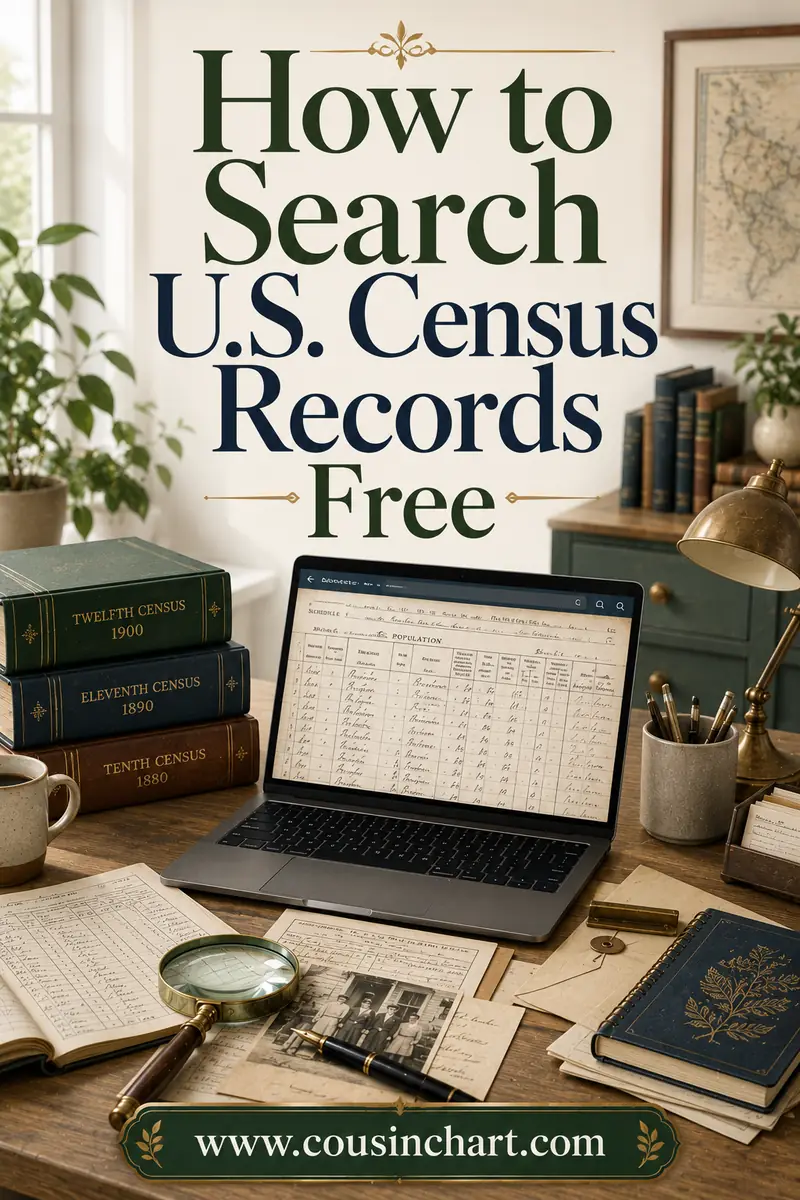
How to search the 1900 census free
- Open the 1900 census collection on FamilySearch.org (free account).
- Search name + state, birth year ±3.
- Always open the image. The index typically shows name, age, and birthplace — but the birth month, years married, children born/living, and immigration columns live on the page scan, and they're the reason you came.
- Copy the citation: state, county, enumeration district (ED), sheet, line.
- Scan the neighbors for married children, in-laws, and same-surname households.
If the search fails, run the standard rescues — the household's most distinctive first name, phonetic surname spellings, no-surname searches with age and birthplace inside one county — all covered in our census search guide.
Decoding the power columns
| Column | Example entry | What you do with it |
|---|---|---|
| Birth month/year | "Feb 1858" | Treat as best-available birth evidence; verify against church records |
| Years married | "22" | 1900 − 22 = married ~1878 → pull the marriage record |
| Children born / living | "9 / 6" | Three children died — hunt cemetery and church burial records |
| Immigration year | "1887" | Search passenger lists in an 1885–1889 window |
| Naturalization | "Pa" | First papers filed — look for the declaration of intention in county/federal court |
| Home data | "R" (rented) | Renters move often — expect address changes in directories |
Two reading tips: the numbers are testimony, not truth — birth months are marvelously specific and still sometimes wrong, so cross-check 1900 against 1910's overlapping questions. And the children-born column belongs to the mother: in blended families, her count includes children from earlier marriages who may live elsewhere, a discrepancy that has solved many a "who was the first husband?" mystery.
1900 as the bridge over the 1890 gap
Because the 1890 census is gone, 1900 does retrospective duty for the whole missing decade:
- Marriages: "years married: 8" documents an 1892 wedding no census witnessed.
- Births: children aged 1–19 were all born since 1880; their birth months/years rebuild the family's 1880s–90s timeline.
- Deaths: children born minus children living = the gap decade's losses.
- Arrivals: an 1893 immigration year points to a manifest — and a family reconstituted across the ocean during the invisible decade.
A single well-read 1900 household can regenerate most of what the 1890 fire took. Pair it with the 1880 census on the far side and the reconstruction is complete.
Households, grandchildren, and who's-who puzzles
1900 households sprawl: widowed mothers moved in, grandchildren appear with no parents in sight, and "boarders" share suspicious surnames. The relationship column states everything relative to the head — a "granddaughter" is the head's granddaughter, and which of the head's children is her parent remains your puzzle. Standard technique: match her birth month/year against each married child's household elsewhere in 1900, using the mothers' children-born/living counts to see whose tally she fits.
Then place her in your tree: if she's the granddaughter of your great-great-grandfather via a daughter who isn't your ancestor, she's your first cousin twice removed. Chains like that are exactly what the free CousinChart relationship calculator computes — trace the path in the records, let the calculator name it.
Worked example: one 1900 household, one lost decade recovered
Here's the census earning its reputation. The 1900 household of Michael and Bridget Doyle, rural Wisconsin, reads:
- Michael, head, born May 1851, married 24 years, immigrated 1872, "Na"
- Bridget, wife, born Nov 1856, married 24 years, mother of 10 children, 7 living
- Six children at home, born 1878–1897, plus one married daughter two farms over
Now reconstruct the invisible years:
- Married ~1876 (1900 − 24). Pull the county marriage record — it will give Bridget's maiden name.
- Ten born, seven living. Six at home plus the married daughter accounts for seven. Three children died — and given the children-at-home birth gaps (a suspicious four-year gap 1884–1888), at least one died in the lost 1890 decade. Cemetery and church burial registers are next.
- Immigrated 1872, naturalized. An 1870s arrival means Castle Garden-era manifests; the "Na" means county courthouse naturalization papers exist, likely 1877–1890.
- Birth months for everyone. Michael's "May 1851" will anchor his Irish baptism search; the children's months/years rebuild the family Bible nobody saved.
One free census page produced a marriage record target, three unrecorded child deaths, an immigration window, and a naturalization file — the 1890s, recovered from testimony. When the married daughter's line eventually connects to living cousins comparing notes with you, the free calculator will name the relationship (her great-grandchildren and Michael-line great-grandchildren are third cousins).
FAQ
Where can I search the 1900 census for free?
FamilySearch.org has the complete 1900 census — full name index plus original page images — free with a free account. Library editions of subscription sites offer a second index free at many public libraries.
What makes the 1900 census unique?
It's the only U.S. census that recorded each person's month and year of birth. It also asked years married, children born and living, immigration year, and naturalization status — an unmatched combination.
How accurate are the 1900 birth dates?
They're the family's own statement, so usually close but not guaranteed — people rounded, misremembered, and occasionally shaved years. Cross-check against church baptisms, the 1910 census, and death records.
What do "Al," "Pa," and "Na" mean in the 1900 census?
Citizenship status for foreign-born men: "Al" = alien, "Pa" = filed first papers (declaration of intention), "Na" = naturalized. Each points to a specific set of naturalization documents to find next.
How does the 1900 census help with the missing 1890 census?
Its retrospective questions — years married, children born and living, birth months/years, immigration year — reconstruct the events of the lost 1880–1900 gap from the family's own answers.
Can the 1900 census reveal children who died young?
Yes. Every mother was asked how many children she had borne and how many were living. A gap between the two numbers documents children — often 1890s infants — who appear in no other federal record.
Open the century's best census tonight
If you check only one census for any American family, make it 1900: birth dates, marriage years, lost children, and immigration facts, all on one free page. Search it on FamilySearch, read every column of the image, then walk the family forward to 1910 and beyond. And as the grandchildren, in-laws, and boarders sort themselves into the tree, the free CousinChart relationship calculator will name exactly what each one is to you.