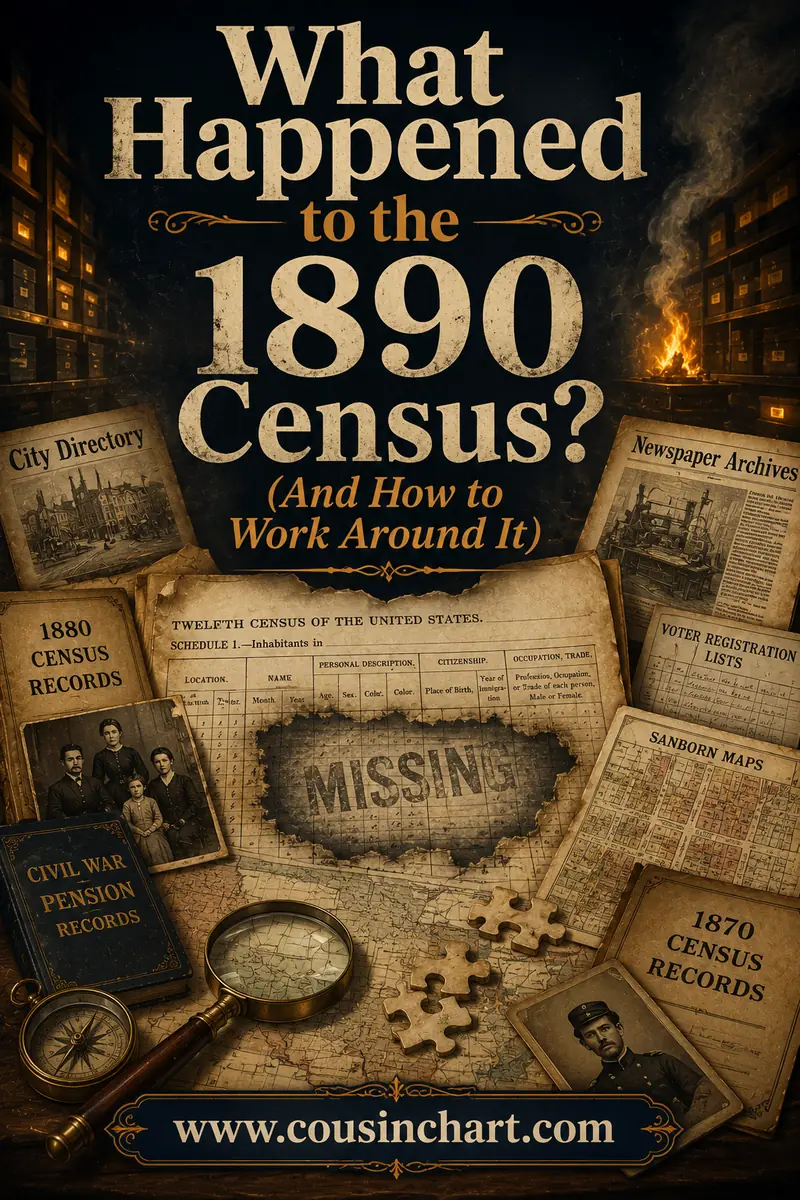
What Happened to the 1890 Census? (And How to Work Around It)
Nearly all of the 1890 census was destroyed — first damaged by a fire in the Commerce Department building on January 10, 1921, then, after years of neglect, the remaining water-soaked schedules were authorized for disposal and destroyed in the mid-1930s. Of a census that counted almost 63 million Americans, surviving population-schedule fragments cover only about 6,000 people. It is the single greatest record loss in American genealogy.
The good news: researchers have spent a century building workarounds, and they're good. This guide explains what happened, exactly what survives (including the underused 1890 veterans schedule), and eight practical ways to carry a family across the 1880–1900 gap for free. As you rebuild those missing-decade families from scattered sources, the free family relationship calculator on our homepage helps you keep every reconstructed connection straight.
Which record should I search? The 1890 census is gone — tap your situation for the best free substitute.
Tap a situation above to see where to search.
Map how you're related to them →The short, sad history
The 1890 census was innovative — the first tabulated by machine, using Herman Hollerith's punch-card system, and the first (and only) census to use a separate schedule for each family. It counted about 62.9 million people as of June 1, 1890.
Then, on January 10, 1921, fire broke out in the basement of the Commerce Department building in Washington, where the schedules were stored — outside any fireproof vault. The fire, water, and smoke damaged an estimated three-quarters of the schedules. What followed was worse than the fire: the damaged records sat for years while officials debated, and in 1933–35, with salvage judged impractical, Congress authorized disposal and the remaining schedules were destroyed. Archivists have mourned it ever since — the loss is a founding argument for the National Archives itself, which was established in 1934, too late to save 1890.
The result: between the 1880 census and the 1900 census lies a twenty-year documentary gap in every American family's story.
What actually survives (check these first)
Not quite everything burned. Two survivor sets are searchable free on FamilySearch:
- Population schedule fragments — roughly 6,000 individuals from scattered localities in ten states (Alabama, Georgia, Illinois, Minnesota, New Jersey, New York, North Carolina, Ohio, South Dakota, Texas) plus the District of Columbia. The odds are terrible, but the check takes ten seconds.
- The 1890 special schedule of Union veterans and widows — a separate enumeration of surviving Union Civil War soldiers, sailors, and marines (and their widows), stored apart from the main census. Schedules for states early in the alphabet were lost earlier, but they survive for roughly half the country — alphabetically from Kentucky through Wyoming, plus DC and some fragments. It records the veteran's name, rank, company, regiment, enlistment and discharge dates, and disabilities — and widows are listed with reference to their late husbands, a genealogical bonus. Some Confederate veterans were recorded too (usually crossed out, but legible).
If your ancestor was a Union veteran living in a surviving state in 1890, this schedule is a genuine census substitute — and a springboard into pension files, which are family-detail goldmines.
Eight free ways to bridge the 1880–1900 gap
| Substitute | What it gives you | Where (free) |
|---|---|---|
| State censuses (1885, 1892, 1895) | Full household snapshots mid-gap | FamilySearch, state archives |
| City directories | Name, address, occupation — annually | Library of Congress, Internet Archive, libraries |
| The 1900 census itself | Birth months/years, years married, children born/living | FamilySearch |
| County marriage records | The gap decade's weddings | FamilySearch, county clerks |
| Church registers | Baptisms, marriages, burials, 1880–1900 | FamilySearch, parishes |
| Probate and wills | Deaths in the gap, with heirs named | FamilySearch, county courts |
| Tax lists and land records | Annual proof of residence | County courthouses, state archives |
| Voter registrations | Adult males, with ages and addresses | State archives (e.g., Great Registers) |
Three of these deserve emphasis:
- State censuses are the closest thing to a real 1890 substitute. New York's 1892 state census is the classic example; Kansas, Nebraska, Colorado, and Florida counted in 1885, and several states again in 1895. If your family lived in a state-census state, the gap nearly closes.
- City directories are the yearly census nobody thinks of. An annual directory line — name, occupation, home address — tracks a family through all twenty years, reveals a widow's first year alone (she appears as "widow of Thomas"), and shows adult sons appearing as they come of age. Our city directories guide shows where to find them free.
- The 1900 census reaches backward. Its questions — birth month and year, years married, number of children born and how many living — reconstruct the gap decade's births, marriages, and infant deaths from the family's own testimony. A woman married 8 years in 1900 with 4 children born and 3 living tells you: married ~1892, four gap-decade births, one gap-decade child death. That's 1890s history, recovered.
Rebuilding a gap-decade family: worked example
Say your great-great-grandparents appear in 1880 with three children, and in 1900 the household shows the parents, one teenage son — and a young married couple next door where the wife's age fits the 1880 baby daughter. The bridge: find the daughter's ~1890s marriage record (county clerk or FamilySearch), confirm with the 1900 "years married" column, and the neighbor couple snaps into the tree. Her children — born in the gap — are your first cousins twice removed... or check the chain yourself in the free CousinChart calculator, which exists precisely for gap-decade reconstruction moments like this. One marriage record plus two censuses, and the "lost decade" family is whole again.
Timeline: how the records were actually lost
The full story is worth knowing, if only because "it burned in 1921" is only half true:
| Date | What happened |
|---|---|
| June 1, 1890 | Census day; ~62.9 million counted on per-family schedules |
| Early 1890s | Tabulated by Hollerith punch-card machines — a technological first |
| Jan 10, 1921 | Fire in the Commerce Department basement; schedules soaked and charred, an estimated three-quarters damaged |
| 1921–1932 | The damaged schedules sit in limbo; librarians and genealogists petition for salvage, no funding materializes |
| 1933–1935 | Congress authorizes disposal of the remaining schedules; destruction is carried out |
| 1934 | The National Archives is established — one year too late |
| 1940s–1950s | The surviving fragments (a few bundles that had been stored separately) are identified and preserved at NARA |
The bitter lesson — that damaged records were destroyed after the fire, during years when they might have been saved — is why the loss still stings archivists, and why every later census has been microfilmed and vaulted with near-religious care.
Two silver linings for researchers. First, because the veterans schedule was stored apart from the main census, half the country's Union veterans and widows escaped the fire entirely. Second, the disaster happened at the exact historical moment when substitute records were at their densest: the 1880s–90s produced annual city directories in every town, aggressive state censuses, and increasingly complete county vital registration. The decade is missing its census, but it is far from undocumented.
FAQ
Was the entire 1890 census destroyed?
Nearly. A 1921 fire in the Commerce Department building damaged most schedules, and the remainder were destroyed in the mid-1930s after Congress authorized disposal. Fragments naming only about 6,000 people survive, plus much of the special 1890 Union veterans schedule.
Can I search what's left of the 1890 census?
Yes — the surviving population fragments and the veterans schedule are indexed free on FamilySearch. The fragments cover scattered localities in ten states plus DC; the veterans schedule survives for roughly the second half of the alphabet, Kentucky through Wyoming.
Who started the 1921 fire?
The cause was never determined — investigations pointed to possibilities like a discarded cigarette or spontaneous combustion in the basement storage, but no definitive cause was established.
How do I trace a family between 1880 and 1900?
Layer substitutes: state censuses (1885/1892/1895), annual city directories, county marriage and probate records, church registers, tax lists, and the 1900 census's retrospective questions (birth month/year, years married, children born and living).
Did the 1890 fire lead to anything good?
Yes — the loss became a central argument for building a proper national archive. The National Archives was established in 1934, and census preservation has been dramatically better ever since.
What did the 1890 census ask that we lost?
A lot: it was the only census with a separate schedule per family, and it asked about Civil War service, home ownership and mortgages, immigration and naturalization, and (of women) children born and living — most of it now reconstructable only through substitutes.
The gap is real — but it's beatable
The 1890 census is gone, and no single record replaces it. But a state census here, a directory run there, a marriage record and the 1900 census's memory columns — stacked together, they rebuild almost any family's missing decade. Work the substitutes free on FamilySearch, keep 1880 and 1900 as your bookends, and let the free CousinChart relationship calculator verify every relationship your reconstruction produces.