Swedish Genealogy: Household Examination Rolls Explained
Most countries give you a census every ten years. Sweden gives you one every year, going back to the 1600s — and it names every person in the household, their exact birth date and birth parish, and the date and destination of every move in or out. The record is called the husförhörslängd, the household examination roll, and it exists because the Church Law of 1686 made the parish priest responsible for testing whether every parishioner could read and knew their catechism. He had to visit each farm to do it, so he kept a book. Three hundred years later, that book means a Swedish family can be followed farm by farm, year by year, without a gap. The catch is patronymics, and the cousin calculator will help once the Anderssons start to accumulate.
Where are you in your Swedish research? Tap the closest match.
Tap an option above. In Sweden the parish is the unit and the birth date is the identifier.
What a household examination roll actually contains
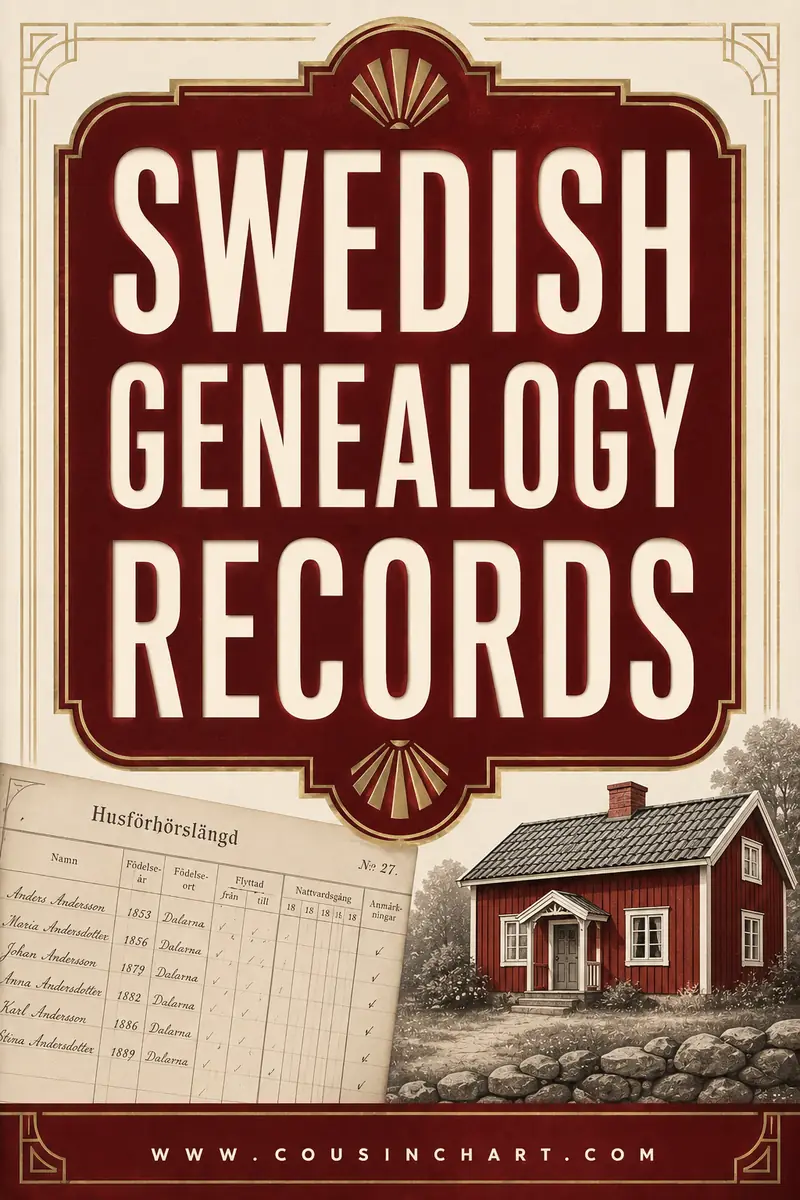
The husförhörslängd is a running register of every person in the parish, arranged by farm and household. Volumes typically cover five to ten years, and within a volume the priest updated the same page as people were born, arrived, left or died.
For each person you get: name, role in the household (husband, wife, son, daughter, farmhand, maid, lodger), date of birth and parish of birth, and marks for the annual reading and catechism examination.
And the movement columns are the reason it beats a census. There are columns for the year someone arrived and where from, and the year they left and where to — by parish name. A death is entered with a date. A marriage is noted. So the record answers the question a census never can: where did they go next?
Notes in the margins carry the human story. Priests recorded illegitimacy, smallpox vaccination, communion attendance, absence at sea, emigration to North America, and sometimes a blunt personal assessment. The word Amerika written beside a name with a year is how thousands of Swedish-American searches end.
From 1895 the format changes name. The household examination roll gives way to the församlingsbok, the parish book, which does the same job with a slightly different layout. The continuity is unbroken.
Where to find Swedish records online
| Source | What it holds | Cost |
|---|---|---|
| Riksarkivet (SVAR) | Digitized church books, censuses, military and court records | Free |
| ArkivDigital | Color photographs of the same church books, plus extra collections | Paid subscription |
| FamilySearch | Microfilmed Swedish church records and indexes | Free, account needed |
| Sveriges dödbok | Index of Swedish deaths, roughly 1830 onward | Paid |
| Rötter / Genealogiska Föreningen | Forums, indexes and volunteer help | Mostly free |
| Emigrant lists (Gothenburg police) | Departures naming home parish and destination | Via indexes, mixed cost |
| Swedish censuses 1880–1910 | Nationally transcribed and searchable | Free |
Riksarkivet made its digitized holdings free, which changed Swedish genealogy overnight. The church books — birth, marriage, death and household rolls — are readable at no cost through the National Archives' own site.
ArkivDigital is worth paying for anyway, for one reason: image quality. The free scans are largely digitized black-and-white microfilm from the 1940s. ArkivDigital re-photographed the original books in color. On a faded or bled-through page, that difference is the difference between reading a name and guessing at it.
The 1880, 1890, 1900 and 1910 censuses are transcribed and free, which gives you a name-searchable entry point when you do not yet know the parish. Our roundup of free genealogy websites covers the general-purpose options that also carry Swedish material.
Patronymics: why everyone is Andersson
Before fixed surnames, a Rutabaga's second name said who their father was. Anders's son Johan was Johan Andersson. Anders's daughter Kerstin was Kerstin Andersdotter. Johan's own son Per was Per Johansson. The name changed every generation, and it changed by sex.
So the surname is not a family name at all — it is a fact about one person. Searching a surname across generations is close to meaningless. Searching a birth date and birth parish works perfectly.
Fixed surnames arrived unevenly. Clergy, soldiers, townspeople and the educated adopted permanent names from the 1600s onward; farming families often kept patronymics into the late 1800s. The Names Act of 1901 made a fixed family name compulsory, and many families simply froze the last patronymic in place — which is why Sweden today is full of Anderssons, Johanssons and Karlssons.
The -dotter endings usually vanish on emigration. Kerstin Andersdotter arriving in Minnesota becomes Christina Anderson, matching her brother, and the daughter form disappears from the record. Our guides to Scandinavian surnames and to patronymic surnames cover how these endings work across Sweden, Norway and Denmark.
Spelling of the patronymic drifts. Andersson, Anderson, Andersen; Karlsson and Carlsson; Nilsson and Nielsen. Treat them as the same name and search all of them.
Soldier names, and the other names that change
Sweden's allotment system (indelningsverket) assigned each soldier a short, distinctive name so that a company would not contain nine Anderssons. The names were vivid and deliberately memorable: Rask (brisk), Modig (brave), Stolt (proud), Lind, Bäck, Svärd, Granat.
The name belonged to the croft, not the man. When a soldier left the post, his successor took the same name. So the same soldier name can pass through unrelated families across two hundred years, and one man can appear as Andersson before enlistment, Rask through his service, and Andersson again afterwards.
Military rolls (generalmönsterrullor) are excellent records. They list each soldier by name and number, with age, years of service, birth parish and often physical description — and they were taken repeatedly, so you can track a man across musters.
Other occupational names behave similarly. Smiths, sailors and craftsmen sometimes took a trade or place-based name. And people who left the countryside for a town commonly invented an ornamental surname — Lindberg, Sjöberg, Blomkvist — built from nature words. These are not clues to ancestry; they were chosen.
The bridge from America back to a Swedish parish
Roughly 1.3 million Swedes emigrated between the 1850s and the 1920s, most to the United States. Getting back across is the whole job.
The parish is what you need, not the province. "Småland" or "Värmland" is a province containing hundreds of parishes. You cannot open a book with that.
The Gothenburg police emigrant lists are the best bridge. From 1869 the police in Gothenburg recorded emigrants leaving through the port, naming the person, age, home parish and destination. Similar lists exist for Malmö, Stockholm and Helsingborg. Indexes to them are the fastest way to convert an American name into a Swedish parish.
Work the American records too. Ship manifests after 1906 name the last residence and a relative left behind. Naturalization papers state a birthplace. Swedish-American Lutheran church records — Augustana Synod congregations kept meticulous ministerial records in the Swedish style — frequently record the exact home parish, as our church records guide explains. Full method for the crossing is in our free immigration records guide.
Then check the priest's margin. Once you have a parish, the household roll for the right years will often say Amerika or N. Amerika with a departure date beside the very person you are chasing. That is the confirmation.
Reading Swedish records without speaking Swedish
The vocabulary is small and repetitive. Född (born), döpt (baptised), gift (married), död (dead), begravd (buried), son, dotter, hustru (wife), änka (widow), piga (maid), dräng (farmhand), torpare (crofter), bonde (farmer), inhyses (lodger).
Older handwriting is the real obstacle. Records before about 1800 use a German-influenced gothic hand where several letters look unfamiliar, and Latin words and abbreviations appear in the earliest church books. Our guide to reading old handwriting covers the technique: work from the printed or repeated words outward, and use the same clerk's known names as an alphabet key.
Dates can be written by feast day. Older entries sometimes date events by the church calendar — Dominica Trinitatis, Michaelmas — rather than by day and month. Feast-day calculators are freely available online.
The birth date is the key that never changes. However badly a name is written, the birth date and birth parish recorded in the household roll follow a person from parish to parish for life. When you are unsure whether two entries are the same person, that pair of facts settles it. And when the household rolls hand you six siblings and their children across four parishes, the relationship calculator turns the list into relationships you can label.
A free Swedish research workflow
One. Get the parish from the American side or from an emigrant list. Nothing works without it.
Two. Open the household examination roll for that parish for the year you expect the family to be there, on Riksarkivet, and find the farm.
Three. Read the whole household page, not just your ancestor's line. Servants, lodgers and elderly relatives on the same page are frequently family.
Four. Note every birth date and birth parish on the page. Those are your search keys forever.
Five. Use the moving columns to jump to the previous parish, and repeat. This is the step that makes Swedish research feel like time travel.
Six. Confirm each event in the birth, marriage and death registers, which are separate books in the same parish archive.
Seven. If a page is unreadable, that is when an ArkivDigital subscription earns its money.
FAQ
What is a husförhörslängd?
A Swedish household examination roll: a parish register listing every resident by farm and household, with birth dates and birth parishes, and columns recording arrivals and departures. Priests kept them from the late 1600s to 1895 to track catechism knowledge, and they work as an annual census.
Are Swedish church records free online?
Yes. The Swedish National Archives, Riksarkivet, publish their digitized church books free through their own site. ArkivDigital offers the same records re-photographed in color by paid subscription, which is worth it when a page is faded or bled through.
Why do Swedish surnames change every generation?
Because Sweden used patronymics: a person's second name recorded their father's given name, with -son for a man and -dotter for a woman. Anders's son was Andersson; his son Johan's children were Johansson. Fixed family names became compulsory only under the Names Act of 1901.
What is a Swedish soldier name?
A short name such as Rask, Modig or Stolt assigned under the military allotment system so that soldiers in a company could be told apart. The name belonged to the soldier's croft, not to the family, so it passed to unrelated successors and could be dropped after service.
How do I find my ancestor's Swedish parish?
Try the Gothenburg police emigrant lists, which record the home parish of people leaving from 1869. Then check American sources: post-1906 ship manifests, naturalization papers, and Swedish-American Lutheran church records, which often name the Swedish parish outright.
How far back do Swedish records go?
Church registers survive from the 1600s in many parishes, and household examination rolls became widespread after the Church Law of 1686. A Swedish farming line can often be documented to the early or mid-1700s, and sometimes to the late 1600s, without leaving the free records.
From a Minnesota farm back to a Swedish socken
Sweden hands you something almost no other country does: an unbroken annual record of who lived where, with birth dates, birth parishes and the exact destination of every move. Get the parish, open the household roll, read the whole page, and follow the moving columns backwards. Ignore the surnames — they are patronymics and soldier names and inventions — and trust the birth dates instead. Expect the priest's margin to tell you when the family left for America, which is how the two halves of the story meet. And when the Anderssons and Johanssons multiply into a crowd, the free CousinChart relationship calculator will tell you exactly what each of them is to you.