Puerto Rican Genealogy: Free Civil and Church Records
Two facts save Puerto Rican researchers the most time, and both surprise people. The first is that almost everything you need is free on FamilySearch — the island's civil registration and its Catholic parish records were both microfilmed and are online at no charge. The second is that you should stop looking for naturalization papers, because Puerto Ricans have been United States citizens since the Jones Act of 1917 and never had to naturalize. People spend months hunting a document that was never created. What you should be doing instead is learning to read the two-surname system properly, because a Puerto Rican name carries the mother's family name as well as the father's, which means every record hands you both sides of a family at once. When those sides multiply, the cousin calculator sorts out the relationships.
What are you trying to find? Tap the closest match.
Tap an option above. Most Puerto Rican records are free — the naming system is the thing to learn first.
The two-surname system, and why it is a gift
Every Spanish-tradition name carries two surnames: the father's first, the mother's second. Juan Ríos Collazo has a father surnamed Ríos and a mother surnamed Collazo. His sister is María Ríos Collazo. His children by a woman named Torres Vega will be Ríos Torres.
So a single record names two families. A baptism entry for Juan Ríos Collazo tells you the father's line and the mother's line before you have read a word of the entry itself. No other European naming tradition gives you that.
Women do not change their names on marriage. A woman is recorded under her own two surnames throughout her life, sometimes with "de" and her husband's first surname added socially. In the records, look for her birth name.
Mainland indexes mangle it constantly. A US census taker or a hospital clerk treats the first surname as a middle name and the second as the family name, so Juan Ríos Collazo is indexed as Juan R. Collazo, or as Juan Rios with Collazo dropped entirely. Search both surnames separately, and search each as a middle name.
Accents and spelling drift on the mainland. Ríos becomes Rios, Rodríguez becomes Rodriguez, and Collazo may be Collazo or Colazo. Our lists of Puerto Rican surnames and Spanish surnames and their meanings cover the common island names and where they came from.
Naming patterns repeat within families. A grandfather's name reappearing in alternate generations is normal, so three men called José Ríos Collazo in the same municipality across a century is a pattern, not a coincidence. Use birth dates and parents' names to tell them apart.
Civil registration from 1885
Spain introduced civil registration in Puerto Rico in 1885, a few years before the island passed to the United States in 1898. From that date, births, marriages and deaths were registered by the municipality (municipio) as well as by the church.
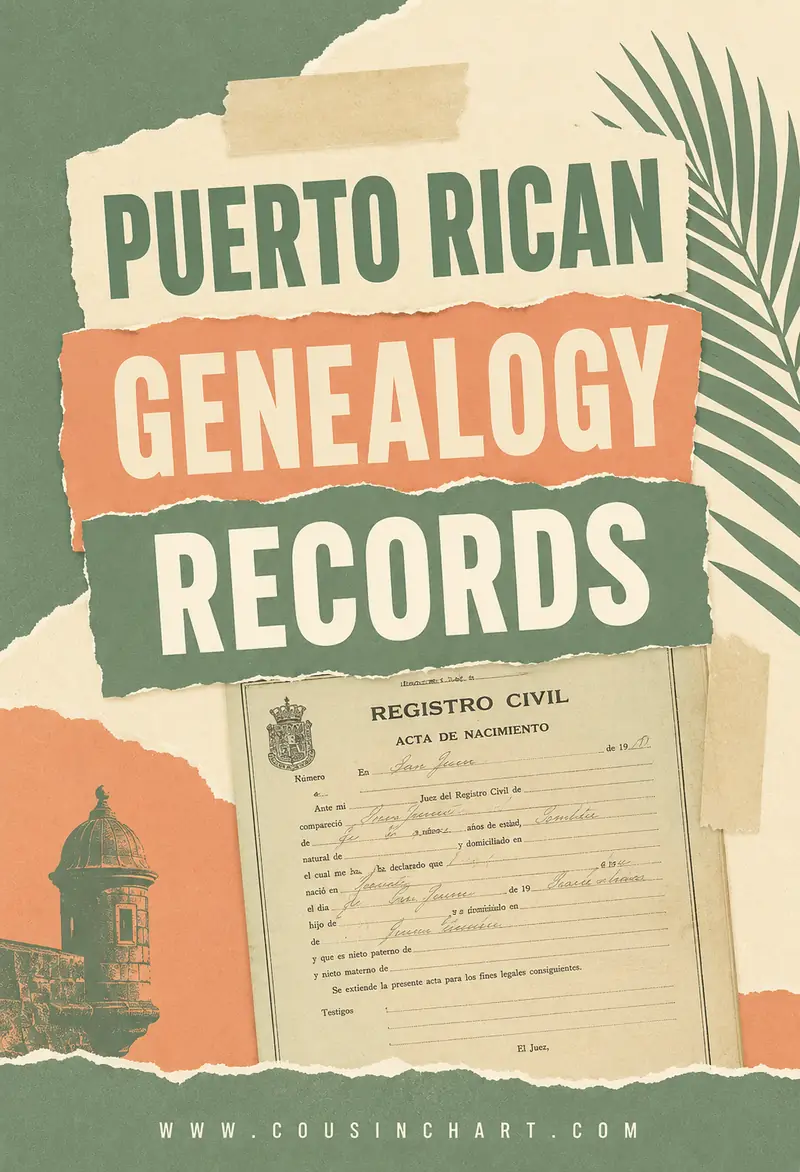
Entries are detailed. A birth registration gives the child's full name with both surnames, the date and hour, the parents with their ages, occupations, birthplaces and residences, and both sets of grandparents by name. Grandparents on a birth record is a genuine luxury.
FamilySearch holds the microfilmed civil registration for the island, indexed and browsable free, running from the 1880s into the twentieth century with privacy cut-offs on the recent end.
Recent records go through the Registro Demográfico. Puerto Rico's vital records office in San Juan issues certificates for modern events. Note that a 2009 law invalidated all Puerto Rican birth certificates issued before 1 July 2010 as identity documents, so an old certificate in a family folder is still fine as genealogical evidence but is no longer valid for official use.
The Archivo General de Puerto Rico in San Juan holds municipal, court, notarial and property records that were never microfilmed, and it is the destination for research that outgrows the online collections.
Catholic parish records: the deep layer
The Catholic Church recorded Puerto Rican life from the 1500s, and the surviving parish books are the vital record for everything before 1885.
The microfilmed collection is free. FamilySearch's Puerto Rico Catholic church records cover baptisms, marriages, confirmations and burials across the island's parishes, roughly from the 1600s to the mid-twentieth century, with the earliest books in San Juan.
Baptism entries name godparents, and godparents are relatives. As across Catholic Europe and Latin America, sponsors were normally grandparents, aunts, uncles or older cousins, so a run of baptisms sketches the extended family. Our church records guide covers requesting material from a parish directly when the film does not reach far enough.
Marriage records record dispensations. Where a couple were related within the prohibited degrees, the priest recorded a Church dispensation stating the exact relationship — "third degree of consanguinity" — which is a documented family link handed to you. Feed it into the relationship calculator and you have a modern cousin term for it.
Racial categories appear in older entries. Colonial parish books frequently classified people as blanco, pardo, moreno, mulato or esclavo, and separate registers were sometimes kept. These labels were assigned by clerks and shifted between records; treat them as historical administrative categories rather than reliable facts about a person.
The record sets at a glance
| Record set | Coverage | Where | Cost |
|---|---|---|---|
| Civil registration | 1885 onward | FamilySearch, Registro Demográfico | Free online |
| Catholic parish registers | 1600s to mid-1900s | FamilySearch, parish archives | Free online |
| US federal censuses | 1910, 1920, 1930, 1940 | FamilySearch, NARA, commercial sites | Free at several |
| Puerto Rico census | 1935 | FamilySearch and commercial sites | Free at FamilySearch |
| Spanish colonial censuses | Various, 1700s–1800s | Archivo General de Puerto Rico, PARES | Free to search |
| Registro Central de Esclavos | 1872 | Archivo General, indexed online | Free |
| PARES | Spanish state archives, colonial administration | pares.mcu.es | Free |
| Notarial and property records | 1700s onward | Archivo General de Puerto Rico | On site |
Puerto Rico is in the US census from 1910. The 1910, 1920, 1930 and 1940 federal censuses enumerated the island, so a family that never left still appears in the same census series as mainland relatives. Our FamilySearch guide covers searching those collections effectively.
The 1935 Puerto Rican census is the extra one. Taken under the Puerto Rico Reconstruction Administration, it captured the island between two federal censuses and is indexed, which makes it very useful for the Depression years when families were moving.
PARES is the Spanish colonial layer. The Portal de Archivos Españoles gives free access to the Spanish state archives, including the Archivo General de Indias in Seville, which holds colonial administration, military service records, and files on people who moved between Spain and the Indies.
The 1872 slave register and Afro-Puerto Rican research
Slavery was abolished in Puerto Rico on 22 March 1873. The year before, Spanish authorities compiled the Registro Central de Esclavos, a central register of every enslaved person on the island.
It names people, and that is the point. Entries record the person's name, age, place of origin (including African origin where recorded), physical description, occupation and the owner's name — creating a documentary link between an individual and a specific household at a specific moment.
It is indexed and searchable. The register is held at the Archivo General de Puerto Rico and has been digitized and indexed, and it is free.
Then work forward and back. Forward: post-abolition civil and parish records show freed people choosing and registering surnames. Backward: notarial records, wills, estate inventories and slave sale documents at the Archivo General name enslaved people in the decades before 1872. The research strategy has much in common with mainland practice, covered in our guide to African American genealogy.
Free people of color were a large population long before abolition, and they appear throughout the ordinary parish and civil records, often with a racial category noted. Do not assume an Afro-Puerto Rican line runs through slavery; many did not.
Immigration to the island, and migration from it
The Real Cédula de Gracias of 1815 changed the island's surnames. Spain offered land and tax concessions to Catholic settlers willing to move to Puerto Rico, and families arrived from the Canary Islands, Corsica, Mallorca, France, Ireland, Germany and Catalonia.
That is why island families carry names like Betancourt, Paoli, Pietri, O'Neill, Quiñones and Lefebre. A non-Spanish surname in a Puerto Rican tree usually points to nineteenth-century immigration under that decree, not to a mainland connection. Applications and residence documents for these settlers survive in colonial administrative records.
Migration to the mainland is internal migration, legally speaking. Since the Jones Act of 1917, Puerto Ricans have been US citizens by birth, so there are no immigration or naturalization files for someone moving from Ponce to New York. Our naturalization records guide explains what those records are and when they do apply — this is a case where they do not.
But there is still a paper trail. Ship manifests were filed for San Juan to New York sailings and are searchable in the US passenger arrival records. Add city directories, church records in mainland parishes, World War draft registrations, social security applications and Spanish-language newspapers in New York for the great post-1945 migration.
Expect the name to change on arrival. A mainland clerk drops the second surname, an accent disappears, and José becomes Joseph. Search the mainland records under every plausible form, and the island records under the full two-surname name.
FAQ
Are Puerto Rican genealogy records free?
Largely, yes. FamilySearch holds microfilmed Puerto Rican civil registration from 1885 and Catholic parish records reaching back to the 1600s, both free with an account. The 1872 slave register is indexed free, and PARES gives free access to Spanish colonial archives.
How do Puerto Rican surnames work?
Each person carries two: the father's first surname, then the mother's first surname. Juan Ríos Collazo has a Ríos father and a Collazo mother. Women keep their own surnames after marriage, and mainland indexes frequently mistake the first surname for a middle name.
When did civil registration start in Puerto Rico?
In 1885, under Spanish rule. Before then, Catholic parish registers of baptism, marriage and burial serve as the vital records, and many parishes have books from the 1700s or earlier. After 1885 the two systems overlap, so check both for the same event.
Why can't I find Puerto Rican naturalization records?
Because Puerto Ricans have been United States citizens since the Jones Act of 1917, so moving to the mainland required no immigration or naturalization process. Search instead for ship manifests, city directories, mainland parish records, draft registrations and Spanish-language newspapers.
What is the 1872 slave register?
The Registro Central de Esclavos, compiled a year before Puerto Rico abolished slavery in 1873. It lists enslaved people by name with age, origin, description, occupation and owner, and it is digitized, indexed and free — the essential starting record for Afro-Puerto Rican research.
Why does my Puerto Rican family have a French or Irish surname?
Most likely because of the Real Cédula de Gracias of 1815, which offered land and tax concessions to Catholic settlers. Families came from Corsica, France, Ireland, Germany, Catalonia and the Canary Islands, and their surnames became thoroughly Puerto Rican over the following generations.
From two surnames to four hundred years
Puerto Rican research is one of the better bargains in genealogy: the civil registers from 1885, the parish books reaching back into the colonial centuries, the federal censuses from 1910 and the extra island census of 1935 are all free or close to it. Learn the two-surname system first, because it doubles what every record tells you and it explains why mainland indexes keep losing your family. Stop hunting for naturalization papers that were never filed. Use the 1872 register and the notarial records for Afro-Puerto Rican lines, and the 1815 decree to explain a surname that does not look Spanish. When the Ríos and Collazo branches spread from Ponce to the Bronx and back, the free CousinChart relationship calculator will name every connection for you.