Family History Advent Calendar: 24 December Prompts for Christmas Memories
A family history advent calendar gives you one small memory prompt for each day from December 1 to December 24. Each one takes about five to fifteen minutes: write a few lines, snap a photo, or ask a relative one question. By Christmas Eve you'll have 24 little stories saved, and nobody had to sit through a big genealogy project to get them.
In 2026, Day 1 is Tuesday, December 1, and Day 24 is Thursday, December 24, Christmas Eve. The first Sunday of Advent is a few days earlier, on Sunday, November 29, so you've got that weekend to gather a notebook and a pen. Tap a day below to see its prompt. In December, the card opens on today's date.
▶ Name any relative in the free calculator
How does a genealogy advent calendar work?
It works just like the chocolate kind, except what's behind each door is a question. You open one prompt a day and answer it in whatever way fits your evening:
- Write it. A few sentences in a notebook or a phone note is plenty.
- Snap it. Photograph the ornament, the recipe card or the old photo the prompt is about.
- Ask it. Text or call a parent, grandparent, great-aunt or cousin and ask them the prompt instead.
- Record it. Say your answer out loud into your phone's voice memo app. Older relatives often find this easier than writing.
Skipping a day is fine. So is doing three at once on Saturday. The goal is a December full of small stories, not a perfect streak.
The 24 family history prompts for December 2026
Here's the whole calendar at a glance. Weekend days have the slightly bigger prompts, like cooking a family recipe or calling a relative, since most people have more time then.
| Day | Date | Prompt |
|---|---|---|
| 1 | Tue, Dec 1 | The ornament with a story: who gave it, when, and why you still hang it |
| 2 | Wed, Dec 2 | Who hosted Christmas when your parents were kids? |
| 3 | Thu, Dec 3 | A recipe in someone's handwriting: photograph it and note whose writing it is |
| 4 | Fri, Dec 4 | The oldest holiday photo you have: who's in it, and how are they related to you? |
| 5 | Sat, Dec 5 | Call the oldest relative you can reach and ask about their earliest Christmas memory |
| 6 | Sun, Dec 6 | A carol, hymn or song your family always sang |
| 7 | Mon, Dec 7 | The gift you still remember, and who gave it to you |
| 8 | Tue, Dec 8 | Where did everyone sleep when the house was full? |
| 9 | Wed, Dec 9 | A name that keeps coming back in your family, and who it came from |
| 10 | Thu, Dec 10 | The kids' table: who sat there, and when did you "graduate"? |
| 11 | Fri, Dec 11 | A tradition that came from your family's heritage |
| 12 | Sat, Dec 12 | Cook or bake one family dish and write the steps down as you go |
| 13 | Sun, Dec 13 | Reread a card or letter from someone who has passed away |
| 14 | Mon, Dec 14 | The winter weather story your family still tells |
| 15 | Tue, Dec 15 | Who decorated the tree, and what went on top? |
| 16 | Wed, Dec 16 | List every house where your family's Christmases happened |
| 17 | Thu, Dec 17 | An ancestor you never met: one thing you know about their life |
| 18 | Fri, Dec 18 | The funniest Christmas mishap in family history |
| 19 | Sat, Dec 19 | Label 10 holiday photos with names and relationships |
| 20 | Sun, Dec 20 | A blessing, grace or wish your family says at the table |
| 21 | Mon, Dec 21 | The longest night of the year: what did evenings look like in December when you were small? |
| 22 | Tue, Dec 22 | The holiday music that played every single year |
| 23 | Wed, Dec 23 | Write a short note to a future grandchild about this Christmas |
| 24 | Thu, Dec 24 | Christmas Eve: read one favorite answer out loud and save them all in one place |
Day 21 lines up with the winter solstice, which falls on Monday, December 21, 2026, in US time zones. Days 6, 13 and 20 are the second, third and fourth Sundays of Advent, so they lean a little gentler and quieter.
A closer look at a few favorite prompts
Day 1: The ornament with a story
Almost every family has one: the lopsided clay star a kid made in 1987, the glass bird that belonged to a great-grandmother, the ornament someone bought on a honeymoon trip. Hold it, photograph it and write three lines. Who gave it? About what year? Where does it hang? If you're making photo ornaments of ancestors this year, our guide to labeling ancestor ornaments with the right relationship pairs nicely with this one.
Day 3: A recipe in someone's handwriting
Handwriting is one of the most personal things a relative leaves behind. Photograph the card in good daylight, front and back, and write down whose writing it is and how they were related to you. If the recipe has stains and little notes like "less sugar" in the margin, those are part of the story too. Keep the photos together and they're the start of a family recipe book.
Day 11: A tradition from your family's heritage
Maybe it's a Polish wafer shared at Christmas Eve supper, Swedish saffron buns on St. Lucia Day or a Mexican tamale-making afternoon. Write down where the tradition came from and who in the family still does it. If you'd like ideas for one to bring back, see our list of Christmas traditions by heritage.
Day 5: Call the oldest relative you can reach
This one's worth the effort. Ask one simple question, like "What's the first Christmas you remember?" and then mostly listen. If they're happy for you to record, a phone voice memo is fine. Our guide on how to record oral history has easy tips for getting good sound and asking follow-up questions without it feeling like an interview.
Day 19: Label 10 holiday photos
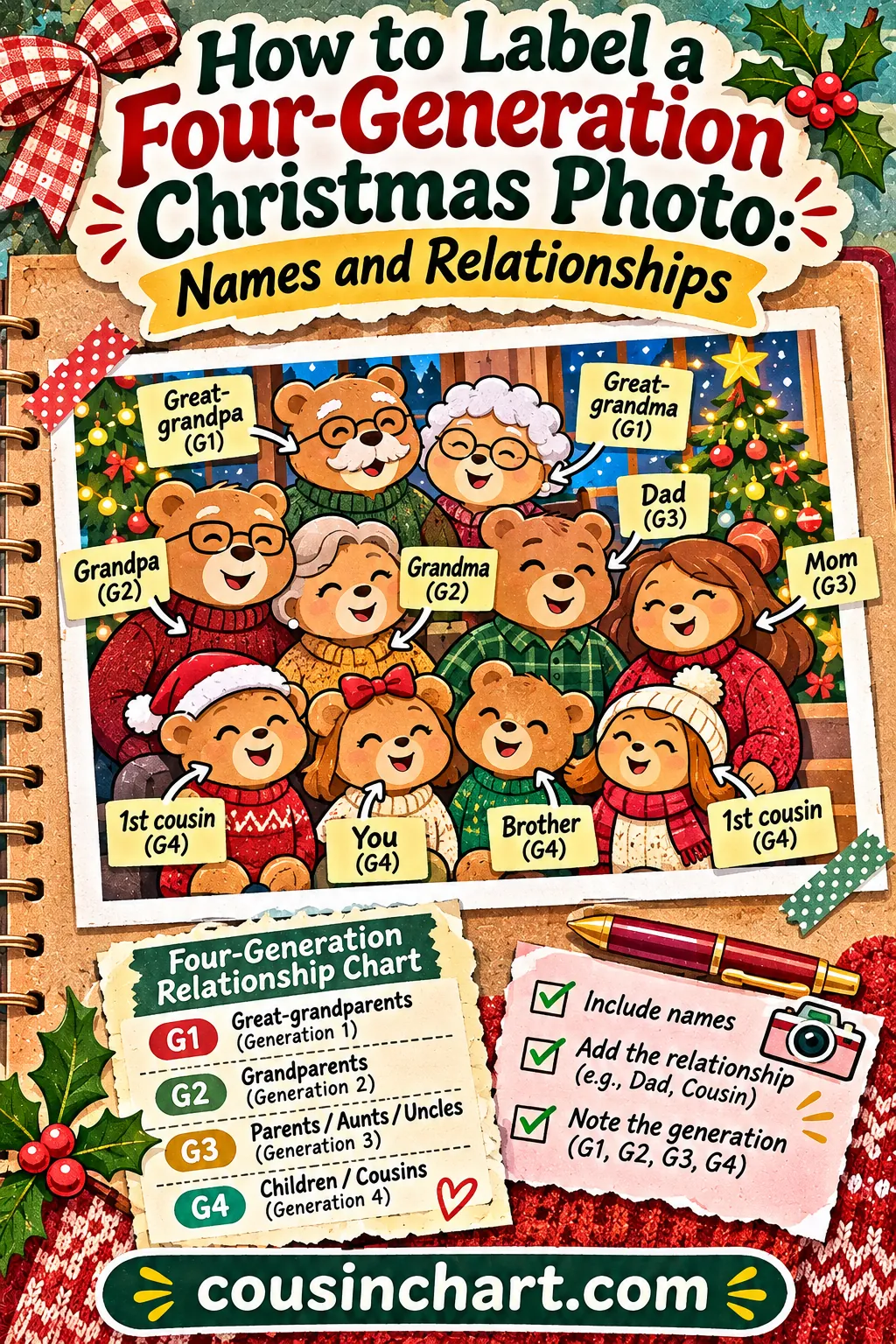
Unlabeled photos are the biggest headache for future family historians. Pick 10 holiday photos and write the names, the year and each person's relationship on the back in soft pencil, or in the photo's caption if it's digital. "Aunt Ruth" is helpful today. "Ruth Miller, Grandma's younger sister" is helpful in 50 years.
Day 24: Save it all in one place
On Christmas Eve, gather your notes, photos and voice memos into one folder, physical or digital. Pick one favorite answer to read out loud at dinner or after the kids are in bed. Then you're done, and next December you can add a new set of 24.
Getting the relationship words right
A lot of these prompts ask "how are they related to you?" That's where people get stuck. Is Grandma's sister your great-aunt or your great-great-aunt? Is Dad's cousin your second cousin? (She's your great-aunt, and he's your first cousin once removed.)
You don't have to work these out in your head. Tap a few names into the free relationship calculator and it names the relationship and draws a tiny chart of how you're connected. It's handy on Day 4, Day 17 and Day 19, when you're writing labels that will outlast you.
Ways to run it as a family
- Morning jar. Print the 24 prompts, cut them into strips and fold them into a jar. One kid pulls the day's prompt at breakfast.
- Group chat calendar. Post each day's prompt in the family group chat. Cousins in different states answer with photos, and suddenly everyone's sharing.
- Dinner question. Ask the prompt at dinner and let each person answer in one sentence.
- Grandparent edition. Mail or email the full list to a grandparent on November 30 and ask them to answer whichever ones they like. You'll get stories you never knew to ask about.
- Two-person version. A parent and teen, or two siblings, each answer the same prompt and compare. It's often funny how differently you remember the same Christmas.
If your family also lights the menorah, Hanukkah runs from sundown Friday, December 4, to nightfall Saturday, December 12, this year. Many of these prompts work just as well for Hanukkah memories. Swap "the tree" for "the menorah" and "Christmas" for "the eight nights."
What to do with your answers after Christmas
- Make a small book. Twenty-four short memories plus photos is the perfect size for a simple printed booklet. Our family memory book ideas have layouts and caption ideas.
- Keep going in January. If you loved it, carry on with our family history journal prompts, one a week.
- Add names to a tree. Every person you mentioned can go onto the printable family tree, so the stories and the tree live side by side.
Mistakes that make these calendars fizzle
- Making every prompt a big project. If Day 2 needs an hour, Day 3 won't happen. Keep weekday prompts tiny.
- Writing only for yourself. Add names, years and relationships so someone who never met these people can follow along.
- Waiting for the "right" relative. Ask whoever is around. A cousin's version of a story still counts.
- Quitting after a missed day. Just pick up with today's date. The calendar doesn't mind.
When you're ready to label the people in your stories, the free Cousin Chart relationship calculator will tell you exactly what to call each of them, from great-grandparents to second cousins once removed.
▶ Name any relative in the free calculator
Frequently Asked Questions
What is a family history advent calendar?
It's a December countdown where each day from the 1st to the 24th has a short family history prompt instead of a treat, like photographing a handwritten recipe or asking a grandparent about their first Christmas memory.
When should I start a genealogy advent calendar in 2026?
Day 1 is Tuesday, December 1, and Day 24 is Christmas Eve, Thursday, December 24. The first Sunday of Advent is November 29, which is a good weekend to set up your notebook or folder.
How long does each prompt take?
Most take five to fifteen minutes. Weekend prompts, like cooking a family recipe or calling an older relative, can take a bit longer.
Can kids do an advent calendar of Christmas memories?
Yes. Kids can draw an answer, ask a grandparent the question on a video call or pull the day's prompt from a jar at breakfast. Many prompts, like the favorite ornament or the funniest mishap, are perfect for them.
What if I miss a few days?
Just pick up with today's prompt, or do a few together on the weekend. The point is to collect stories, not to keep a perfect streak.
What should I do with the answers after Christmas?
Gather them in one folder, then turn them into a small memory book or keep going with weekly journal prompts in January. Add the people you wrote about to a printable family tree.