Family Bible Records: Genealogy's Overlooked Source
A family Bible's register pages — the decorated leaves between the Old and New Testaments where families recorded births, marriages, and deaths — are often the only written record of events from before civil registration. And you don't need to inherit the Bible to use one: the DAR's Genealogical Research System offers a free index to thousands of transcribed Bible records, several state archives (Virginia's is the standout) have digitized their Bible record collections free, and lost family Bibles surface constantly on auction sites where volunteers work to reunite them with descendants.
Governments came late to record-keeping — most U.S. states didn't register births statewide until the early 1900s — but families wrote in their Bibles for centuries before that. This guide covers where to find Bible records, how to weigh their accuracy, and what to do with the names you harvest. When a register page links four generations in fading ink, the free family relationship calculator at CousinChart tells you what each of those people is to you.
Which record should I search? Tap your situation and see the best free starting point.
Tap a situation above to see where to search.
Work out any family relationship →Why Bible records matter more than they look
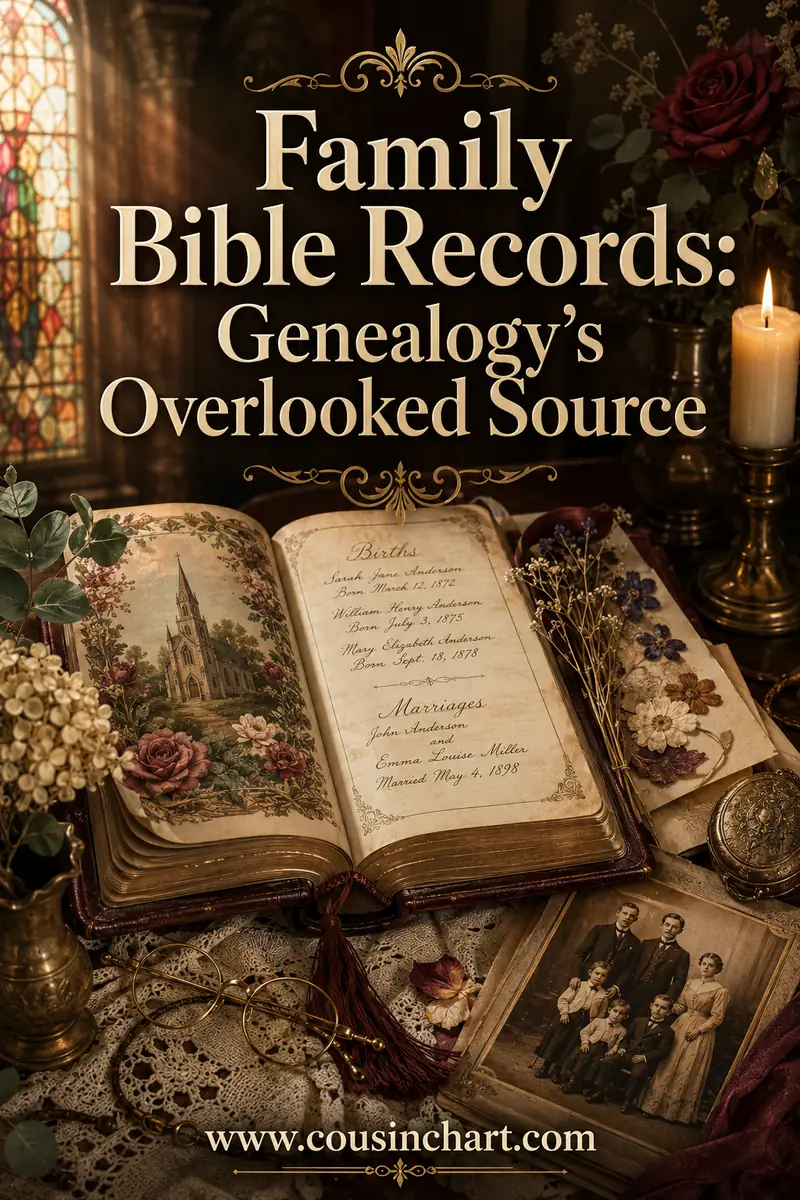
Between roughly 1750 and 1920, the family Bible was many American families' entire archive. Publishers leaned into it: 19th-century Bibles came with printed register sections — "Births," "Marriages," "Deaths," often with ornate borders — expressly for family record-keeping. What families wrote there frequently exists nowhere else:
- Exact birth dates from decades before any state recorded births. (See our free birth records guide for when official records begin in each era.)
- Married daughters' names, spelled out at their weddings.
- Children who died young — babies who lived weeks, appeared in no census, and are remembered only on that page.
- The family's own claimed connections — "Grandmother Polly Harmon, born in Culpeper Co., Va." — hometown clues that unlock earlier generations.
Courts agreed on their value. For most of American history, a Bible register was accepted as legal evidence of age and marriage — which is why pension offices collected so many of them.
Here's the register at a glance — what families typically wrote, why each entry matters, and how to weigh it:
| What the register records | Why it's valuable | How to judge its reliability |
|---|---|---|
| Births | Exact dates from decades before any state registered them | Strongest when each entry is in a different ink and hand; compare against census ages |
| Marriages | Dates, places, and daughters' married names spelled out | Written at the time is strong evidence; verify against church and civil records |
| Deaths | Dates for infants and adults no official record captured | A death date in the same ink as the birth above it was written later, at or after the death |
| Baptisms | A near-birth date plus godparents — usually close relatives | Cross-check the parish register when it survives |
Where to find a family Bible record (without the Bible)
The DAR collections
Daughters of the American Revolution volunteers have transcribed Bible records for over a century, and the Genealogical Research System (GRS) at dar.org indexes them — searchable free. A hit tells you a transcription exists; copies come by mail for a modest fee. You don't need any Revolutionary ancestor to use it.
State archives and libraries
Several state archives actively collected Bible records:
- Library of Virginia — thousands of Bible records, digitized and free online.
- North Carolina, Tennessee, South Carolina, Georgia state archives — large transcription collections, some digitized, all answerable by mail.
- State historical and genealogical societies — many published Bible transcriptions in their quarterlies for decades; those journals are indexed in PERSI (the Periodical Source Index, searchable free).
Pension files — the hidden trove
When a Revolutionary or Civil War widow applied for a pension, she had to prove her marriage — and thousands of women proved it by cutting the register page out of the family Bible and mailing it to Washington. The government kept them. Those pages sit in pension files at the National Archives today, and digitized pension files (free at some libraries, subscription elsewhere) regularly contain an entire Bible register in the middle of the paperwork.
The open market
Bibles escape families through estate sales, and they surface online continuously. Save a search on auction sites for the surname plus "family Bible," and check the volunteer "Bible reunion" projects that buy orphaned Bibles, post the register pages, and try to find descendants. Free to search; occasionally life-changing.
How to evaluate a Bible record like a professional
A Bible record is testimony, not gospel — evaluate it before you build on it:
- Find the publication date. It's on the title page or its reverse. This is the single most important test: no entry can have been written before the Bible was printed. An 1874 Bible listing births from 1820 to 1880 means everything before 1874 was written from memory or copied from an older source.
- Study ink and handwriting. Entries made "live," as events occurred, show different hands, different inks, different pen pressure across the years — strong evidence. Twenty entries in one uniform hand were copied in a sitting, and copying invites errors.
- Watch for retro-fitting. A death date in the same ink as the birth entry above it means the birth entry was written at or after the death.
- Check internal consistency. Children born seven months apart, a marriage after a first child's birth quietly adjusted — families edited their stories. Compare every date against the census, church records, and vital records.
- Record the provenance. Who owned the Bible, in what order? "It came from Grandma Hess's house" is part of the evidence — it tells you which branch's version of events you're reading.
None of this makes a copied register worthless. Even a memory-written page preserves names and relationships nobody else wrote down. It just moves the record from "primary evidence" to "family testimony to verify."
You have the Bible — now do this
- Photograph everything: title page (for the publication date), every register page, the inside covers, and every loose item tucked in the leaves — funeral cards, obituary clippings, letters, locks of hair, pressed flowers. Tucked-in items identify people the register never mentions.
- Transcribe exactly, preserving spellings and crossings-out; note each change of handwriting.
- Don't restore it yourself. No tape, no rubber bands, no attic storage. Acid-free box, cool dry room.
- Share the images with the whole family and your tree software — a Bible in one cousin's closet is one house fire from oblivion; a scanned Bible is immortal.
- Interview the elders about it. Who wrote the later entries? Whose Bible was it first? Pair it with our questions to ask grandparents — and with any old photos stored in the same box, which the register often helps identify.
Then map the register onto your tree. A good Bible page runs three or four generations deep — the original owners, their children with birth dates, marriages in, grandchildren. Enter each link into the CousinChart calculator and the fading ink resolves into exact relationships: that infant who died in 1858 was your great-great-uncle; the "Cousin Ella" who signed the flyleaf is likely your first cousin three times removed.
FAQ
Are family Bible records considered reliable genealogical evidence?
Yes, with grading. Entries made as events happened — shown by varied inks and hands, and dates after the Bible's publication — are strong evidence. Entries copied in one sitting or written before the printing date are family testimony to verify against censuses, church books, and vital records.
How do I find my family's lost Bible?
Ask every branch of the family systematically, then search the DAR's free GRS index, your state archive's Bible record collection, USGenWeb county pages, and saved auction-site searches for the surname plus "family Bible." Check pension files too — register pages were mailed in as marriage proof.
What if the Bible's dates conflict with official records?
Weigh which record was made closer to the event by someone who knew the facts. A live-entered Bible birth date often beats a death certificate's birth date (reported decades later by a grieving relative) — but a copied Bible page can lose to a baptism register. Note the conflict; keep both.
Where were births recorded before birth certificates?
In family Bibles, church baptism registers, and scattered town or county books. For most Americans born before about 1900, a Bible page or a baptism entry is the birth record.
Should I remove the register pages to preserve them?
No — never cut or remove pages. The record's credibility depends partly on staying inside its Bible, with the publication date and provenance intact. Photograph the pages at high resolution instead and store the whole book in an acid-free box.
What's usually written in a family Bible besides births and deaths?
Marriages, baptisms, sometimes military service or migration notes ("left for Missouri, April 1869"), plus everything tucked between the pages: funeral cards, clippings, letters, photographs. Inspect every leaf.
Turn a register page into a living chart
One Bible page can anchor an entire branch: names, exact dates, and relationships written by the people who lived them. Find the record (free routes first), grade it honestly, verify what you can — and then let the free CousinChart relationship calculator convert every name in that faded register into its precise place on your family tree.