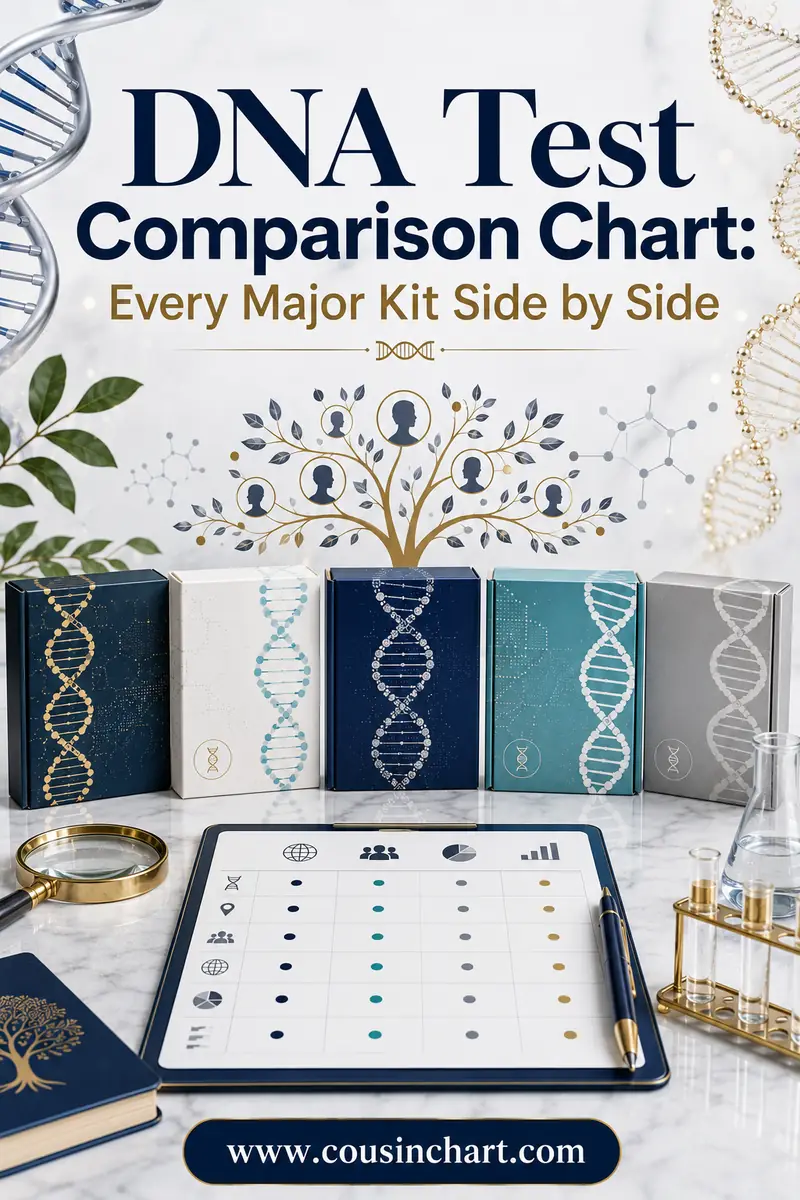
DNA Test Comparison Chart: Every Major Kit Side by Side
Here is the whole DNA testing market on one page. The four kits most people compare, AncestryDNA, 23andMe, MyHeritage, and FamilyTreeDNA, all read your DNA at similar, high accuracy. They differ in database size, records, health features, haplogroups, and whether they accept free uploads. This chart lays those differences out side by side so you can pick without wading through marketing.
The one-line summary: Ancestry for the biggest match pool and US records, 23andMe for haplogroups and health, MyHeritage for European roots and budget uploads, FamilyTreeDNA for deep direct-line research. Below you will find the full comparison plus how to read it. And once you have results, the free relationship calculator turns match labels into clear relationships.
Jump to the right kit. Tap your top need:
Tap a need above.
Work out how you are related to a match →The Master Comparison Chart
| Feature | AncestryDNA | 23andMe | MyHeritage | FamilyTreeDNA |
|---|---|---|---|---|
| Main test type | Autosomal | Autosomal | Autosomal | Autosomal + Y-DNA + mtDNA |
| Database size (recent reporting) | Largest | Large | Large, international | Smaller |
| Best for | Trees, most matches | Deep lines, health | Europe, budget | Direct-line, surnames |
| Ethnicity estimate | Yes, fine EU detail | Yes, confidence slider | Yes, many EU regions | Yes |
| Health reports | Separate tier | Yes, FDA-authorized | No | No |
| Haplogroups | No | Yes | Not a focus | Yes (dedicated tests) |
| Historical records | Largest, US-strong | None | Strong, international | Limited |
| Family tree tools | Extensive | Basic | Extensive | Moderate |
| Photo tools | Basic | None | Advanced | None |
| Accepts free uploads | No | No | Yes | Yes |
| Raw data download | Yes | Yes | Yes | Yes |
Prices are left out on purpose: they change constantly with sales, and a number here would be stale within weeks. Always check current pricing, and see our cheapest DNA tests guide for how value shifts at each price point.
How to Read the Chart
A chart is only useful if you know which rows matter for your goal. Here is what each key row actually means for you.
Test type
Most kits are autosomal, reading DNA from all your lines, which is ideal for cousin-matching out a few generations and for ethnicity. FamilyTreeDNA additionally offers Y-DNA (direct paternal line) and mtDNA (direct maternal line) tests for deep single-line research. If you want to trace one specific line back many generations, autosomal alone will not do it; you need the line-specific test. Our explainer on mtDNA, Y-DNA, and autosomal testing covers the difference.
Database size
This is the most practical row for most people. A relative appears only if they tested with that company, so a bigger database finds more cousins. AncestryDNA leads as of recent reporting; MyHeritage is smaller but proportionally more international. Database size affects matching, not ethnicity accuracy.
Ethnicity estimate
Every kit offers one, and every one is reliable at the continental level and softer at the country level. They differ from each other because each uses its own reference panels. Do not read the ethnicity row as "who is most accurate," because they are all estimates. Our ethnicity accuracy guide explains why.
Health reports
Only 23andMe offers FDA-authorized health screening among these four (Ancestry has offered health products separately at times). Remember these are screens for specific variants, not diagnoses, so confirm anything meaningful with a doctor.
Records
For building a documented tree, records matter as much as DNA. Ancestry has the largest, US-strong collection; MyHeritage is strong and international. 23andMe and FamilyTreeDNA are not records platforms. Full record access is subscription-based, an ongoing cost beyond the kit.
Accepts free uploads
A quietly important row. MyHeritage and FamilyTreeDNA accept free raw-DNA uploads; Ancestry and 23andMe do not. That means you can test once and spread your data across the upload-friendly databases for little or no extra cost.
The Strategy the Chart Suggests
Read together, the rows point to a clear money-smart plan for maximum coverage:
- Test with AncestryDNA to get into the largest database (it does not accept uploads, so testing there is the only way in).
- Download your raw DNA file.
- Upload it free to MyHeritage and FamilyTreeDNA, and to certain third-party matching sites.
One kit then reaches several databases. Add 23andMe separately only if haplogroups or health screening specifically appeal, since its data does not transfer in. Always review each destination's current upload and privacy policy first. For the reasoning in depth, see our best DNA tests for ancestry guide and the three-way comparison of the big consumer brands.
What the Chart Deliberately Leaves Out
A comparison chart is powerful, but it can flatten nuance, so a few honest caveats belong alongside it:
- "Largest database" is a moving target. The companies grow at different rates and rarely publish exact, current figures, so treat size rankings as "as of recent reporting," not fixed facts. The broad picture, Ancestry largest, then the others, has held for a while, but numbers shift.
- Ethnicity cannot be ranked in a single cell. The chart marks that each kit offers an estimate, but it cannot say which is "most accurate," because accuracy depends on your specific regions and each company's reference panels. A one-word chart entry hides that.
- Features change. Companies add and remove tools (chromosome browsers, health tiers, region lists) over time. A chart is a snapshot; verify a make-or-break feature on the company's current site before buying.
- Privacy is not a checkbox. All four let you download and delete data, but their research-consent and law-enforcement policies differ and evolve. Read the current policy of whichever you choose rather than trusting a single chart row.
None of this undermines the chart; it just reminds you to use it as a shortlisting tool, then confirm the details that matter to you.
From Chart to Decision in Three Questions
If the full chart feels like a lot, three questions collapse it into a choice:
- Do I mainly want to find relatives and build a tree? If yes, the database and records rows point to AncestryDNA, with MyHeritage as a strong European alternative.
- Do I want something the autosomal test cannot give, a deep single line or health? If a single line, FamilyTreeDNA's Y-DNA/mtDNA tests; if health, 23andMe.
- Do I want to spend the least while reaching the most? Then the "accepts uploads" row is your friend: test into the biggest pool, upload out to the free ones.
Answer those and the right row of the chart lights up on its own.
Quick Picks by Goal
- Find relatives / build a tree: AncestryDNA.
- Deep direct line or surname study: FamilyTreeDNA.
- European roots or budget matching: MyHeritage.
- Ancestry plus health: 23andMe.
- Widest reach for least money: AncestryDNA kit, then free uploads to MyHeritage and FamilyTreeDNA.
One Thing All Four Share
For all their differences, the four kits agree on the fundamentals, and it is worth stating plainly so the chart does not make them seem more different than they are.
Every one of them reads your DNA accurately, at comparable, high per-marker accuracy, using similar genotyping technology. Every one produces a match list built on real, measured shared DNA, where close relatives are matched with near-certainty and distant cousins carry a best-guess label from overlapping ranges. Every one offers an ethnicity estimate that is reliable at the continental level and softer at the country level. And every one lets you download your raw DNA file, which is the key that unlocks the free-upload strategy.
So the choice between them is not a choice between accurate and inaccurate tests. It is a choice about features, database reach, and extras layered on top of a shared, dependable foundation. That reframing takes the pressure off: you are unlikely to pick a "bad" test among these four. You are simply picking the one whose extras fit your goal, and then, if you are smart, uploading your file to reach the others for free.
FAQ
Which DNA test is the best overall?
There is no single best. AncestryDNA leads for match count and US records, 23andMe for haplogroups and health, MyHeritage for international matches and budget uploads, and FamilyTreeDNA for deep direct-line testing. The best one is whichever fits your specific goal, which is what the chart above is for.
Which DNA test has the largest database?
AncestryDNA, as of recent reporting, with a pool commonly cited above 20 million testers. A larger database means more relatives to match, not a more accurate ethnicity estimate. MyHeritage is smaller but proportionally more international.
Which DNA tests let me upload my raw data for free?
MyHeritage and FamilyTreeDNA both accept free raw-DNA uploads (some advanced features may need a small unlock fee). AncestryDNA and 23andMe do not accept uploads, so you must take their own tests to be in their databases. Check current upload terms before sending data.
Which DNA test is best for one specific direct line?
FamilyTreeDNA, which offers dedicated Y-DNA (direct paternal line) and mtDNA (direct maternal line) tests. 23andMe also assigns haplogroups. A plain autosomal test cannot trace a single line deeply, so choose the right test type for that goal.
Are the more feature-rich kits more accurate?
Not for reading DNA. All four read your DNA at comparable, high accuracy. Extra features, health reports, haplogroups, bigger databases, add capabilities and cost, not raw accuracy. Ethnicity estimates remain estimates on every kit.
Do all these tests give the same ethnicity result?
No, and that is expected. Each uses its own reference panels and algorithms, so the same DNA produces different estimates. All are reliable at the continental level and diverge in country-level detail. Comparing several estimates, easy via free uploads, shows you where your ancestry is certain and where it is not.
The Bottom Line
Every major DNA kit reads your DNA accurately; the chart above shows where they differ, database, records, health, haplogroups, and uploads. Ancestry wins for match count and US records, 23andMe for haplogroups and health, MyHeritage for European roots and budget uploads, FamilyTreeDNA for deep direct lines. The smartest play is often one Ancestry kit plus free uploads to the upload-friendly databases, adding 23andMe only if you want haplogroups or health. Pick by your goal, expect ethnicity numbers to be estimates, and when a match leaves you puzzling over exactly how you connect, the free family relationship calculator turns shared DNA and a family detail into the correct relationship name in seconds.