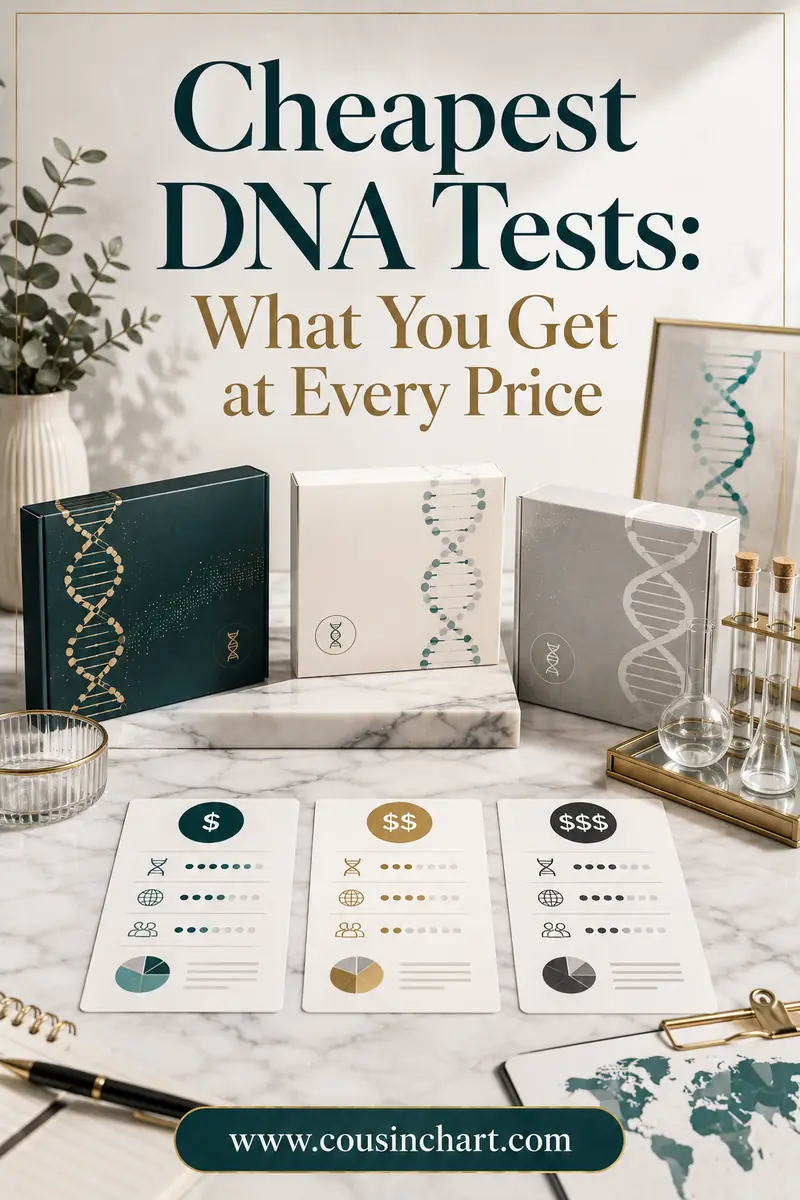
Cheapest DNA Tests: What You Get at Every Price
The cheapest way to get DNA matches is often free: if you already have a raw DNA file, uploading it to a service that accepts uploads can cost nothing. If you need a fresh kit, the big autosomal tests frequently drop under $50 during sales, which is the smart time to buy. Full price without a sale is the most expensive route and rarely necessary.
Cheap does not have to mean worse. Because DNA-reading accuracy is broadly similar across the major kits, spending less mostly costs you features and database access, not accuracy. This guide breaks down what you actually get at each price tier so you can spend the least for what you need. And once results arrive, the free relationship calculator turns match labels into clear relationships at no cost.
How much do you want to spend? Tap a budget:
Tap a budget above.
See how you are related to a match →The Cheapest Option Is Often Free
The single most overlooked money-saver: if you already own a raw DNA file from any past test, you can upload it to services that accept uploads and get matches for free or nearly free. Several genealogy databases and third-party matching sites let you upload at no cost, sometimes with a small one-time fee to unlock advanced tools like chromosome browsers or ethnicity breakdowns.
So before buying anything, ask whether you (or a close relative willing to share) already have a raw file sitting in an account somewhere. If so, your cheapest next step is an upload, not a purchase. Always check the current upload and privacy policy of any site before sending your data.
Why Cheap Does Not Mean Inaccurate
A reassuring fact for budget shoppers: the low price of a sale kit does not make it less accurate. All the major consumer tests use similar genotyping technology and read your DNA at comparable, high accuracy, better than 99% per marker across the industry. What you pay more for is usually one of these:
- A bigger database (more relatives to match).
- Deeper records access (often a separate subscription anyway).
- Extra features like health reports, haplogroups, or advanced tools.
- Simply not waiting for a sale.
None of those is raw accuracy. Our AncestryDNA accuracy guide explains why the reading itself is reliable regardless of what you paid.
Price Tiers: What You Get
For the three big base kits, here's the typical picture in recent years — treat these as ballparks, because prices shift constantly and the whole game is waiting for a holiday sale:
| Kit (base ancestry version) | Typical full price | Typical sale price | What's included |
|---|---|---|---|
| AncestryDNA | Around $99 | Often $39–$59 during holiday sales | Matches in the largest database + ethnicity estimate |
| MyHeritage DNA | Around $89 | Often under $40 on sale | Matches (strong European reach) + ethnicity; also accepts free uploads |
| 23andMe (Ancestry service) | Roughly $99–$119 | Often $69–$79 on sale | Matches + ethnicity + maternal/paternal haplogroups |
Free (uploads)
Upload an existing raw file and get a match list, often with basic ethnicity, at no cost. Some sites charge a small fee to unlock full features. Best for: people who already have a raw file and want more matches.
Under $50 (kits on sale)
The big autosomal kits regularly discount to this range around major holidays. You get the full standard test, matches, and an ethnicity estimate. Best for: most people, because buying on sale is the sweet spot of price and value. Patience pays; sales come often.
$50 to $100 (full-price kits and add-ons)
Full-price autosomal kits land here, as do discounted kits bundled with a records subscription or a basic health add-on. Best for: buyers who need results now and cannot wait for a sale, or who want a modest add-on.
Over $100 (health bundles and deep-line tests)
This tier covers health-plus-ancestry bundles and dedicated Y-DNA or mtDNA tests for deep direct-line research. These cost more because they do more, not because the ancestry reading is better. Best for: people who specifically want health screening or serious single-line research.
The Cheapest Way to Get the Most Matches
Here is the strategy that spends the least for the widest reach:
- Buy one kit during a sale from the company with the largest database (AncestryDNA does not accept uploads, so testing there is the way into its big pool).
- Download your raw DNA file from that account.
- Upload it free to every service that accepts uploads, MyHeritage, FamilyTreeDNA, and certain third-party matching sites.
One discounted kit then reaches several databases at little or no extra cost. That is far cheaper than buying a separate kit for each company, and it maximizes the relatives you can find. Our best DNA tests for ancestry guide details which pools are worth reaching.
Free and Low-Cost Databases Worth Knowing
Part of spending little is knowing which pools accept your data without a fresh purchase. A few points keep the picture clear:
- Upload-friendly services exist. Some genealogy databases accept a raw DNA file from another company and give you a match list free, occasionally charging a small one-time fee to unlock advanced tools like a chromosome browser or full ethnicity breakdown. That fee is still far cheaper than a new kit.
- Third-party matching sites. Independent matching sites let you upload a raw file to compare against people who tested with different companies, widening your reach at no kit cost. Review each site's current privacy and consent terms before uploading, since these vary.
- The catch: you cannot upload into every company. The largest databases generally do not accept uploads, so to appear there you must buy their test. That is exactly why the smart budget play is to buy into the biggest pool once, then upload out to the free ones.
The practical lesson: your raw DNA file is a reusable asset. Download it and keep it, because one file can seed several free databases over time.
Watch the True Cost, Not Just the Sticker
A cheap kit is only cheap if you avoid the add-on costs that pile up later. Three to watch:
- Records subscriptions. On records-based services, attaching documents to your tree usually needs a paid subscription separate from the kit. If you only want matches and ethnicity, you can skip it; if you want a documented tree, budget for it.
- Auto-renewals. A discounted kit sometimes bundles a trial subscription that renews at full price. Note the renewal date the day you activate, and cancel if you do not need it.
- Shipping and taxes. The headline sale price is not always the checkout total. Check the final number before assuming you got the deal.
Being alert to these keeps a genuinely cheap test from quietly becoming an expensive one.
Money-Saving Tips
- Wait for a sale. Major holidays (spring, early summer, late autumn, year-end) reliably bring discounts. Full price is rarely the best deal.
- Skip add-ons you will not use. Health bundles and deep-line tests cost more; buy them only if you specifically want those features.
- Watch for subscription traps. A cheap kit can come with a records subscription that auto-renews. Note the renewal date and cancel if you do not need it.
- Share within the family. A close relative's existing raw file, uploaded with permission, can answer many questions without a new purchase.
- Buy the test type you need. For a deep single line, a Y-DNA or mtDNA test is the right (pricier) tool; for cousin-matching and ethnicity, a cheap autosomal kit is plenty.
Is a Free Upload Really Enough?
For many people, yes. If your goal is finding relatives, an upload into a database gives you a real match list computed on your actual shared DNA, the same core feature you would pay for. The paid extras you might miss are things like a chromosome browser, a full ethnicity breakdown, or advanced tree tools, and some services unlock those for a small one-time fee rather than a full kit price.
So the honest guidance is: start free. Upload an existing raw file, see who you match, and only spend money if you hit a specific need the free tier does not cover. Plenty of productive genealogy happens entirely on free uploads and free record sites. Paying more is a choice you make when a concrete goal, more matches, deeper records, a specific region, justifies it, not a default you owe the companies.
A Note on Ethnicity at Any Price
Do not pay extra expecting a more "accurate" ethnicity map. Every company's estimate is solid at the continental level and softer at the country level, and the same DNA gives different numbers across companies because each uses its own reference panels. Price does not fix that; it is inherent to ethnicity being an estimate. If ethnicity is your focus, our best DNA test for ethnicity guide weighs the trade-offs without assuming pricier is better.
FAQ
What is the cheapest DNA test?
Often a free raw-DNA upload. If you already have a raw file from any past test, uploading it to a service that accepts uploads can cost nothing, sometimes with a small fee to unlock full tools. For a fresh kit, the big autosomal tests frequently drop under $50 during sales.
Are cheap DNA tests accurate?
Yes. A low sale price does not reduce accuracy. All major consumer tests use similar technology and read DNA at comparable, high accuracy. Paying more buys features, database access, or add-ons, not a better reading.
How can I get the most matches for the least money?
Buy one kit on sale from the company with the largest database, download your raw file, then upload it free to every service that accepts uploads. One discounted kit can reach several databases at little extra cost.
When do DNA tests go on sale?
Reliably around major holidays through the year, spring, early summer, late autumn, and year-end. Buying during a sale, rather than at full price, is the biggest single saving for most people.
Is a free DNA upload as good as buying that company's kit?
For matching, yes, because the shared-DNA data comes from your original test. An upload lets you appear in a new database without buying its kit. Some advanced features may require a small unlock fee. Always check the site's current upload terms.
The Bottom Line
The cheapest DNA test is frequently free, an upload of a raw file you already have. If you need a fresh kit, buy on sale (often under $50) rather than at full price, and remember that a low price does not cost you accuracy, only features and database access. The savviest budget move is to test once with the biggest database, then upload that file free to every service that accepts uploads. Spend the least, reach the most cousins, and when a match label leaves you puzzled, the free family relationship calculator turns shared DNA and a family detail into the correct relationship name in seconds.